Formaloo vs Wufoo
People are often torn between Formaloo’s advanced database capabilities and Wufoo’s renowned simplicity. Formaloo offers truly unlimited usage and deep customization features for power users. Wufoo makes form building dead simple but imposes strict monthly limits on your submissions and users.
Best for: Marketing agencies needing unlimited submission volume, Teams requiring custom CRM or no-code database views
Best for: Small businesses collecting simple payment forms frequently, Users prioritizing speed and dead-simple form deployment
Powerful features with reliability concerns.
Formaloo offers an extremely versatile platform, transforming basic forms into relational databases, dashboards, and custom CRMs. While the feature set is impressive and generous, we found pervasive user frustration regarding reliability following updates and extremely poor customer service responsiveness. Overall, Formaloo demonstrates significant potential but requires immediate structural improvements in product stability and customer support to be fully dependable for core operations.
Pros
- Functions as a versatile no-code database, CRM, and dashboard builder, not just a simple form tool.
- Allows advanced customization using folder-level access management, custom CSS, and JavaScript.
- Includes unlimited forms, submissions, questions, and database records, even on the free plan.
- Offers numerous built-in templates and powerful calculation and conditional logic features.
Cons
- Customer service responsiveness is often severely lacking, sometimes taking weeks to resolve critical issues.
- Recent software updates have reportedly introduced substantial bugs, rendering existing forms unusable.
- The user interface (UI) and workflow are frequently described as poorly responsive and confusing.
- Reports indicate inconsistency in honoring promised benefits and limits for early adopters.
Easy forms, hard customer support.
We found Wufoo excels at delivering a simple, code-free form builder ideal for users needing quick deployment and key integrations like payment processing. Overall, the serious and recurring complaints about nonexistent customer support and inflexible billing practices significantly overshadow the benefits of its award-winning interface.
Pros
- Code-free simplicity built into an easy-to-use interface.
- Excellent platform optimized for self-serving form creation.
- Seamless integration for online payment processing (Stripe, PayPal).
- Supports total brand control and customization.
Cons
- Customer support is consistently reported as slow or nearly nonexistent.
- Paid "expedited support" is often ineffective and delayed by up to 22 hours.
- Forms may lack a modern or visually appealing design.
- Inflexible billing practices, including difficulty changing plans.
AboutFormaloo
Formaloo provides a set of powerful, user-friendly survey tools designed specifically for effectiveness. It helps you collect the feedback you need without unnecessary friction. Marketing teams looking to transform insights into real results will find this platform perfect. You're ready to start building impactful campaigns today! ✅
AboutWufoo
Wufoo is an extremely powerful online form builder trusted by over three million users and many popular brands. You can easily create the forms you need to collect valuable data, files, and payments. The builder provides an easy-to-use experience, complete with templates, galleries, and robust reporting tools. It’s designed to let you customize forms to your heart's delight. Whether you are a webmaster or a marketing manager, the goal is to provide a flexible tool that integrates immediately into your existing framework. 💡
Highlights
Feature Comparison
Features Overview
We highlight the main differences and pick a winner for each feature.
Usage Limits & Scale
Formaloo gives you truly unlimited submissions on all plans, including free. Wufoo charges overage fees if you exceed strict entry caps.
Formaloo provides unlimited forms, submissions, and database records across every tier. You will never incur unexpected costs based on usage with Formaloo. Wufoo limits monthly entries, charging $0.05 per extra submission if exceeded. Wufoo’s top tier only allows 200,000 entries before overages kick in. If volume is a concern, Formaloo is the safer, more cost-effective choice. Wufoo's usage-based model requires careful monitoring, especially for high-volume campaigns. Formaloo is built to scale without penalties, offering peace of mind for marketing teams.
Ease of Use
Wufoo is celebrated for its instant, dead-simple interface. Formaloo’s setup is more complex and has reported responsiveness issues.
Wufoo proudly offers an award-winning interface for code-free form creation. Your team can build and embed professional forms instantly using Wufoo. This simplicity minimizes the learning curve for new users. Formaloo users often report that the UI is confusing or poorly responsive following updates. Formaloo requires a deeper dive to utilize its database features effectively. If speed and simplicity are your top priorities, Wufoo is the clear winner for deployment.
Database & CRM Tools
Formaloo transforms forms into custom no-code databases. Wufoo is a simpler tool for collection and standard reporting.
Formaloo functions as a versatile platform, enabling the creation of custom CRMs and dashboards. The platform’s power lies in how Formaloo handles and visualizes collected data. Wufoo handles data retention and standard analytics reporting reliably. Wufoo does not offer the advanced relational features of a custom database. If you plan to pivot your forms into applications, Formaloo is the only option here.
Customer Support
Both Formaloo and Wufoo receive significant, recurring complaints about slow or nonexistent customer support. Reliability is a major risk.
Formaloo users describe support as awful, sometimes taking weeks to resolve critical bugs. Wufoo customers paying for 'Priority Support' report waiting 22 hours for a response via chatbot. Reliability issues plague both platforms, compounded by poor resolution times. Choosing either Formaloo or Wufoo means accepting a high risk regarding vendor support and service. Users of both Formaloo and Wufoo report frustration with unresponsive help teams.
Advanced Customization
Formaloo allows deep customization with code and domains. Wufoo is visually flexible but less geared toward complex logic.
Formaloo’s Team plan unlocks custom CSS, JavaScript, and unlimited custom domains. You can align Formaloo perfectly with unique brand experiences or complex logic. Wufoo permits design customization that works well with or without using CSS. Formaloo offers unique features like visual logic jumps for complex questionnaire routing. If complex design or deep integration is key, Formaloo is the more powerful, flexible solution.
Payment Capabilities
Wufoo offers seamless integration with three major payment partners. Formaloo manages payments via connecting external gateways.
Wufoo integrates directly with Stripe, PayPal, and Authorize.Net for instant payment collection. Wufoo offers payment collection starting on the Professional plan. Formaloo supports collecting payments and recurring subscriptions. Formaloo requires you to connect your preferred payment gateway. Wufoo provides a slightly more integrated and streamlined payment acceptance experience.
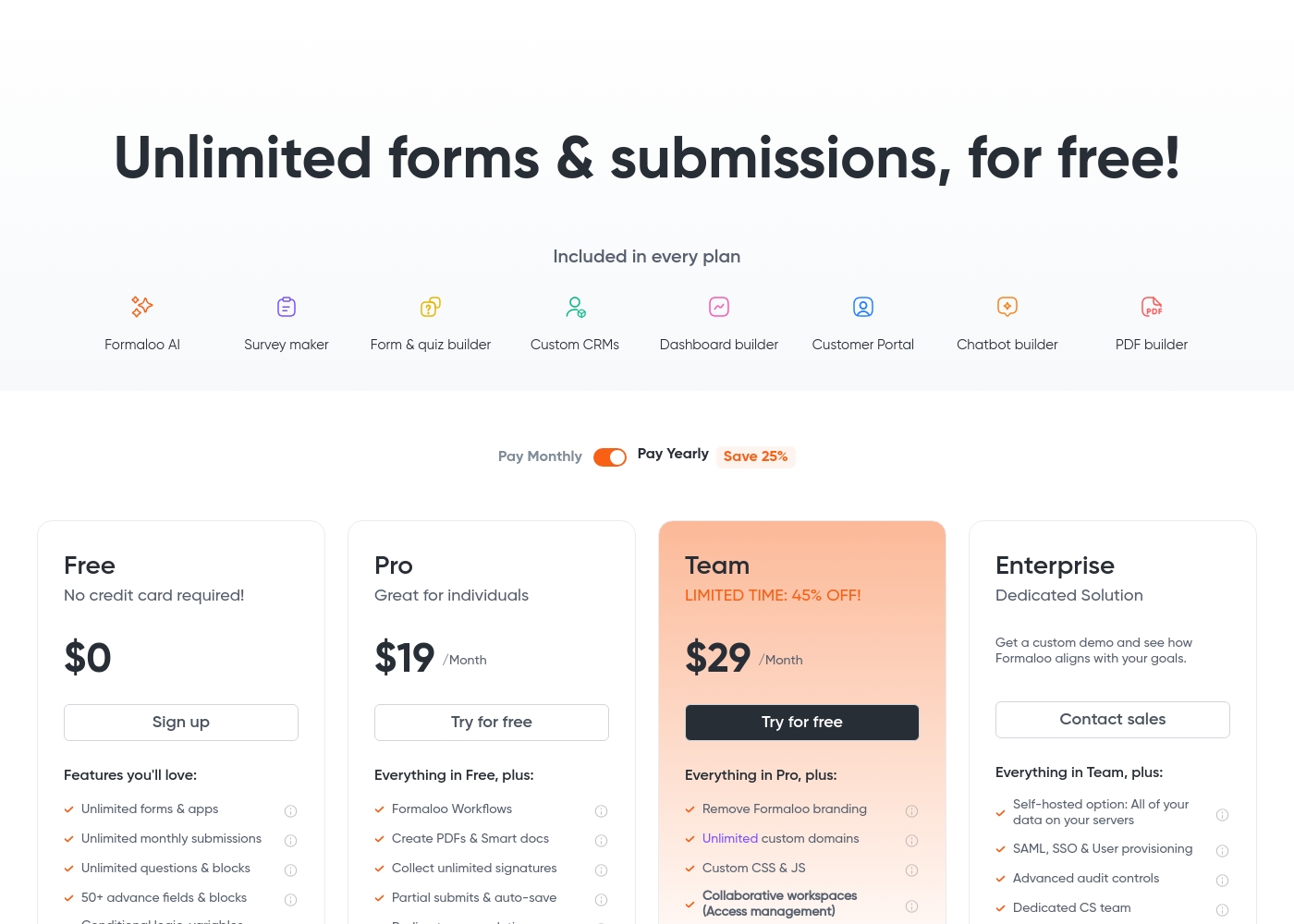
Formaloo costs between $0 and $29 per month with four plans: Free at $0, Pro at $19/month, Team at $29/month, and Enterprise (Contact Sales).
You can easily switch between paying monthly or saving 25% if you choose the yearly billing cycle.
Free
Price: $0 Other Features:
- Unlimited forms and apps
- Unlimited monthly submissions
- Unlimited questions and blocks
- 50+ advanced field types and database blocks
- Unlimited forms & apps
- Unlimited monthly submissions
- 50+ advance fields & blocks
- Conditional logic and variables
- Formaloo Workflows
- Create PDFs & Smart docs
- Collect unlimited signatures
- Partial submits & auto-save
- Remove Formaloo branding
- Unlimited custom domains
- Custom CSS & JS
- Collaborative workspaces (Access management)
- Self-hosted option: All of your data on your servers
- SAML, SSO & User provisioning
- Advanced audit controls
- Dedicated CS team
Wufoo costs between $0 and $210.25 per month with five plans: Free at $0/mo, Starter at $16.25/mo, Professional at $33.25/mo, Advanced at $83.25/mo, and Ultimate at $210.25/mo (based on annual billing).
Let's explore the details of each available plan to help you decide which one works best for your needs.
Free
Price: $0/mo Best For: Build and share basic forms and collect limited number of responses Other Features:
- 5 Forms
- 100 Entries
- 1 User
- 10 Fields Max
- Email Support
- 5 Forms
- 100 Entries
- 1 User
- Basic Forms and Limited Responses
- 10 Forms
- 1,000 Entries
- 1GB File Storage
- Custom Logo
- Confirmation Email
- Unlimited Forms
- 5,000 Entries
- Accept Payments
- Password Protect
- 5 Users
- Unlimited Forms
- 25,000 Entries
- 20 Users
- 10GB File Storage
- Priority Support

Pricing Notes
- Formaloo's paid plans, Pro ($19) and Team ($29), focus on features and seats, not usage volume.
- Wufoo's pricing scales up aggressively based on entry volume, peaking at $210.25/month for 200,000 entries.
- Wufoo charges a $0.05 overage fee per submission if you exceed your plan’s entry limit.
- Formaloo offers highly generous savings (25%) for choosing annual billing in the Pro and Team tiers.
- Formaloo's Free plan offers unlimited submissions, making it vastly superior to Wufoo's 100-entry limit.
Pricing Head-to-Head
User Reviews
Formaloo's external reviews paint a picture of great potential hindered by significant operational issues. Users frequently praise the platform's versatility and power, noting it functions well beyond a standard form builder, acting as a no-code database capable of building custom CRMs and apps.
Many appreciate innovative features like visual logic jumps and the freedom to add custom CSS or JavaScript. However, this positive sentiment regarding features is consistently overshadowed by serious concerns.
Excellent alternative to other established products that have become stale. Formaloo offers innovative features and their support is fast and knowledgeable. The team helped us iron out all small issues during the first two days, even implementing requested features within hours.
Wufoo users encounter a significant dichotomy: the platform itself is praised for its ease of use and ability to launch forms quickly without requiring extensive technical knowledge. It is highly effective for self-serving form creation.
However, customer sentiment is overwhelmingly critical regarding support and basic reliability issues 🎉. Recent reviews highlight severe operational problems, noting instances where Wufoo reportedly disabled all live forms without prior notification—even while continuing recurring billing.
It's an amazing platform for digital marketing and earning. We found the forms easy to build quickly. They are reliable and we were paid for transactions in less than 24 hours.
Our Verdict
Choosing between Formaloo and Wufoo boils down to your need for scale versus simplicity. Formaloo is the modern powerhouse that offers unlimited capacity for data collection. This platform gives you peace of mind regarding high-volume campaigns, which is a massive advantage. Formaloo’s superpower is transforming simple forms into advanced databases and CRM tools. It allows deep technical customization using custom CSS and JavaScript. If you need powerful automation and unrestricted scale for complex operations, Formaloo is the one to pick. Wufoo excels as an established, easy-to-use veteran in the field. Wufoo’s award-winning interface means anyone can deploy professional forms instantly. It shines when integrating payments seamlessly with partners like Stripe and PayPal. The critical deciding factor is volume versus budget risk. Formaloo avoids usage limits entirely, but Wufoo will charge you $0.05 per entry once you exceed your limit. If you have any high-volume projects, Wufoo becomes dangerously expensive very fast. If you are a marketing team needing complex, unlimited forms, choose Formaloo. If you need 10 simple payment forms deployed by Tuesday, Wufoo is the simpler way to start. But be aware that both Formaloo and Wufoo have significant negative reports regarding customer support.
Frequently Asked Questions
Which is better for high-volume data collection: Formaloo or Wufoo?
Formaloo is significantly better for high volume. Formaloo offers unlimited monthly submissions on all plans, including free. Wufoo imposes strict entry limits and charges $0.05 per submission overage.
Is Wufoo worth the extra cost over Formaloo’s free plan?
Wufoo's paid plans become very expensive quickly based on entry limits. Formaloo’s free plan is far more robust, offering unlimited forms and submissions. Only choose Wufoo if simplicity or direct bank integrations are absolutely critical.
Can Formaloo operate as a CRM or database like Wufoo?
Yes, Formaloo functions far beyond a standard form builder. Formaloo can be used to build custom no-code databases, dashboards, and CRMs. Wufoo focuses primarily on simple collection and standard reporting.
Which tool offers better customer support, Formaloo or Wufoo?
Neither tool has good support performance based on user reviews. Both Formaloo and Wufoo receive significant complaints about unresponsiveness. Proceed cautiously if reliable customer support is essential for your operations.
Does Formaloo have self-hosting options like Wufoo?
Formaloo offers a dedicated self-hosted option through its Enterprise plan. This allows data to reside on your own servers. Wufoo does not offer any self-hosted or on-premise deployment options.
Which tool is easier for accepting payments, Formaloo or Wufoo?
Wufoo offers slick, direct integration with Stripe, PayPal, and Authorize.Net. Formaloo can accept payments but requires connecting an external payment gateway. Wufoo provides a slightly easier onboarding for commerce forms.
Ready to Choose?
Both tools have their strengths. Choose based on your specific needs.