ERPNext vs Odoo
ERPNext and Odoo are the two strongest contenders in open-source ERP today. They compete fiercely on features but diverge sharply on cost structure. ERPNext eliminates per-user fees, while Odoo offers unmatched integration speed and world-class support. This guide helps you choose based on your scaling needs and budget priority.
Best for: Cost-sensitive businesses aiming for the lowest Total Cost of Ownership (TCO), Organizations with very high user counts needing to bypass per-staff pricing
Best for: Startups needing a permanent free plan for one core application (e.g., CRM), Companies prioritizing superior, guaranteed 24/5 customer support inclusion
Flexible ERP, low total cost.
We find ERPNext to be an immensely powerful, open-source ERP solution that excels due to its lack of per-user fees and high customization capability. The platform handles complex enterprise needs, from manufacturing to multi-subsidiary accounting, offering remarkable flexibility compared to proprietary systems. Overall, it’s an outstanding value proposition, but organizations must weigh the reported inconsistencies in paid support against the potential cost savings.
Pros
- Open-source core software with high flexibility and no vendor lock-in.
- The pricing model excludes per-user fees, greatly reducing Total Cost of Ownership (TCO).
- Highly customizable platform adaptable to unique business workflows and needs.
- Supports complex functions like multi-currency accounting and handling global operations.
Cons
- Essential technical support often requires purchasing a separate, mandatory paid plan.
- Reliability issues reported, including unaddressed bugs created by the provider.
- Customer support response times can be significantly slow in critical cases.
- Enterprise deployments require budgeting for expensive dedicated servers ($200+/month).
Powerful Integration, Complex Setup.
We find Odoo to be an exceptionally flexible and powerful all-in-one business platform, celebrated by users for its comprehensive application suite and superb customer support responsiveness. Overall, based on its high feature value and dedication to integration, we rate Odoo very highly, despite user friction surrounding setup complexity and occasional clarity issues regarding total implementation costs.
Pros
- Access to a comprehensive suite of fully integrated business applications.
- High level of flexibility and customization supported by Odoo Studio and 40,000+ community apps.
- Support team is highly responsive, knowledgeable, and willing to assist even free users.
- Affordable and clear per-user pricing structure with a permanent free plan option.
Cons
- Initial setup and implementation process is often slow, complex, and requires significant client time.
- Some users report unexpected costs related to custom code or specific hosting solutions.
- Website functionality can sometimes break after major platform updates or upgrades.
- Advanced users report issues with external API reliability.
AboutERPNext
ERPNext is a powerful, comprehensive Enterprise Resource Planning (ERP) solution. It manages everything your business needs to operate and grow, including accounting, procurement, sales, manufacturing, and HR.
It works reliably out of the box across nearly every industry and country. Because it is completely open source, the software provides unmatched freedom and flexibility for customization. Over 30,000 companies have already adopted this robust solution. ✨
AboutOdoo
Odoo is a comprehensive platform designed to handle nearly all aspects of your business operations. It combines a vast collection of apps that are perfectly integrated and ready to install with a single click. If you identify an issue or process you want to improve, there is likely an app for that purpose.
Odoo offers ultimate flexibility, catering to companies from micro businesses to large enterprises. It comes in two versions: the Community edition, which is 100% free and open source, and Enterprise, which includes extra apps, infrastructure, and professional services. This robust system is supported by a global developer community of over 100,000 people. ✅
Highlights
Feature Comparison
Features Overview
We highlight the main differences and pick a winner for each feature.
Pricing Model
ERPNext bases costs on infrastructure, eliminating per-user fees. Odoo uses clear, predictable per-user pricing.
The biggest difference is how costs scale for ERPNext. Since ERPNext charges based on server resources, your expense doesn't increase simply because you hired new staff. Hosted plans start affordably at $5/month for small businesses but scale dramatically for dedicated environments. Odoo uses a standard per-user fee for paid plans like Standard and Custom. Odoo offers a permanent free plan limited to one core application with unlimited users. Choosing between them depends on whether your organization grows faster by headcount or by data volume/compute needs.
Ecosystem & Apps
Odoo has the world’s largest business app store, vastly exceeding core ERPNext modules.
Odoo’s open-source model supports a massive community effort. This led to Odoo offering over 40,000 community applications in its store. These apps provide niche functionality beyond the core suite. ERPNext includes all Frappe apps in its hosting plans, offering robust core functions like Manufacturing and HR. While ERPNext is comprehensive, it relies more on native features and API integrations. Odoo’s vast selection makes it simpler to find specialized solutions for almost any industry requirement.
Customer Support
Odoo provides superior, highly-rated, and fully included professional support. ERPNext support is inconsistent.
Odoo users consistently praise the support team, even noting assistance is available on the permanent free plan. Unlimited, professional support is included 24/5 with all Odoo paid subscriptions. ERPNext reviews are highly polarized regarding support quality and responsiveness. Critical ERPNext technical support often requires purchasing a separate, mandatory paid plan. This cost is separate from basic hosting fees, increasing the total cost of ownership. Odoo offers peace of mind with integrated support, while ERPNext demands internal expertise or an added budget.
Low-Code Customization
ERPNext includes the low-code builder in all plans, giving users unparalleled customization freedom.
ERPNext incorporates an integrated low-code, no-code builder for visual customization. This tool allows users to quickly automate complex tasks and design custom multi-level approval workflows. Odoo also offers an excellent configuration tool, Odoo Studio. However, Odoo Studio is exclusively locked into the higher-priced Custom plan. ERPNext provides this core flexibility much earlier in its pricing tiers. This makes ERPNext immediately more adaptable for businesses needing deep, ongoing regulatory or process modifications.
Global Operations Setup
ERPNext includes crucial multi-subsidiary capabilities as a standard feature. Odoo locks this behind a top tier.
ERPNext is fundamentally built to manage global complexity easily. It supports multi-subsidiary accounting and multi-currency reporting within a single unified instance. The Multi-Company management feature in Odoo is restricted. Users must subscribe to Odoo’s Custom plan to access this critical capability. For organizations with numerous branches or international entities, ERPNext removes a major pricing gate. ERPNext offers a better standard solution for complex global financial consolidation.
System Performance
Odoo prioritizes speed and AI; ERPNext focuses on functional depth and customization.
Odoo is explicitly built for exceptional speed and efficiency backed by smart AI tools. Odoo reports operations often completing in less than 90 milliseconds, ensuring a truly fast user interface experience. ERPNext is generally reliable, but system performance is not a primary marketing highlight. While ERPNext is robust, Odoo's commitment to speed reduces administrative lag. Users seeking maximum UI responsiveness will likely prefer Odoo.
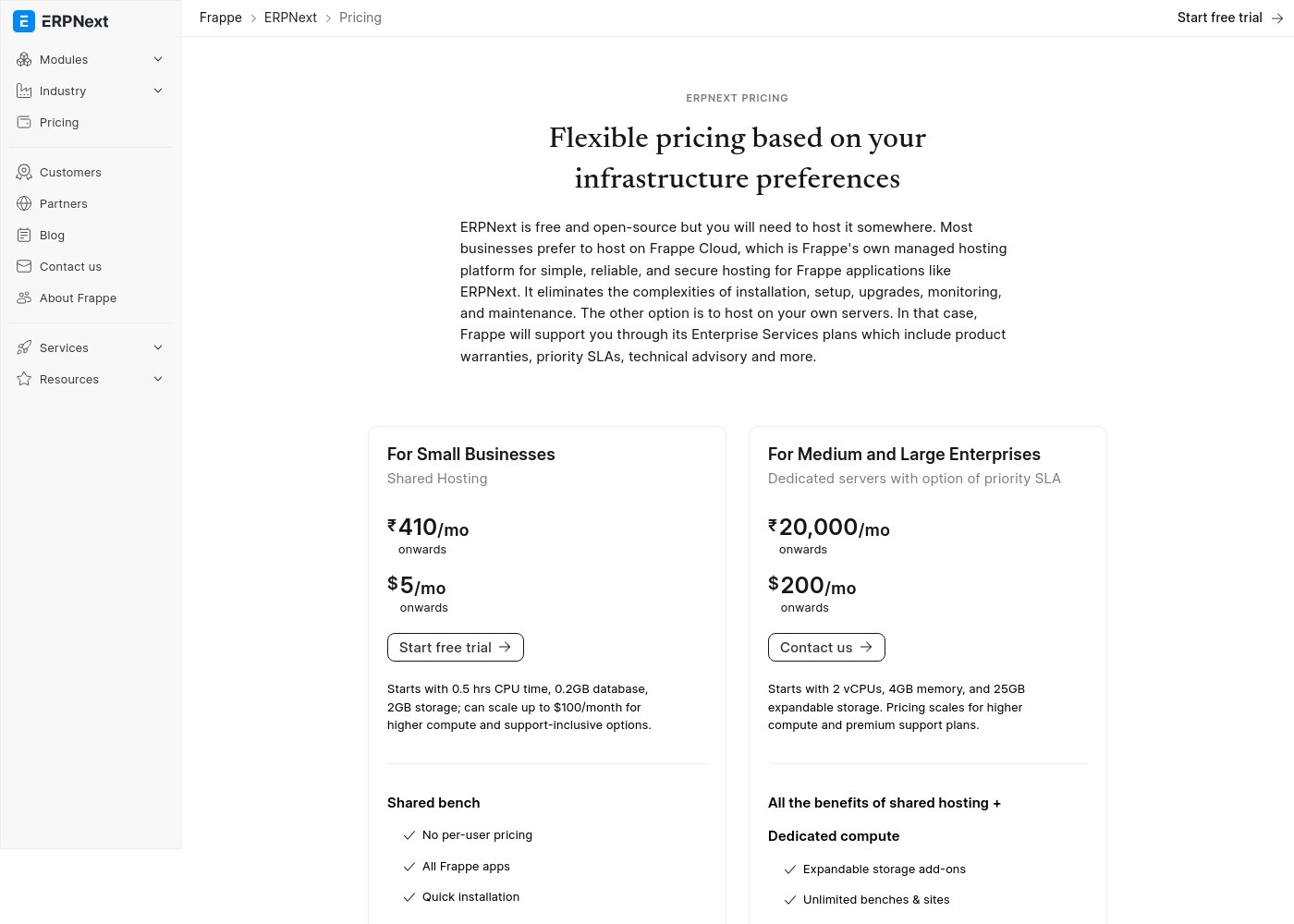
ERPNext managed cloud hosting costs between $5 and $200+ per month with two primary plans: Shared Hosting at $5/mo and Dedicated Servers at $200/mo.
These hosting plans offer flexible infrastructure tailored to fit different business sizes and technical needs.
Shared Hosting (For Small Businesses)
Price: $5/mo onwards Best For: Small Businesses Other Features:
- No per-user pricing
- Includes all Frappe apps
- Quick installation
- Starts with 0.5 hrs CPU time, 0.2GB database, and 2GB storage
- Scales up to $100/month for advanced support or compute
- No per-user pricing
- Includes all Frappe apps
- Quick installation
- 0.5 hrs CPU time, 0.2GB database, 2GB storage included
- All benefits of shared hosting + dedicated compute
- Expandable storage add-ons
- Unlimited benches & sites
- Starts with 2 vCPUs, 4GB memory, and 25GB expandable storage
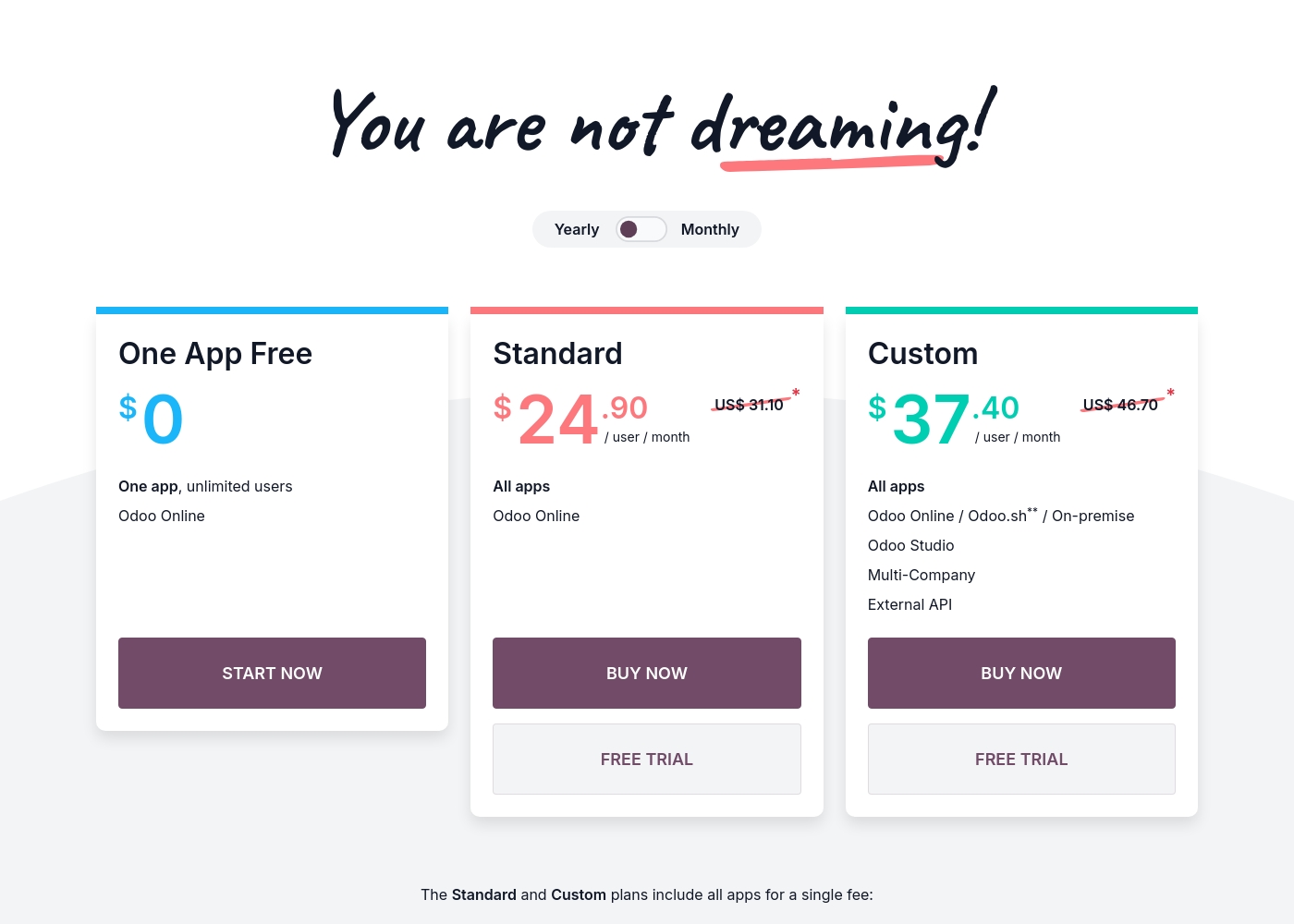
Odoo costs between $0 and $37.40 per user/month annually with three plans: One App Free at $0, Standard at $24.90, and Custom at $37.40.
These plans are designed to accommodate businesses of all sizes, offering scalable solutions based on your need for integrated apps and deployment flexibility.
One App Free
Price: $0 Best For: Small teams or individuals focusing on a single core operation. Other Features:
- One application included
- Unlimited users
- Hosted on Odoo Online
- One application included
- Unlimited users
- Hosted on Odoo Online
- Access to all apps
- Hosted on Odoo Online
- Unlimited support, hosting, and maintenance
- Access to all apps
- Odoo Studio
- Multi-Company support
- External API access
- Flexible hosting: Odoo Online, Odoo.sh, or On-premise
Pricing Notes
- ERPNext eliminates all per-user fees; cost is based on required compute capacity and storage usage only.
- Odoo offers a permanent 'One App Free' plan that supports unlimited users.
- Odoo's Standard and Custom annual rates (e.g., $24.90/user/month) are usually discounted rates for the first 12 months.
- Enterprise users of ERPNext must budget for expensive dedicated servers starting at $200+/month.
- Implementation services for Odoo must be purchased separately through Success Packs; they are not included in subscription fees.
Pricing Head-to-Head
User Reviews
User feedback highlights a sharp contrast in the ERPNext experience. On one hand, reviewers praise the system as an excellent, highly customizable suite for comprehensive business management, including accounting and project management.
Users found the well-designed, open-source platform successful in various business environments, like architecture firms and startups. This confirms the strong value proposition of free core software and flexible implementation.
This is an excellent, highly customizable suite for company management, accounting, and project needs. The platform is promising and well-designed. We have used it for about a year with much success in three different businesses.
Odoo users generally praise the platform's flexibility and power, noting its ability to manage diverse business processes like invoicing, stock control, and subscriptions all in one integrated system. Many customers highlight the exceptional quality and responsiveness of the Odoo support team 🌟.
Reviewers often mention individual support members by name for providing timely, knowledgeable, and multilingual assistance, even to those on free plans. The system is frequently described as robust regarding cybersecurity, maintenance, and upgrades.
Thanks to Odoo, I can now manage all my processes through one single software. Having everything integrated helps save money by stopping the usage of other tools and also saves significant time. The system is very complete and flexible for our specific needs.
Our Verdict
Choosing between ERPNext and Odoo means prioritizing cost structure versus ecosystem and support. Most growing companies will find Odoo the simpler and safer path to comprehensive integration. Odoo provides a fully integrated, fast experience with guaranteed support from day one. You can start maximizing Odoo productivity instantly using their permanent free tier for single-app use. ERPNext’s superpower is its commitment to cost control and true open-source freedom. Since ERPNext eliminates per-user fees, your expense won't explode as the team scales to 50 or 500 users. ERPNext also offers a standard, powerful low-code builder to deeply tailor the system to unique workflows. This is ideal for large, budget-conscious organizations driving extreme flexibility. Odoo, conversely, wins big on ecosystem, speed, and indispensable responsive support. Odoo’s UI is optimized for operations under 90 milliseconds, ensuring quick administrative tasks. Odoo also gives access to over 40,000 community apps, easily covering any niche feature need. Users consistently praise Odoo’s reliable 24/5 support, unlike the inconsistent reports for ERPNext. The deciding factor should be support reliability versus user cost avoidance. Choose Odoo if responsive customer support is critical for your operational stability. Select ERPNext if avoiding exponential user-based scaling costs is your top financial priority. If you run a high-headcount company with strong internal IT talent, ERPNext offers unbeatable TCO. For vast integrated features and predictable, high-quality support, Odoo is the clearer choice for rapid business process acceleration.
Frequently Asked Questions
Which is more affordable for large teams: ERPNext or Odoo?
ERPNext is generally more affordable for large teams because it eliminates per-user fees entirely. ERPNext costs scale based on required infrastructure, not on headcount. Odoo uses standard per-user pricing, which increases linearly as your team grows.
Does Odoo offer better customer support than ERPNext?
Yes, Odoo consistently receives highly positive feedback for its support team responsiveness and knowledge. Unlimited 24/5 support is included in Odoo’s paid plans. ERPNext requires purchasing a separate, expensive plan for reliable, critical technical support.
Can I manage multiple companies in both ERPNext and Odoo?
Yes, both ERPNext and Odoo support multi-company or multi-subsidiary management. However, ERPNext includes this core feature as standard functionality. Odoo restricts multi-company configuration to its higher-tier Custom plan.
Which tool offers the best open-source customization experience?
ERPNext offers its powerful low-code, no-code builder on its most basic hosted plans. Odoo Studio is a great customization tool, but it is only available to users on the expensive Custom plan. ERPNext gives broader access to deep customization.
Does ERPNext have a permanent free plan like Odoo?
No, ERPNext does not offer a permanent free commercial plan for its entire suite. Odoo offers a permanent 'One App Free' plan for unlimited users. ERPNext's core software is free, but managed hosting starts at $5/month.
Which ERP system is designed for faster performance?
Odoo is explicitly built for exceptional speed, with operations often completing in under 90 milliseconds. This focus on performance ensures a fast, efficient daily user experience. ERPNext focuses more heavily on functional depth and open-source freedom.
Ready to Choose?
Both tools have their strengths. Choose based on your specific needs.