Drip vs Mailpoet
Drip and Mailpoet both promise to turn your email list into revenue, but they're built for very different worlds. Drip is a powerful, standalone automation platform for e-commerce. Mailpoet is a WordPress-native plugin designed for simplicity and workflow. Here's how to decide.
Best for: E-commerce brands (Shopify, BigCommerce, WooCommerce), Course creators and educators
Best for: WordPress bloggers and content creators, Small businesses on a tight budget
Powerful for e-commerce, but check the support.
We find Drip to be a highly capable email automation platform built specifically for B2C e-commerce. Its visual builder and smart segmentation are standout features for creating personalized customer journeys. Overall, it's a strong choice for online brands, provided your team can manage the learning curve and verify support levels.
Pros
- Excellent visual workflow builder for automation
- Deep e-commerce integrations (Shopify, WooCommerce)
- Powerful, behavior-based segmentation tools
- Free migration for large lists (17,500+)
Cons
- Pricing can become expensive as contacts scale
- Some users report slow or inconsistent customer support
- Requires integration with compatible platforms
- Advanced features may have a learning curve
Reliability Issues Undercut Strong WordPress Integration
We assessed Mailpoet’s native WordPress integration, which genuinely simplifies content use and email creation right in your existing dashboard. However, the external feedback pointed to critical failures in account reliability and customer support responsiveness, particularly regarding arbitrary account suspensions and long resolution times. Overall, the reported operational inconsistency and poor support experience make it difficult for us to recommend Mailpoet for mission-critical campaigns.
Pros
- Native integration simplifies WordPress workflow and content access.
- Offers a powerful free plan for up to 500 subscribers.
- Intuitive design builder supports drag-and-drop customization.
- Automated campaigns (welcome emails, post notifications) are included.
Cons
- Frequent, arbitrary suspension of paid accounts and sending abilities.
- Customer support is often unresponsive and unavailable on weekends.
- Abandoned cart feature is limited, only working for existing subscribers.
- Onboarding process requires tedious verification and validation steps, leading to significant delays.
AboutDrip
Drip is an email marketing automation platform built for B2C companies that sell online. Whether you're an e-commerce brand, a course creator, or a travel provider, it gives you the tools to move beyond generic newsletters. It's designed to be a powerful yet simple engine for driving revenue through personalization. 💡
AboutMailpoet
Mailpoet is the essential email marketing plugin built specifically for WordPress 💡. It currently helps over 500,000 websites connect with their audience. Since it works right alongside your existing CMS, you use your existing media library and content instantly. This seamless integration means you can get started sending important messages in minutes, not hours. It’s designed for busy site owners who need efficiency and reliable performance.
Highlights
Feature Comparison
Features Overview
We highlight the main differences and pick a winner for each feature.
Ease of Use
Mailpoet wins for WordPress users. Drip offers more power but has a steeper curve.
Drip's visual builder is powerful for creating complex automations. It's designed for marketers who want control. However, mastering its segmentation and workflow logic takes time. Mailpoet lives inside your WordPress dashboard. If you know WordPress, you already know half the tool. Adding images from your media library feels natural and fast. The key trade-off is simplicity vs. power. Mailpoet gets you sending in minutes. Drip requires setup but pays off with sophisticated revenue-driving sequences.
Automation & Workflows
Drip is built for advanced automation. Mailpoet offers basic, essential sequences only.
Drip's core strength is its visual automation builder. You can create multi-step workflows based on browsing behavior, purchases, and engagement. Templates cover cart abandonment, welcome series, and more. Mailpoet's automation is more limited. It excels at automated welcome emails and sharing your latest blog post. It's great for nurturing but not for complex, behavior-triggered sequences. For most e-commerce brands, Drip's automation is a game-changer. Mailpoet's approach is simpler but effective for content-driven sites.
Integration Ecosystem
Drip connects widely. Mailpoet is deep but narrow, focused on WordPress.
Drip boasts 50+ native integrations. This includes major e-commerce platforms like Shopify, BigCommerce, and WooCommerce. It also connects to booking and course systems. Mailpoet's power is its native integration with WordPress and WooCommerce. You can also import from Mailchimp and use Google Analytics. Its ecosystem is focused, not broad. Drip gives you flexibility to connect your entire tech stack. Mailpoet gives you depth within the WordPress world.
Pricing & Value
Mailpoet's free plan is unmatched. Drip's value depends on your list size and revenue.
Mailpoet offers a free plan supporting up to 500 subscribers. Paid plans start at $10/month, scaling with your list. This is incredibly accessible for small businesses. Drip starts at $39/month for 2,500 contacts. Pricing scales based on list size. It's an investment, but the advanced features aim to drive higher revenue. The value proposition is clear. Mailpoet is for budget-conscious WordPress users. Drip is for e-commerce brands ready to invest in tools that grow revenue.
Customer Support
Both have reported issues. Drip's documented response times are faster.
Drip highlights a 97.3% customer satisfaction score. They list live chat responses in under 2 minutes and email replies in less than 1.6 hours for paying customers. Mailpoet also reports a 90% Happiness Score. However, user reviews frequently cite slow or unresponsive support, especially on weekends. This is a consistent pain point. Based on documented metrics and user feedback, Drip appears to offer more reliable, responsive support, though both have room for improvement.
Reporting & Analytics
Drip provides deeper insights, especially for revenue attribution.
Drip offers detailed reporting focused on e-commerce. You can track revenue generated from campaigns and see how segments perform. It's built for data-driven marketers. Mailpoet provides standard open and click-through rates. It's sufficient for basic newsletter performance tracking but lacks the deep revenue integration. For understanding what directly impacts your bottom line, Drip's analytics are far more actionable.
Drip pricing: Drip offers a flexible, usage-based subscription starting at $39/month for up to 2,500 people. Pricing scales based on your email list size and includes a 14-day free trial with no credit card required to start browsing its powerful automation tools tool and visual builder.
Your monthly cost increases as your audience grows, but you always get features like unlimited email sends and onsite campaigns. This ensures you only pay for what you actually use while accessing expert support and pre-built marketing playbooks right from the start.
You can cancel your subscription at any time within your billing settings if your business needs change. This model is specifically designed for e-commerce brands looking for deep segmentation and personalized customer journeys without enterprise-level complexity or hidden fees.

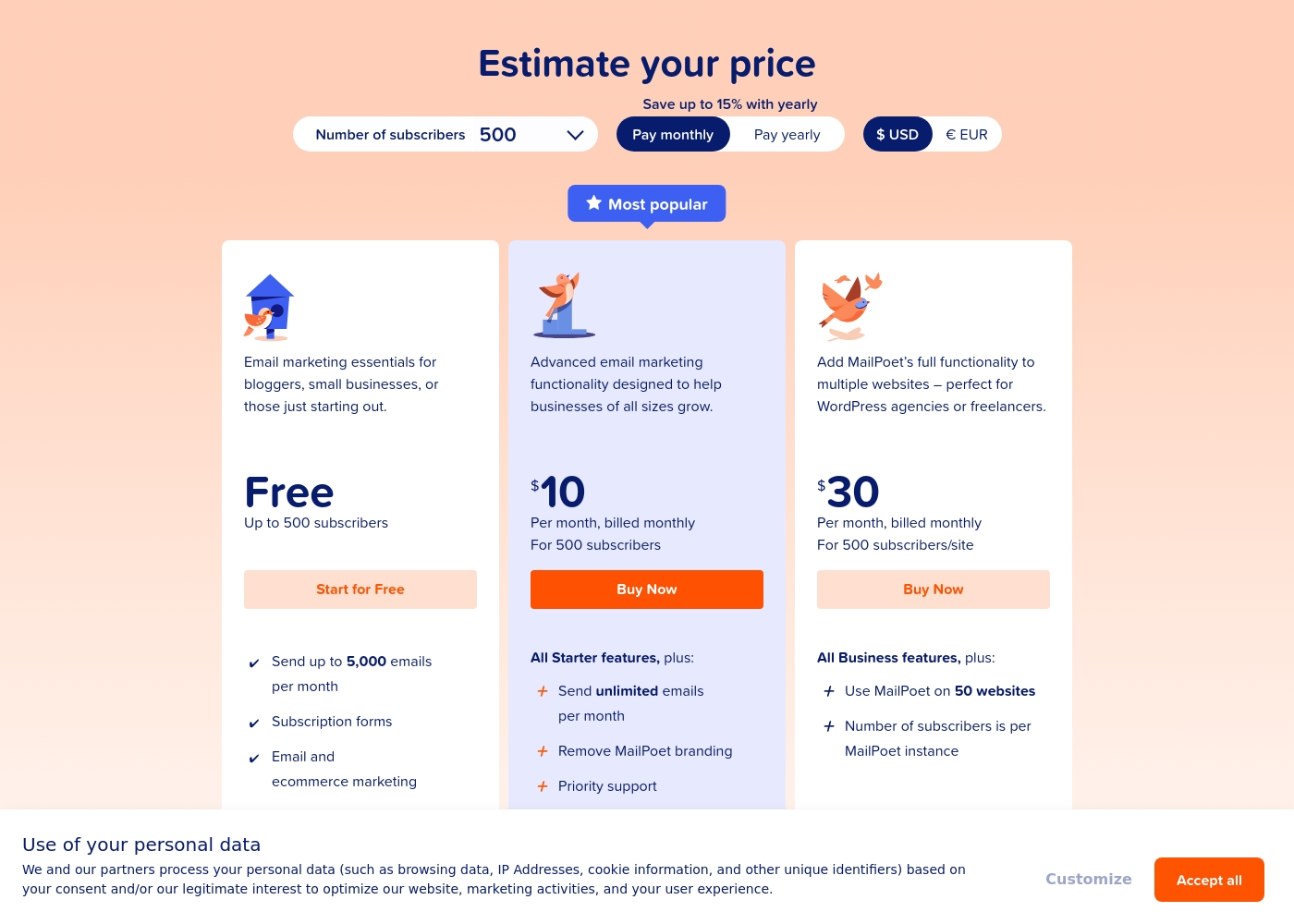
Mailpoet costs between Free and $30 per month for 500 subscribers, with three accessible plans: the Free Plan at $0, the Advanced Marketing Plan at $10/month, and the Multi-Site Agency Plan at $30/month.
Here’s a closer look at what you get with each option, based on the starting tier of 500 subscribers.
Free Plan
Price: Free Best For: Bloggers, small businesses, or those just starting out. Other Features:
- Send up to 5,000 emails per month
- Includes subscription forms
- Provides email and ecommerce marketing tools
- Send up to 5,000 emails per month
- Subscription forms
- Email and ecommerce marketing
- Send unlimited emails per month
- Remove MailPoet branding
- Priority support
- Use MailPoet on 50 websites
- Subscriber count is adjusted per MailPoet instance
Pricing Notes
- Drip's pricing is based on active contacts and starts at $39/month for 2,500 people.
- Mailpoet offers a generous free plan for up to 500 subscribers and 5,000 emails/month.
- Mailpoet's paid plans start at $10/month, making it much more affordable for small lists.
- Drip's cost can scale significantly with list growth, which is a common user complaint.
- Mailpoet offers up to 15% savings for annual billing.
Pricing Head-to-Head
User Reviews
We found a mixed bag of user sentiment from Trustpilot, as the Capterra link was inaccessible. Reviews praise Drip's powerful automation and segmentation for driving revenue, with many noting its ease of use for e-commerce.
💡 On the downside, several users report frustration with customer support responsiveness and occasional platform glitches. Pricing is frequently cited as a concern, with some feeling the cost can escalate quickly as contacts grow.
Drip's automation tools are top-notch. We set up abandoned cart sequences that really boosted our recovery rate. The visual builder makes it easy to see the customer journey.
The external reviews for Mailpoet reveal a stark and polarized user experience, heavily weighted toward frustration. While a few long-term users praise the affordability and ease of use for basic email creation and claim reliable deliverability, the overwhelming majority report severe technical and customer support issues. Reviewers frequently mention paid accounts being arbitrarily suspended or blocked, sometimes related to high bounce rates or fraud handling, leading to lost campaigns and high friction regardless of the subscription tier.
Crucially, complaints about support are recurrent. Users report waits of several days, receiving vague, ‘AI generated’ answers, or finding that dedicated support is unavailable on weekends ⚠️. Others note painful onboarding (delayed subscription validation) and limitations in core features, such as abandoned cart emails only targeting existing subscribers, rendering the tool useless for lead capture. Reliability and customer service responsiveness are the chief concerns consistently raised across these platforms. Ultimately, many users feel the systemic blockages entirely negate the convenience of WordPress integration.
I love using MailPoet for myself and my local business clients. It makes creating and managing emails across several client websites very easy. It is affordable and the emails always land where they are supposed to.
Our Verdict
Drip and Mailpoet solve different problems. Your choice depends entirely on your platform and ambition. Drip's superpower is turning browsers into buyers. Its advanced automation and deep e-commerce integrations let you create sophisticated customer journeys. Brands using its segments earn 5x more revenue. Mailpoet's superpower is simplicity for WordPress. It lives right in your dashboard, letting you use your media library and send beautiful emails in minutes. It's built for efficiency. The deciding factor is your platform. If you run a serious e-commerce store and want to maximize revenue through automation, choose Drip. If you're a WordPress site that needs simple, reliable email marketing, Mailpoet is the easier path. For most growing online stores, Drip is the better long-term investment. For budget-focused WordPress users, Mailpoet gets the job done without leaving your site.
Frequently Asked Questions
Which is better for WordPress users, Drip or Mailpoet?
Mailpoet is built specifically for WordPress. It integrates natively into your dashboard. Drip works with WordPress via plugins but is a separate platform.
Is Mailpoet's free plan really free forever?
Yes, Mailpoet's free plan supports up to 500 subscribers and 5,000 emails per month indefinitely. Drip only offers a 14-day free trial.
Can Drip's automation handle complex e-commerce sequences?
Yes, Drip's core strength is advanced, visual automation. You can build workflows based on browsing behavior, purchases, and lifecycle stages to drive revenue.
Why do Mailpoet reviews mention account suspensions?
Multiple user reviews report paid accounts being arbitrarily suspended or blocked. This is a major, recurring concern regarding Mailpoet's reliability.
Which platform is cheaper for a list of 1,000 subscribers?
Mailpoet would cost $10/month. Drip's pricing starts at $39/month for 2,500 people, so its cost for 1,000 would be lower but still higher than Mailpoet's.
Does Drip offer a free plan?
No, Drip does not have a free plan. It offers a 14-day free trial with no credit card required to test the platform.
Ready to Choose?
Both tools have their strengths. Choose based on your specific needs.