Drip vs Groundhogg
Drip and Groundhogg both automate email marketing, but they take totally different paths. Drip is a cloud-based platform built for e-commerce brands. Groundhogg is a self-hosted WordPress plugin for full control.
Best for: E-commerce brands (Shopify, BigCommerce, WooCommerce), Course creators and educators
Best for: WordPress agencies managing multiple client sites, Developers wanting full control and customization
Powerful for e-commerce, but check the support.
We find Drip to be a highly capable email automation platform built specifically for B2C e-commerce. Its visual builder and smart segmentation are standout features for creating personalized customer journeys. Overall, it's a strong choice for online brands, provided your team can manage the learning curve and verify support levels.
Pros
- Excellent visual workflow builder for automation
- Deep e-commerce integrations (Shopify, WooCommerce)
- Powerful, behavior-based segmentation tools
- Free migration for large lists (17,500+)
Cons
- Pricing can become expensive as contacts scale
- Some users report slow or inconsistent customer support
- Requires integration with compatible platforms
- Advanced features may have a learning curve
Solid WordPress CRM with caveats
Groundhogg is a self-hosted WordPress CRM with flat-rate pricing and deep WordPress integration. We value control, data locality, and a broad feature set, but external feedback points to inconsistent service delivery and onboarding gaps. Overall, it’s a solid foundation for WordPress users, balanced by reliability concerns.
Pros
- Flat-rate pricing
- Self-hosted data on your own servers
- Open-source with developer tools
- Deep WordPress integration
Cons
- External reviews mention inconsistent service delivery and misalignment with expectations
- Onboarding clarity and scope alignment can be challenging
- Reliability concerns raised by external reviews
- Self-hosted setup may require more technical effort
AboutDrip
Drip is an email marketing automation platform built for B2C companies that sell online. Whether you're an e-commerce brand, a course creator, or a travel provider, it gives you the tools to move beyond generic newsletters. It's designed to be a powerful yet simple engine for driving revenue through personalization. 💡
AboutGroundhogg
Groundhogg is a self-hosted WordPress plugin that serves as a CRM and marketing automation tool for WordPress users, including agencies, businesses, and nonprofits. It keeps your data on your own servers and is open-source, allowing for customization. You can connect with your SMTP service to manage email deliverability, and Groundhogg integrates within the WordPress ecosystem to support your marketing efforts from inside your site.
Highlights
Feature Comparison
Features Overview
We highlight the main differences and pick a winner for each feature.
Pricing & Value
Drip's cost scales with your contact list. Groundhogg's cost is fixed per site, no matter how many contacts you have.
Drip uses a usage-based model. It starts at $39/month for up to 2,500 people. Your bill grows as your email list grows. Groundhogg offers four flat-rate plans: $20/month for 1 site, up to $100/month for 25 sites. Your price never changes based on contact volume. The key trade-off is predictability vs. scale. Groundhogg costs more upfront for a small list but becomes much cheaper as you grow. Drip's cost escalates with your success.
Data Control & Hosting
Groundhogg is 100% self-hosted on your WordPress server. Drip hosts your data in the cloud.
With Groundhogg, your customer data stays on your own servers. You have full control over privacy and access. It's open-source for full transparency. Drip is a SaaS platform. Your data lives on their servers. They manage security, updates, and infrastructure. If data ownership and GDPR compliance are non-negotiable, Groundhogg wins. If you prefer not to manage server security, Drip is the hands-off choice.
E-commerce Integration
Drip offers deep, specialized integrations for major e-commerce platforms like Shopify.
Drip is built for B2C commerce. It has direct, pre-built integrations with Shopify, BigCommerce, and WooCommerce. It syncs customer and order data for powerful segmentation. Groundhogg integrates natively with WooCommerce through WordPress. For other platforms, you'd need custom development or Zapier. For a dedicated Shopify or BigCommerce store, Drip provides a smoother, more powerful out-of-the-box experience.
WordPress Integration
Groundhogg lives inside your WordPress dashboard. Drip connects via plugins or API.
Groundhogg is a native WordPress plugin. You manage contacts, funnels, and analytics without leaving your site. It works with other WordPress plugins directly. Drip integrates with WordPress via its official plugin for forms and tracking. Core management happens in the separate Drip app. For a pure WordPress workflow, Groundhogg offers a more seamless, integrated experience.
Automation & Funnels
Both offer visual workflow builders, but Groundhogg's is part of its WordPress core.
Drip provides a powerful visual builder for automated email sequences. It's designed for e-commerce journeys like cart abandonment. Groundhogg's flow editor uses a 'do this, until that' logic. It's also visual but lives within your WordPress site and can trigger WordPress actions. Both are capable. Drip's may feel more polished for email-only flows. Groundhogg's can control more site elements.
Developer Customization
Groundhogg is open-source with extensive developer tools. Drip has a standard API.
Groundhogg is fully open-source. Developers can use hundreds of hooks, filters, the REST API, and webhooks to build custom functionality. Drip provides a REST API for integration but is a closed-source platform. You work within their defined features and connections. For teams needing deep customization or building proprietary features, Groundhogg offers far more flexibility.
Scalability & Limits
Groundhogg has no contact limits. Drip's limits are based on your plan.
With Groundhogg, contacts are unlimited. Your only limits are your server resources and which plan you choose for sites and features. Drip's pricing and features are tiered by your number of contacts. A 100,000-contact list costs significantly more than a 10,000-contact list. Groundhogg's model scales better for lists. Drip's scales better for businesses needing managed infrastructure.
User Experience & Support
Drip offers a dedicated support team. Groundhogg's support is tied to your hosting and plan.
Drip provides email support to all paid users and live chat for higher-tier plans. They report a 97.3% satisfaction score. Groundhogg offers premium support with its paid plans. You're also relying on your WordPress hosting provider for server issues. Drip's support is more comprehensive for the marketing platform itself. Groundhogg's support may require coordinating with your host.
Drip pricing: Drip offers a flexible, usage-based subscription starting at $39/month for up to 2,500 people. Pricing scales based on your email list size and includes a 14-day free trial with no credit card required to start browsing its powerful automation tools tool and visual builder.
Your monthly cost increases as your audience grows, but you always get features like unlimited email sends and onsite campaigns. This ensures you only pay for what you actually use while accessing expert support and pre-built marketing playbooks right from the start.
You can cancel your subscription at any time within your billing settings if your business needs change. This model is specifically designed for e-commerce brands looking for deep segmentation and personalized customer journeys without enterprise-level complexity or hidden fees.

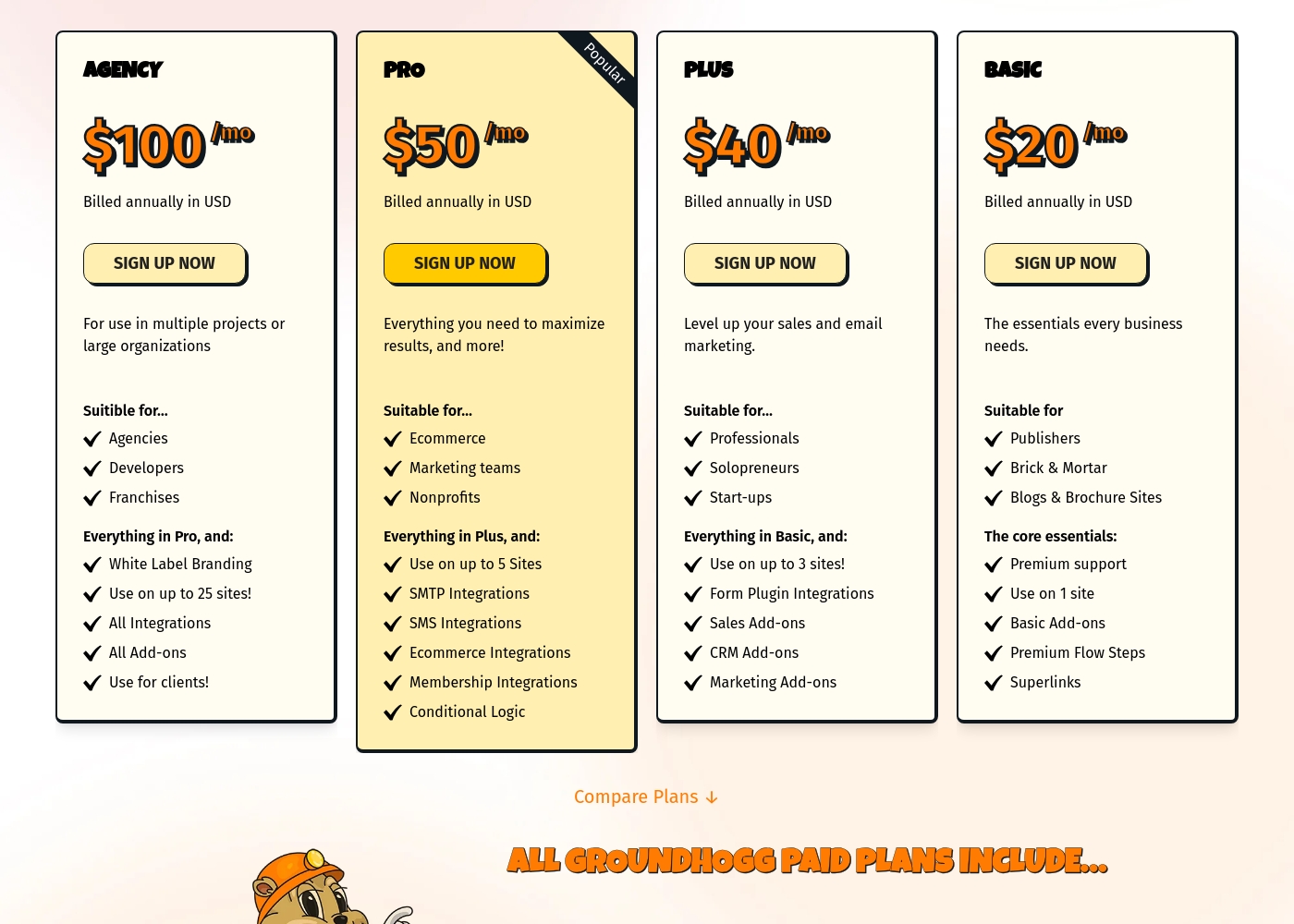
Groundhogg costs between $20 and $100 per month with 4 plans: Basic at $20/mo, Plus at $40/mo, Pro at $50/mo, Agency at $100/mo. Here's a quick look at the plans.
Agency
Price: $100 /mo Websites Supported: 25 Refund Policy: 14-day money-back Other Features: White Label Branding, Use on up to 25 sites, All Integrations, All Add-ons, Use for clients If you run multiple WordPress sites or manage client work, Agency is the top tier. It offers broad site capacity and full feature access to support large-scale campaigns.
Pro
Price: $50 /mo Websites Supported: 5 Refund Policy: 14-day money-back Other Features: Use on up to 5 Sites, SMTP Integrations, SMS Integrations, Ecommerce Integrations, Membership Integrations For teams that need more connectivity and sites than Plus but not the full agency scale, Pro balances capacity with a strong featureset.
- White Label Branding
- Use on up to 25 sites
- All Integrations
- All Add-ons
- Use for clients
- Use on up to 5 Sites
- SMTP Integrations
- SMS Integrations
- Ecommerce Integrations
- Membership Integrations
- Use on up to 3 Sites
- Form Plugin Integrations
- Sales Add-ons
- CRM Add-ons
- Marketing Add-ons
- Premium support
- Use on 1 site
- Basic Add-ons
- Premium Flow Steps
- Superlinks
Pricing Notes
- Drip's pricing scales with your contact list. A 2,500-contact list starts at $39/month. Costs rise as your list grows.
- Groundhogg has fixed monthly plans: Basic ($20/1 site), Plus ($40/3 sites), Pro ($50/5 sites), Agency ($100/25 sites).
- Groundhogg has no contact limits. Your cost stays the same whether you have 100 or 100,000 contacts.
- Drip offers a 14-day free trial. Groundhogg has a 14-day money-back guarantee instead of a free trial.
- For large lists (50,000+ contacts), Groundhogg's flat-rate model becomes significantly cheaper than Drip's usage-based pricing.
Pricing Head-to-Head
User Reviews
We found a mixed bag of user sentiment from Trustpilot, as the Capterra link was inaccessible. Reviews praise Drip's powerful automation and segmentation for driving revenue, with many noting its ease of use for e-commerce.
💡 On the downside, several users report frustration with customer support responsiveness and occasional platform glitches. Pricing is frequently cited as a concern, with some feeling the cost can escalate quickly as contacts grow.
Drip's automation tools are top-notch. We set up abandoned cart sequences that really boosted our recovery rate. The visual builder makes it easy to see the customer journey.
Trustpilot's page for Groundhoggrade shows a 3.2 average from a single review, highlighting unsatisfactory service and a mismatch between promises and outcomes. The reviewer notes polished initial communication but says the actual results didn’t align with what was discussed, and stresses the need to document all details in writing before proceeding.
While this is just one data point, it underscores concerns about consistency, clear scope, and reliability. No additional Capterra reviews are included in the provided sources to balance the view, so potential buyers should weigh a single low-visibility score against Groundhogg’s stated advantages like flat-rate pricing, self-hosted data, and strong WordPress integration.
Initial communication was polished, but the service fell short of expectations.
Our Verdict
Drip and Groundhogg are both strong email automation tools, but they serve completely different audiences. There's no single winner here—it depends entirely on your technical needs. Drip's superpower is its e-commerce focus. It turns browsers into buyers with deep Shopify integrations and behavior-based automation. The platform is polished and powerful for online stores. Groundhogg's superpower is control. Being self-hosted and open-source means you own your data completely. You can customize it endlessly and avoid per-contact fees forever. The deciding factor is your tech stack. Choose Drip if you want a managed, SaaS solution built for e-commerce. Choose Groundhogg if you live in WordPress and demand full data ownership. For most e-commerce businesses, Drip is the easier, more powerful choice. For WordPress agencies and developers, Groundhogg offers unmatched flexibility and value. Pick the tool that matches how you work.
Frequently Asked Questions
Which is cheaper for a large list of 50,000 contacts?
Groundhogg is much cheaper. Its pricing is flat-rate (e.g., $100/month for Agency), while Drip's cost would be significantly higher based on contact volume.
Does Drip integrate with WordPress like Groundhogg does?
Yes, Drip has a WordPress plugin for forms and tracking. However, Groundhogg is a native WordPress plugin, offering deeper, seamless integration within the dashboard.
Can I self-host Drip like I can with Groundhogg?
No. Drip is a cloud-based SaaS platform. Groundhogg is 100% self-hosted, meaning you install it on your own WordPress server.
Which is better for a Shopify store?
Drip is typically better for Shopify. It offers a deep, pre-built integration for automating cart recovery and customer journeys. Groundhogg would require custom development.
Do I need technical skills to use Groundhogg?
Yes, some technical skill helps. You need to manage your WordPress hosting, handle updates, and configure SMTP. Drip is more beginner-friendly for pure marketing use.
Which tool has better email automation templates?
Both offer templates. Drip's are focused on e-commerce journeys like browse abandonment. Groundhogg's are WordPress-focused funnels. It depends on your primary use case.
Ready to Choose?
Both tools have their strengths. Choose based on your specific needs.