Docsie vs Zendesk
Users often compare these two platforms for their robust knowledge base features. Docsie leverages powerful AI for lightning-fast, high-security documentation creation. Zendesk focuses entirely on unifying omnichannel customer service and robust agent workflows. They serve different primary goals, making your strategic choice critical.
Best for: Enterprise organizations requiring SOC 2 and GDPR compliance standards, Product teams needing advanced version control and reusable content blocks
Best for: Businesses needing a complete, omnichannel support solution out-of-the-box, Organizations prioritizing high ROI and agent ticket management efficiency
AI documentation built for enterprise scale.
Docsie is a powerful, AI-driven knowledge management platform, focusing heavily on specialized needs like advanced translation and robust security protocols. We appreciate the clear pricing structure across three defined tiers and the deep inclusion of productivity features like video transcription. Overall, we see Docsie as a strong contender for scaling enterprises needing specialized, security-conscious documentation software.
Pros
- AI features automate content creation and optimize complex content efficiently.
- High-end enterprise security features include SSO, SAML, and a 99.9% uptime SLA.
- Converts existing instructional videos into structured documentation automatically.
- Clear, tiered pricing structure offers substantial savings with annual billing.
Cons
- The price jump from the Standard plan ($33/mo) to Premium ($170/mo) is significant.
- Efficiency claims (up to 60% faster documentation) require real-world validation.
- A specific refund policy or money-back guarantee is not explicitly listed.
Powerful functionality, inconsistent service execution.
Zendesk is globally known for its powerful features, extensive integrations, and high reported ROI for customer experience management. However, we observe substantial dissatisfaction among users concerning support responsiveness, pricing transparency, and billing practices. Overall, Zendesk provides a robust, scalable platform, but its operational execution regarding customer service and contract flexibility is highly inconsistent.
Pros
- Provides deep features allowing scaling and creativity in business workflows.
- Platform meets the core ticketing needs for many organizations most of the time.
- Access to a marketplace offering alternate solutions for specialized needs.
- An established solution used by global businesses for many years.
Cons
- Customer support is frequently described as useless, unresponsive, and over-reliant on bots.
- Significant issues with aggressive, non-transparent billing, auto-subscriptions, and unexpected fees.
- Cancellation and refund processes are confusing and often result in unwanted charges or refusal of credit.
- Interface can feel outdated and clunky, requiring extensive customization for modern use.
AboutDocsie
Docsie is an award-winning platform designed specifically for managing enterprise knowledge bases. It acts as your central hub for standard operating procedures (SOPs), help documents, and essential knowledge sharing. The platform transforms outdated, complicated files into dynamic, searchable, and multilingual solutions. Docsie is built for teams worldwide who need to deliver consistent, high-quality technical content efficiently. Everything is secured with robust enterprise-grade features. ✅
AboutZendesk
Zendesk is the complete solution for both customer and employee service. It brings together conversations from every channel, which gives your agents the full context they need. This award-winning platform also features an employee service solution. The goal is making it simple for teams to get the help they require and stay efficient at scale. It’s a powerful, flexible platform trusted by over 100,000 companies globally. ✅
Highlights
Feature Comparison
Features Overview
We highlight the main differences and pick a winner for each feature.
Core Platform Focus
Docsie specializes in structured knowledge creation; Zendesk focuses on customer support ticketing.
Docsie is designed as a powerful knowledge management platform first. It helps teams create, manage, and scale complex technical documents securely. Docsie focuses entirely on content quality and deployment. Zendesk functions as a comprehensive customer service platform solution. It centralizes all communication channels like chat, email, and voice support. Zendesk prioritizes optimizing agent efficiency and ticket flow. The core functionality is vastly different: documentation publishing versus support ticketing. You must identify if your goal is content infrastructure or customer interaction volume. Docsie builds the documentation; Zendesk deploys it for active service. Choose Docsie if content governance is your biggest pain point. Choose Zendesk if eliminating chaotic customer inboxes is the main driver.
AI Content Creation
Docsie’s AI writes documentation; Zendesk’s AI deflects customer tickets.
Docsie features a dedicated AI Technical Writer Assistant right in the editor. This powerful tool generates, refines, and optimizes content quickly. Docsie claims this speeds documentation creation by up to 60%. Zendesk uses AI for automating resolutions and supporting agent tasks. It helps deflect up to 25% of routine customer contacts automatically. You can also purchase Advanced AI Agents for complex issue resolution. Docsie wins heavily for specialized *content creation* and writing tasks. Zendesk excels in automated *ticket deflection* and response routing. If you write 50+ articles monthly, Docsie's AI provides superior support. Docsie also uses AI to automatically convert existing instructional videos into structured documentation. This unique feature saves massive time on manual transcription tasks.
Security and Compliance
Docsie lists specific enterprise compliance (SOC 2); Zendesk offers standard security features.
Docsie provides enterprise-grade security features right across its platform. It is explicitly confirmed to be both GDPR Compliant and SOC 2 Type II Security certified. Higher tiers include a guaranteed 99.9% uptime Service Level Agreement. Zendesk applies combined audits of their networks and systems for standard security. They do offer an Advanced Data Privacy and Protection add-on for regulated environments. Standard security includes 256-bit encryption for sensitive data. Docsie provides clear proof of adherence to high-level compliance standards like SOC 2 Type II. This level of verification is critical for large, regulated organizations. Docsie provides immediate confidence and transparency. For security assurance, especially for finance or healthcare documentation, Docsie is the safer, more explicit choice. Zendesk requires researching add-ons for comparable features.
Multilingual Content
Docsie offers instant translation into 40+ languages; Zendesk relies on external solutions.
Docsie offers deep integration allowing automatic translation into 40+ languages instantly. Features like ghost translations support seamless, speedy global deployment. This is a powerful, integrated feature offered on all tiers. Zendesk requires potential add-ons or custom development work for full multilingual support. Its resources focus on channel unification, not extensive content localization. Translation capabilities are not a core marketed service. Docsie delivers significant localization efficiency for organizations targeting global markets immediately. Saving hours on translation means faster time-to-market worldwide. This is a critical advantage for Docsie users. Teams using Docsie can publish real-time updates across all 40+ languages simultaneously. This prevents information lag experienced when manual translation is necessary.
Pricing Transparency
Docsie is transparent with listed costs; Zendesk requires talking to sales for all pricing.
Docsie lists all prices openly, ranging from $33 to $170 per month annually. Limits on team members and AI usage are clearly defined across all plans. This high transparency facilitates easy initial budgeting calculations. Zendesk publicly lists zero specific prices for the Zendesk Suite or Support plans. You must contact their sales team or start a trial for explicit cost estimates. This opacity also aligns with reported user billing complaints. Docsie allows small teams to easily self-serve and calculate annual costs without vendor interaction. Zendesk's hidden pricing barrier creates immediate friction for potential customers. Furthermore, Zendesk explicitly states they provide no refunds for cancellations or plan downgrades. Docsie's flexibility allows changes anytime, though they don't list a refund policy.
Integration Ecosystem
Zendesk provides thousands of pre-built apps; Docsie focuses on custom API connectivity.
Docsie offers API and custom integration options, mainly available via the Enterprise tier. Details regarding specific third-party integrations for smaller plans are not explicitly stated. The focus is on secure, custom connectivity. Zendesk boasts a vast Marketplace offering thousands of pre-built apps and integrations. It is designed to connect seamlessly with nearly every CRM and CX system. The platform allows users to be highly creative with service workflows. For connecting dozens of marketing tools, analytics platforms, and CRMs, Zendesk provides stronger native support. Zendesks is clearly the integration hub for service operations. If you need a massive library of instant solutions, Zendesk is the superior choice. If you require deep, high-security customization, Docsie's Enterprise API is competitive.
Customer Support Quality
Docsie scales support with plans; Zendesk's support is notoriously unreliable, users report.
Docsie offers standard Email support for lower tiers and Priority Email for Premium users. The elite Enterprise plan includes a dedicated success manager for implementation support. Support scales clearly with your financial tier. Zendesk offers comprehensive online resources, a Help Center, and training for all customers. However, public user reviews consistently describe support staff as unhelpful, slow, or over-reliant on bots. 24/7 service costs extra. User complaints frequently cite unhelpful staff and tickets auto-closing before proper resolution from Zendesk. This public sentiment deeply damages trust in their support. While Docsie's operational support quality is not widely publicized, its committed approach at higher tiers seems more focused than Zendesk's reported friction points.
Deployment Speed
Zendesk works instantly out-of-the-box; Docsie focuses setup on content structuring.
Docsie promises fast documentation creation (up to 60% faster) once set up. Building complex knowledge architectures and migrating content may require planning. The emphasis is on content governance and quality. Zendesk strongly emphasizes that it works effectively right out of the box immediately. It minimizes complex configuration needs to achieve an immediate time to value. This ensures rapid problem-solving for new agents. If you need a ticketing system operational within 48 hours, Zendesk offers a faster start. Docsie is better for long-term, structured documentation management planning. Zendesk’s focus is pure productivity from day one. Zendesk often sees a 301% ROI reported by customers who achieve payback in six months. This rapid financial return correlates strongly with its quick deployment capability.
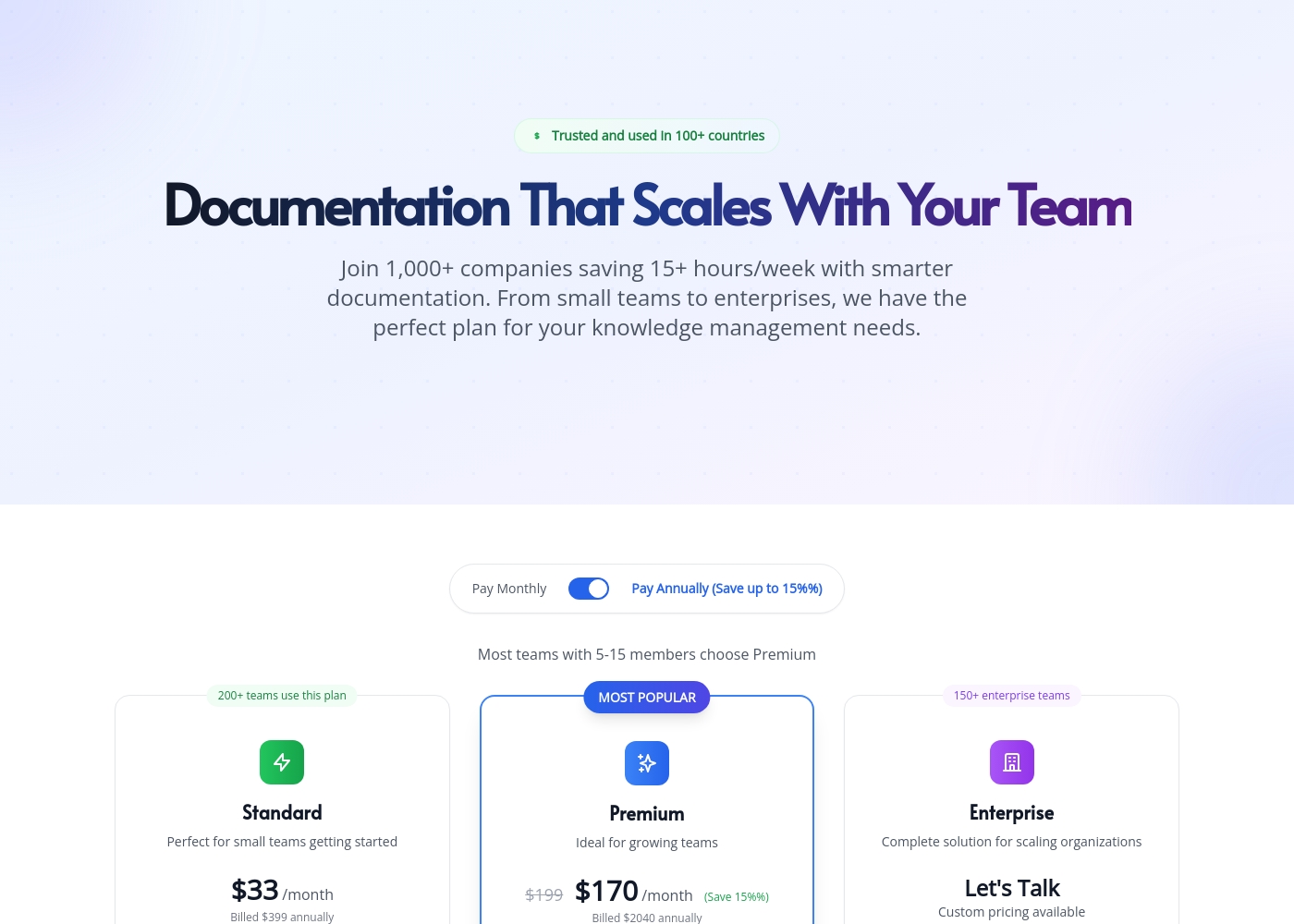
Docsie costs between $33 and $170 per month, billed annually, based on three plans: Standard at $33 per month, Premium at $170 per month, and Enterprise which requires custom pricing.
You'll see options to pay monthly or choose annual billing, which saves you up to 15%. This structure ensures you find the perfect fit, whether you're a small team or a scaling organization.
Standard
Price: $33/month (Billed $399 annually) or $45/month (Monthly) Websites Supported: 2 documentation sites Best For: Startups, small teams, side projects Other Features:
- 5 team members
- AI writes docs for you
- Translate to 40+ languages
- Your logo & colors
- 5 team members
- 2 documentation sites
- AI writes docs for you
- Translate to 40+ languages
- Email support
- 15 team members
- Reusable content blocks
- Help widget for your site
- AI chatbot answers 24/7
- Customer help desk
- Advanced analytics & insights
- Granular permissions & SSO
- Dedicated success manager
- Priority roadmap influence
- Unlimited storage & translations
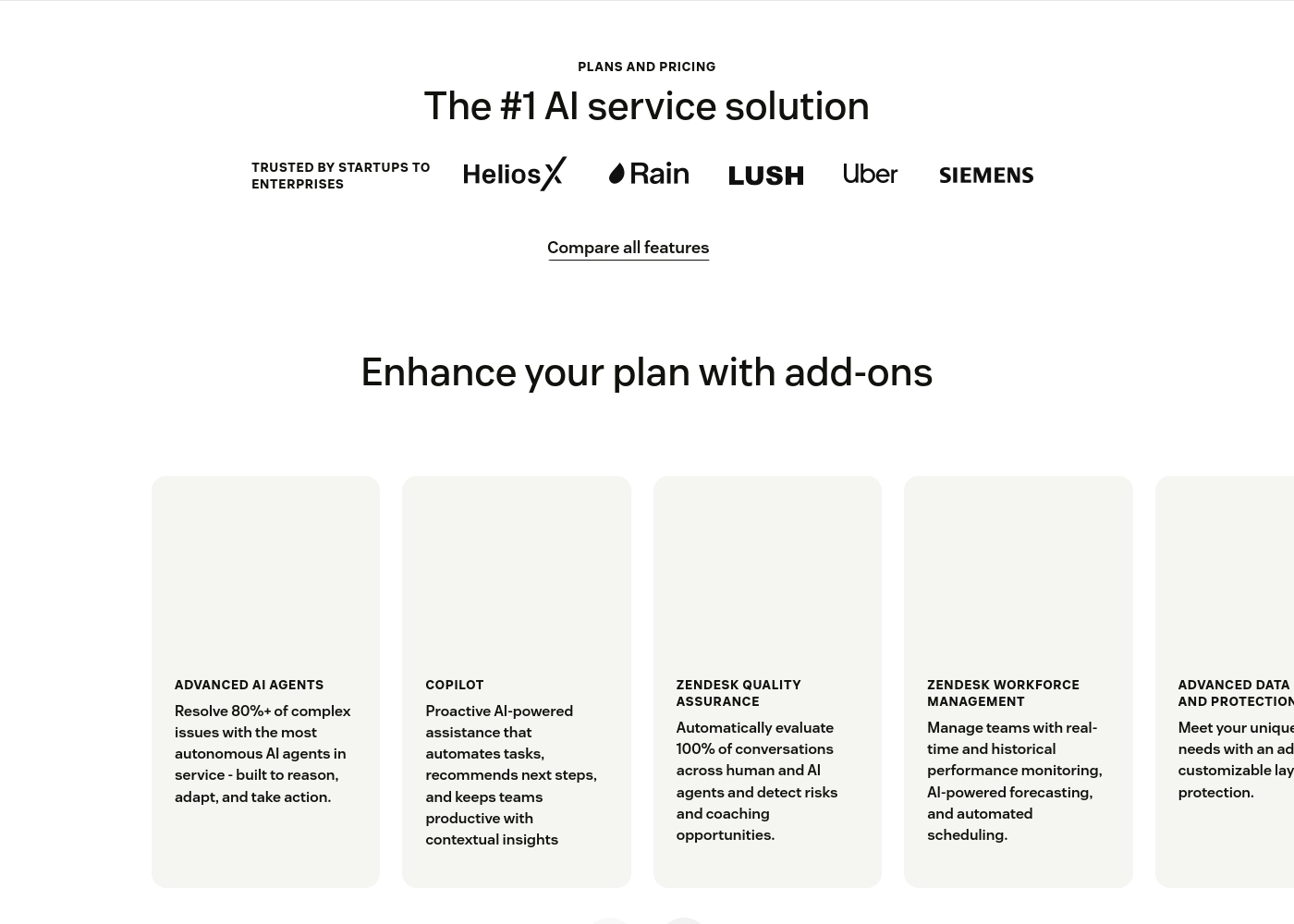
Here’s a breakdown of the two main ways you can subscribe to Zendesk's service solutions.
Zendesk Suite
Best For: Businesses providing support across multiple channels Refund Policy: Refunds are not given for cancellation or downgrades Other Features:
- Ticketing and messaging (including live chat capabilities)
- Robust help center (for both internal and external use)
- Voice support
- Cutting-edge automations and 24/7 AI agents
The Zendesk Suite is the ultimate all-in-one solution for modern customer experience. It is fully equipped for the AI era and works across every major channel you need. This plan is ideal if your business requires a complete, powerful CX solution right from the start.
- All-in-one complete CX solution
- Ticketing and messaging (including live chat)
- Robust help center, voice support
- Cutting-edge automations and 24/7 AI agents
- Focus on email customer support
- Flexibility to add more channels later
- Option to upgrade to the full Zendesk suite
Pricing Notes
- Docsie pricing is fully transparent, ranging from $33 to $170/month with substantial annual billing savings.
- Zendesk's specific pricing is not publicly listed and requires contacting sales for custom quotes.
- Docsie limits access primarily by team members (5-15) and AI usage volume per plan.
- Zendesk explicitly states they provide no refunds for cancellations or subscription downgrades.
- Docsie offers a generous 30-day free trial without requiring a credit card commitment.
Pricing Head-to-Head
User Reviews
We tried to gather external sentiment for Docsie, but public user feedback proved challenging to synthesize. While a Capterra page exists, we could not access current user snippet data detailing common experiences.
Trustpilot currently shows no aggregation of reviews. Therefore, our assessment relies heavily on Docsie's robust feature set and professional claims.
User sentiment, particularly on Trustpilot, is significantly negative, resulting in a very low overall satisfaction score. While the core ticketing platform is considered adequate and meets the basic needs of some users most of the time, reviewers report massive organizational and support failures.
The most persistent complaint focuses on customer support responsiveness; users cite unhelpful staff, slow resolution times, and excessive reliance on bots that tend to auto-close tickets before human assistance is provided. Furthermore, many customers express strong concerns about pricing and value, frequently labeling Zendesk's billing practices as unethical and a 'money grab.' Issues include unexpected charges, refusal of partial refunds for unused features, complex cancellation processes, and difficulty updating seats or accessing invoices.
We asked to reduce our seat count just five days into the contract, having already paid for 10 unused licenses. Zendesk flatly refused to kindly re-quote us a reduced amount. Their customer service shows zero interest in retention or flexibility for long-time clients.
Our Verdict
This isn't a direct feature-for-feature battle; it’s a choice of primary focus. Docsie is tailor-made for managing complex documentation and enterprise knowledge securely. Zendesk is the undisputed champion of immediate omnichannel customer service and efficient ticketing workflows. Your decision hinges entirely on whether you prioritize robust content infrastructure or high-volume ticket resolution. Docsie's superpower is structured content creation and multilingual translation at scale. Its powerful AI Writer speeds documentation creation by up to 60% immediately. Highly complex organizations will appreciate Docsie’s mandatory features like SOC 2 compliance and 99.9% uptime guarantees. Zendesk's strength lies in unifying customer interactions across chat, voice, and email. Its AI agents can successfully deflect up to 25% of routine contacts automatically. Zendesk delivers rapid time-to-value and integrates with thousands of existing CX tools easily. The biggest trade-off is organizational trust versus immediate feature breadth. Docsie provides clear pricing and strong institutional security confidence. Zendesk has comprehensive features but suffers from alarming user reviews regarding billing transparency and unhelpful support teams. Choose Docsie if you need secure, technical knowledge management and transparent scaling for global content. Choose Zendesk only if managing massive, omnichannel ticket volume is your absolute top priority and you can tolerate billing volatility.
Frequently Asked Questions
Which tool is better for documentation creation: Docsie or Zendesk?
Docsie is purpose-built for specialized documentation and knowledge management creation. It includes features like reusable content blocks and strong version control immediately. Zendesk focuses documentation resources on supporting agent ticket resolution.
Does Zendesk have the strong security features of Docsie?
Docsie explicitly meets GDPR and SOC 2 Type II compliance standards and offers a 99.9% uptime SLA. Zendesk offers enterprise security but does not explicitly guarantee these specific compliance stamps. Docsie is the clearer choice for regulatory needs.
Why is Docsie's pricing so much clearer than Zendesk's?
Docsie publicly lists all tier prices, ranging from $33-$170/month annually, with clear limits. Zendesk does not publish its prices and requires customers to contact sales for estimates. This lack of transparency is a major user complaint about Zendesk.
Can Docsie handle customer ticketing like Zendesk?
Docsie offers a knowledge base-powered chatbot and a customer help desk widget for self-service. It is not a full-suite omnichannel ticketing system like Zendesk. Zendesk excels in managing agent workflows across chat and voice.
Which platform is better for building multilingual content?
Docsie is far superior for multilingual content, offering automatic translation into 40+ languages instantly. This dedicated feature is available on most plans. Zendesk requires using add-ons or custom development for similar support.
Is Zendesk worth the high ROI claims despite the bad reviews?
Zendesk claims a 301% ROI over three years, often due to high ticket deflection and agent efficiency. However, numerous user reviews report serious pain points involving billing errors and poor support. High ROI comes with organizational risk.
Ready to Choose?
Both tools have their strengths. Choose based on your specific needs.