DataSnipper vs Splunk
DataSnipper and Splunk solve very different problems for very different teams. DataSnipper automates repetitive audit and finance tasks. Splunk analyzes massive volumes of machine data for security and operations. Your choice depends entirely on your workflow.
Best for: Audit firms performing high-volume document review and verification., Corporate finance teams automating data extraction from financial reports.
Best for: Enterprise security teams running a Security Operations Center (SOC)., DevOps and SRE teams monitoring application performance and infrastructure.
AI-Powered Audit Assistant
We found DataSnipper to be a specialized AI platform that genuinely tackles the repetitive data tasks in audit and finance. It promises significant time savings by automating data collection, extraction, and verification. Overall, it looks like a powerful tool for teams ready to embrace intelligent automation, though the lack of transparent pricing and external review details is a consideration.
Pros
- Automates repetitive data tasks like collection and extraction, promising major time savings.
- Focuses on enhancing accuracy by using AI to cross-reference and validate information.
- Designed to integrate with existing documents and workflows, minimizing disruption.
- Keeps humans in control with a 'human-led intelligence' approach.
Cons
- Pricing is not public and requires a custom proposal, lacking transparency upfront.
- No free trial or money-back guarantee is mentioned, increasing commitment risk.
- Core feature details beyond automation benefits are not deeply specified.
- No accessible external user reviews were found to verify claims or gauge satisfaction.
Powerful but complex data platform.
We find Splunk offers a robust, unified platform for security and observability with extensive integrations and scalability. However, its pricing structure is opaque and usage-based, which can make cost planning challenging. Overall, it's a strong choice for enterprises needing deep data analysis, but smaller teams may find it complex and expensive.
Pros
- Unified platform for security and observability.
- Over 2,000 integrations with various data sources.
- AI and automation for threat response.
- Handles massive data volumes at scale.
Cons
- Opaque pricing requires consultation with sales.
- Can be complex to set up and learn.
- Usage-based models may lead to unpredictable costs.
- External review access was blocked, limiting user sentiment data.
AboutDataSnipper
DataSnipper is an Intelligent Automation Platform designed for Audit and Finance teams. 💡 It acts as a virtual assistant, using AI to handle complex data workflows. The platform helps professionals gather information from multiple sources, pull out key details, and check everything for accuracy. It’s built to work with you, keeping humans in control.
AboutSplunk
Splunk is a unified platform for security and observability. It's designed for teams that need to search, analyze, and act on data from any source. Whether you're a security analyst hunting threats or an engineer troubleshooting app performance, it brings everything together in one place. ✨
Highlights
Feature Comparison
Features Overview
We highlight the main differences and pick a winner for each feature.
Core Purpose
DataSnipper automates audit data tasks. Splunk analyzes machine data for security.
DataSnipper acts as an AI-powered assistant for audit and finance teams. It automates the collection, extraction, and verification of data from documents like PDFs and spreadsheets. This cuts hours of manual work on every engagement. Splunk is a unified platform for searching, monitoring, and analyzing machine data. It ingests logs, metrics, and traces from any source to provide real-time insights for security and IT operations. It helps you see and understand what's happening across your entire technology stack. The key difference is scope. DataSnipper is a specialized tool for a specific profession. Splunk is a broad platform for a specific type of data (machine data) used across many IT and security functions.
Data Handling
DataSnipper works with business documents. Splunk works with machine logs.
DataSnipper focuses on structured and semi-structured business documents. It extracts key data points from financial statements, invoices, and receipts. Its AI agents are trained to understand audit and finance context. Splunk is built to ingest and index massive volumes of machine data from any source. This includes application logs, network events, cloud infrastructure metrics, and security alerts. It handles petabytes of data with high performance. The trade-off is specialization vs. scale. DataSnipper understands your financial documents deeply. Splunk can handle virtually any log file or metric stream at enterprise scale.
User Interface
DataSnipper is designed for document review. Splunk is built for data exploration.
DataSnipper's interface is built around document workflows. It likely features side-by-side views for comparing documents and extracted data. The goal is to make verification tasks intuitive for auditors. Splunk provides a powerful search and dashboard interface. Users write queries (using Splunk Processing Language) to explore data. It offers extensive visualization options for building real-time monitoring dashboards. The learning curves differ. DataSnipper should feel familiar to anyone who uses audit software. Splunk requires learning a powerful but complex query language and dashboard system.
Automation
DataSnipper automates data gathering. Splunk automates incident response.
DataSnipper automates repetitive data tasks within the audit cycle. This includes gathering documents, extracting figures, and cross-referencing them against ledgers. It's process automation for a specific workflow. Splunk's automation focuses on security and operations. It uses AI to generate high-fidelity alerts and can trigger automated playbooks to investigate or contain threats. This is called Security Orchestration, Automation, and Response (SOAR). The automation goals are different. DataSnipper aims to reduce manual labor for compliance tasks. Splunk aims to speed up detection and response to operational or security incidents.
Reporting & Analytics
DataSnipper generates audit evidence. Splunk builds real-time dashboards.
DataSnipper's reporting is centered on audit output. It helps compile verified data for financial statements and workpapers. Advanced reporting is a feature of its Enterprise plan, likely for tracking team productivity or audit status. Splunk is a powerhouse for analytics and reporting. It allows you to build complex dashboards that visualize trends in security threats, application errors, or infrastructure performance in real time. Reports can be scheduled and distributed. Analytics is Splunk's core strength. DataSnipper's reporting supports the final output of an audit, while Splunk's analytics provide continuous, real-time insight into system health.
Collaboration
DataSnipper enables audit team collaboration. Splunk supports cross-functional IT ops.
DataSnipper's Enterprise plan includes features for team collaboration on audits. This likely involves shared access to projects, verified data, and standardized templates to ensure consistency across the team. Splunk facilitates collaboration across security, DevOps, and IT teams. Different roles can use the same data source for different purposes—security analysts hunt threats while engineers troubleshoot performance. Dashboards can be shared across teams. Collaboration happens at different levels. DataSnipper helps a team of auditors work on the same engagement. Splunk helps multiple IT disciplines collaborate using a single source of truth for machine data.
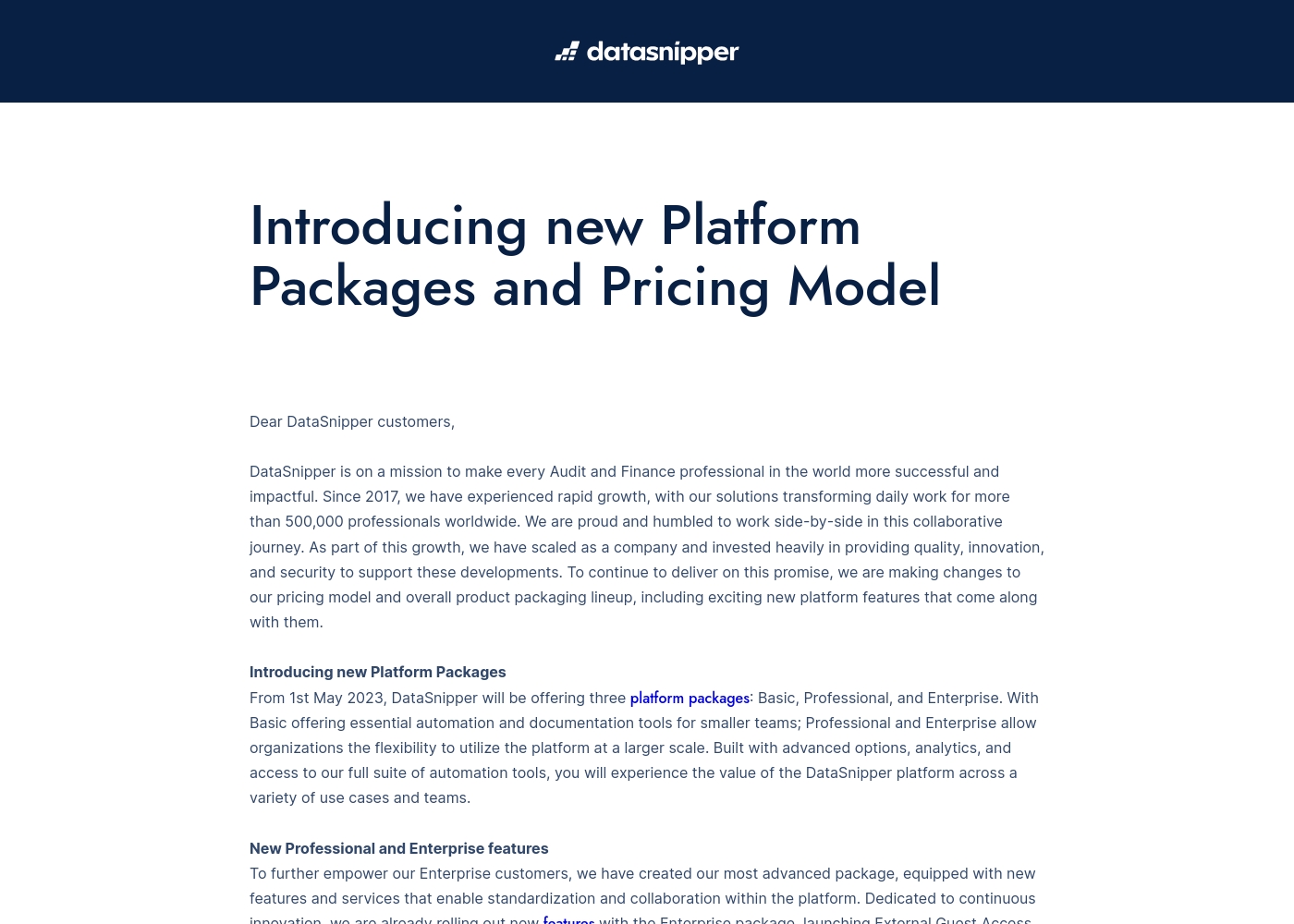
Take a look at the breakdown of our platform packages below to find your fit.
Basic
Best For: Smaller teams needing essential automation Other Features: Essential automation tools, Documentation tools
This plan is great for smaller audit or finance teams who want to start automating their workflows. It provides the core tools you need to document your work faster and more accurately.
- Essential automation tools
- Documentation tools
- Advanced options
- Advanced analytics
- Full suite of automation tools
- External Guest Access
- Advanced Reporting
- Company Templates
- Standardization tools
- World-class support & training
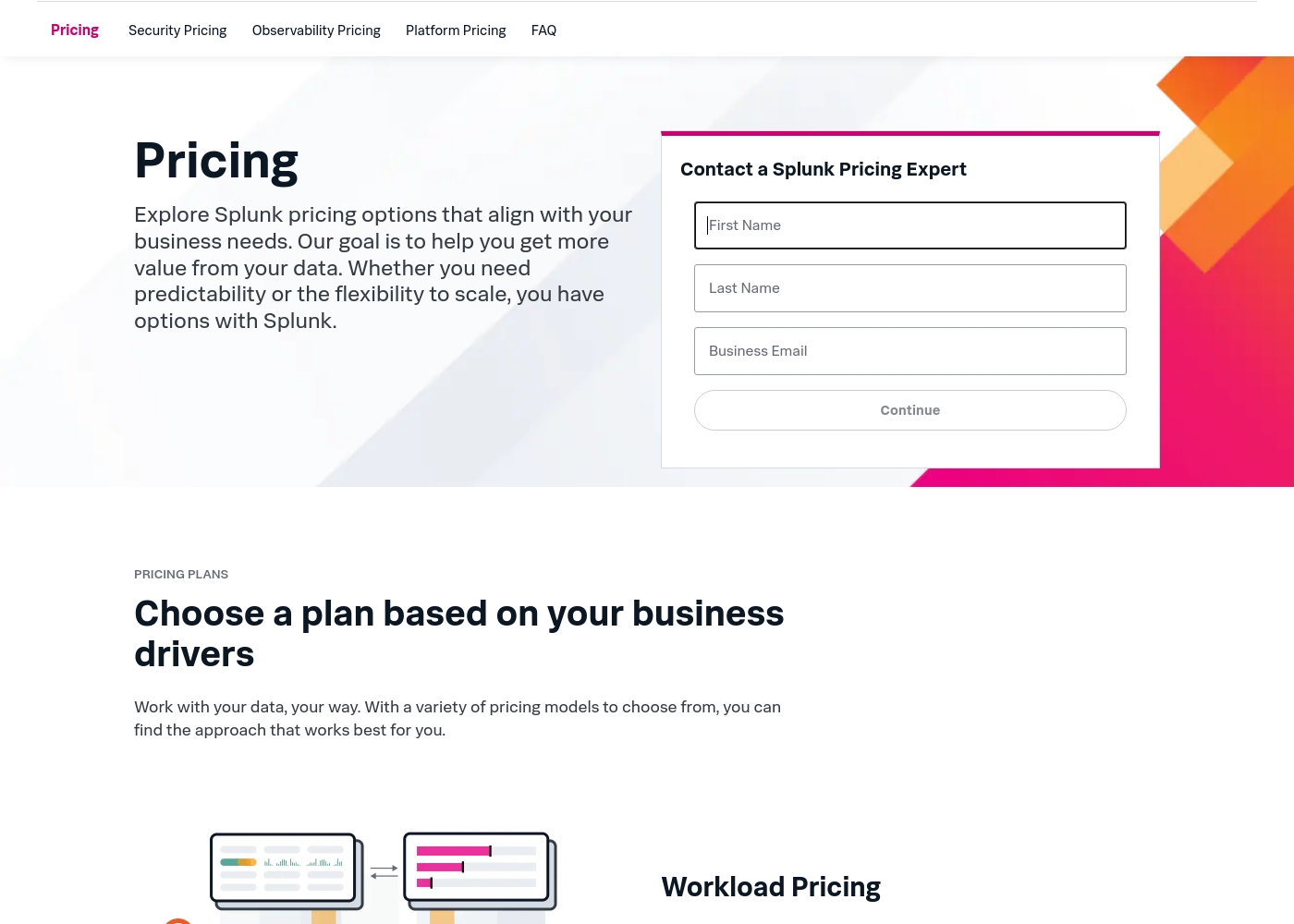
Take a look at the different ways you can manage your data costs below.
Ingest Pricing
Best For: Teams needing predictable costs for high-volume data ingestion Other Features: Simple predictable approach, Economical search scaling, Broad data ingestion
This plan is a great fit if you want a straightforward bill based on the amount of data you bring into the platform. It makes it easy to run extra searches without worrying about hidden fees. It's built for consistency and long-term planning.
- Search and analyze machine data
- Expanded use cases on ingested data
- Standard data ingestion
- Metric time series (MTS)
- Traces analyzed per minute
- Sessions monitoring
- Uptime requests
Pricing Notes
- DataSnipper uses a bespoke pricing model. You must contact sales for a proposal based on your team size and needs.
- Splunk offers a free trial, letting you explore the UI before committing.
- DataSnipper has three clear tiers, but prices are hidden. Splunk's cost is tied to usage, which can be unpredictable without careful monitoring.
- Both require sales consultation for final pricing. Splunk's usage model may suit variable data volumes better than a fixed per-seat fee.
Pricing Head-to-Head
User Reviews
Based on the limited external data we could access, the Capterra review page was unavailable due to a security verification block, so we have no direct user review snippets to analyze. We cannot provide a balanced summary of recurring themes like accuracy, ease of use, or support responsiveness without actual user feedback.
Our review is therefore primarily based on the product information provided by DataSnipper, which highlights its focus on audit and finance automation. We recommend checking the external review platforms directly for current user sentiment.
Based on the provided external sources, we couldn't retrieve detailed user reviews for Splunk due to access restrictions. Trustpilot and Capterra both returned verification or security pages, preventing us from gathering specific sentiment on accuracy, ease of use, support, or pricing.
This means our review is based solely on the official product information and pricing details provided. We recommend checking these review sites directly for the latest user feedback before making a decision.
Our Verdict
Choosing between DataSnipper and Splunk is straightforward because they serve completely different masters. DataSnipper wins for audit and finance pros. Splunk wins for IT, security, and data teams. DataSnipper's superpower is turning hours of manual data grunt work into minutes. Its AI agents automatically collect, extract, and verify information from financial documents. If you're an auditor, this is a game-changer for engagement efficiency. Splunk's superpower is making sense of the world's machine data chaos. It searches, analyzes, and visualizes logs from over 2,000 sources in real time. For security threat hunting or troubleshooting app performance, it's an industry standard. The deciding factor is your role. Pick DataSnipper if your core job involves auditing financial statements or processing invoices. Pick Splunk if your core job involves monitoring system health, hunting security threats, or analyzing IT operations data. Final verdict: DataSnipper is the specialized AI assistant for audit and finance workflows. Splunk is the powerful, scalable data platform for security and observability. Your job function makes the choice clear.
Frequently Asked Questions
Which is better for small teams: DataSnipper or Splunk?
DataSnipper's Basic plan is designed for smaller audit or finance teams starting with automation. Splunk can be complex and expensive for small teams unless their data analysis needs are critical. Consider your budget and technical expertise.
Does DataSnipper have real-time monitoring like Splunk?
No. DataSnipper is focused on automating document-based audit and finance tasks, not real-time monitoring. Splunk specializes in real-time search, monitoring, and analysis of live machine data streams.
Is Splunk worth the extra cost over DataSnipper?
The cost isn't directly comparable as they serve different needs. Splunk is an enterprise data platform, so its usage-based pricing reflects that scale. DataSnipper's cost is for a specialized workflow tool. Compare based on the ROI for your specific team.
Can I migrate from DataSnipper to Splunk easily?
Migration wouldn't make sense, as they solve different problems. DataSnipper handles document data for audits. Splunk ingests machine logs for IT operations. You would use them for entirely different tasks.
Which tool is easier to learn and implement?
DataSnipper is likely easier to learn for its target users, as it's designed for a specific audit workflow. Splunk has a steeper learning curve due to its powerful query language and broad capabilities. Both require professional onboarding.
Do they both offer free trials?
Splunk offers a free trial to explore its interface and features. DataSnipper does not mention a free trial; its next step is to book a demo and get a custom proposal from their sales team.
Ready to Choose?
Both tools have their strengths. Choose based on your specific needs.