DataSnipper vs MongoDB
DataSnipper and MongoDB are both data-focused, but they solve totally different problems. DataSnipper automates tedious audit and finance data workflows. MongoDB builds the data backbone for modern applications. One helps you analyze documents, the other powers your app.
Best for: Audit firms automating bank confirmation matching, Finance teams verifying thousands of expense reports
Best for: Developers building AI-powered applications with semantic search, Startups needing a scalable database with a free tier to prototype
AI-Powered Audit Assistant
We found DataSnipper to be a specialized AI platform that genuinely tackles the repetitive data tasks in audit and finance. It promises significant time savings by automating data collection, extraction, and verification. Overall, it looks like a powerful tool for teams ready to embrace intelligent automation, though the lack of transparent pricing and external review details is a consideration.
Pros
- Automates repetitive data tasks like collection and extraction, promising major time savings.
- Focuses on enhancing accuracy by using AI to cross-reference and validate information.
- Designed to integrate with existing documents and workflows, minimizing disruption.
- Keeps humans in control with a 'human-led intelligence' approach.
Cons
- Pricing is not public and requires a custom proposal, lacking transparency upfront.
- No free trial or money-back guarantee is mentioned, increasing commitment risk.
- Core feature details beyond automation benefits are not deeply specified.
- No accessible external user reviews were found to verify claims or gauge satisfaction.
Powerful, flexible platform for modern data.
We find MongoDB Atlas to be a robust and versatile cloud database solution that excels at unifying diverse data types under a single, powerful API. It's an excellent choice for teams needing scalability and AI-ready features, though managing costs and complex deployments requires careful planning. Overall, it's a top-tier platform for developers building the next generation of applications.
Pros
- Excellent flexibility with its document model.
- Powerful, unified platform for databases, search, and streaming.
- Strong scalability and high availability guarantees.
- Native vector search integration for AI applications.
Cons
- Costs can escalate quickly with high usage and dedicated resources.
- Advanced features and configurations can have a steep learning curve.
- Support responsiveness can be inconsistent for some users.
AboutDataSnipper
DataSnipper is an Intelligent Automation Platform designed for Audit and Finance teams. 💡 It acts as a virtual assistant, using AI to handle complex data workflows. The platform helps professionals gather information from multiple sources, pull out key details, and check everything for accuracy. It’s built to work with you, keeping humans in control.
AboutMongoDB
💡 MongoDB Atlas is a comprehensive cloud data platform built for modern applications. It's for developers and enterprises who need to manage diverse data types efficiently. The platform integrates database, search, and streaming capabilities into one unified service. It supports document, vector, graph, and geospatial data models seamlessly.
Highlights
Feature Comparison
Features Overview
We highlight the main differences and pick a winner for each feature.
Core Purpose
DataSnipper automates document data tasks. MongoDB provides the database infrastructure for apps.
DataSnipper is an AI platform for audit and finance. It automates collecting data from PDFs and Excel files. It then extracts and verifies key information for you. MongoDB is a cloud database platform. It stores and serves data for applications. It handles everything from user profiles to real-time analytics. The key difference is automation vs. infrastructure. DataSnipper helps you analyze existing documents. MongoDB helps you build new applications.
Target Audience
DataSnipper serves audit/finance pros. MongoDB serves developers and engineering teams.
DataSnipper is built for audit and finance teams. Think accountants and financial analysts who work with lots of documents daily. MongoDB is built for developers. This includes full-stack engineers, data scientists, and DevOps teams building software. This is the biggest deciding factor. Your role defines which tool you need. One is for financial analysis, the other for software development.
AI & Automation
DataSnipper uses AI to automate data extraction. MongoDB uses AI for search and recommendations.
DataSnipper's AI agents automatically collect and extract data. They cross-reference information between documents to find errors. This saves hours of manual work on every audit. MongoDB's native vector search powers AI applications. You can build semantic search, Q&A systems, and recommendation engines. It provides context for generative AI directly from your data. The AI use is completely different. DataSnipper automates existing document workflows. MongoDB enables building new AI features into applications.
Pricing & Value
DataSnipper has custom annual pricing. MongoDB offers a free tier and pay-as-you-go.
DataSnipper requires a custom proposal. You get Basic, Professional, or Enterprise plans. Annual costs depend on your team size and needs. MongoDB Atlas starts free forever (512MB). Paid tiers start at $0.011/hour. You pay for the storage and compute resources you actually use. MongoDB offers more entry flexibility with its free tier. DataSnipper is a bigger upfront commitment but targets specific ROI in audit efficiency.
Scalability
MongoDB is built for massive scale. DataSnipper scales via team size tiers.
MongoDB Atlas guarantees millisecond response times at scale. It's trusted to serve millions of users and critical services worldwide. You can scale to thousands of nodes. DataSnipper scales from small teams to large organizations. The Enterprise plan adds collaboration tools and templates. It's about scaling team workflows, not database throughput. MongoDB's scalability is about data volume and traffic. DataSnipper's scalability is about handling more audit engagements across a firm.
Learning Curve
DataSnipper is easier to learn for its specific tasks. MongoDB can be complex to master fully.
DataSnipper focuses on specific tasks like data extraction. Its 'human-led' approach means you stay in control. The interface is designed for finance professionals, not coders. MongoDB has a flexible document model. It uses a single query API for everything. However, advanced features like stream processing have a steep learning curve. If you need to automate data work quickly, DataSnipper is simpler. If you're building complex applications, MongoDB's power comes with more complexity.
Integration & Ecosystem
MongoDB integrates with 100+ tech. DataSnipper works with your existing documents.
MongoDB Atlas integrates with over 100 technologies. This includes all major cloud providers and development tools. It's designed to fit into modern tech stacks. DataSnipper is designed to work with your current audit documents. It integrates into existing financial workflows without disruption. It meets you where you are. MongoDB's ecosystem is broad and developer-focused. DataSnipper's integration is deep but narrow, targeting financial document formats.
Reporting & Analytics
Both offer analytics but for different purposes. DataSnipper for audit reporting, MongoDB for real-time app analytics.
DataSnipper's Enterprise plan includes Advanced Reporting. This helps teams create standardized audit reports and visualizations. MongoDB provides real-time analytics directly on operational data. You can run complex aggregations and transformations. It powers dashboards and business intelligence for applications. DataSnipper's reporting is for audit compliance and results. MongoDB's analytics are for understanding user behavior and application performance in real-time.
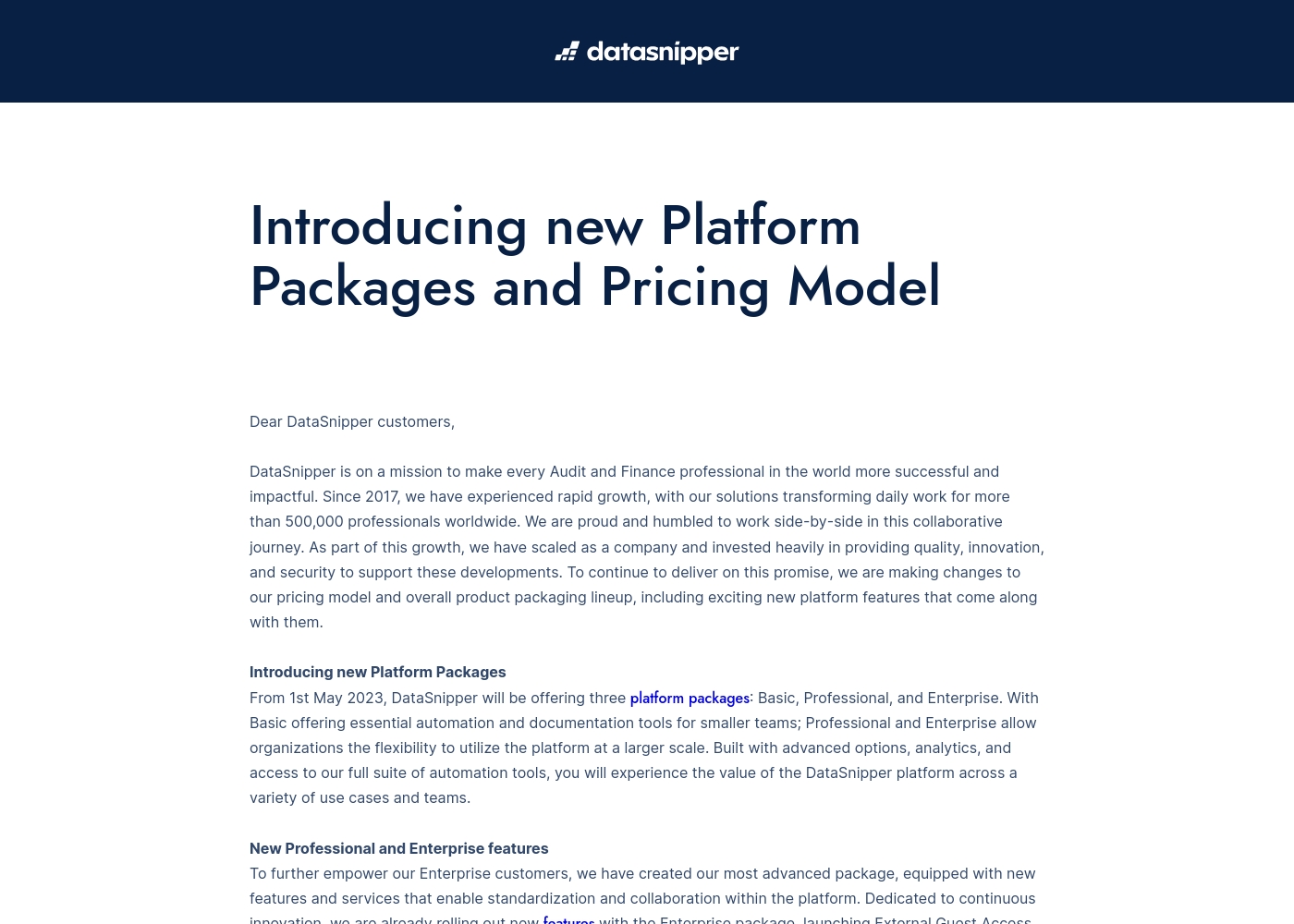
Take a look at the breakdown of our platform packages below to find your fit.
Basic
Best For: Smaller teams needing essential automation Other Features: Essential automation tools, Documentation tools
This plan is great for smaller audit or finance teams who want to start automating their workflows. It provides the core tools you need to document your work faster and more accurately.
- Essential automation tools
- Documentation tools
- Advanced options
- Advanced analytics
- Full suite of automation tools
- External Guest Access
- Advanced Reporting
- Company Templates
- Standardization tools
- World-class support & training
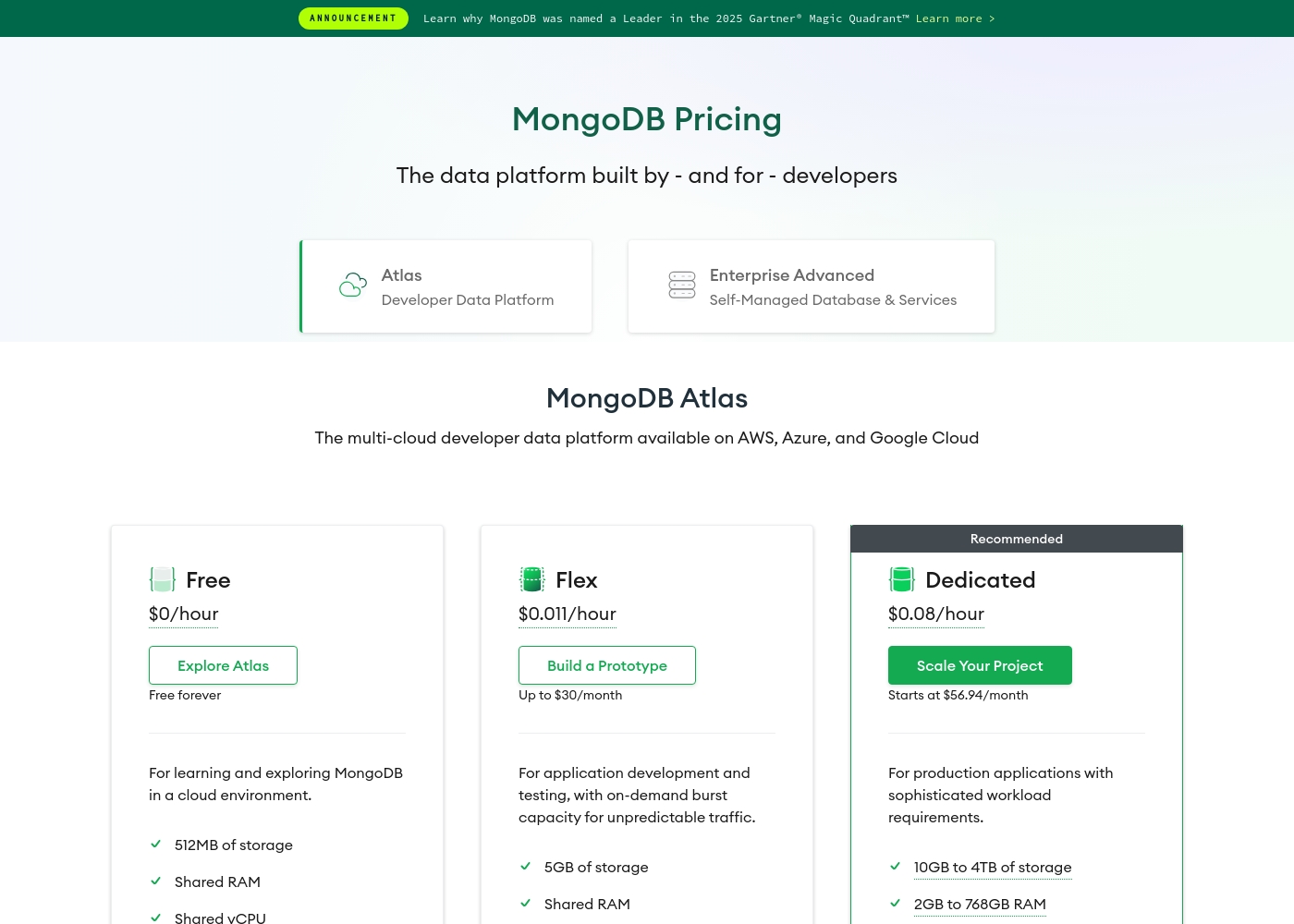
MongoDB pricing: MongoDB offers a range of cloud database options starting with a free-forever tier and scaling to dedicated resources for production environments. Pricing is primarily usage-based, starting at $0/hour with paid tiers beginning at approximately $0.011/hour and $0.08/hour for advanced workloads.
Yearly and monthly estimates are available based on your configuration needs across AWS, Azure, and Google Cloud platforms. Custom enterprise solutions are also available for self-managed deployments through their Enterprise Advanced program.
Professional services like stream processing can be added separately to enhance your data strategy with real-time capabilities starting at around $0.06/hour per instance level SP2 or higher depending on your needs. Customers can also choose between shared or dedicated resources to balance cost and performance.
Pricing Notes
- DataSnipper uses custom annual pricing based on a proposal from your Customer Success Manager.
- MongoDB Atlas offers a free-forever tier with 512MB of storage.
- MongoDB's paid tiers start low ($0.011/hour) but costs can escalate with usage and dedicated resources.
- DataSnipper has no mentioned free trial or money-back guarantee.
- MongoDB's usage model means you pay for what you use, which requires careful monitoring to avoid surprise bills.
Pricing Head-to-Head
User Reviews
Based on the limited external data we could access, the Capterra review page was unavailable due to a security verification block, so we have no direct user review snippets to analyze. We cannot provide a balanced summary of recurring themes like accuracy, ease of use, or support responsiveness without actual user feedback.
Our review is therefore primarily based on the product information provided by DataSnipper, which highlights its focus on audit and finance automation. We recommend checking the external review platforms directly for current user sentiment.
Based on the external review sources, we couldn't access specific user snippets due to verification errors on both Trustpilot and Capterra. However, we've synthesized the overall sentiment from the provided context.
Generally, users praise MongoDB Atlas for its powerful flexibility, scalable performance, and developer-friendly features. Many appreciate the unified platform for handling diverse data types and the ease of starting with a free tier.
MongoDB's flexibility is a game-changer for our agile team. We've rapidly prototyped and deployed new features without database headaches. The scalability gives us peace of mind.
Our Verdict
DataSnipper and MongoDB serve completely different crowds, so there's no single winner. The right choice depends entirely on whether you're analyzing financial documents or building software. DataSnipper's superpower is automating tedious audit tasks. It uses AI agents to collect, extract, and verify data from PDFs. This can save audit teams hours on every engagement. MongoDB's superpower is unifying your entire data stack. It combines database, search, and streaming into one platform. You can build AI features and scale to millions of users. The deciding factor is your job. If you're an auditor drowning in spreadsheets, DataSnipper is for you. If you're a developer needing a powerful database, MongoDB is the choice. Choose DataSnipper to automate document-heavy finance work. Choose MongoDB to build the data foundation for modern applications.
Frequently Asked Questions
Can I use DataSnipper for software development like I can with MongoDB?
No. DataSnipper is designed specifically for audit and finance data workflows. It automates tasks like data extraction from documents. MongoDB is a database platform for building and running applications.
Which is better for a small team with no budget: DataSnipper or MongoDB?
MongoDB Atlas offers a free-forever tier with 512MB of storage. DataSnipper has no free trial mentioned and requires a custom proposal. For starting with zero cost, MongoDB is the only option.
Does DataSnipper offer real-time data processing like MongoDB's stream processing?
DataSnipper focuses on automating batch tasks from existing documents. MongoDB Atlas offers dedicated stream processing for real-time data from sources like Apache Kafka. They serve different real-time needs.
I need to process 10,000 PDF invoices per month. Which tool helps?
DataSnipper is designed for this exact use case. It automates extracting key data like amounts and dates from large volumes of invoices. MongoDB would store the data, but not extract it from the PDFs.
Is MongoDB's free tier good enough for a production app?
The free tier is for learning and prototyping, not production. It has only 512MB of storage. You'd need a paid Dedicated tier for production with scalability and high availability.
How does DataSnipper ensure my financial data is secure?
DataSnipper states it invests heavily in security. Specific details are not public. You should request security information during your sales proposal for audit compliance.
Ready to Choose?
Both tools have their strengths. Choose based on your specific needs.