Clover vs SumUp
Clover and SumUp both offer integrated POS and payment solutions for small businesses. They differ significantly in price transparency and ease of setup. Clover forces custom quotes and contracts, while SumUp scales with transparent monthly tiers.
Unreliable support and costly hidden fees.
We found that the extensive negative user feedback concerning billing integrity and unresponsive support casts serious doubt on Clover's operational credibility. The reported frequency of undisclosed fees and sudden fund freezing highlights significant financial risk for users. Overall, we advise caution due to recurring documented sales misrepresentation and critical customer service failures.
Pros
- Provides a comprehensive POS system combined with card reader technology.
- Used by established banks as a standard merchant service provider.
- The system has been in use by some customers for many years.
Cons
- Customer support is frequently described as unprofessional and extremely difficult to reach.
- Users report high incidences of unexpected fees and unauthorized charges.
- Sales representatives allegedly misrepresent rates and contract terms.
- There are reports of customer funds being frozen without communication or timely release.
Simple payments meet growth tools.
We find SumUp offers a compelling package for small businesses seeking transparent pricing and robust POS tools starting at $99/month. While users consistently praise the intuitive interface and affordable transaction fees, we observed significant recurring concerns regarding hardware reliability and slow customer support response times. Overall, SumUp is a powerful, low-cost solution best suited for users who value simplicity and can tolerate occasional technical glitches.
Pros
- Highly user-friendly app and intuitive interface for easy tracking.
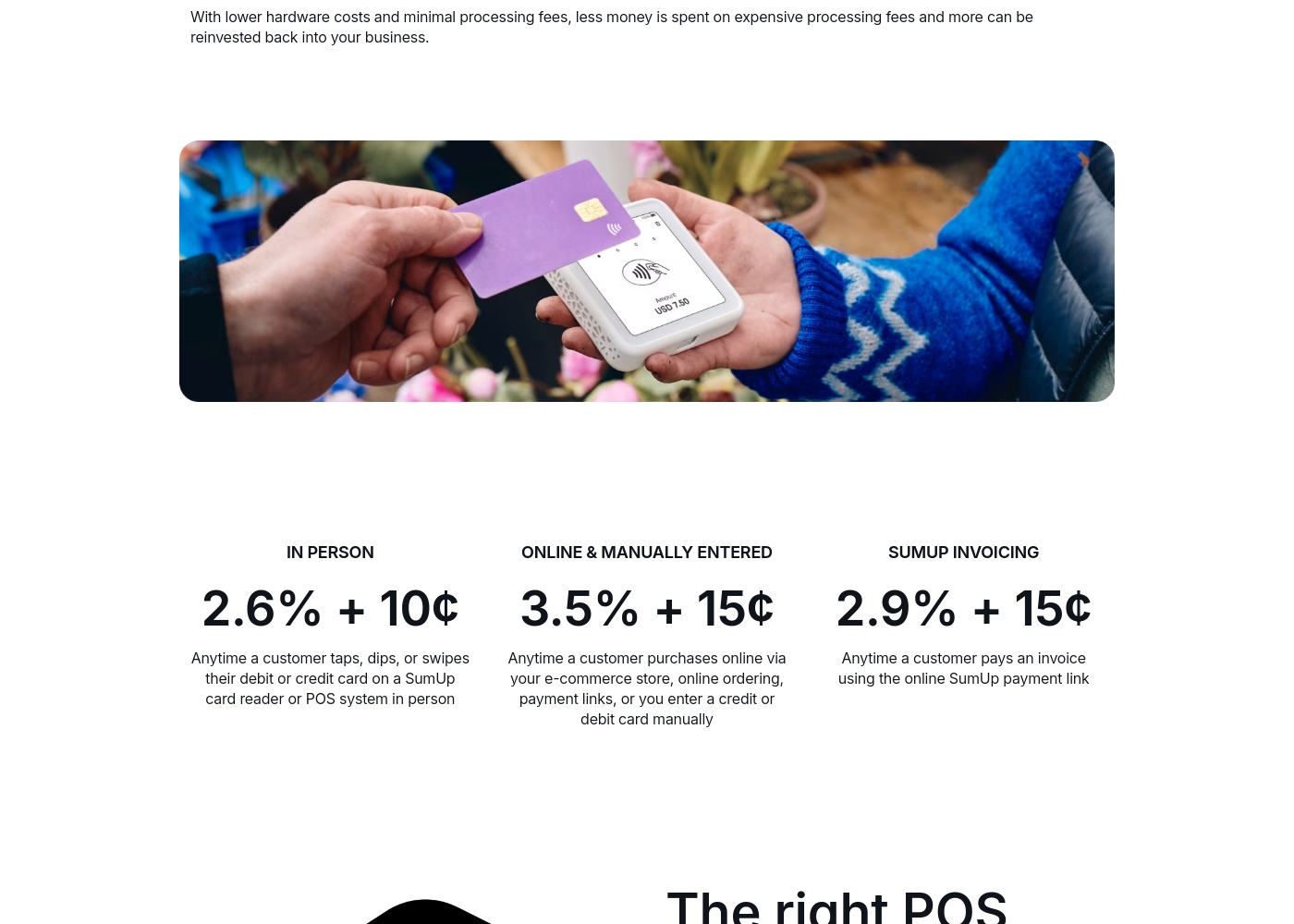
- Transparent pricing with competitive in-person transaction fees (2.6% + 10¢).
- Next-day payouts boost cash flow efficiency.
- Comprehensive POS plans include dedicated installation and training.
Cons
- Customer service is often reported as slow, unhelpful, or inaccessible.
- Mobile/tap-to-pay functions sometimes prove unreliable or slow.
- Connectivity issues reported with card readers and WiFi stability.
- Some users felt surprised by unannounced changes to pricing or features.
AboutClover
Clover provides essential tools for small businesses seeking better payment solutions. It integrates both a complete POS System and reliable Credit Card Reader technology. If you need a trustworthy platform to handle transactions and processing, Clover is ready to deliver. 💡
AboutSumUp
SumUp provides comprehensive payment solutions including Card Readers and POS Systems. This integrated ecosystem is designed to help you run your entire business smoothly. It manages everything from processing orders to full customer acquisition. Over 4 million businesses worldwide have already chosen SumUp to be their partner 💡.
You can select products based on your specific needs, including powerful POS tools, Card Readers, and Invoicing capabilities. The platform serves a wide range of entrepreneurs, from coffee shops and fast casual restaurants to barber shops and clothing boutiques. Simply download the free SumUp App to access these business solutions quickly.
Highlights
Feature Comparison
Features Overview
We highlight the main differences and pick a winner for each feature.
Pricing Transparency
SumUp publishes clear tiered pricing; Clover forces you to contact sales for a quote.
Clover’s costs are highly individualized, requiring you to contact their sales team directly. You must negotiate hardware, subscription, and custom transaction rates with Clover. SumUp offers three clear monthly plans ranging from $99 to $289/month for easy budgeting. SumUp explicitly guarantees zero admin costs, annual fees, or minimum processing limits. This difference is predictability versus potentially risky contractual negotiation with Clover.
Transaction Fees
SumUp provides a clear 2.6% + 10¢ rate; Clover rates require negotiation and lack transparency.
SumUp offers a competitive fixed rate of 2.6% + 10¢ for all in-person card transactions. This gives small businesses immediate clarity on processing costs. Clover’s transaction rates are variable and hidden within custom quotes from the sales team. The data indicates sales reps negotiating Clover rates allegedly misrepresent the long-term charges. With SumUp, what you see is exactly what you pay for processing.
Customer Support
Both platforms receive severe criticism, but Clover's issues include catastrophic financial failures.
Clover’s support is frequently described as atrocious and extremely difficult to reach by users. Reports highlight Clover users losing access to large frozen funds ($63k) with no timely resolution. SumUp also receives complaints about slow, unhelpful, or inaccessible customer service responses. If forced to choose, SumUp’s support failures appear less financially catastrophic than those reported with Clover.
Start-up Support
SumUp guarantees dedicated installation and training; Clover's resources are undefined.
SumUp includes dedicated installation and training staff with all three POS subscription tiers. This ensures your new business can launch smoothly and staff are comfortable immediately. Clover does not explicitly state offering personalized data migration or training resources for new users. If hands-on help is critical, SumUp provides guaranteed onboarding assistance from the start.
Loyalty & Marketing
SumUp offers advanced, AI-enhanced marketing tools; Clover does not detail specific customer loyalty features.
SumUp Connect Pro includes unlimited, daily AI-enhanced SMS and email promotions to maximize customer reach. SumUp integrates with the Fivestars App to actively drive customer rewards programs. Clover does not explicitly mention customer loyalty programs or specialized marketing automation tools in their features. SumUp clearly targets business growth through proactive engagement strategies and rewards.
Financial Control
SumUp enables next-day payouts and transparent invoicing; Clover carries a high risk of funds being frozen.
SumUp provides next-day payouts when utilizing their SumUp Business Account, offering superior cash flow efficiency. SumUp offers free professional invoicing, charging only a fee upon successful payment via the link. Clover’s system is associated with the risk of having large sales funds frozen by their risk department. The lack of reliable financial access makes Clover risky for small businesses.
Clover pricing details are not explicitly stated on the provided page, requiring direct contact with the sales team for current rates.
While specific details are unavailable here, Clover operates as a comprehensive POS and payment processing provider. This means your required pricing components will likely include hardware costs, ongoing transaction fees, and subscription fees for software access.
Plan A: Not explicitly stated
Price: Not explicitly stated Websites Supported: Not explicitly stated Best For: Not explicitly stated Refund Policy: Not explicitly stated Other Features: Not explicitly stated

SumUp offers POS solutions ranging from $99/month to $289/month, with three structured plans: POS with Connect Lite at $99/month, POS with Connect Plus at $199/month, and POS with Connect Pro at $289/month.
We want to help guide you to the right system for your business and budget. Here is a detailed comparison of the monthly subscription tiers available.
POS with Connect Lite
Price: $99/month Websites Supported: Not explicitly stated Best For: Starting a business and streamlining operations Refund Policy: Not explicitly stated Other Features:
- Cloud-based POS
- Customer Database
- Dedicated installation and training
- Standard POS software
- Standard POS software
- Cloud-based POS
- Customer Database
- Dedicated installation and training
- Money Back Guarantee*
- Cloud-based POS
- Customer Database
- Dedicated installation and training
- Customer rewards and automated marketing
- Money Back Guarantee*
- Cloud-based POS
- Customer Database
- Dedicated installation and training
- Customer rewards and automated marketing
Pricing Notes
- Clover’s pricing is opaque, requiring direct contact with sales for an individualized quote based on hardware and software needs.
- SumUp offers clear tiered monthly software pricing, starting at $99/month for Connect Lite.
- Clover users consistently report experiencing unexpected fees, unauthorized charges, and high cancelation costs.
- SumUp guarantees no hidden admin costs, annual renewal fees, or monthly processing minimums.
- SumUp's in-person transaction rate is competitive at 2.6% + 10¢, offering superior predictability.
Pricing Head-to-Head
User Reviews
The external sentiment for Clover is decisively negative, particularly apparent in the high volume of concerns raised on Trustpilot. The most recurring complaint centers on atrocious customer service.
Users report spending hours attempting to resolve basic issues, often being transferred repeatedly or failing to reach helpful representatives. Financially, many users feel deceived.
I spent over six hours dealing with support trying to stop invalid billing charges. They kept bouncing me between tech support and their 3rd party merchant service provider. This is the worst customer support I have ever experienced.
SumUp earns high marks from most users, who consistently praise the platform's ease of use and intuitive interface. Users find the app simple to navigate, making transaction tracking and sending receipts hassle-free.
The transparent pricing and affordable transaction fees, especially the 2.6% + 10¢ for in-person sales, are seen as exceptional value for small businesses and sole traders. Features like payment links and next-day payouts support efficient operations.
I’m completely new to using a card reader and Apple Pay payment methods. Using SUMUP has been intuitive and easy to use. I’m impressed with the app and the communications.
Our Verdict
This comparison is straightforward: SumUp dramatically outperforms Clover in cost transparency and financial reliability. Clover’s pricing is opaque and frequently associated with high user risk, making SumUp the clear choice for most small businesses. We highly recommend SumUp. Clover’s superpower is its comprehensive, integrated POS system often utilized by major banks. If you require deep, complex customization and are prepared to negotiate specialized contracts, Clover might offer the right system. Unfortunately, Clover users report frequent issues, including frozen funds and sales reps misrepresenting contract terms. SumUp’s superpower is its financial predictability and clear value. You get tiered monthly plans ($99–$289) and a great 2.6% + 10¢ in-person processing rate. SumUp explicitly guarantees no hidden admin fees or monthly minimums, which is critical for budgeting. The deciding factor is financial security and trust. SumUp guarantees against hidden fees and ensures next-day payouts for rapid cash flow. Clover users face severe issues like unexpected charges and poor support when trying to recover frozen funds or cancel service. Choose SumUp if you need predictable pricing, included onboarding, and automated growth tools for your new shop. Only consider Clover if you are a large, established enterprise comfortable managing complex, riskier merchant contracts.
Frequently Asked Questions
Which POS system has better pricing transparency: Clover or SumUp?
SumUp is far more transparent, offering fixed monthly plans from $99–$289. Clover requires you to contact sales for a custom quote not visible publicly. SumUp guarantees no hidden administrative or annual renewal fees.
Are Clover's transaction fees cheaper than SumUp's?
SumUp’s explicit in-person fee is 2.6% + 10¢, which is very competitive. Clover’s fees are variable and negotiated, and users report they often end up paying more due to misrepresented or unexpected charges.
Which is better for cash flow: Clover or SumUp?
SumUp is superior for cash flow because it offers reliable next-day payouts via its Business Account. Clover does not explicitly promise next-day payouts and carries the risk of freezing user funds for extended periods.
Does SumUp include automated marketing like Clover?
SumUp includes robust automated marketing, especially in the Connect Pro plan, with daily AI-enhanced promotions. Clover does not advertise specific customer loyalty or automated marketing tools in its feature list.
Which tool is riskier regarding hidden costs and financial liability?
Clover is far riskier according to user reviews. Users complain frequently about hidden fees, unauthorized charges, and massive cancellation fees. SumUp explicitly guarantees no hidden costs or unnecessary fees.
Can I try SumUp or Clover before fully committing?
SumUp offers a 30-day money-back guarantee on hardware products for Plus and Pro plans. Clover does not explicitly state a free trial, money-back policy, or satisfaction guarantee.
Ready to Choose?
Both tools have their strengths. Choose based on your specific needs.