Close CRM vs Shape
Close CRM and Shape both aim to centralize sales communications, but they target different needs. Close CRM fights workflow chaos and Zapier bills with specific AI tools. Shape delivers a full marketing and sales suite centered on reliable, high-volume communication.
Best for: Small sales teams (Solo to Growth plans), Organizations highly focused on reducing Zapier/tool integration costs
Best for: Teams needing high-volume, automated lead engagement across text and email, Businesses that rely heavily on inbound/outbound calling (local presence dialing)
Simple CRM with mixed user experiences.
We find Close CRM offers a solid, all-in-one platform for small sales teams needing built-in calling, email, and AI automation. Overall, it's a capable tool, but its reliability and support responsiveness have drawn significant criticism from some users, making it a mixed bag for certain teams.
Pros
- All-in-one platform for calling, email, SMS, and pipeline management.
- AI agent (Chloe) automates follow-ups and lead engagement.
- Built-in Power and Predictive Dialers for high-volume teams.
- Straightforward UI that's easy to learn without complex training.
Cons
- Auto-security system can lock trials or accounts without warning, causing data access issues.
- Support sometimes provides generic, copy-paste responses instead of personalized help.
- Recent interface updates have introduced bugs, high latency, and missing functions for some users.
- iPhone app has been reported as slow and prone to call stuttering.
Automated engagement meets comprehensive sales tools.
We evaluated Shape based on its commitment to automated lead engagement and integrated sales tools. The platform offers sophisticated AI scoring, an award-winning communication system, and dedicated onboarding across all plans. Overall, Shape provides a robust, all-in-one solution for managing and closing leads efficiently, but pricing transparency is a significant hurdle for potential buyers.
Pros
- Comprehensive CRM and marketing platform integration.
- Powerful automation for consistent lead follow-up.
- Award-winning communication system (phone, text, MMS).
- Secure and reliable email delivery using compliant SMTP servers.
Cons
- Opaque, quote-based pricing structure requiring sales contact.
- Absence of a publicly stated free trial or money-back guarantee.
AboutClose CRM
Close is a sales CRM built for teams that sell. It combines calling, email, SMS, pipeline management, reporting, and an AI sales agent named Chloe into a single platform. ✅ It's designed for sales teams who want to act on their sales data quickly and efficiently, rather than juggling multiple tools. The platform is trusted by over 11,500 sales teams.
AboutShape
Shape is a comprehensive platform combining a powerful Sales CRM with a robust marketing suite. This system helps you efficiently automate your sales and marketing activities.
It includes sophisticated communication tools designed to maximize productivity. You get an award-winning phone system that handles calls, texts, and MMS seamlessly.
The platform also features built-in CRMs for texting and emailing. This setup allows for powerful bi-directional communication, ensuring your delivery is secure and reliable.
Highlights
Feature Comparison
Features Overview
We highlight the main differences and pick a winner for each feature.
Pricing & Transparency
Close CRM offers clear, published plans starting at $0/year. Shape uses opaque per-seat pricing requiring a direct sales quote.
Close CRM provides budget transparency with plans ranging from free up to $250 annually. Teams can quickly review prices online and know their exact costs immediately. Shape mandates a quote-based, per-seat pricing structure across all three tiers. Users must contact sales directly to determine their implementation and ongoing costs. This price obscurity is the biggest hurdle for Shape when compared to the highly affordable Close CRM. Close CRM lets you start exploring the platform without any mandatory sales contact.
Onboarding Support
Shape includes expert help for data imports and full system implementation. Close CRM relies on user self-service and email support.
Close CRM users rely on the 24/7 knowledge base and standard email support for implementation. Initial setup and data migration largely fall upon the internal team. Shape includes an Expert Onboarding Plan with every tier you purchase. Their professional support team manages data imports and full system implementation for you. This service allows Shape customers to launch faster without heavy initial internal effort. Shape makes it easier to switch systems, especially if you have complex data to move.
AI Functionality
Close CRM uses AI for rep productivity and external chatbot integration. Shape utilizes AI for smarter lead prioritization and scoring.
Close CRM boosts everyday sales tasks using its built-in AI Notetaker and AI Summaries. It also offers direct third-party integration with Claude and ChatGPT. Shape focuses its intelligence on the lead pipeline using advanced AI lead scoring. This capability instantly identifies top-converting prospects for your agents to call first. Close CRM helps the rep work faster; Shape helps the team focus better on high-value activity. Both approaches support different but equally critical sales objectives.
Communication Tools
Shape provides an award-winning integrated calling and texting system. Close CRM prioritizes centralizing multi-channel sales conversations.
Shape offers an award-winning phone system that handles voice, SMS, and MMS messaging seamlessly. Key features include local presence dialing to significantly boost connection rates. Close CRM is a single hub for all communication channels like email and calling. It is designed to minimize the need to jump between external tools. If high-volume calling and texting is a foundational part of your strategy, Shape offers superior built-in infrastructure. Close CRM's strength is simplicity and reduced external tool dependency.
Automation & Integration
Close CRM reduces integration complexity to improve reliability. Shape provides robust, powerful, built-in automated follow-up sequences.
Close CRM aims to cut high Zapier bills and improve data flow reliability by centralizing everything. It supports standard integrations like Zoom, Segment, and API access. Shape excels at automated lead follow-up using powerful sequences across email and texting CRMs. It offers hundreds of pre-built templates for quick deployment. If external tool dependency causes pain, Close CRM fixes the issue by replacement. Shape delivers pre-packaged automation power right out of the box.
Security & Compliance
Close CRM provides explicit SOC2 compliance standards and 2FA support. Shape guarantees authenticated email delivery through compliant SMTP servers.
Close CRM explicitly maintains SOC2 Type 2 compliance and supports Google SSO and two-factor authentication. These are clear trust signals for larger organizations. Shape focuses its security features on ensuring reliable and secure delivery of email marketing campaigns. It uses compliant SMTP servers for authenticated mail delivery. Close CRM offers documented platform-wide security compliance. Shape focuses on the specific security of its communication delivery infrastructure.
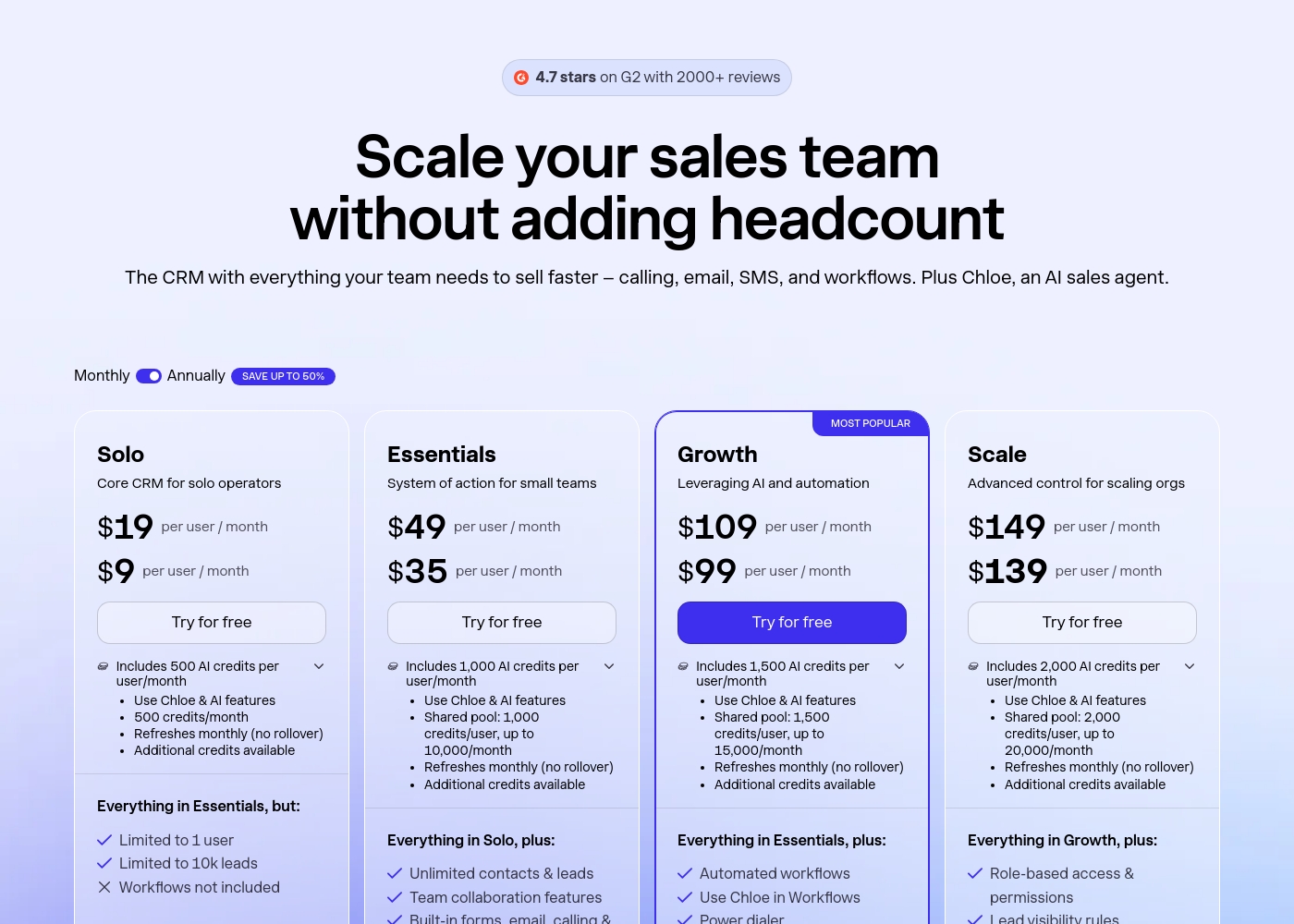
Close CRM costs between $9 and $139 per user/month with 4 plans: Solo at $9, Essentials at $35, Growth at $99, and Scale at $139.
Here is a quick breakdown to help you pick the best tier for your sales workflow.
Solo
Price: $9 per user/month (billed annually) Best For: Founders and solo reps who need a CRM instead of a spreadsheet Other Features:
- Includes 500 AI credits per user each month
- Limited to 1 user and up to 10,000 leads
- Core CRM tools for email, calling, and SMS
- Includes 500 AI credits per user/month
- Use Chloe & AI features
- 500 credits/month, refreshes monthly
- Limited to 1 user
- Limited to 10k leads
- Includes 1,000 AI credits per user/month
- Shared pool: 1,000 credits/user, up to 10,000/month
- Unlimited contacts & leads
- Team collaboration features
- Built-in forms, email, calling & SMS
- Includes 1,500 AI credits per user/month
- Shared pool: 1,500 credits/user, up to 15,000/month
- Automated workflows
- Use Chloe in Workflows
- Power dialer
- Includes 2,000 AI credits per user/month
- Shared pool: 2,000 credits/user, up to 20,000/month
- Role-based access & permissions
- Lead visibility settings
- Predictive dialer
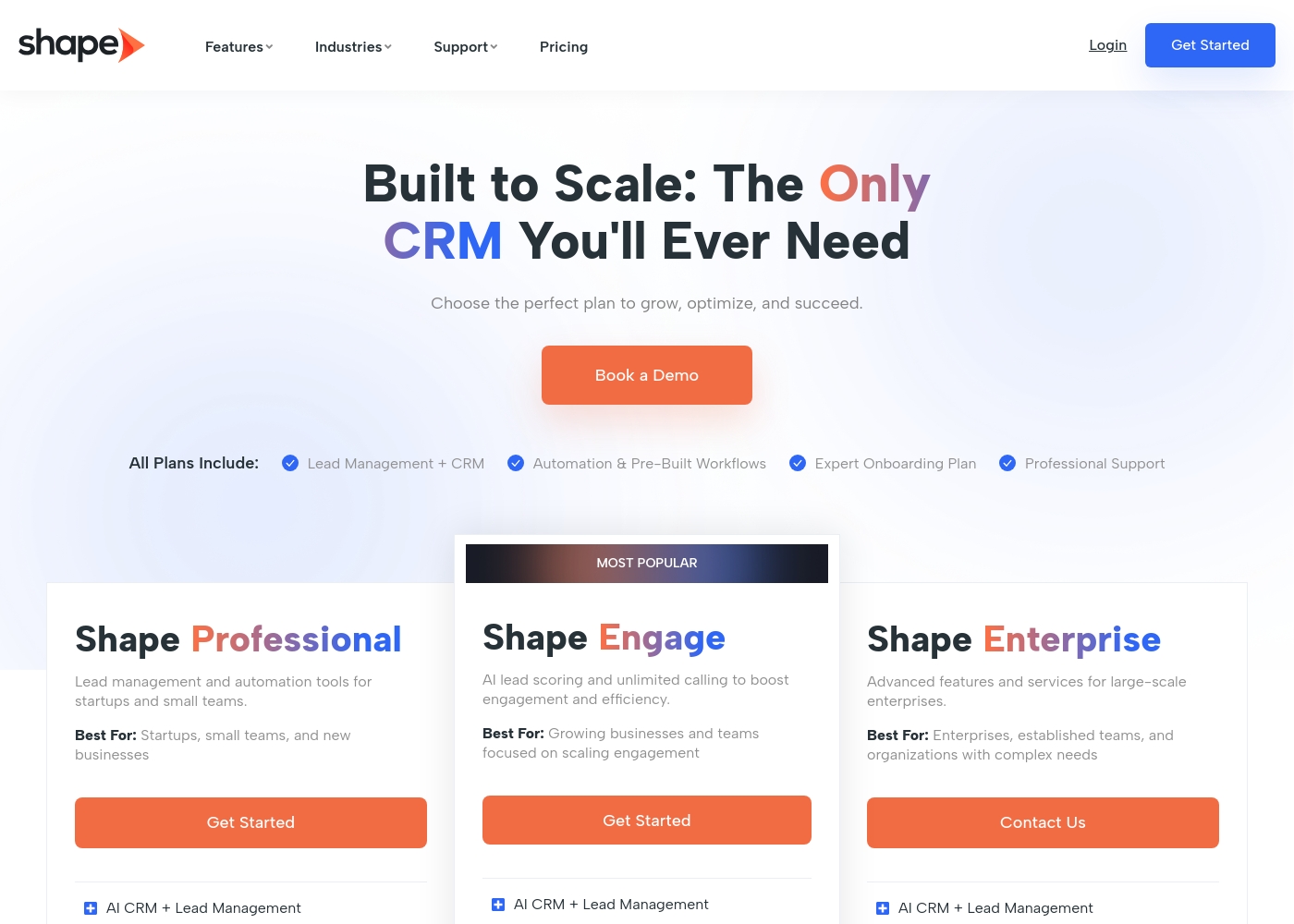
Shape uses a quote-based pricing model with three main plans: Professional, Engage, and Enterprise, none of which have explicitly listed costs.
To view current pricing details, you must contact their sales team or click 'Get Started' for a personalized quote.
Shape Professional
Best For: Startups, small teams, and new businesses Other Features: AI CRM + Lead Management, Lead Management + CRM, Automation & Pre-Built Workflows, Expert Onboarding Plan, Professional Support
- AI CRM + Lead Management
- Lead Management + CRM
- Automation & Pre-Built Workflows
- Expert Onboarding Plan
- Professional Support
- AI lead scoring and unlimited calling to boost engagement and efficiency
- AI CRM + Lead Management
- Lead Management + CRM
- Automation & Pre-Built Workflows
- Expert Onboarding Plan
- Advanced features and services for large-scale enterprises
- AI CRM + Lead Management
- Lead Management + CRM
- Automation & Pre-Built Workflows
- Expert Onboarding Plan
Pricing Notes
- Close CRM offers transparent, public pricing starting at $0/year, making it highly accessible and budget-friendly.
- Shape uses a quote-based, per-seat model, requiring users to contact sales for any specific pricing.
- Close CRM offers a free trial for its paid plans; Shape does not explicitly advertise a public trial or money-back guarantee.
- The opaque pricing of Shape means its long-term cost is impossible to compare directly against Close CRM’s maximum $250/year starting rate.
Pricing Head-to-Head
User Reviews
On Trustpilot, Close CRM holds a rating of 2.8/5. Users praise its straightforward UI, built-in calling and SMS, and responsive support that resolves issues quickly.
Many appreciate it as a simple alternative to complex tools like HubSpot. However, recurring concerns include unreliable auto-security systems that lock trials or accounts without warning, poor onboarding with copy-paste support responses, and occasional bugs in the AI search and newer interface.
Close is an amazing CRM and company. Our users found other CRMs complicated and over featured. The features we needed like SMS, Calling, and call recording are built in, so you don't need to figure out how to setup and support that. And speaking of support, their support team is incredible.
The customer snippets provided are unique because they exclusively discuss 'Shape Republic,' a nutritional supplement brand selling protein shakes and weight loss products, not the 'Shape' CRM software platform. Users frequently praised the great quality and effectiveness of the physical products, specifically noting how much they love the taste of the Slim Shakes and protein powders (using flavors like Vanilla Cafe Frappe and Blueberry Muffin).
However, parallel to the positive product feedback, users reported highly negative experiences with customer service and logistics. Reviewers mentioned unresponsive support responses, long processing times (up to three weeks), difficulties with promotion codes not working, and issues with lost or incomplete orders.
Apart from a very long shopping procedure, the quality and effectiveness of the productions are A+++. They deliver great products.
Our Verdict
Choosing between Close CRM and Shape really depends on whether you value affordability or comprehensive, hands-on support. Close CRM is the decisive winner for transparent pricing, while Shape is the powerhouse for sophisticated, high-volume engagement campaigns. Close CRM’s superpower is fighting tool sprawl and maximizing AI productivity for smaller teams. It explicitly helps you cut your high Zapier bills, centralizing all communication into one place. You get helpful AI notes, summaries, and direct Claude/ChatGPT integration. Close CRM also offers security via SOC2 compliance and plans starting at $0/year. Shape dominates the high-touch, multi-channel engagement game for organizations focused on scaling outreach. It offers an award-winning integrated system for calls, texts, and secure emails, including local presence dialing. Shape also provides an Expert Onboarding team that handles data migration and system setup for you. The core difference rests on cost visibility versus comprehensive service. Pick Close CRM if budget transparency and essential AI productivity are your main focus. Choose Shape if you need advanced features, high-volume texting, and personalized expert implementation. If you run a lean team and want to eliminate external automation chaos, Close CRM is the faster, more affordable choice right away. If your priority is building reliable, powerful outreach workflows with professional setup support, Shape is the robust, feature-rich suite you require.
Frequently Asked Questions
Which is better for small teams: Close CRM or Shape?
Close CRM is generally better for small teams due to its transparent pricing structure starting at $0/year. Closing CRM offers flexibility with monthly or annual billing. Shape uses a quote-based, per-seat model that requires talking to sales for any pricing information.
Does Shape offer better communication tools than Close CRM?
Yes, Shape offers superior built-in communication systems for high-volume outreach. It includes an award-winning phone system with local presence dialing and a powerful texting CRM. Close CRM focuses on centralizing standard communication, but Shape offers more specialized tools.
Is Close CRM truly a Zapier replacement?
Close CRM markets itself explicitly to cut down on flaky external automations and Zapier costs. It integrates necessary features like automated note-taking and data enrichment directly. This centralized approach drastically reduces the need for middleman tools.
How does the AI lead scoring in Shape compare to Close CRM's AI?
Shape utilizes AI for strategic lead scoring to prioritize high-value prospects for your agents. Close CRM focuses on practical AI productivity tools like email rewriting, rich data enrichment, and conversation summaries. They target different parts of the sales workflow.
Which platform offers superior support for setup and data migration?
Shape offers superior setup support through its included Expert Onboarding Plan. Their team handles data imports and system implementation for you. Close CRM primarily relies on self-service resources and email support for its setup process.
Which platform is more secure or compliant?
Close CRM provides explicit enterprise trust signals like SOC2 Type 2 compliance and 2FA support. Shape mentions using compliant SMTP servers for secure email delivery. For overall compliance assurance, Close CRM provides more documented certifications.
Ready to Choose?
Both tools have their strengths. Choose based on your specific needs.