ClickTime vs Parim Workforce Software
ClickTime and Parim Workforce Software both manage time, but for very different worlds. ClickTime is built for project profitability and resource forecasting. Parim is built for complex, shift-based scheduling and compliance.
Best for: Project-based agencies (advertising, IT, consulting), Architecture and engineering firms
Best for: Security firms and event staffing agencies, Warehouses and manufacturing with 24/7 shifts
Strategic Time and Financial Control
We found ClickTime offers powerful tools for minimizing manual errors and obtaining financial clarity. Its clear tiered plans start affordably yet scale up to robust resource and project budgeting features. Overall, this is a highly strategic platform that turns routine time logging into crucial business intelligence suitable for scaling organizations.
Pros
- Scales effectively from basic Starter ($12) to comprehensive Premier tiers.
- Provides strong financial reporting and project cost analysis.
- Automated reminders and sync features reduce manual input errors.
- Advanced resource management and capacity planning are included in Premier.
Cons
- Widespread, recent positive user validation is currently sparse.
- Expense tracking requires an additional $4 per user monthly add-on.
- Top-tier features like resource management are reserved for the higher plans.
A robust toolkit for shift-heavy operations.
We find Parim Workforce Software to be a comprehensive and well-structured solution for managing complex, shift-based teams. It excels at automating the entire cycle from scheduling to payroll, which can save significant administrative time. Overall, it’s a strong contender for agencies and businesses needing to scale operations with clarity and control.
Pros
- Comprehensive scheduling with templates, patterns, and self-service shifts.
- Automated time tracking, timesheet generation, and payroll calculation.
- Strong compliance features for managing rules, breaks, and certifications.
- Unlimited employees and locations across all plans for predictable scaling.
Cons
- Pricing is custom-quoted, lacking transparency on the website.
- No free trial or standard money-back guarantee mentioned.
- Feature availability depends entirely on the selected tier.
- Requires a demo or call to get detailed information.
AboutClickTime
ClickTime is a powerful platform for comprehensive time tracking and resource management. It is designed to give you deep insights into how your team uses its bandwidth. This system tracks employee hours, project deadlines, and budget targets seamlessly. By using ClickTime, you get valuable information about project costs and overall profitability. It is the tool that helps you unify your planning and financial forecasting efforts. 💡
AboutParim Workforce Software
Parim is a comprehensive workforce management platform. It's designed for businesses with complex, shift-based work. This includes security firms, event staffing agencies, warehouses, and hospitality teams. The software helps you schedule, track time, manage payroll, and ensure compliance—all in one place. 💡
Highlights
Feature Comparison
Features Overview
We highlight the main differences and pick a winner for each feature.
Core Purpose
ClickTime optimizes project profitability. Parim automates complex shift operations.
ClickTime is a strategic tool for firms tracking billable hours against project budgets. It helps you analyze historical costs and forecast resource needs. Parim is an operational engine for businesses with rolling rotas and large teams. It automates scheduling, time tracking, and payroll for a mobile workforce. The key difference is your work type. ClickTime suits project-based work. Parim suits location-based, shift-based work.
Scheduling & Rota Management
ClickTime plans capacity. Parim builds and automates detailed schedules.
ClickTime focuses on capacity planning. You can see team availability and future workloads to staff projects intelligently. Parim is a scheduling powerhouse. It lets you create long-term schedules using templates, patterns, and publish open shifts for self-scheduling. For managing a 24/7 warehouse rota or a festival event, Parim is the clear winner. ClickTime is for planning, not daily shift management.
Time Tracking & Clock-In
ClickTime tracks time to projects. Parim tracks clock-in/out at locations.
ClickTime uses calendar sync and mobile logging. Employees often log time to specific projects and tasks for client billing. Parim uses GPS-enabled mobile apps, kiosks, or NFC tags. It automatically calculates hours from clock-in/out data against scheduled shifts. ClickTime captures time for financial reporting. Parim captures attendance for compliance and payroll accuracy.
Financial & Payroll Automation
ClickTime provides project financial insights. Parim automates payroll calculations.
ClickTime offers deep project budgeting and cost analysis. You can monitor profits, costs, and billings in real-time to improve cash flow. Parim automates the path to payroll. It calculates hours, applies overtime multipliers, and generates timesheets ready for export. ClickTime gives you financial intelligence. Parim gives you payroll efficiency.
Compliance & Risk Management
ClickTime handles data compliance. Parim handles labor and document compliance.
ClickTime is SOC 2 compliant and adheres to GDPR/CCPA. It helps with secure data handling and audit trails. Parim manages working time rules, rest breaks, and document expiry dates. It includes features like automatic SIA badge checks for UK security. For data security, ClickTime is strong. For on-the-ground labor compliance, Parim is more specialized.
Scalability & Limits
ClickTime scales with user tiers. Parim scales with unlimited users and locations.
ClickTime's plans have user limits (25, 200). You move to a higher plan or Enterprise tier as you grow. Parim includes unlimited employees and locations in every plan. You don't pay more per seat as your team or number of sites expands. For a rapidly growing staffing agency, Parim's unlimited model is a major advantage. ClickTime's tiered approach is predictable for project teams.
User Experience & Implementation
ClickTime offers a self-service start. Parim requires a custom onboarding process.
ClickTime provides a 14-day free trial with no credit card. You can sign up and explore the platform yourself immediately. Parim does not list a free trial. You must book a demo to see the software and get a custom quote. ClickTime allows for faster, self-driven evaluation. Parim involves a more guided, sales-led implementation process.
Integration Ecosystem
ClickTime highlights a robust API. Parim's integration details are less visible.
ClickTime promotes its 'award-winning API' for connecting to payroll, accounting, and ERP systems. It also offers Zapier integrations. Parim's website does not explicitly detail its integration partners or API. You need to ask during the sales process. If seamless data flow to other systems is critical, ClickTime's stated integrations provide more clarity.
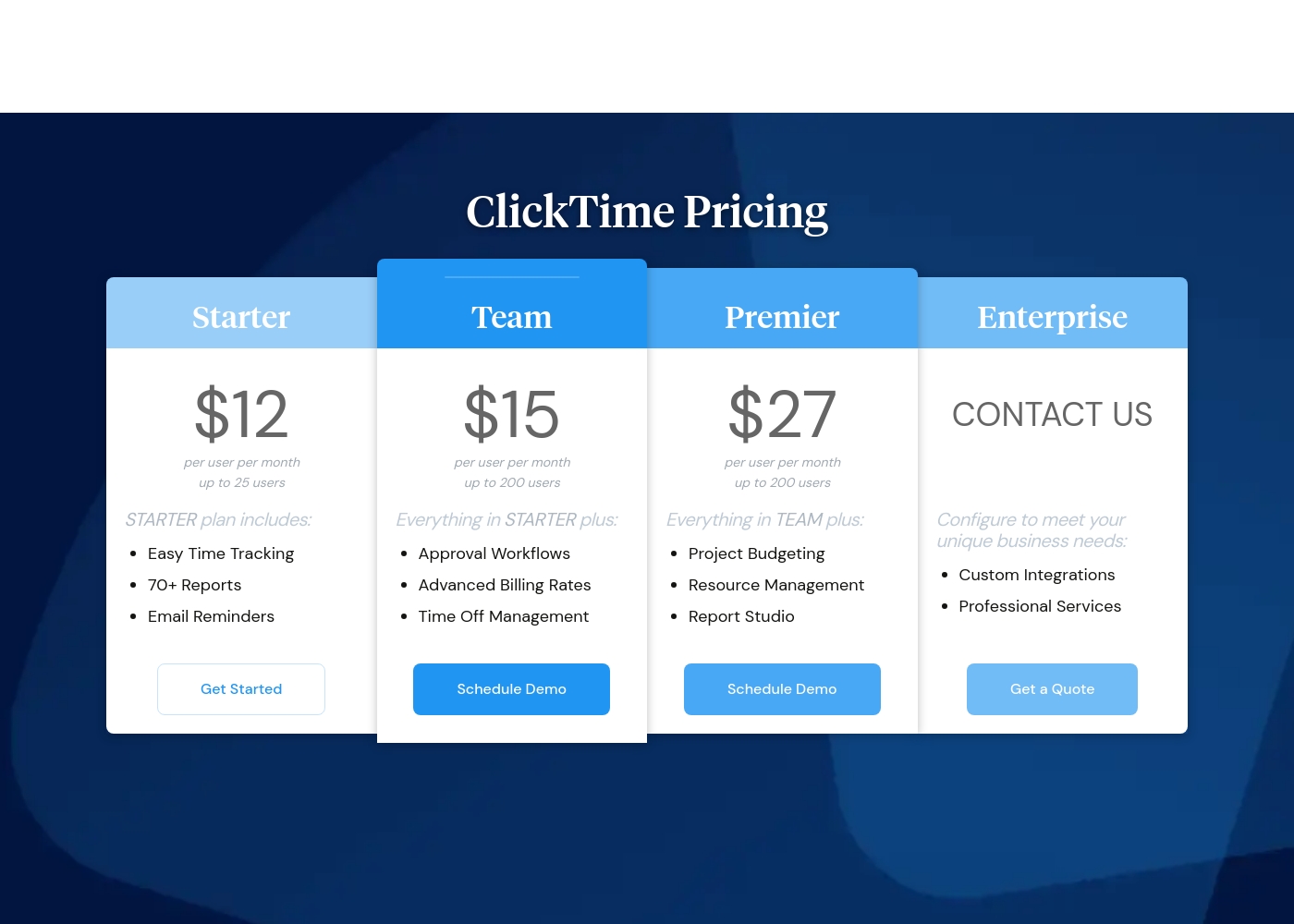
ClickTime costs between $12 and $27 per user per month (billed annually) with four plans: Starter at $12, Team at $15, Premier at $27, and Enterprise (Custom Pricing).
Here’s a closer look at what each plan offers.
Starter
Price: $12 per user per month (billed annually) / $15 per user per month (billed monthly) Best For: Small teams needing basic time tracking Other Features: Easy Time Tracking, 70+ Reports, Email Reminders, Mobile App Access, Basic Billing Rates
- Easy Time Tracking
- 70+ Pre-Built Reports
- Email Reminders
- Mobile App
- Daily, Weekly, and Biweekly Timesheets
- Everything in Starter
- Approval Workflows
- Advanced Billing Rates
- Time Off Management
- Employee Costs
- Everything in Team
- Project Budgeting
- Resource Management
- Report Studio
- Custom Fields
- Configuration to meet unique business needs
- Custom Integrations
- Professional Services
- Okta, OneLogin, Azure AD SSO
- SCIM User Provisioning (Quote)
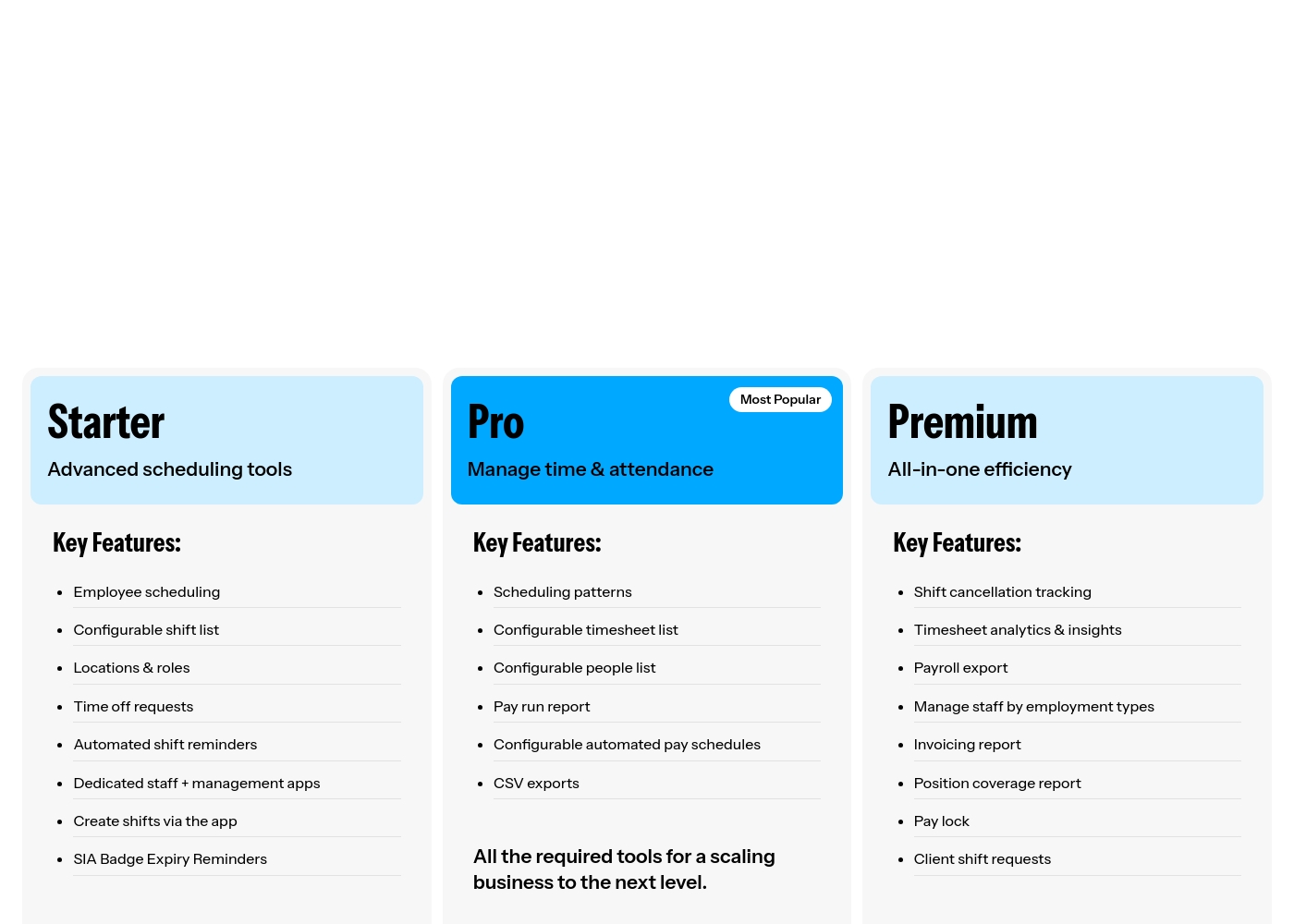
Parim Workforce Software pricing: Parim Workforce Software offers three tiered service levels—Starter, Pro, and Premium—with custom pricing based on your specific business needs. The platform includes unlimited employees and manager seats in every plan to help your operations grow without extra costs per person. 🚀
Take a look at the breakdown of our features below to see which plan fits your workflow best.
Starter
Best For: Advanced scheduling tools Other Features:
- Employee scheduling
- Configurable shift list
- Locations & roles
- Time off requests
- Automated shift reminders
Pricing Notes
- ClickTime's pricing is transparent and published, starting at $12/user/month.
- Parim uses custom quotes; you must contact sales to get pricing.
- ClickTime charges per user, so costs scale linearly with team size.
- Parim includes unlimited employees and locations in its quote, which can be more cost-effective for large, shift-based teams.
- ClickTime offers a 14-day free trial; Parim does not advertise one.
Pricing Head-to-Head
User Reviews
Review data for ClickTime is currently sparse across major platforms. On Trustpilot (with only 2 reviews), the score averages 2.9 stars, but the publicly available feedback suggests users find the software usable ("I like this software quite a bit."). We lack sufficient detailed submission data from both Trustpilot and Capterra to establish clear recurring user themes regarding specific performance aspects. Therefore, we cannot conclusively comment on customer support responsiveness, value derived from pricing tiers, onboarding complexity, or reliability of integrations.
Typically, independent reviews emphasize trends in accuracy, reliability, and ease of use, but these are not reflected in the handful of submissions provided. Based purely on the vendor's product description, ClickTime appears strong in specialized areas like financial forecasting and complex project budgeting. However, user validation on these advanced features is entirely unavailable at this time. Potential users should utilize the 14-day free trial to assess the platform’s efficiency and features directly. 🤔
We struggled with incorrect timesheets until we implemented ClickTime. The mobile app makes logging hours simple and quick, even when staff are working offsite. It's a huge improvement to our workflow.
Our external review check hit a wall. The Trustpilot page for Parim returned a 403 error, so we couldn't access any user reviews or ratings.
The Capterra page wasn't provided. Therefore, we have no external review data to summarize from these sources.
Our Verdict
This isn't a fair fight—it's a battle for two different types of work. ClickTime wins for project-based firms. Parim Workforce Software wins for shift-heavy operations. ClickTime's superpower is turning time tracking into financial intelligence. It helps you analyze project costs, forecast resource needs, and improve profitability. If you bill clients by the hour, ClickTime is built for you. Parim Workforce Software's superpower is automating complex daily operations. It handles intricate schedules, GPS clock-ins, and payroll calculations for large teams. If you manage a 24/7 rota or a festival crew, Parim brings order to chaos. The deciding factor is your work type. Choose ClickTime if your challenges are budget accuracy and resource planning. Choose Parim if your challenges are scheduling gaps and manual payroll errors. For most professional service firms, ClickTime is the strategic choice. For staffing agencies and operational businesses, Parim is the operational powerhouse. Know which battle you're fighting.
Frequently Asked Questions
Which is better for small teams: ClickTime or Parim Workforce Software?
ClickTime's Starter plan supports up to 25 users and starts at $12/user/month. Parim offers unlimited employees but uses custom pricing. For a small project team, ClickTime is more accessible to start.
Is Parim Workforce Software worth the extra cost over ClickTime?
Parim's cost depends on your custom quote, but it includes unlimited employees. ClickTime charges per user. For a large, shift-based team, Parim's model could be more cost-effective long-term.
Does ClickTime have scheduling features like Parim?
ClickTime offers capacity planning to see team availability. It does not have Parim's advanced shift scheduling, templates, or self-service shifts. They serve different scheduling needs.
Can I try ClickTime before buying?
Yes, ClickTime offers a 14-day free trial with no credit card required. You can explore all features risk-free. Parim does not advertise a free trial; you must book a demo.
Which tool is better for payroll automation?
Parim Workforce Software automates the full path to payroll from clock-in data. ClickTime focuses on time tracking for reporting and billing, with payroll export as a feature.
How do I migrate my data from one tool to the other?
ClickTime includes Historical Data Upload in its plans. For Parim, you must discuss data migration during the custom quoting process. Both require planning for a smooth transition.
Ready to Choose?
Both tools have their strengths. Choose based on your specific needs.