Capsule CRM vs Shape
Capsule CRM and Shape tug at decision makers who want results fast. The big difference is Capsule CRM's lean, per-user pricing versus Shape's quote-based model. If you want speed and simplicity, Capsule CRM wins.
Best for: Solo entrepreneurs, Freelancers transitioning to SMBs
Best for: Mid-sized marketing agencies, Sales teams needing AI lead scoring
Simple, Powerful CRM for Growing Teams
We found Capsule CRM excels as an affordable, lightweight solution designed specifically for smaller teams who need simplicity without sacrificing powerful features. Its primary strength lies in its user-friendly design and commitment to fast setup, minimizing complexity and learning curves compared to larger platforms. Overall, Capsule provides excellent organizational tools and complete contact visibility at a high value for money.
Pros
- Simple, intuitive interface that is lightweight and clean.
- Affordable pricing structure providing consistently high value for money.
- Extremely fast implementation; customization takes only a few hours.
- Highly responsive and helpful customer support team.
Cons
- Removal of key social features, such as the Twitter API integration.
- Lacks requested advanced functionality, like stand-alone web form links.
- Some isolated reports of poor usability or unhelpful customer service.
Automated engagement meets comprehensive sales tools.
We evaluated Shape based on its commitment to automated lead engagement and integrated sales tools. The platform offers sophisticated AI scoring, an award-winning communication system, and dedicated onboarding across all plans. Overall, Shape provides a robust, all-in-one solution for managing and closing leads efficiently, but pricing transparency is a significant hurdle for potential buyers.
Pros
- Comprehensive CRM and marketing platform integration.
- Powerful automation for consistent lead follow-up.
- Award-winning communication system (phone, text, MMS).
- Secure and reliable email delivery using compliant SMTP servers.
Cons
- Opaque, quote-based pricing structure requiring sales contact.
- Absence of a publicly stated free trial or money-back guarantee.
AboutCapsule CRM
Capsule is a trusted, simple Customer Relationship Management (CRM) system built specifically for small businesses, startups, and freelancers. It has served over 40,000 customers since 2009. This online system centralizes customer data, which helps improve team collaboration and business operations overall. It organizes contact information and facilitates communication, resulting in strong relationship management. Users praise Capsule for its simple setup and user-friendly interface 💡.
AboutShape
Shape is a comprehensive platform combining a powerful Sales CRM with a robust marketing suite. This system helps you efficiently automate your sales and marketing activities.
It includes sophisticated communication tools designed to maximize productivity. You get an award-winning phone system that handles calls, texts, and MMS seamlessly.
The platform also features built-in CRMs for texting and emailing. This setup allows for powerful bi-directional communication, ensuring your delivery is secure and reliable.
Highlights
Feature Comparison
Features Overview
We highlight the main differences and pick a winner for each feature.
UI & Usability
Capsule CRM is clean and fast; Shape is feature-rich but denser.
Capsule CRM keeps the interface lean and approachable; Shape users still feel it’s simple. Capsule CRM offers a streamlined UI; Shape presents a broader toolkit and more menus. Capsule CRM prioritizes speed; Shape emphasizes depth and customization. In real teams, Capsule CRM lets you ship faster; Shape shines with complex workflows.
Automation & Workflows
Capsule CRM has Workflow Automations; Shape has Automation & Pre-Built Workflows.
Capsule CRM automations cut repetitive tasks; Shape supports automation too. Shape provides pre-built workflows and AI prompts. Capsule focuses on quick setup; Shape targets scale and consistency. A small team uses Capsule to speed up onboarding; Shape handles growth.
Data Migration & Onboarding
Capsule can import from spreadsheets; Shape includes Expert Onboarding.
Capsule CRM supports importing existing data from spreadsheets. Shape includes Expert Onboarding Plan with data imports. Capsule emphasizes rapid setup; Shape focuses on guided onboarding. If you need fast migration, Shape onboarding helps teams start quickly.
Integrations & Customization
Capsule CRM offers over 60 native integrations; Shape ships with built-in capabilities.
Capsule CRM offers over 60 native integrations, plus Zapier and Make. Shape ships with built-in marketing and CRM features; third-party integrations are less documented. Capsule emphasizes external integrations; Shape emphasizes built-in capabilities. Use Capsule to connect QuickBooks or Slack; Shape to unify marketing tools.
Lead & Pipeline Management
Capsule supports multiple sales pipelines; Shape provides lead management with AI.
Capsule CRM supports multiple sales pipelines and forecasting dashboards. Shape provides lead management and AI scoring. Capsule is pipeline-centric; Shape emphasizes lead scoring and engagement. Multi-product teams benefit from Capsule; Shape helps prioritize leads with AI.
Email & Text Marketing
Capsule offers templates and a Marketing add-on; Shape offers multi-channel reach.
Capsule CRM offers email templates and basic marketing tools. Shape combines secure email marketing with texting and MMS. Capsule relies on templates and optional add-on; Shape provides multi-channel reach. For email blasts, Capsule works; for broad outreach, Shape wins.
Onboarding & Support
Capsule offers onboarding and training; Shape includes expert onboarding.
Capsule CRM offers onboarding support and training options. Shape includes Expert Onboarding Plan on all plans with daily webinars. Capsule onboarding varies by plan; Shape provides consistent onboarding. New teams adopt quickly with Shape onboarding.
AI & Analytics
Capsule uses AI-powered email and analytics; Shape uses AI lead scoring.
Capsule CRM offers AI-powered email assistance and sales analytics. Shape adds AI lead scoring and detection tools for prioritization. Capsule emphasizes analytics; Shape emphasizes lead scoring and engagement. Decide where you want insights: analytics depth or lead prioritization with AI.
Pricing & Value
Capsule pricing is per user with a Free plan; Shape pricing is by quote.
Capsule CRM pricing is per user, with a Free plan and annual discounts. Shape pricing is quote-based; there are no public prices listed. Capsule is more transparent; Shape offers tailored pricing. If you want predictable costs, Capsule; if you need tailored features, Shape.
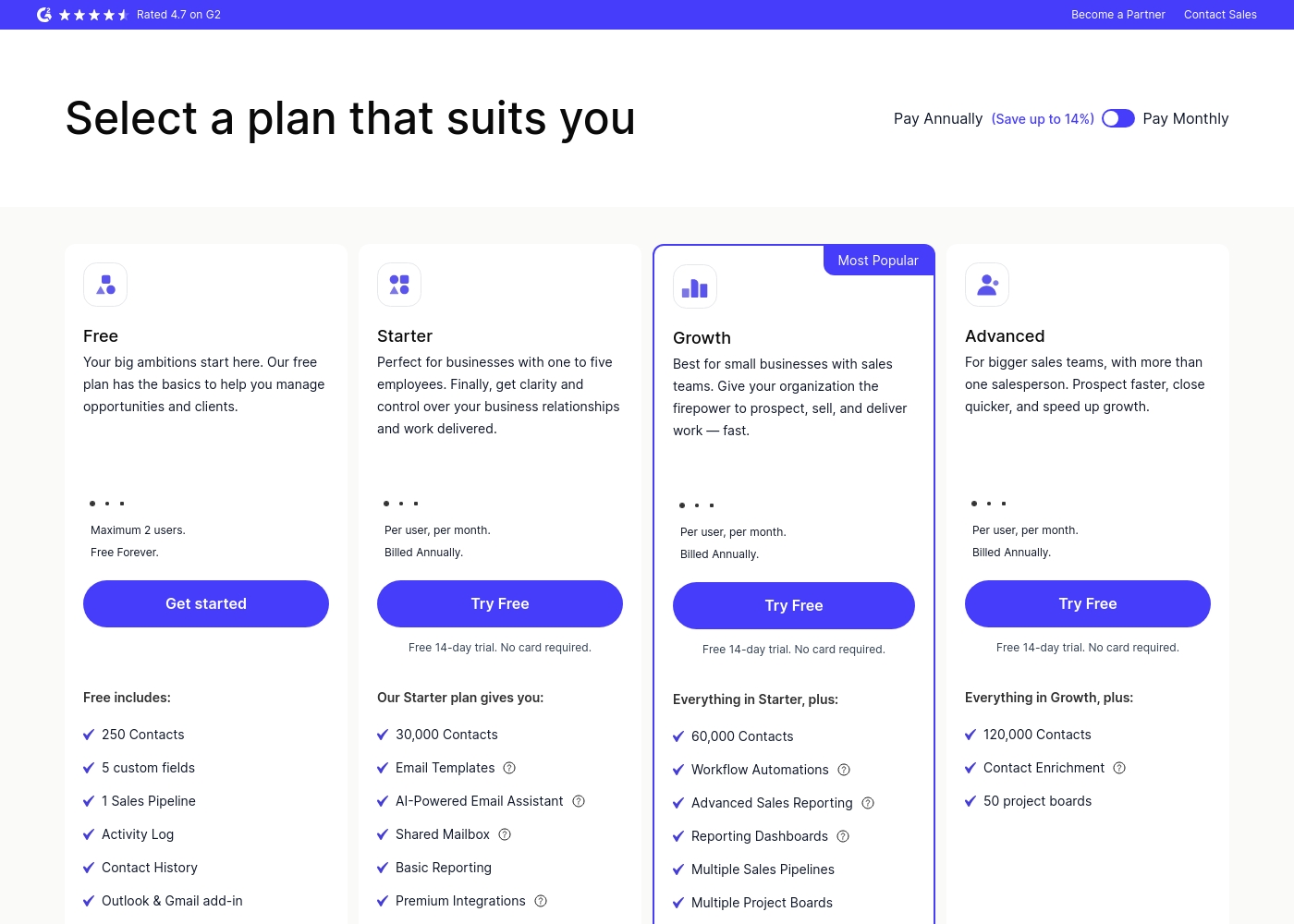
Review the available options below to find the best fit for your team.
Free
Price: Free Forever Best For: Managing opportunities and clients; testing the functionality Other Features:
- Maximum 2 users
- 250 Contacts
- 5 custom fields
- 1 Sales Pipeline
- Outlook & Gmail add-in
The Free plan is perfect for individuals or tiny teams just navigating client relationships. You get the fundamental tools needed to manage activity and history, but you are limited to only two users and 250 contacts. It's a great zero-cost way to test the core CRM features.
- 250 Contacts
- 5 custom fields
- 1 Sales Pipeline
- Activity Log
- Contact History
- 30,000 Contacts
- Email Templates
- AI-Powered Email Assistant
- Shared Mailbox
- Basic Reporting
- 60,000 Contacts
- Workflow Automations
- Advanced Sales Reporting
- Reporting Dashboards
- Multiple Sales Pipelines
- 120,000 Contacts
- Contact Enrichment
- 50 project boards
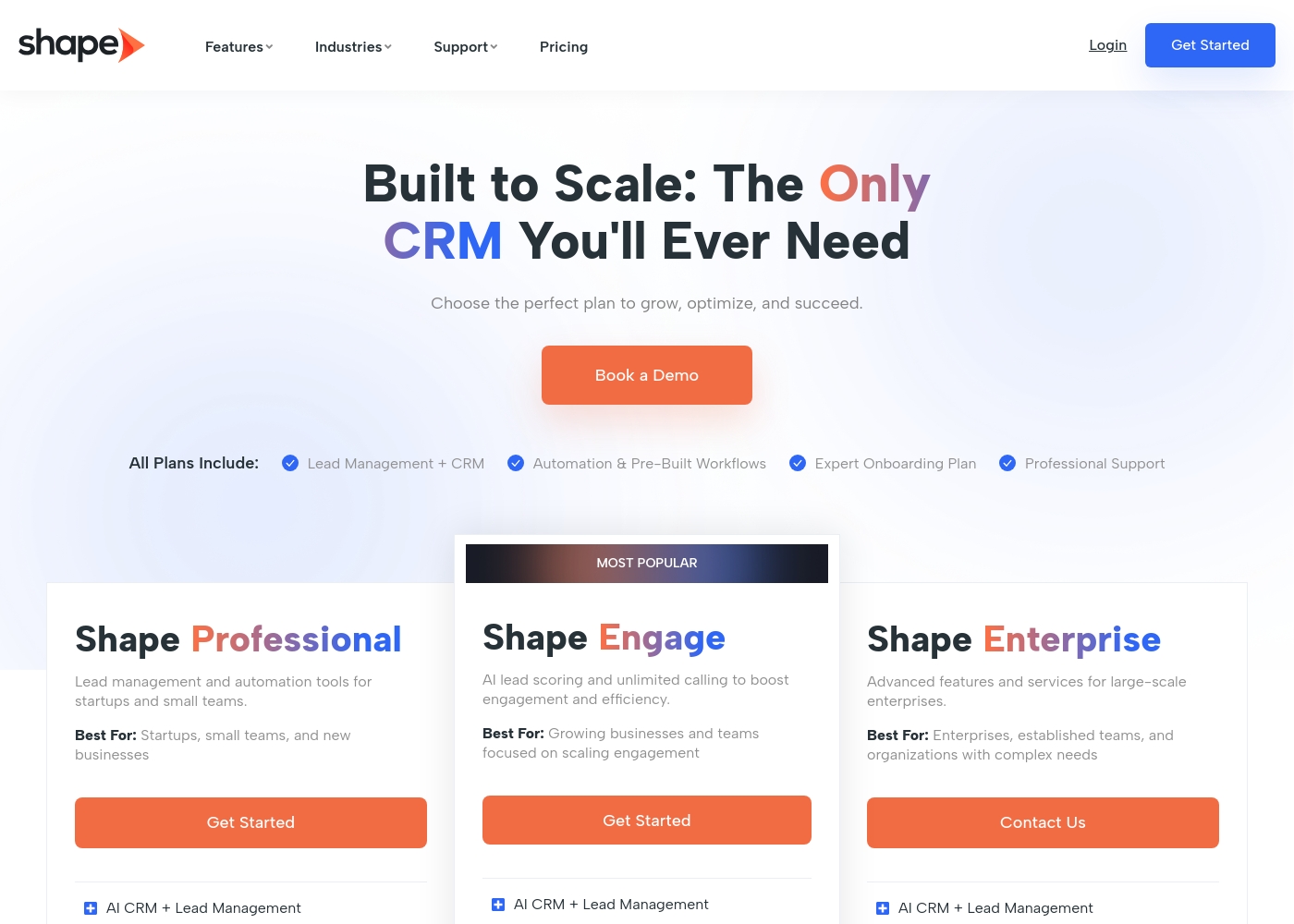
Shape uses a quote-based pricing model with three main plans: Professional, Engage, and Enterprise, none of which have explicitly listed costs.
To view current pricing details, you must contact their sales team or click 'Get Started' for a personalized quote.
Shape Professional
Best For: Startups, small teams, and new businesses Other Features: AI CRM + Lead Management, Lead Management + CRM, Automation & Pre-Built Workflows, Expert Onboarding Plan, Professional Support
- AI CRM + Lead Management
- Lead Management + CRM
- Automation & Pre-Built Workflows
- Expert Onboarding Plan
- Professional Support
- AI lead scoring and unlimited calling to boost engagement and efficiency
- AI CRM + Lead Management
- Lead Management + CRM
- Automation & Pre-Built Workflows
- Expert Onboarding Plan
- Advanced features and services for large-scale enterprises
- AI CRM + Lead Management
- Lead Management + CRM
- Automation & Pre-Built Workflows
- Expert Onboarding Plan
Pricing Notes
- Capsule CRM offers a Free Forever plan; annual billing discounts up to 15%.
- Capsule CRM pricing is clearly per user; Shape pricing is not public and requires contact.
Pricing Head-to-Head
User Reviews
Capsule CRM users consistently report high satisfaction, frequently highlighting the platform's exceptional simplicity and great value. Many reviewers confirm that Capsule is highly intuitive and easy to use, noting it took only a few hours to customize—a stark contrast to competitors that require months of expensive consultant time. This affordability and ease of setup are main draws for small and growing teams. Users feel the CRM helps them stay incredibly organized by providing complete visibility of tasks, pipelines, and client history in one specific place. Furthermore, the support team receives high praise for being quick, responsive, and thorough when resolving issues 👍.
However, feedback is not entirely perfect. A small number of reviewers expressed frustration over the removal of the Twitter API integration, arguing the feature should have been retained given the subscription fees. Users also occasionally request minor quality-of-life additions, such as a stand-alone, no-code form link feature to automate data entry. Overall, the sentiment affirms Capsule as a powerful, affordable, and stress-free solution built for scalability.
The problem with many CRM systems is using them requires too long of a learning curve. I love Capsule because it's super easy to use from day one. Despite its simplicity, it packs a lot of power and many useful features. Highly recommended for any small business.
The customer snippets provided are unique because they exclusively discuss 'Shape Republic,' a nutritional supplement brand selling protein shakes and weight loss products, not the 'Shape' CRM software platform. Users frequently praised the great quality and effectiveness of the physical products, specifically noting how much they love the taste of the Slim Shakes and protein powders (using flavors like Vanilla Cafe Frappe and Blueberry Muffin).
However, parallel to the positive product feedback, users reported highly negative experiences with customer service and logistics. Reviewers mentioned unresponsive support responses, long processing times (up to three weeks), difficulties with promotion codes not working, and issues with lost or incomplete orders.
Apart from a very long shopping procedure, the quality and effectiveness of the productions are A+++. They deliver great products.
Our Verdict
Capsule CRM often wins for most teams, Shape for others. Capsule CRM shines with fast setup and simple pricing; Shape emphasizes onboarding and automated engagement. If you want speed and simplicity, Capsule CRM wins. If you need onboarding and AI-driven engagement at scale, Shape matters. For many teams, Capsule CRM proves fast ROI; If you want onboarding and AI scoring at scale, Shape is your pick.
Frequently Asked Questions
Which is better for small teams: Capsule CRM or Shape?
Capsule CRM is often the better fit for small teams. It has a Free Forever plan and per-user pricing. Shape uses a quote-based model with onboarding included. If you want low upfront cost and fast value, Capsule CRM wins.
Does Capsule CRM offer AI features like Shape?
Capsule CRM offers AI-powered email assistance on some plans. Shape includes AI lead scoring and detection tools. If you need AI for scoring, Shape is strong; for assisted emails, Capsule has options.
Is Shape worth the extra cost over Capsule CRM?
Shape pricing is not public and requires contacting sales for a quote. Capsule is per user with transparent tiers and a Free plan. If you value predictability, Capsule CRM is safer; if you need tailored features, Shape may be worth it.
Can I migrate from Capsule CRM to Shape easily?
Capsule offers data migration and spreadsheet imports. Shape includes Expert Onboarding Plan with data imports. If you need a smooth handoff, Shape onboarding helps; Capsule supports migration too.
Does Capsule have a money-back guarantee or refund policy?
Capsule offers a 14-day free trial for paid plans. Details on refunds aren’t explicitly stated. If you want a test period, Capsule provides a trial; refunds aren’t documented.
Can I access Capsule CRM and Shape on mobile?
Capsule provides a mobile app for on-the-go use. Shape’s mobile availability isn’t clearly documented. If mobile access matters, Capsule CRM has the edge.
Ready to Choose?
Both tools have their strengths. Choose based on your specific needs.