Capsule CRM vs Salesflare
Capsule CRM and Salesflare both target small, growing businesses. Capsule CRM focuses on simple organization and rapid, effortless setup. Salesflare favors heavy automation and deep integration across communication channels. You must decide between simple affordability versus powerful, automatic data capture.
Best for: SMBs needing fast, affordable implementation, Teams prioritizing task management and project delivery post-sale
Best for: B2B sales teams using LinkedIn heavily for prospecting, Teams who hate manual data entry and want proactive follow-ups
Simple, Powerful CRM for Growing Teams
We found Capsule CRM excels as an affordable, lightweight solution designed specifically for smaller teams who need simplicity without sacrificing powerful features. Its primary strength lies in its user-friendly design and commitment to fast setup, minimizing complexity and learning curves compared to larger platforms. Overall, Capsule provides excellent organizational tools and complete contact visibility at a high value for money.
Pros
- Simple, intuitive interface that is lightweight and clean.
- Affordable pricing structure providing consistently high value for money.
- Extremely fast implementation; customization takes only a few hours.
- Highly responsive and helpful customer support team.
Cons
- Removal of key social features, such as the Twitter API integration.
- Lacks requested advanced functionality, like stand-alone web form links.
- Some isolated reports of poor usability or unhelpful customer service.
Simple, Powerful CRM for B2B Success.
We note that Salesflare successfully delivers on its promise of simplifying CRM tasks through strong built-in automation features that cut down on administrative work. The overwhelmingly positive user feedback regarding reliability, ease of use, and speedy customer support increases our confidence in the platform's high value proposition. Overall, Salesflare is a well-priced, effective solution ideal for small and medium-sized B2B teams focused on streamlining follow-up and maximizing efficiency.
Pros
- Automated data input significantly cuts required administrative time.
- Customer support is highly responsive and tailors solutions to specific needs.
- The platform is reported as highly reliable, with users citing years without downtime.
- Simple interface that is deemed very easy to use for startups and small teams.
Cons
- The Enterprise plan requires a minimum commitment of five users to start.
AboutCapsule CRM
Capsule is a trusted, simple Customer Relationship Management (CRM) system built specifically for small businesses, startups, and freelancers. It has served over 40,000 customers since 2009. This online system centralizes customer data, which helps improve team collaboration and business operations overall. It organizes contact information and facilitates communication, resulting in strong relationship management. Users praise Capsule for its simple setup and user-friendly interface 💡.
AboutSalesflare
Salesflare is an intelligent CRM built specifically for small and medium-sized businesses selling B2B. This platform is designed to be simple yet powerful, ensuring the whole sales team truly benefits from using it. It delivers higher sales results and happier customers by making tracking effortless. Salesflare has been adopted by over 10,000 companies to help them manage contacts and relationships better. ✨
Highlights
Feature Comparison
Features Overview
We highlight the main differences and pick a winner for each feature.
Automation & Data Entry
Salesflare excels at automatic data capture; Capsule CRM focuses on manual tasks and workflow automation.
Capsule CRM uses workflow automations to streamline repeatable processes. It provides an AI Email Assistant starting on the Starter plan. However, core tracking still relies more heavily on manual input and data imports. Salesflare is built around 'semi-automatic data filling' and automatic tracking. It drastically reduces manual entry by logging interactions instantly. This means less administrative work for your sales team. Salesflare wins here by prioritizing hands-off data collection from the start. Capsule CRM requires users to define and customize complex workflows first. If your biggest headache is reps forgetting to log emails, Salesflare offers the better solution right out of the box.
Email & Social Integration
Salesflare integrates deeply with Gmail, Outlook, and LinkedIn; Capsule CRM offers broader native apps.
Capsule CRM boasts over 60 native integrations, connecting widely with tools like Xero and QuickBooks. It supports Zapier and Make for custom connections. Capsule CRM, however, removed key social features like the Twitter API integration. Salesflare specializes in deep integrations with core B2B communication tools. It provides sidebars for LinkedIn, Gmail, and Outlook. This eliminates the need for copy-pasting customer data. Salesflare’s integrations are designed specifically to boost sales workflow efficiency. Capsule CRM offers quantity, but Salesflare provides contextual depth where it matters most for B2B selling. For teams who spend all day communicating via email and LinkedIn, Salesflare offers a huge productivity advantage.
Ease of Use / Setup
Capsule CRM is faster to set up; Salesflare has a strong initial learning curve for its automation.
Capsule CRM is famous for its simple, intuitive interface and rapid adoption. Users report customization takes only a few hours, minimizing disruption. There are zero upfront setup fees, making implementation fast. Salesflare is also rated highly for ease of use once configured for automation. However, setting up all the automatic tracking features requires focus initially. Salesflare provides free onboarding support. Capsule CRM offers unparalleled speed to value, making it instantly useful for small teams. Salesflare requires a slightly deeper initial time investment to leverage its automatic features. If you needed a functional CRM yesterday, Capsule CRM’s lightweight design wins on immediate simplicity and zero implementation complexity.
Project & Task Management
Capsule CRM includes dedicated project boards; Salesflare handles post-sale activity within pipelines.
Capsule CRM features multiple dedicated Project Boards for task management and delivery. This helps teams manage deliverables smoothly after closing the deal. Collaboration centers around managing these projects efficiently. Salesflare focuses heavily on the sales pipeline, using visual boards for deal management only. It lacks the dedicated, separate framework for post-sale project organization. Capsule CRM is better equipped for teams that combine sales and project delivery functions within the CRM. It ensures client onboarding stays on track effectively. If your business manages complex fulfillment or delivery cycles, Capsule CRM's specific project boards are a distinct advantage.
Lead Intelligence
Salesflare offers proactive intelligence and lead finding; Capsule CRM focuses on relationship history.
Capsule CRM centralizes contact history, providing a single view of all past interactions. It offers advanced sales reporting to detect deals nearing closure. Capsule CRM uses basic data enrichment on higher tiers. Salesflare provides powerful Relationship Intelligence, showing 'who knows whom' across your team. It also includes a dedicated Lead Finder tool. Salesflare proactively reminds reps to follow up. Salesflare's intelligence features are decidedly more proactive and focused on B2B prospecting efficiency. Capsule CRM provides reliable retroactive historical data. Teams that need competitive intelligence or help prioritizing warm introductions should look closely at Salesflare.
Scalability & Limits
Salesflare advertises unlimited contacts; Capsule CRM has hard limits structured by plan tier.
Capsule CRM's contact limits start low at 250 for the Free plan and reach 120,000 in the Advanced tier. Scaling beyond 120,000 contacts requires contacting sales for the Ultimate plan. This clearly defined tier structure manages capacity growth. Salesflare explicitly states there are no hidden limits to contacts, users, pipelines, or dashboards. This offers confidence for businesses expecting massive growth without worrying about arbitrary caps. Salesflare provides more peace of mind for high-growth companies anticipating handling large databases. Capsule CRM is better suited for SMBs with known, bounded database sizes. If you project rapid, large-scale contact list expansion quickly, Salesflare removes one major pricing consideration.
Review the available options below to find the best fit for your team.
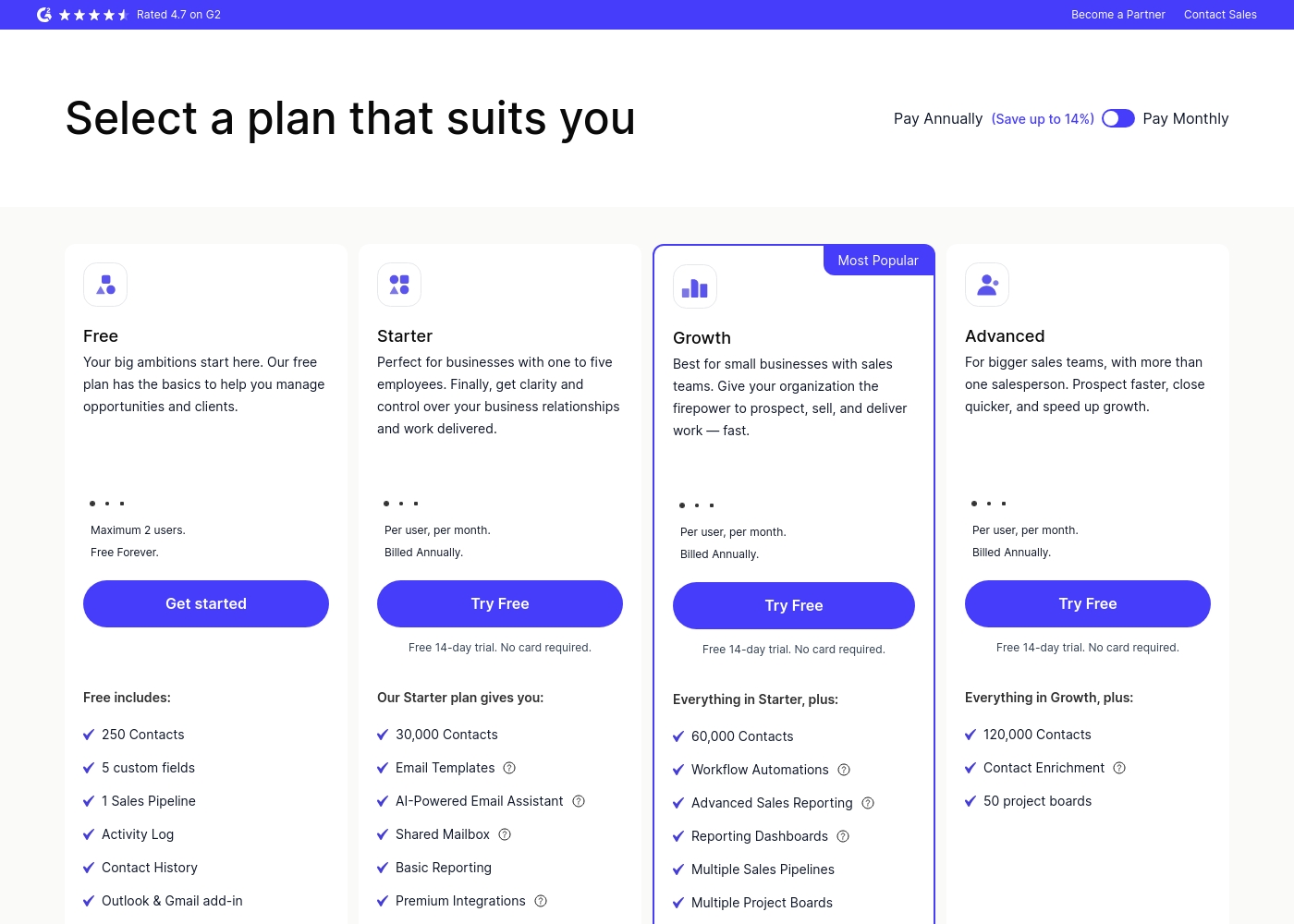
Free
Price: Free Forever Best For: Managing opportunities and clients; testing the functionality Other Features:
- Maximum 2 users
- 250 Contacts
- 5 custom fields
- 1 Sales Pipeline
- Outlook & Gmail add-in
The Free plan is perfect for individuals or tiny teams just navigating client relationships. You get the fundamental tools needed to manage activity and history, but you are limited to only two users and 250 contacts. It's a great zero-cost way to test the core CRM features.
- 250 Contacts
- 5 custom fields
- 1 Sales Pipeline
- Activity Log
- Contact History
- 30,000 Contacts
- Email Templates
- AI-Powered Email Assistant
- Shared Mailbox
- Basic Reporting
- 60,000 Contacts
- Workflow Automations
- Advanced Sales Reporting
- Reporting Dashboards
- Multiple Sales Pipelines
- 120,000 Contacts
- Contact Enrichment
- 50 project boards
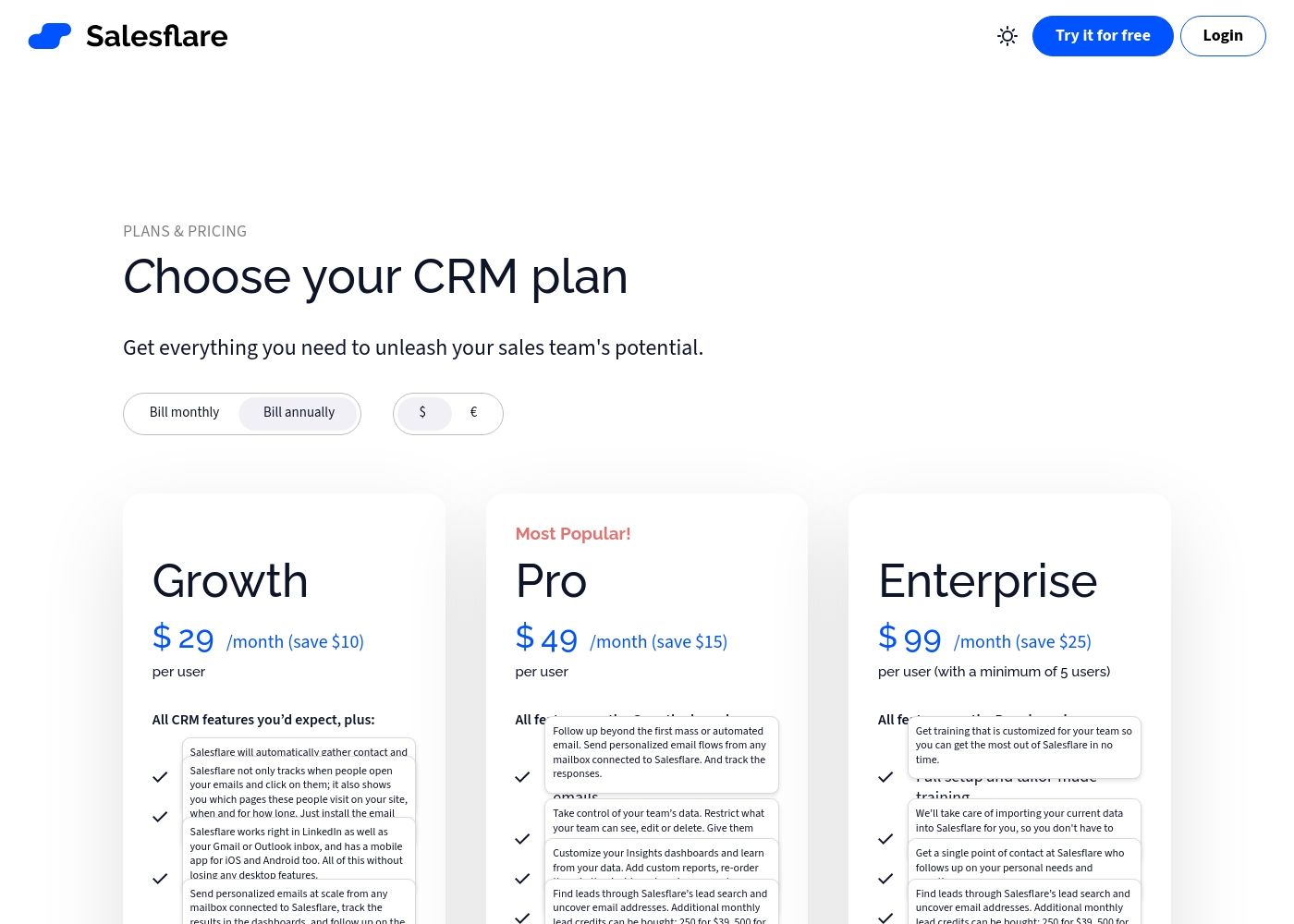
Salesflare costs between $29 and $99 per user per month (billed annually) with three plans: Growth at $29/month, Pro at $49/month, and Enterprise at $99/month.
Now, let's look closer at the features included in each option, focusing on the USD annual rates.
Growth
Price: $29/user/month (Billed Annually) Best For: Teams starting out with sales automation and core CRM needs Other Features:
- Automatic contact and company data input
- Email, link, and website visit tracking
- LinkedIn sidebar and mobile app access
- Send personalized email campaigns
- 5 lead credits included monthly
- Automated CRM data input
- Track emails, links and website visits
- LinkedIn sidebar, email sidebar & mobile app access
- Send personalized email campaigns
- All features on the Growth plan
- Send workflows of multiple emails (email flows)
- Set user permissions and access controls
- Create custom dashboards
- All features on the Pro plan
- Full setup and tailor-made training
- Data migration done for you
- Dedicated account manager
Pricing Notes
- Capsule CRM offers a 14-day trial and discounts up to 15% for annual billing, with zero setup fees.
- Both Capsule CRM and Salesflare offer permanent free plans for basic functionality and testing.
- Salesflare provides a longer 30-day free trial on its paid plans, enabling thorough testing.
- Salesflare uses Lead Credits, introducing usage-based elements not present in the standard Capsule CRM tiers.
- Specific monthly dollar prices for Capsule CRM's paid tiers were not explicitly stated in the source data.
Pricing Head-to-Head
User Reviews
Capsule CRM users consistently report high satisfaction, frequently highlighting the platform's exceptional simplicity and great value. Many reviewers confirm that Capsule is highly intuitive and easy to use, noting it took only a few hours to customize—a stark contrast to competitors that require months of expensive consultant time. This affordability and ease of setup are main draws for small and growing teams. Users feel the CRM helps them stay incredibly organized by providing complete visibility of tasks, pipelines, and client history in one specific place. Furthermore, the support team receives high praise for being quick, responsive, and thorough when resolving issues 👍.
However, feedback is not entirely perfect. A small number of reviewers expressed frustration over the removal of the Twitter API integration, arguing the feature should have been retained given the subscription fees. Users also occasionally request minor quality-of-life additions, such as a stand-alone, no-code form link feature to automate data entry. Overall, the sentiment affirms Capsule as a powerful, affordable, and stress-free solution built for scalability.
The problem with many CRM systems is using them requires too long of a learning curve. I love Capsule because it's super easy to use from day one. Despite its simplicity, it packs a lot of power and many useful features. Highly recommended for any small business.
Salesflare earns exceptionally positive feedback, primarily highlighting its suitability for B2B sales and startups. Users frequently praise the platform's reliability, with some noting they have used it for years “without downtime.” A strong recurring theme is the excellent customer service; the team is described as responsive, accessible, and willing to adjust the product based on user input, ensuring the CRM meets unique business needs.
Users call Salesflare easy to use, intuitive, and a “Flawless CRM.” Its ability to automate data input, manage flexible pipelines, and run effective email campaigns is consistently highlighted as adding significant value. Furthermore, users recognize the pricing as reasonable, offering strong capabilities for the cost.
This is the best CRM for small businesses and startups. The product is great and very easy to use. I also appreciate that the Salesflare team is small and easily accessible.
Our Verdict
This choice boils down to how much you value automatic data capture versus general organizational simplicity. If you’re tired of manually logging emails and links, Salesflare is the clear, cutting-edge winner. Salesflare automatically tracks leads and interactions, keeping your data pristine without effort. Capsule CRM is the king of low friction and high value for money. It has zero setup fees and implements in just a few hours. Teams love Capsule CRM for its clean interface and dedicated Project Boards for managing client deliverables. Salesflare excels at automating B2B sales pipelines and mining existing relationships via its intelligence features. It eliminates copy-pasting thanks to deep Gmail and LinkedIn integration. Capsule CRM handles the administrative organization after the sale better than Salesflare. The deciding factor is how much administrative burden you need removed. If high-volume B2B sales require hands-free tracking, Salesflare justifies any extra cost. If simplicity, cost control, and project delivery management are your core needs, Capsule CRM is the better fit now. Choose Capsule CRM for its unparalleled ease of use and effective project task management. Pick Salesflare if automatic lead tracking and deep contextual email/LinkedIn integration are non-negotiable for rapid B2B growth.
Frequently Asked Questions
Which CRM is easier to set up: Capsule CRM or Salesflare?
Capsule CRM is known for extremely fast, simple implementation; customization takes only hours. Salesflare is also easy but setting up its deep automation and integrations may require more initial focus. Capsule CRM is instantly usable.
Which platform is better for deep email and LinkedIn integration?
Salesflare is superior here, offering sidebars and automatic tracking for Gmail, Outlook, and LinkedIn. Capsule CRM focuses on broader integrations but lacks this deep, contextual communication tracking. Salesflare reduces manual data entry significantly.
Does Salesflare limit the number of contacts like Capsule CRM?
No, Salesflare explicitly states there are no hidden limits to contacts, users, or pipelines. Capsule CRM limits contacts, capping at 120,000 on its Advanced plan. Salesflare is better for fast, large-scale data growth.
Which CRM is better rated by current users?
Salesflare has better overall external review ratings (4.6) than Capsule CRM (4.1). Salesflare users praise its automation and reliable performance. Capsule CRM users consistently highlight its outstanding support team and simplicity.
Which CRM is better for project management after closing a deal?
Capsule CRM is clearly better for post-sale activity management. It features dedicated Project Boards and multiple pipeline support for managing deliverables. Salesflare manages activity mostly within the sales pipeline view.
Are there free trials available for Capsule CRM and Salesflare?
Yes, both CRMs offer free trials without requiring a credit card to start. Capsule CRM provides a 14-day free trial on paid plans. Salesflare offers a longer, more generous 30-day free trial.
Ready to Choose?
Both tools have their strengths. Choose based on your specific needs.