Capsule CRM vs Pipedrive
Capsule CRM and Pipedrive are both top choices for growing small businesses. Capsule CRM focuses on simple client relationship management and project delivery. Pipedrive is intensely focused on optimizing the sales pipeline to close deals faster. We compare their strengths so you can pick the right CRM platform today.
Simple, Powerful CRM for Growing Teams
We found Capsule CRM excels as an affordable, lightweight solution designed specifically for smaller teams who need simplicity without sacrificing powerful features. Its primary strength lies in its user-friendly design and commitment to fast setup, minimizing complexity and learning curves compared to larger platforms. Overall, Capsule provides excellent organizational tools and complete contact visibility at a high value for money.
Pros
- Simple, intuitive interface that is lightweight and clean.
- Affordable pricing structure providing consistently high value for money.
- Extremely fast implementation; customization takes only a few hours.
- Highly responsive and helpful customer support team.
Cons
- Removal of key social features, such as the Twitter API integration.
- Lacks requested advanced functionality, like stand-alone web form links.
- Some isolated reports of poor usability or unhelpful customer service.
Excellent value, intuitive pipeline management.
We find Pipedrive to be an exceptionally strong CRM solution, proven effective for sales teams worldwide needing reliable pipeline management and deep customization. Its reputation for providing excellent value and rapid onboarding is well-deserved, according to extensive user feedback. Overall, we confidently recommend Pipedrive as an efficient and highly user-focused tool for scaling sales operations.
Pros
- Highly intuitive and user-friendly interface.
- Excellent value compared to complex CRM alternatives (HubSpot, Salesforce).
- Smooth, efficient onboarding and implementation for new teams.
- Customer support is reliable, prompt, and often personalized.
Cons
- Specific pricing details are currently unavailable on the site.
- Some users reported difficulty scheduling quick or timely sales calls.
- Initial setup of automation features can be confusing.
- A specific functional limitation on associating only one deal with a person/organization was noted.
AboutCapsule CRM
Capsule is a trusted, simple Customer Relationship Management (CRM) system built specifically for small businesses, startups, and freelancers. It has served over 40,000 customers since 2009. This online system centralizes customer data, which helps improve team collaboration and business operations overall. It organizes contact information and facilitates communication, resulting in strong relationship management. Users praise Capsule for its simple setup and user-friendly interface 💡.
AboutPipedrive
Pipedrive is a trusted CRM platform already used by over 100,000 companies worldwide. It is designed specifically for sales teams and growing small businesses.
The tool helps you easily manage all your leads and deals. It provides a single space for your activities and instant access to crucial sales data. The core benefit is simple: less time managing and more time closing deals. 💡
Highlights
Feature Comparison
Features Overview
We highlight the main differences and pick a winner for each feature.
Core Focus & Philosophy
Pipedrive is purely a sales tool; Capsule CRM manages the entire client lifecycle, including projects.
Capsule CRM excels at blending contact history, task management, and sales pipeline tracking together. It focuses on complete visibility of every client interaction for superior relationship management. Capsule CRM also includes Project Boards for managing client deliverables after the deal closes. This makes Capsule CRM great for service-based businesses who also manage client projects.
Pipeline Management
Pipedrive is engineered for high-velocity deal closing; Capsule CRM handles multiple pipelines well.
Pipedrive is a true pipeline powerhouse dedicated to maximizing deal progression and closing success. It provides instant access to crucial sales data and real-time insights for informed decisions. Teams using Pipedrive report reducing manual administrative hours by up to 40% through optimization. Capsule CRM also supports multiple distinct sales pipelines for growing teams. However, Pipedrive's core design maximizes efficiency strictly for sales processes.
Ease & Implementation
Capsule CRM boasts zero setup fees; Pipedrive is highly intuitive for first-time CRM users.
One key advantage of Capsule CRM is the zero upfront setup fees, enabling rapid adoption. Users report customizing Capsule CRM to their process in only a few hours. Pipedrive is widely praised as being incredibly easy to use and an ideal first-time CRM. The onboarding process for Pipedrive is described as smooth, quick, and very efficient for new teams. Both tools offer simple UIs, avoiding the complexity of large enterprise CRMs.
Scalability & Limits
Capsule CRM provides defined, high contact limits; Pipedrive’s usage limits are less explicit.
Capsule CRM clearly defines its capacity, supporting up to 120,000 contacts in its Advanced plan. This clarity helps businesses confidently plan their growth and scale their data management. Capsule CRM also offers a powerful Free plan, unlike Pipedrive which requires a free trial. Pipedrive caters well to large sales teams but the specific limits for active deals or contacts are not available in the current data. Capsule CRM publicly commits to supporting larger SMB contact volumes.
Automation & AI
Capsule CRM includes an AI Email Assistant; Pipedrive focuses automation on workflow reduction.
Capsule CRM’s Starter plan includes an AI-Powered Email Assistant to help draft faster communications. It also provides Workflow Automations to streamline repeatable sales processes efficiently. Pipedrive offers robust workflow automations aimed at reducing manual tasks by up to 40%. While Pipedrive setup can sometimes be confusing, its automations are excellent for process scaling. Both CRMs remove tedious administrative tasks from daily sales workloads.
Integration Ecosystem
Capsule CRM lists 60+ native tools; Pipedrive generally mentions 'game-changing integrations'.
Capsule CRM confirms it works seamlessly with over 60 native integrations for popular tools. This includes essential connections like QuickBooks, Xero, and Mailchimp for streamlined operations. Capsule CRM also supports custom connectors via Zapier and Make for niche business uses. Pipedrive mentions having 'game-changing integrations' but does not specify a list or API tools in the data provided. For known connectivity, Capsule CRM provides more confidence with specific numbers.
Reporting & Insights
Pipedrive guarantees predictable revenue; Capsule CRM focuses on advanced sales analytics and dashboards.
Pipedrive is optimized for predictable revenue by providing real-time data access instantly. Managers use this data to accurately predict future income streams and improve strategy. Capsule CRM offers advanced sales reporting and analytical dashboards for comprehensive oversight. Capsule CRM helps detect deals nearing closure so action is always timely. The core difference is Pipedrive’s focus on high-level revenue generation clarity.
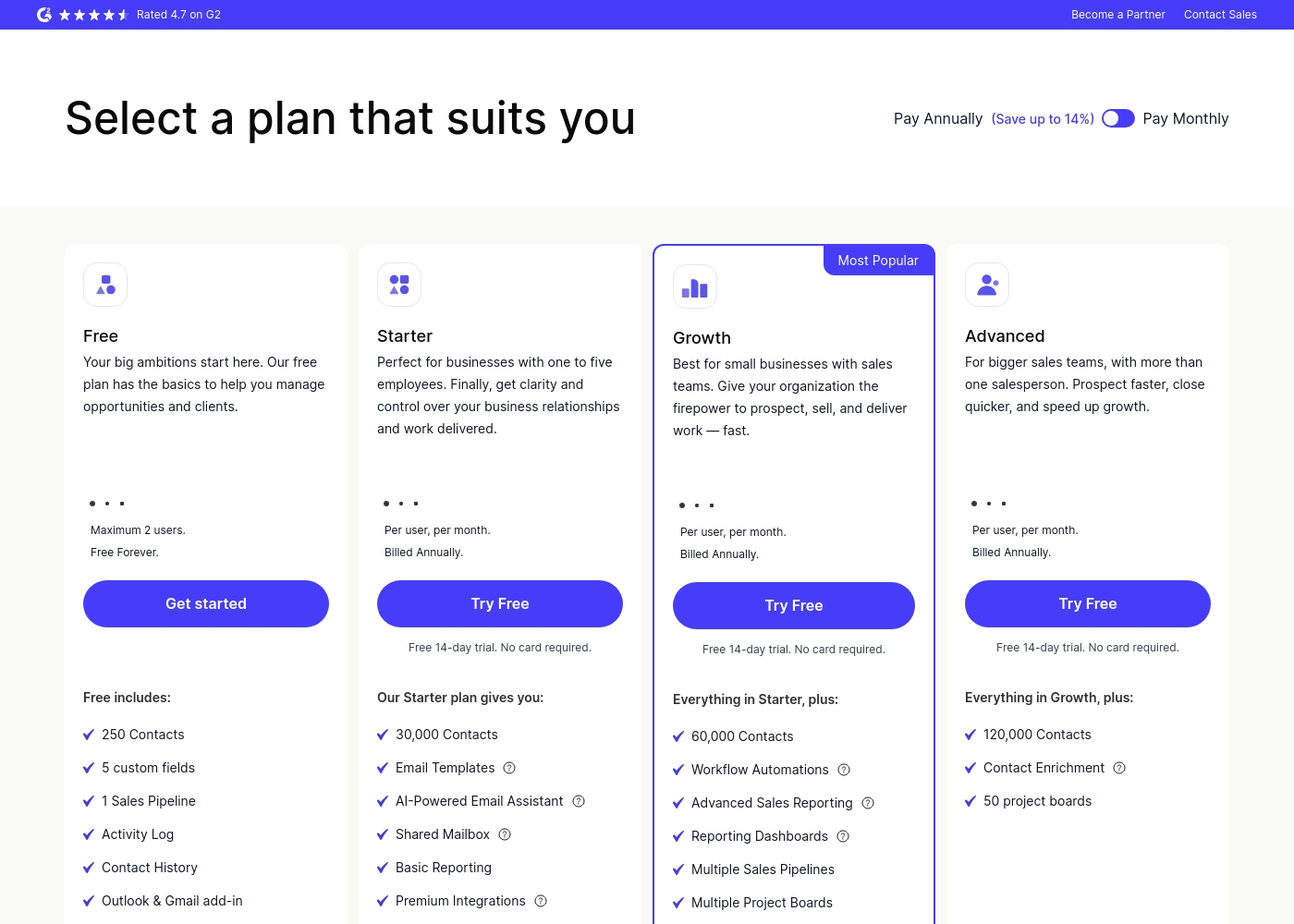
Capsule CRM costs between Free and Not explicitly stated per user per month with five plans: Free, Starter, Growth, Advanced, and Ultimate.
Review the available options below to find the best fit for your team.
Free
Price: Free Forever Websites Supported: Not explicitly stated Best For: Managing opportunities and clients; testing the functionality Refund Policy: Not explicitly stated Other Features:
- Maximum 2 users
- 250 Contacts
- 5 custom fields
- 1 Sales Pipeline
- Outlook & Gmail add-in
- 250 Contacts
- 5 custom fields
- 1 Sales Pipeline
- Activity Log
- Contact History
- 30,000 Contacts
- Email Templates
- AI-Powered Email Assistant
- Shared Mailbox
- Basic Reporting
- 60,000 Contacts
- Workflow Automations
- Advanced Sales Reporting
- Reporting Dashboards
- Multiple Sales Pipelines
- 120,000 Contacts
- Contact Enrichment
- 50 project boards
Pipedrive costs between Not explicitly stated and Not explicitly stated per Not explicitly stated, and details about its plans (Essential, Advanced, Professional, and Enterprise) are currently Not explicitly stated.
We are currently unable to display the current, official pricing table for Pipedrive. The platform strongly focuses on providing an effective CRM experience, trusted by over 100,000 companies globally. While we cannot confirm specific figures, Pipedrive typically offers tiered subscriptions based on required features and the number of users, allowing systems to easily scale. Here is the anticipated structural breakdown:
Essential
Price: Not explicitly stated Websites Supported: Not explicitly stated Best For: Not explicitly stated Refund Policy: Not explicitly stated Other Features:
- Key baseline features are Not explicitly stated
- Necessary administration tools are Not explicitly stated
- Likely supports basic sales pipeline management
- Not explicitly stated
- Not explicitly stated
- Not explicitly stated
- Not explicitly stated
Pricing Notes
- Capsule CRM offers a Free Forever plan suitable for two users and 250 contacts.
- All paid Capsule CRM plans are billed per user, per month, with annual billing discounts up to 15%.
- Specific dollar pricing for the paid tiers of both Pipedrive and Capsule CRM is currently unavailable in the provided data, requiring direct contact with sales teams.
- Capsule CRM has an optional Marketing add-on beginning at $11 per month for robust campaign management.
- Pipedrive is widely valued by users as a cost-effective alternative to complex systems like Salesforce or HubSpot.
Pricing Head-to-Head
User Reviews
Capsule CRM users consistently report high satisfaction, frequently highlighting the platform's exceptional simplicity and great value. Many reviewers confirm that Capsule is highly intuitive and easy to use, noting it took only a few hours to customize—a stark contrast to competitors that require months of expensive consultant time. This affordability and ease of setup are main draws for small and growing teams. Users feel the CRM helps them stay incredibly organized by providing complete visibility of tasks, pipelines, and client history in one specific place. Furthermore, the support team receives high praise for being quick, responsive, and thorough when resolving issues 👍.
However, feedback is not entirely perfect. A small number of reviewers expressed frustration over the removal of the Twitter API integration, arguing the feature should have been retained given the subscription fees. Users also occasionally request minor quality-of-life additions, such as a stand-alone, no-code form link feature to automate data entry. Overall, the sentiment affirms Capsule as a powerful, affordable, and stress-free solution built for scalability.
The problem with many CRM systems is using them requires too long of a learning curve. I love Capsule because it's super easy to use from day one. Despite its simplicity, it packs a lot of power and many useful features. Highly recommended for any small business.
Pipedrive receives exceptionally high praise across both Trustpilot (4.5/5) and Capterra, reflecting a strong consensus among users. Reviewers frequently describe the platform as intuitive and user-friendly, making implementation quick and efficient, especially for first-time CRM users.
A major theme is the outstanding value it offers compared to more complex competitors like HubSpot or Salesforce, providing great features for the price. Users value its high degree of flexibility and customization, allowing teams to easily tailor the platform to match specific sales workflows and track relevant metrics.
Implementing Pipedrive as our first CRM was incredibly easy. The onboarding process was smooth and efficient, getting everything setup and running quickly. The platform is truly intuitive and user-friendly for beginners.
Our Verdict
This isn't just about picking a CRM; it’s about choosing your flavor of growth. If your business focuses intensely on closing deals, Pipedrive is the clear winner. If your client relationship continues into project delivery, choose Capsule CRM. Capsule CRM's superpower is simplicity wrapped in utility, managing the entire customer journey. It includes project boards and high contact limits, perfect for service firms managing ongoing work. You also get zero setup fees, making Capsule CRM incredibly fast to implement. Pipedrive’s superpower is relentless sales optimization and pipeline management effectiveness. It’s engineered to reduce admin work by up to 40% and ensure predictable revenue streams. Pipedrive is consistently recommended as the best starting CRM for sales-focused teams. The deciding factor is your core operation: relationship management versus transaction focus. If you need 120,000 contacts and project oversight, pick Capsule CRM. If you need a customizable sales engine that closes deals faster, go with Pipedrive. Ultimately, Pipedrive is the better, more specialized tool for sales organizations. Choose Pipedrive if your priority is efficient, repeatable sales process scaling. Pick Capsule CRM for an excellent, simpler all-in-one relationship and project solution.
Frequently Asked Questions
Which is easier to set up, Capsule CRM or Pipedrive?
Both platforms are noted for fast, easy implementations compared to larger CRMs. Capsule CRM specifically advertises zero upfront setup fees, eliminating a common barrier. Pipedrive is widely regarded as one of the most intuitive CRMs for first-time users. Your team should adopt either platform quickly and efficiently.
Does Capsule CRM or Pipedrive have a Free plan?
Yes, Capsule CRM offers a 'Free Forever' plan limited to two users and 250 contacts. Pipedrive does not appear to offer a permanent free tier. Both Capsule CRM and Pipedrive provide free trials for their paid subscriptions. This lets you test all advanced features before making a financial commitment.
Which software is better suited for sales teams focused on closing deals?
Pipedrive is specifically designed and engineered for sales teams and deal closing. User reports suggest Pipedrive can lower administrative time by up to 40%. Capsule CRM offers strong sales tools but integrates them with broader relationship and project management.
Does Capsule CRM include project management features like Pipedrive?
Capsule CRM explicitly includes multiple Project Boards features for delivery and team collaboration. The available data for Pipedrive does not explicitly list comparable project management features. If managing client deliverables post-sale is critical, Capsule CRM is the better fit.
How do the maximum data limits compare between Capsule CRM and Pipedrive?
Capsule CRM clearly supports up to 120,000 contacts on its Advanced plan. The functional limits for maximum contacts or users on Pipedrive are not explicitly stated in the public data. For guaranteed high-capacity contact management, Capsule CRM offers more transparent scaling.
Is Pipedrive worth the cost difference over Capsule CRM for value?
Users highly value Pipedrive, citing its exceptional features compared to its price point. It’s often seen as a superior value alternative to higher-cost, complex CRMs like Salesforce. Capsule CRM also provides great value and the added benefit of a permanent free plan.
Ready to Choose?
Both tools have their strengths. Choose based on your specific needs.