Capsule CRM vs Hubspot
Capsule CRM and Hubspot represent two very different CRM philosophies, confusing many buyers. Capsule CRM is the lightweight, affordable option focused on core CRM simplicity. Hubspot offers a powerful, expansive ecosystem unifying marketing, sales, and service with advanced AI. Your decision comes down to budget, complexity tolerance, and desired feature breadth.
Best for: Solo entrepreneurs and freelancers, Teams prioritizing simplicity and low learning curve
Best for: Marketing agencies needing deep MarTech integration, Large organizations requiring 1,900+ app connectors
Simple, Powerful CRM for Growing Teams
We found Capsule CRM excels as an affordable, lightweight solution designed specifically for smaller teams who need simplicity without sacrificing powerful features. Its primary strength lies in its user-friendly design and commitment to fast setup, minimizing complexity and learning curves compared to larger platforms. Overall, Capsule provides excellent organizational tools and complete contact visibility at a high value for money.
Pros
- Simple, intuitive interface that is lightweight and clean.
- Affordable pricing structure providing consistently high value for money.
- Extremely fast implementation; customization takes only a few hours.
- Highly responsive and helpful customer support team.
Cons
- Removal of key social features, such as the Twitter API integration.
- Lacks requested advanced functionality, like stand-alone web form links.
- Some isolated reports of poor usability or unhelpful customer service.
AI power, significant user friction.
We recognize the expansive feature set and powerful underlying Smart CRM offered by HubSpot, which unifies marketing, sales, and service. However, overwhelming user feedback reports severe issues with customer support responsiveness and problematic, aggressive billing practices, particularly concerning automatic contact tier upgrades. Overall, the platform holds significant potential based on features, but we urge extreme caution regarding contract terms and financial fairness.
Pros
- Comprehensive AI-powered customer platform built on a powerful Smart CRM.
- Deeply integrated ecosystem with 1,900+ available apps.
- Allows businesses to start immediately using robust, free tools.
- Unifies marketing, sales, and service data effectively for growth teams.
Cons
- Support is widely reported as unresponsive, slow, and incapable of solving long-standing issues.
- Users frequently complain about aggressive pricing practices and automatic tier upgrades without clear consent.
- Contracts are restrictive, featuring difficult cancellation processes and automatic annual renewal terms.
- Reported functional reliability issues; features promised by sales sometimes fail to work correctly (e.g., email sequences).
AboutCapsule CRM
Capsule is a trusted, simple Customer Relationship Management (CRM) system built specifically for small businesses, startups, and freelancers. It has served over 40,000 customers since 2009. This online system centralizes customer data, which helps improve team collaboration and business operations overall. It organizes contact information and facilitates communication, resulting in strong relationship management. Users praise Capsule for its simple setup and user-friendly interface 💡.
AboutHubspot
The HubSpot Customer Platform is a comprehensive system built around the Smart CRM. This Smart CRM acts as your single source of truth for all business data. It helps go-to-market teams—marketing, sales, and customer service—work together seamlessly. Over 268,000 customers across more than 135 countries already use it to scale their operations. The platform offers specialized Hubs that connect to everything you need to create content, find leads, close deals, and grow revenue. 💡
Highlights
Feature Comparison
Features Overview
We highlight the main differences and pick a winner for each feature.
Ease of Use
Capsule CRM is renowned for being simple and lightweight. Hubspot's expansive system is reported to be complex and clunky.
Capsule CRM has an intuitive interface that users find incredibly easy to use. Setup is fast, often taking only a few hours to fully customize. Hubspot is a massive platform with many integrated components that require significant management. Users often report the interface feels complex and restrictive for everyday tasks. If your priority is rapid adoption and low learning curve, Capsule CRM is the clear winner. Hubspot requires dedicated staff just to manage its full range of complexity. For small businesses without a dedicated CRM administrator, Capsule CRM provides instant productivity.
Pricing & Transparency
Capsule CRM offers clear, tiered pricing and zero setup fees. Hubspot's pricing structure is aggressive and non-transparent.
Capsule CRM clearly publishes its tiered plans and offers discounts for annual billing. It explicitly states zero setup or onboarding fees for every user. Hubspot does not publish specific paid tier pricing publicly and relies heavily on custom quotes. User reviews frequently cite aggressive billing and unauthorized contact tier upgrades. The core difference is accountability; Capsule CRM offers budget stability. Hubspot users often face unexpected, considerable hikes in contact-based costs. If budget predictability is essential for your company, choosing Capsule CRM will save you potential financial headaches.
Integration Ecosystem
Hubspot offers a vast, superior ecosystem with 1,900+ apps. Capsule CRM provides 60+ native integrations and Zapier support.
Capsule CRM offers 60+ native integrations connecting essential apps like Xero and Mailchimp. Custom connectivity is possible through Zapier and Make for niche use cases. Hubspot’s integration strength is phenomenal, supporting over 1,900 different app integrations. This vast network allows deep embedding into almost any tech stack imaginable. Hubspot is fundamentally designed to connect and unify all functions across a massive tech landscape. Capsule CRM focuses on supporting core SMB tools efficiently. For teams running complex software stacks or needing deep data synergy, Hubspot is the necessary choice.
Automation & AI
Hubspot leverages advanced AI agents for sales and service. Capsule CRM offers workflow automation and an AI email assistant.
Capsule CRM's Growth plan offers robust workflow automations for repeatable sales processes. It also includes an AI-Powered Email Assistant for drafting communication faster. Hubspot utilizes Breeze AI Agents that work 24/7 to boost productivity across the platform. These agents accelerate sales pipelines and create content instantly. Hubspot's AI capability is more expansive, including Customer Agents that resolve 65% of support inquiries automatically. Capsule CRM's approach is more focused on efficiency aids. Hubspot is better for businesses seeking to automate customer engagement and sales prospecting at scale using intelligent systems.
Customer Support
Capsule CRM support is highly praised as quick and responsive. Hubspot support is widely reported as slow, unresponsive, and terrible.
Capsule CRM users consistently report fast, responsive, and thorough support team interactions. The Ultimate plan offers a dedicated account manager and custom training. Hubspot reviewers frequently struggle with customer service response times and issue resolution capabilities. User reports call the support 'horrible' and 'incapable of solving basic problems.' Capsule CRM treats support as a high priority, leading to excellent user satisfaction scores. Hubspot's scale seems to negatively impact support quality. If reliable, human-backed assistance is critical, Capsule CRM offers a much safer experience based on user feedback.
Scalability & Breadth
Hubspot is built as a complete platform for growth teams. Capsule CRM is an excellent CRM focused on SMB needs.
Capsule CRM scales well, offering features like 120,000 contacts and team controls in higher tiers. It remains a focused, dedicated CRM solution. Hubspot is a unified Customer Platform encompassing Marketing, Sales, Service, CMS, and Commerce Hubs. Its immense feature set supports enterprise scale. Hubspot is designed to replace multiple disconnected tools with one integrated platform. Capsule CRM integrates effectively but doesn't offer equal breadth in-house. Teams needing an all-in-one 'MarTech' solution will prefer Hubspot; teams wanting a high-quality CRM only will prefer Capsule CRM.
Project Management
Capsule CRM includes native project management features. Hubspot focuses minimally on project delivery post-sale.
Capsule CRM's Growth and Advanced plans include multiple Project Boards. This helps teams manage deliverables, collaboration, and client onboarding post-sale. Hubspot's platform is primarily structured around sales, marketing, and service execution. It lacks explicit, dedicated Project Management tools like Capsule CRM. Capsule CRM helps teams transition seamlessly from closing a deal to delivering the work. Hubspot may require integrating a separate project tool. For service-based businesses that manage client deliverables inside the CRM, Capsule CRM delivers better integrated functionality.
Data Centralization (CRM)
Both platforms centralize data, but Hubspot's Smart CRM is the foundation for its massive ecosystem.
Capsule CRM centralizes all customer history, notes, and emails into a single, comprehensive view. This provides teams with complete relationship visibility. Hubspot uses its Smart CRM as the 'single source of truth' for business data across all its hubs. The philosophy is similar: unified data prevents information silos and drives productive teamwork. Both Capsule CRM and Hubspot excel at providing a centralized contact record essential for high-quality customer experiences.
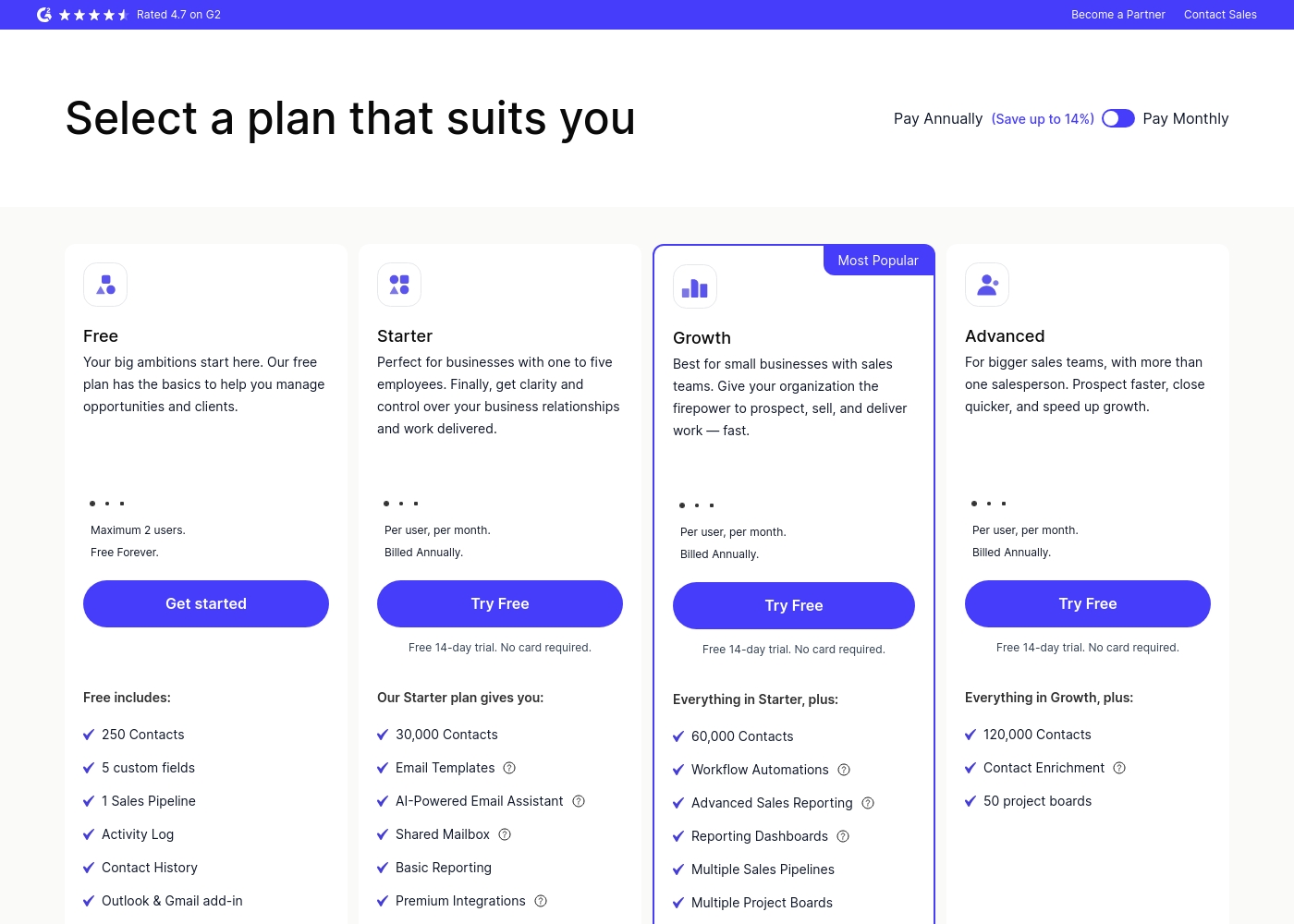
Review the available options below to find the best fit for your team.
Free
Price: Free Forever Best For: Managing opportunities and clients; testing the functionality Other Features:
- Maximum 2 users
- 250 Contacts
- 5 custom fields
- 1 Sales Pipeline
- Outlook & Gmail add-in
The Free plan is perfect for individuals or tiny teams just navigating client relationships. You get the fundamental tools needed to manage activity and history, but you are limited to only two users and 250 contacts. It's a great zero-cost way to test the core CRM features.
- 250 Contacts
- 5 custom fields
- 1 Sales Pipeline
- Activity Log
- Contact History
- 30,000 Contacts
- Email Templates
- AI-Powered Email Assistant
- Shared Mailbox
- Basic Reporting
- 60,000 Contacts
- Workflow Automations
- Advanced Sales Reporting
- Reporting Dashboards
- Multiple Sales Pipelines
- 120,000 Contacts
- Contact Enrichment
- 50 project boards
We understand you need clear pricing information before committing. Here is an overview of the structured purchasing options we know are available, though most exact numerical details are not public.
Free Tools
Price: Free or $0 Refund Policy: Not applicable
This level allows new businesses to start immediately, focusing on core functionality without any initial financial commitment. Since HubSpot explicitly mentions providing these free tools, this is an excellent, zero-risk way to explore the platform's basic features and integrations before considering any paid subscription.
- Starter edition of each product
- Consolidated single price

Pricing Notes
- Capsule CRM offers a 14-day free trial and a permanent Free plan for up to two users.
- Capsule CRM provides up to a 15% discount for choosing annual billing over monthly billing.
- Specific dollar pricing for Hubspot's paid tiers is not publicly available, requiring contact with sales.
- Hubspot users frequently complain about aggressive, non-transparent pricing that escalates costs when contact volume increases.
- Capsule CRM explicitly states zero setup or onboarding fees, unlike the uncertainty often associated with Hubspot.
Pricing Head-to-Head
User Reviews
Capsule CRM users consistently report high satisfaction, frequently highlighting the platform's exceptional simplicity and great value. Many reviewers confirm that Capsule is highly intuitive and easy to use, noting it took only a few hours to customize—a stark contrast to competitors that require months of expensive consultant time. This affordability and ease of setup are main draws for small and growing teams. Users feel the CRM helps them stay incredibly organized by providing complete visibility of tasks, pipelines, and client history in one specific place. Furthermore, the support team receives high praise for being quick, responsive, and thorough when resolving issues 👍.
However, feedback is not entirely perfect. A small number of reviewers expressed frustration over the removal of the Twitter API integration, arguing the feature should have been retained given the subscription fees. Users also occasionally request minor quality-of-life additions, such as a stand-alone, no-code form link feature to automate data entry. Overall, the sentiment affirms Capsule as a powerful, affordable, and stress-free solution built for scalability.
The problem with many CRM systems is using them requires too long of a learning curve. I love Capsule because it's super easy to use from day one. Despite its simplicity, it packs a lot of power and many useful features. Highly recommended for any small business.
User reviews for HubSpot present a highly critical picture, primarily revolving around customer service and billing complexity. While the platform is acknowledged as a solid or capable system by some long-term users, many consumers report significant dissatisfaction.
Frequent issues include rapacious pricing practices and unauthorized contact tier upgrades that substantially increase costs without clear notice. Support responsiveness is a major pain point; reviewers describe customer service as terrible, often robotic, or incapable of resolving long-standing problems.
Horrible customer service. Their system glitched and locked me out for over a month and I couldn't access my paid subscription. They are completely incapable of solving basic problems.
Our Verdict
Choosing between Capsule CRM and Hubspot is about choosing your pain and gain. Both tools feature powerful CRM capabilities, but they target vastly different user needs. Capsule CRM's superpower is its commitment to ease of use for small business teams. You get robust functionality, like Project Boards and Advanced Reporting, without complex setup. Capsule CRM offers guaranteed zero onboarding fees and lightning-fast customization, helping you launch immediately. Hubspot’s superpower is its sheer, expansive breadth as a unified platform. Hubspot links Marketing, Sales, and Service Hubs using a centralized Smart CRM. Its Breeze AI agents automate advanced tasks and resolutions, making Hubspot ideal for massive, cross-functional growth teams. The deciding factor is complexity vs. cost transparency. Hubspot offers endless features but comes with aggressive pricing and restrictive contracts, frustrating many users. Capsule CRM keeps your budget predictable and your team happy with highly rated support. If you run a small business or startup prioritizing simplicity and great support, stick with Capsule CRM. If your company is large, global, and requires deep feature integration across thousands of apps, Hubspot has the ecosystem necessary for that scale.
Frequently Asked Questions
Which is better for small teams: Capsule CRM or Hubspot?
Capsule CRM is explicitly built and priced for small teams and startups. It offers simple adoption and zero upfront setup fees. Hubspot is often too complex and expensive for smaller organizations, based on user feedback.
Does Capsule CRM have AI features like Hubspot?
Capsule CRM offers an AI-Powered Email Assistant starting at the Starter plan. Hubspot's AI is more advanced, featuring Breeze AI Agents that automate prospecting and resolve customer inquiries 24/7.
Is Hubspot worth the extra complexity over Capsule CRM?
Hubspot is only worth the complexity if your team needs its massive 1,900+ integration ecosystem. If you only need core CRM features, Capsule CRM offers better value, simplicity, and superior support.
Who has better customer support: Capsule CRM or Hubspot?
Capsule CRM wins hands down; users frequently praise its quick, responsive, and thorough support staff. Hubspot receives widespread criticism for having poor, slow, and unhelpful customer service.
Can Capsule CRM replace Hubspot for Marketing and Service?
No. Capsule CRM offers a Marketing add-on but lacks Hubspot's dedicated, comprehensive Marketing and Service Hubs. Hubspot is a full MarTech platform, while Capsule CRM is a focused CRM.
Does Capsule CRM include project management tools?
Yes, Capsule CRM includes Multiple Project Boards in its Growth and Advanced plans. Hubspot lacks this integrated project management function and focuses on sales pipeline flow.
Ready to Choose?
Both tools have their strengths. Choose based on your specific needs.