Capsule CRM vs Close CRM
Capsule CRM is the trusted, lightweight CRM focused on organization and simplicity for growing SMBs. Close CRM is ruthlessly sales-focused, designed to centralize communication and accelerate deal closing. Selecting between them depends entirely on your priority: organization or direct selling acceleration.
Best for: Small businesses and freelancers needing a simple, organizing CRM solution., Teams prioritizing fast setup and zero implementation fees for rapid time to value.
Best for: Sales acceleration teams focused purely on closing deals and high-volume communication., Businesses looking to aggressively reduce Zapier dependencies and external automation costs.
Simple, Powerful CRM for Growing Teams
We found Capsule CRM excels as an affordable, lightweight solution designed specifically for smaller teams who need simplicity without sacrificing powerful features. Its primary strength lies in its user-friendly design and commitment to fast setup, minimizing complexity and learning curves compared to larger platforms. Overall, Capsule provides excellent organizational tools and complete contact visibility at a high value for money.
Pros
- Simple, intuitive interface that is lightweight and clean.
- Affordable pricing structure providing consistently high value for money.
- Extremely fast implementation; customization takes only a few hours.
- Highly responsive and helpful customer support team.
Cons
- Removal of key social features, such as the Twitter API integration.
- Lacks requested advanced functionality, like stand-alone web form links.
- Some isolated reports of poor usability or unhelpful customer service.
Simple CRM with mixed user experiences.
We find Close CRM offers a solid, all-in-one platform for small sales teams needing built-in calling, email, and AI automation. Overall, it's a capable tool, but its reliability and support responsiveness have drawn significant criticism from some users, making it a mixed bag for certain teams.
Pros
- All-in-one platform for calling, email, SMS, and pipeline management.
- AI agent (Chloe) automates follow-ups and lead engagement.
- Built-in Power and Predictive Dialers for high-volume teams.
- Straightforward UI that's easy to learn without complex training.
Cons
- Auto-security system can lock trials or accounts without warning, causing data access issues.
- Support sometimes provides generic, copy-paste responses instead of personalized help.
- Recent interface updates have introduced bugs, high latency, and missing functions for some users.
- iPhone app has been reported as slow and prone to call stuttering.
AboutCapsule CRM
Capsule is a trusted, simple Customer Relationship Management (CRM) system built specifically for small businesses, startups, and freelancers. It has served over 40,000 customers since 2009. This online system centralizes customer data, which helps improve team collaboration and business operations overall. It organizes contact information and facilitates communication, resulting in strong relationship management. Users praise Capsule for its simple setup and user-friendly interface 💡.
AboutClose CRM
Close is a sales CRM built for teams that sell. It combines calling, email, SMS, pipeline management, reporting, and an AI sales agent named Chloe into a single platform. ✅ It's designed for sales teams who want to act on their sales data quickly and efficiently, rather than juggling multiple tools. The platform is trusted by over 11,500 sales teams.
Highlights
Feature Comparison
Features Overview
We highlight the main differences and pick a winner for each feature.
Sales Focus & AI
Close CRM offers deep AI features; Capsule CRM provides basic AI email assistance.
Capsule CRM provides an AI-Powered Email Assistant starting in its Starter plan. This helps accelerate drafting daily sales communications. However, this is its primary AI tool for customer interaction. Close CRM is a sales-first tool aiming to cut chaos and move deals faster. Its built-in AI includes Notetaker, Summaries, and Email Rewriting. Close CRM also connects directly with powerful models like Claude and ChatGPT. Close CRM’s approach is about automating complex, administrative sales tasks immediately.
Integrations & Ecosystem
Capsule CRM offers 60+ integrations; Close CRM focuses on tool consolidation.
Capsule CRM connects seamlessly with over 60 native applications like QuickBooks and Xero. It also supports Zapier and Make for creating unique, niche custom connections. Close CRM heavily promotes cutting integration costs, specifically aiming to reduce high Zapier bills. It centralizes all communication into one hub to ensure better reliability and workflow consistency. If your business relies on a wide, complex external stack, choose Capsule CRM's broad connectivity. Close CRM works best if you want to consolidate sales outreach into a single, reliable application.
Ease of Adoption
Capsule CRM delivers rapid implementation with zero setup costs for SMBs.
Capsule CRM users consistently report rapid implementation, often taking only a few hours to customize. The platform has zero upfront setup fees, promoting immediate time-to-value. Close CRM features a sales-first design intended to minimize busywork and tedious data entry for representatives. This focus helps new sales reps onboard quickly and start engaging prospects confidently immediately. Capsule CRM wins on proven ease of customization and long-term simplicity for the general user.
Project Management
Capsule CRM includes post-sale project boards; Close CRM focuses on deal tracking.
Capsule CRM supports Multiple Project Boards and robust Project Management features starting from the Growth tier. This is ideal for managing deliverables post-sale or client onboarding. Close CRM is designed almost entirely around pipeline control and multi-channel communication during the selling process. Explicit features for long-term project and task tracking outside of a deal are not detailed. Pick Capsule CRM if your sales team needs to hand off directly to a delivery team using unified internal project views.
Contact Scalability
Capsule CRM documents higher contract capacity for long-term growth needs.
The Advanced tier of Capsule CRM supports a massive capacity of 120,000 contacts. This range is clearly defined, offering reassurance for businesses undergoing exponential growth stages. The Solo plan of Close CRM specifies a strict limit of 10,000 leads for that single user account. While other Close CRM tiers are available, Capsule CRM provides better documented, high-limit scalability. Choosing Capsule CRM offers significantly more headroom for large, long-term database growth.
Data Enrichment
Both CRMs use automatic features to ensure client contact data remains accurate.
Capsule CRM offers Contact Enrichment in its Advanced plan, automatically populating missing information. Your team avoids manual fixes and keeps client records complete reliably. Close CRM includes an "AI Enrich" function focused on boosting contact details and maintaining data quality. This ensures that records are always current and reliable for targeted communication outreach efforts. Since both platforms offer powerful automatic data updating features, the user benefit is highly comparable.
Review the available options below to find the best fit for your team.
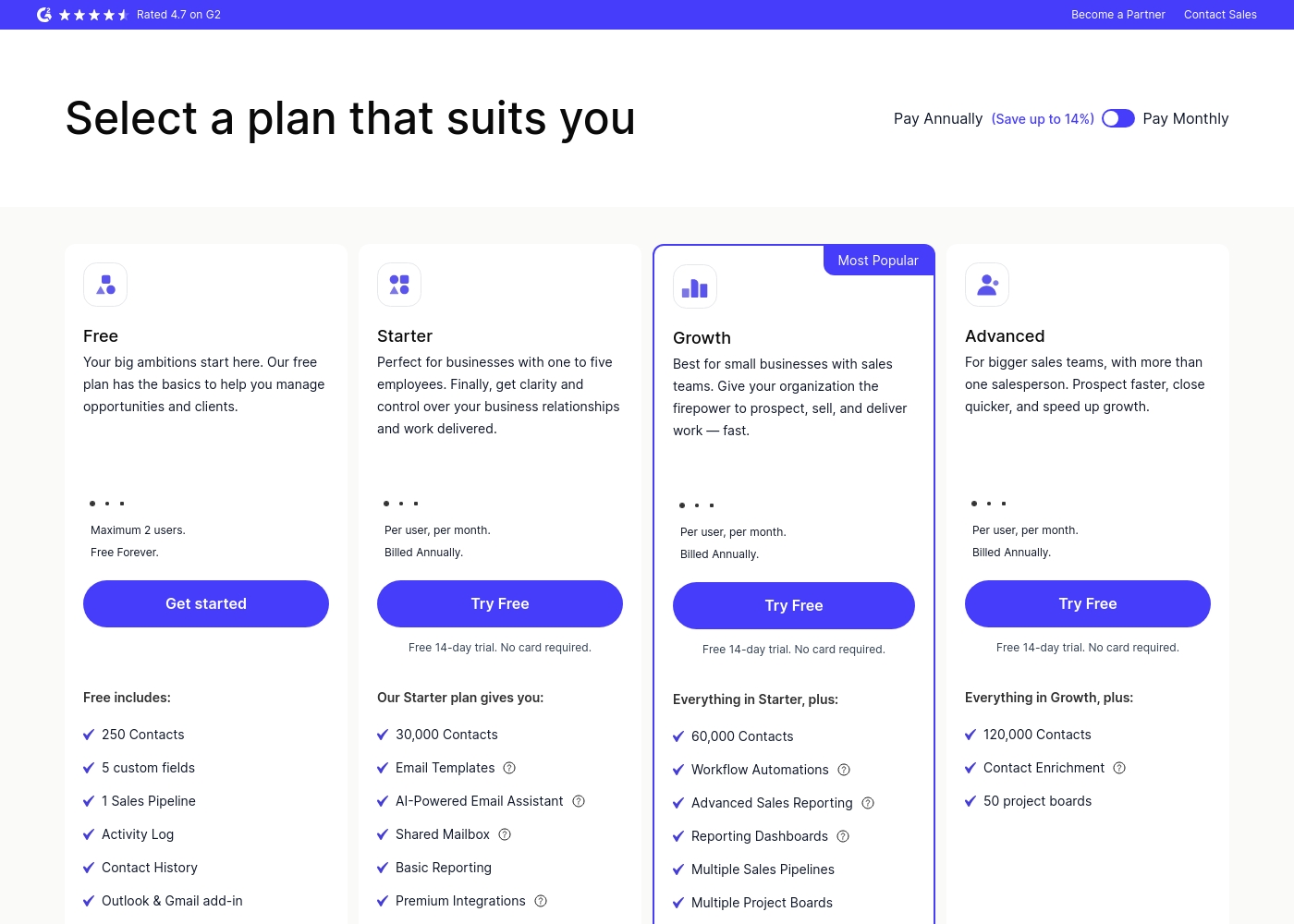
Free
Price: Free Forever Best For: Managing opportunities and clients; testing the functionality Other Features:
- Maximum 2 users
- 250 Contacts
- 5 custom fields
- 1 Sales Pipeline
- Outlook & Gmail add-in
The Free plan is perfect for individuals or tiny teams just navigating client relationships. You get the fundamental tools needed to manage activity and history, but you are limited to only two users and 250 contacts. It's a great zero-cost way to test the core CRM features.
- 250 Contacts
- 5 custom fields
- 1 Sales Pipeline
- Activity Log
- Contact History
- 30,000 Contacts
- Email Templates
- AI-Powered Email Assistant
- Shared Mailbox
- Basic Reporting
- 60,000 Contacts
- Workflow Automations
- Advanced Sales Reporting
- Reporting Dashboards
- Multiple Sales Pipelines
- 120,000 Contacts
- Contact Enrichment
- 50 project boards
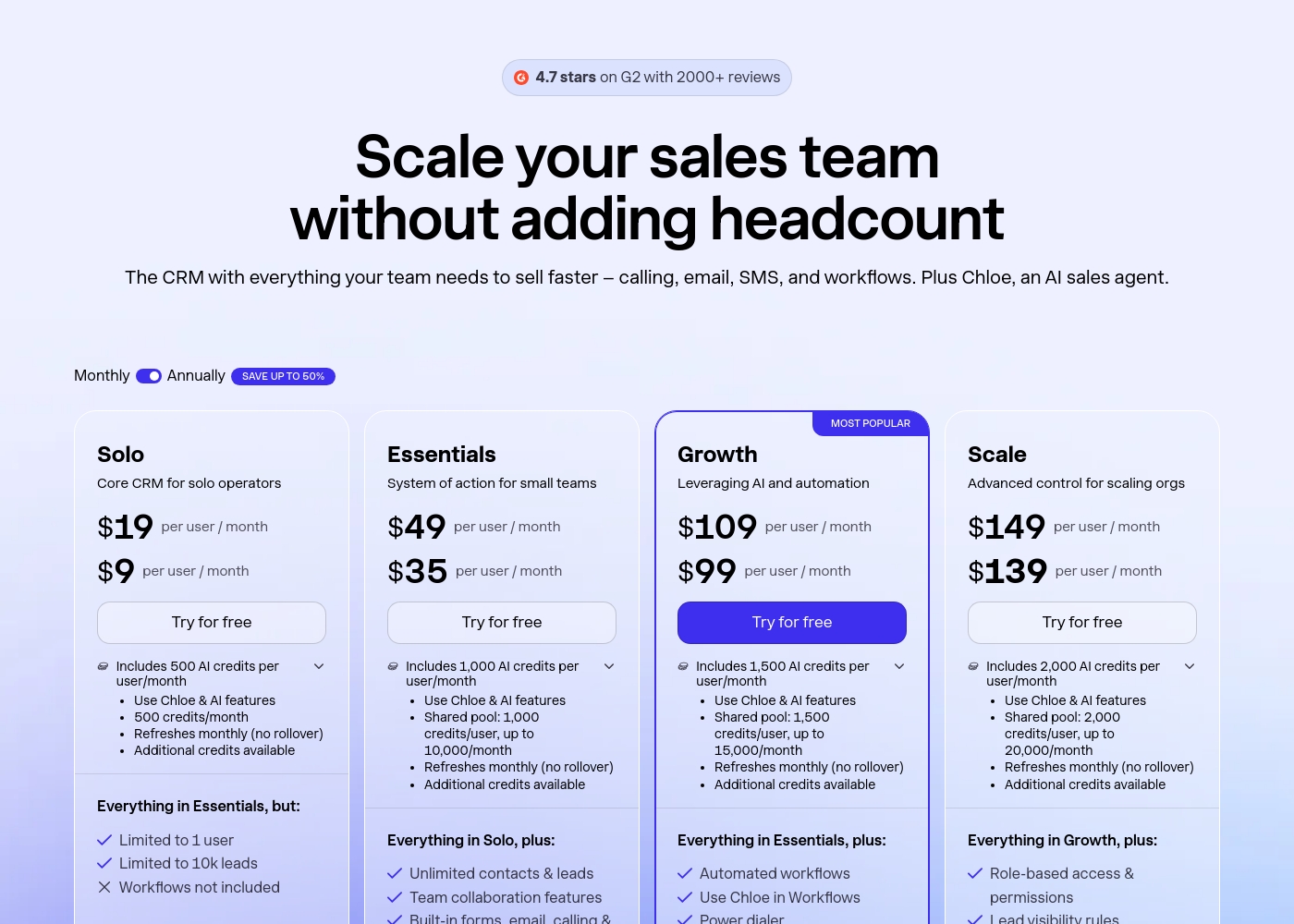
Close CRM costs between $9 and $139 per user/month with 4 plans: Solo at $9, Essentials at $35, Growth at $99, and Scale at $139.
Here is a quick breakdown to help you pick the best tier for your sales workflow.
Solo
Price: $9 per user/month (billed annually) Best For: Founders and solo reps who need a CRM instead of a spreadsheet Other Features:
- Includes 500 AI credits per user each month
- Limited to 1 user and up to 10,000 leads
- Core CRM tools for email, calling, and SMS
- Includes 500 AI credits per user/month
- Use Chloe & AI features
- 500 credits/month, refreshes monthly
- Limited to 1 user
- Limited to 10k leads
- Includes 1,000 AI credits per user/month
- Shared pool: 1,000 credits/user, up to 10,000/month
- Unlimited contacts & leads
- Team collaboration features
- Built-in forms, email, calling & SMS
- Includes 1,500 AI credits per user/month
- Shared pool: 1,500 credits/user, up to 15,000/month
- Automated workflows
- Use Chloe in Workflows
- Power dialer
- Includes 2,000 AI credits per user/month
- Shared pool: 2,000 credits/user, up to 20,000/month
- Role-based access & permissions
- Lead visibility settings
- Predictive dialer
Pricing Notes
- Capsule CRM offers a Free plan and states there are zero upfront implementation or setup fees. All paid plans offer up to 15% off when paying annually.
- Specific dollar prices for Capsule CRM paid tiers (Starter, Growth, etc.) are unlisted, requiring users to contact sales.
- Close CRM lists its range from $0 to $250/year, suggesting possibly simpler initial pricing or a clearly defined Solo subscription.
- Both Capsule CRM and Close CRM offer a free tier option or a free trial to test the software before purchasing.
Pricing Head-to-Head
User Reviews
Capsule CRM users consistently report high satisfaction, frequently highlighting the platform's exceptional simplicity and great value. Many reviewers confirm that Capsule is highly intuitive and easy to use, noting it took only a few hours to customize—a stark contrast to competitors that require months of expensive consultant time. This affordability and ease of setup are main draws for small and growing teams. Users feel the CRM helps them stay incredibly organized by providing complete visibility of tasks, pipelines, and client history in one specific place. Furthermore, the support team receives high praise for being quick, responsive, and thorough when resolving issues 👍.
However, feedback is not entirely perfect. A small number of reviewers expressed frustration over the removal of the Twitter API integration, arguing the feature should have been retained given the subscription fees. Users also occasionally request minor quality-of-life additions, such as a stand-alone, no-code form link feature to automate data entry. Overall, the sentiment affirms Capsule as a powerful, affordable, and stress-free solution built for scalability.
The problem with many CRM systems is using them requires too long of a learning curve. I love Capsule because it's super easy to use from day one. Despite its simplicity, it packs a lot of power and many useful features. Highly recommended for any small business.
On Trustpilot, Close CRM holds a rating of 2.8/5. Users praise its straightforward UI, built-in calling and SMS, and responsive support that resolves issues quickly.
Many appreciate it as a simple alternative to complex tools like HubSpot. However, recurring concerns include unreliable auto-security systems that lock trials or accounts without warning, poor onboarding with copy-paste support responses, and occasional bugs in the AI search and newer interface.
Close is an amazing CRM and company. Our users found other CRMs complicated and over featured. The features we needed like SMS, Calling, and call recording are built in, so you don't need to figure out how to setup and support that. And speaking of support, their support team is incredible.
Our Verdict
Choosing between Capsule CRM and Close CRM means picking simplicity versus specializing in sales acceleration. If you need a tried-and-true organizer for your whole business, Capsule CRM is the clear winner for reliability and value. Capsule CRM’s superpower is making CRM effortless for the small business owner. It boasts zero setup fees and users report customizing the system in hours, not months. Capsule CRM handles not only sales but crucial post-sale client work using its dedicated Project Boards and integrates with 60+ external tools. Close CRM shines if your only goal is to close more sales, faster, using powerful AI assistance. It’s built entirely for selling, aiming to cut chaos by centralizing all communication into one hub. Close CRM offers advanced AI features like Note-taking and direct integration with Claude and ChatGPT. Your deciding factor should be complexity tolerance and existing tech stack reliability needs. If you rely on many external tools, Capsule CRM connects broadly. If you need to curb rising Zapier costs and want deep AI built-in, Close CRM will be a better fit. Ultimately, Capsule CRM is best for well-rounded SMBs seeking simplicity and organization across departments. Close CRM is the choice for aggressive, sales-heavy teams trying to move deals forward with cutting-edge communication automation.
Frequently Asked Questions
Which is better for small teams: Capsule CRM or Close CRM?
Capsule CRM is ideal for small teams prioritizing general business organization and ease of use. Close CRM is better suited if that small team is exclusively focused only on high-volume outbound sales communication. Capsule CRM offers huge contact scalability for expanding datasets.
Does Capsule CRM have built-in AI features like Close CRM?
Capsule CRM includes an AI-Powered Email Assistant for drafting communications, which is helpful. However, Close CRM provides a far more dedicated AI suite, featuring AI Notetaker, Summaries, Enrichment, and direct connection to Claude/ChatGPT. Close CRM wins on AI functionality.
Which CRM has better scalability for managing contacts?
Capsule CRM provides better known scalability, documenting capacity for up to 120,000 contacts in its Advanced tier. Close CRM's Solo plan limits users to 10,000 leads. Capsule CRM offers more transparent and higher documented limits for long-term database growth.
Can I manage client projects or post-sale delivery using Close CRM?
Capsule CRM is superior here because it includes multiple dedicated Project Boards for managing client deliverables and onboarding. Close CRM focuses primarily on the pre-sale deal funnel. If your CRM must also handle post-sale delivery tracking, choose Capsule CRM.
Which tool is easier to set up and customize initially?
Capsule CRM is widely praised for being extremely intuitive and simple to set up, often taking only a few hours. Capsule CRM also promotes immediate value by charging zero upfront implementation or setup fees. Both tools are designed for low friction, but Capsule CRM has proven speedier.
Is Close CRM designed to replace my external automation tools like Zapier?
Yes, Close CRM's core value proposition is consolidation. It is designed as a single tool for all communication, aiming to lower costs and improve workflow reliability by reducing your Zapier dependency. Capsule CRM, conversely, focuses on integrating seamlessly with 60+ external tools.
Ready to Choose?
Both tools have their strengths. Choose based on your specific needs.