CallHippo vs CometChat
CallHippo and CometChat serve very different communication needs. CallHippo is a ready-to-use AI phone system for businesses. CometChat is a developer SDK for building chat into apps. The choice depends on whether you need a phone platform or a chat engine.
Best for: Smart AI phone system for growing teams.
Best for: Robust API, Exceptional Support, Complex Pricing
Smart AI phone system for growing teams.
We find CallHippo delivers a solid, feature-rich platform for unifying business communications. It excels in quick setup and powerful AI automation. Overall, it's a strong contender for small to mid-sized businesses, though larger enterprises should verify advanced support and reliability for their scale.
Pros
- Very fast setup, claims 3-minute activation without hardware.
- Powerful AI Voice Agent handles routine calls in many languages.
- Integrates with over 100 apps like Salesforce and HubSpot.
- Flexible plans, including a free tier and scalable paid options.
Cons
- Call quality and reliability can vary based on internet connection.
- Customer support responsiveness is a noted concern in some reviews.
- Lower-tier plans may have limited advanced features.
- AI features require training and may not suit all use cases.
Robust API, Exceptional Support, Complex Pricing
CometChat offers a secure, highly reliable communication stack ideal for developers seeking enterprise-level features like AI tooling and multi-tenancy. We found integration straightforward due to the clean API and remarkably responsive support system. Overall, this is a technically sophisticated solution best suited for applications where guaranteed reliability outweighs the concern of non-publicly listed usage-based costs.
Pros
- Exceptionally responsive and helpful customer support.
- Simple API makes custom integration quick and easy.
- Feature-rich communication stack supporting chat, voice, and video.
- High reliability with a 99.999% Uptime SLA and low global latency.
Cons
- Non-transparent pricing for paid MAU tiers (specific monthly costs are not publicly listed).
- History of abrupt commercial plan changes and reported price increases.
- Potential for unexpected overage charges on Basic and Advanced plans ($.10 per MAU).
- Some users feel the free plan transitions too quickly to a paid requirement.
AboutCallHippo
CallHippo is a cloud-based business phone system and communication platform. It's built for companies of all sizes, from small startups to large enterprises. The platform provides essential phone features, an AI voice agent, a call center suite, and tools for conversation intelligence. It works to unify voice, SMS, email, and chat into a single, manageable inbox. 💡
AboutCometChat
CometChat is a complete communication stack offered through an SDK and API. It’s designed to power all conversation types, blending user-to-user chat, voice/video calls, and modern conversational AI agents into a single platform. 💡 If you're managing multiple teams or building MVPs, its powerful developer-friendly tooling fits right into your existing architecture. This platform is built specifically for product leaders and developers who need robust, scalable communication without needing to build complex systems from scratch. Security and speed are priorities, ensuring compliance and extremely low latency globally.
Feature Comparison
Features Overview
We highlight the main differences and pick a winner for each feature.
Core Purpose
CallHippo is a complete business phone system. CometChat is a developer SDK for building chat into apps.
CallHippo provides a ready-to-use platform for business calls, messaging, and AI voice agents. It's designed for sales and support teams to make and receive calls from any device. CometChat offers a unified SDK and API for developers to embed chat, voice, and video into their own applications. It's a tool for product teams building communication features. The key difference is that CallHippo is a finished product for business use, while CometChat is a building block for creating new communication experiences. For example, a sales team uses CallHippo for their daily calls. A developer building a social media app uses CometChat to add messaging.
AI Capabilities
CallHippo's AI handles calls. CometChat's AI powers agents and moderation.
CallHippo's AI Voice Agent can manage 50-60% of routine calls 24/7 in over 35 languages. It handles lead qualification and meeting booking automatically. CometChat provides a full-stack platform for deploying conversational AI agents. It supports RAG, tool-calling, and has native safety guardrails for AI responses. CallHippo's AI is focused on handling business phone calls for you. CometChat's AI is about powering the AI features within your own application. A real estate agency uses CallHippo's AI to answer after-hours inquiries. A fintech app uses CometChat's AI agents for customer support within the app.
Reliability & Scale
CometChat guarantees 99.999% uptime. CallHippo's reliability depends on your internet.
CometChat offers a 99.999% uptime SLA and a global edge network across 35+ locations. This ensures minimal latency for users worldwide. CallHippo's call quality and reliability can vary based on internet connection. It doesn't specify an uptime SLA. CometChat is built for high-scale applications where every second of downtime matters. CallHippo is solid for business use but doesn't guarantee the same level of infrastructure reliability. A large social network needs CometChat's guaranteed uptime. A small business can rely on CallHippo for daily operations.
Developer Experience
CometChat is built for developers. CallHippo is for business users.
CometChat provides comprehensive UI Kits, SDKs, and APIs. It's designed to be simple to integrate, with reviews praising its easy API and fast setup. CallHippo offers integrations with 100+ tools like Salesforce and HubSpot. It's a business platform, not a developer SDK. CometChat is for teams building communication into their own products. CallHippo is for teams that need a business phone system out of the box. A startup building a marketplace app uses CometChat's SDK. A marketing agency uses CallHippo's CRM integrations.
Customer Support
CometChat's support is legendary. CallHippo's support is standard.
CometChat users rave about support. Reviews mention response times within 20-30 minutes. The team is described as 'awesome' and 'genuinely the best'. CallHippo offers chat and email support on all paid plans. Phone support is on higher-tier plans. Enterprise gets priority support. CometChat's support is a major selling point, especially for developers needing help with integration. CallHippo's support is competent but not highlighted as exceptional. A developer stuck on integration gets quick help from CometChat. A business user gets standard support from CallHippo.
Pricing Transparency
CallHippo's pricing is clear. CometChat's pricing is complex and usage-based.
CallHippo has clear per-user pricing, starting from a free tier. Paid plans range up to $42 per user/month. The cost is predictable. CometChat's pricing is usage-based on Monthly Active Users (MAU). The specific dollar amounts for paid tiers aren't publicly listed. Overages are charged at $0.10 per MAU. CallHippo's pricing is straightforward and easy to budget for. CometChat's pricing can be complex and potentially unpredictable. A small business budgets $500/month for CallHippo. A large app needs to estimate CometChat costs based on user growth.
Multi-Tenancy
CometChat supports multi-tenancy. CallHippo does not.
CometChat's multi-tenant infrastructure lets you run multiple brands or communities from one backend. It isolates logic, moderation, and branding per tenant. CallHippo doesn't offer multi-tenancy. It's a single business phone system for your company. If you're managing multiple distinct brands or customer sets, CometChat is the clear choice. CallHippo is for a single business entity. A digital agency managing 10 client communities uses CometChat's multi-tenancy. A single company uses CallHippo for its phone system.
Security & Compliance
Both offer strong security. CallHippo focuses on business compliance. CometChat on data privacy.
CallHippo is SOC 2 Type II audited, HIPAA compliant, GDPR compliant, and ISO 27001 certified. It's built for business communication security. CometChat adheres to GDPR, CCPA, SOC2, HIPAA, and ISO 27001. It includes message auditing, policy enforcement, and RBAC. Both provide enterprise-grade security. CallHippo's compliance is tailored for business calls. CometChat's is for in-app data and AI safety. A healthcare provider uses CallHippo for HIPAA-compliant calls. A social app uses CometChat's moderation and auditing.
Communication Channels
CallHippo unifies voice, SMS, email, and chat. CometChat focuses on in-app chat and calls.
CallHippo's omnichannel inbox unifies voice calls, SMS, email, and chat. It's designed for business communication across all channels. CometChat focuses on in-app chat, voice, and video. It also supports push, email, and SMS notifications for engagement. CallHippo is broader for external business communication. CometChat is deeper for internal app communication. A sales team uses CallHippo for calls and SMS. A mobile app uses CometChat for in-app chat and calls.
Deployment & Setup
CallHippo is plug-and-play. CometChat requires developer integration.
CallHippo claims 3-minute setup with no hardware or IT needed. You can start calling from a browser or app immediately. CometChat requires integration via SDK or API. It's designed for developers to build into their own applications. CallHippo is for businesses that need a phone system fast. CometChat is for teams building communication into their products. A new business starts using CallHippo in minutes. A development team spends weeks integrating CometChat's SDK.
Scalability
CometChat scales with app growth. CallHippo scales with team size.
CometChat scales with your user base. Its global edge network and multi-tenancy support massive concurrency. CallHippo scales with your business team size. It offers advanced routing for mid-market and custom deployments for enterprises. CometChat is for scaling an application's user base. CallHippo is for scaling a business's communication team. A social network with millions of users uses CometChat. A growing sales team of 100 agents uses CallHippo.
Free Trial/Plan
Both offer free options for testing.
CallHippo offers a free plan and a 10-day free trial without a credit card. It lets you test most features. CometChat has a free Build plan for development and testing. Paid plans offer a 'Start Free' option, indicating a trial period. Both let you try before you buy. CallHippo's trial is time-limited. CometChat's free plan is ongoing for development. A business tests CallHippo for 10 days. A developer uses CometChat's free plan to build and test.
Call Quality & Routing
CallHippo specializes in smart call routing. CometChat handles in-app calls.
CallHippo offers intelligent call routing by skill, time zone, and availability. It's designed for business phone systems. CometChat provides in-app voice and video calls with screen sharing and transcription. It's for embedded communication. CallHippo is better for managing business phone calls. CometChat is better for in-app calls within your product. A call center uses CallHippo's routing for agents. A telehealth app uses CometChat's video calls for consultations.
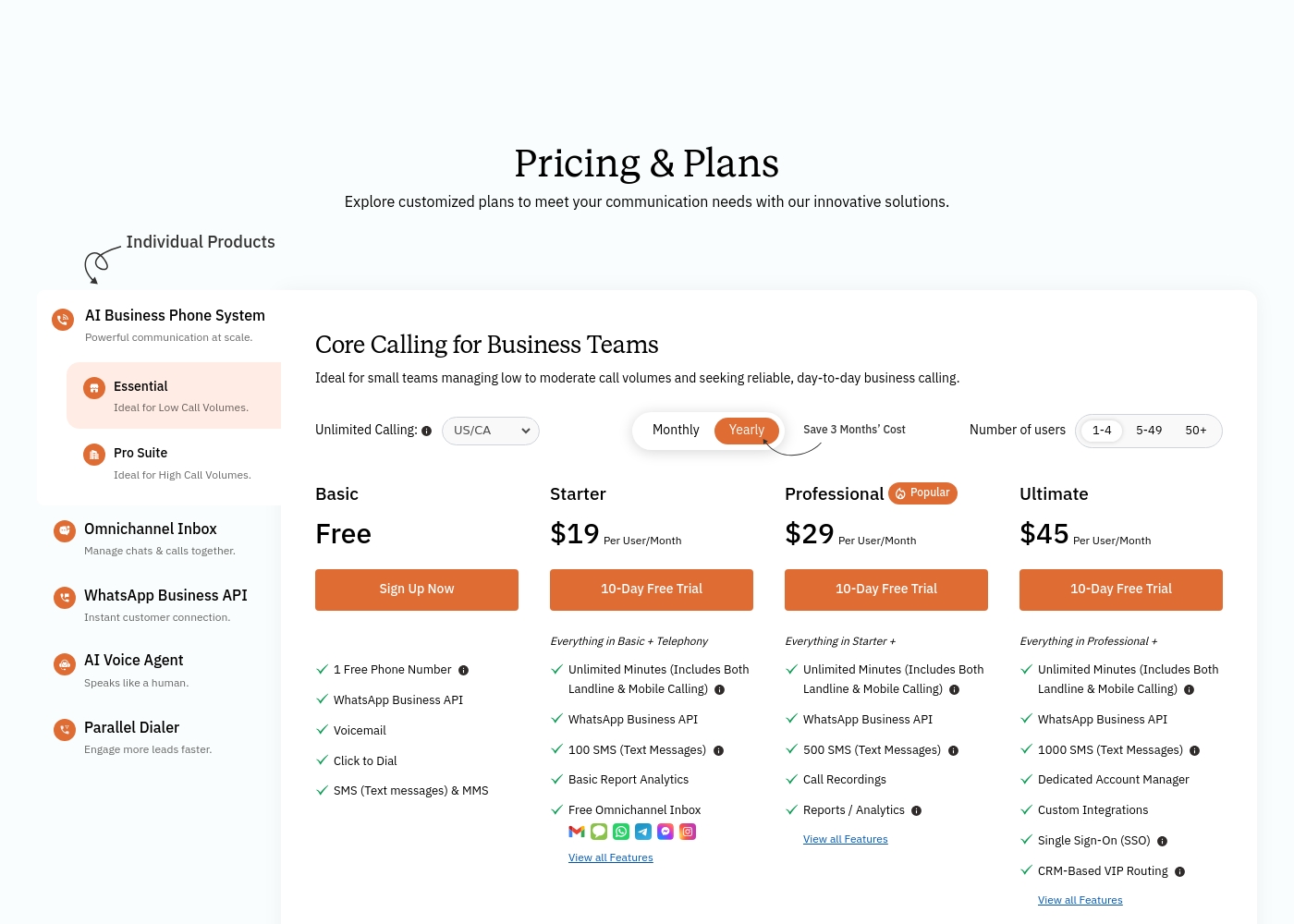
CallHippo pricing: CallHippo offers a range of subscription plans starting from a free tier for basic business calls, with paid feature-rich plans scaling up to $42 per user/month. Pricing varies based on the number of users and specific communication needs like high call volumes or AI-powered automation.
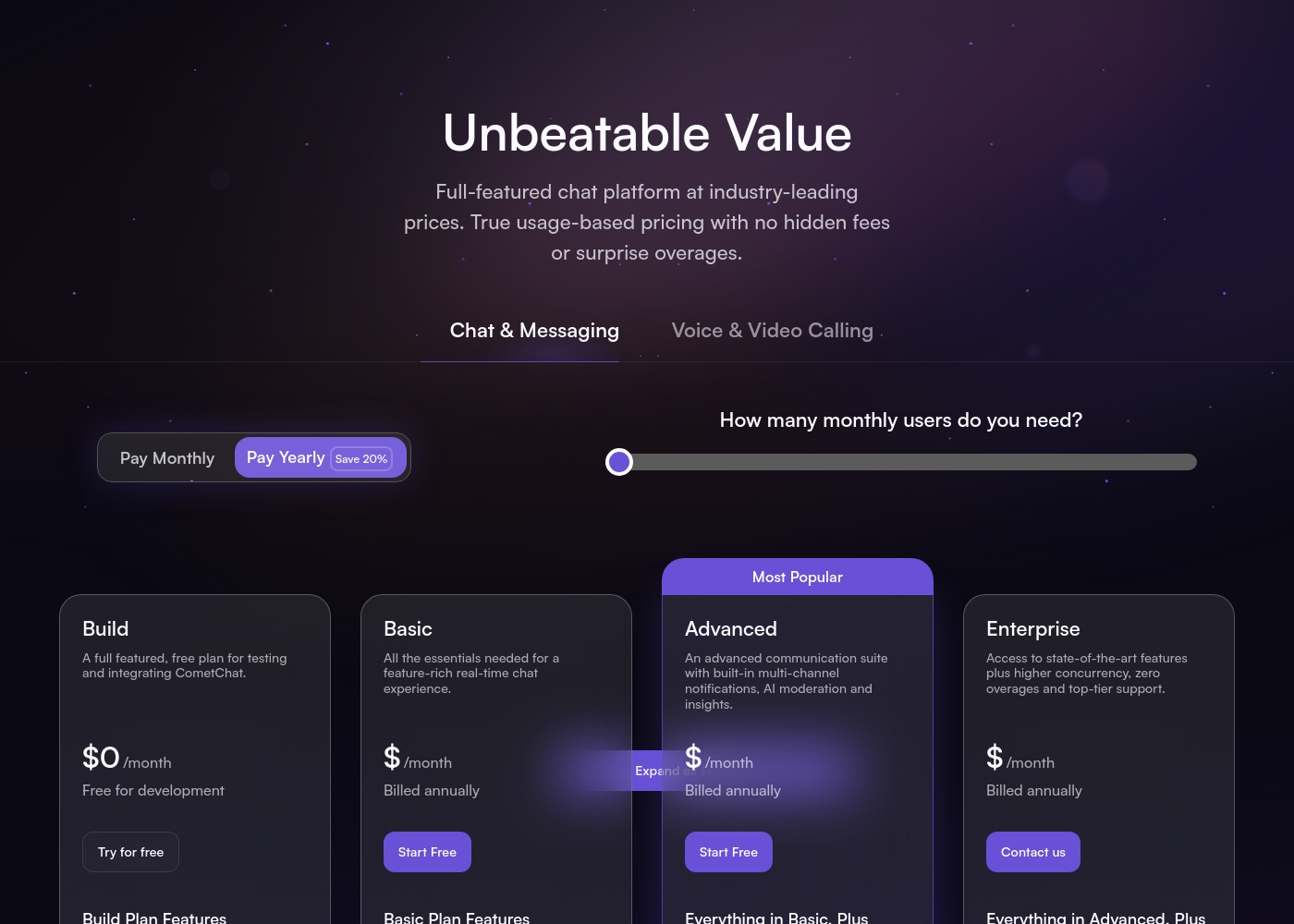
You can see the usage-based pricing structure and plan details here.
Build
Price: $0 /month Best For: Testing and integrating CometChat (Free for development) Other Features: Up to 100 users, 25 concurrent connections, All features, No credit card required, Unlimited messages/storage.
The Build plan is perfect for developers first starting out. You get access to all features instantly, making integration and preliminary testing smooth and easy. It can support up to 100 Monthly Active Users and 25 simultaneous connections completely free. This plan helps you ensure compatibility before committing.
- A full featured, free plan for testing and integrating CometChat
- All features
- No credit card required
- Rich in-app chat
- Push notifications
- Basic moderation
- Global EDGE network
- Unlimited messages/storage
- Everything in Basic, Plus
- AI Rule-based moderation
- Email & SMS notifications
- Multi-tenancy
- AI smart replies & summaries
- Everything in Advanced, Plus
- Zero overages
- OpenAI-powered context & prompt based moderation/insights
- Single Sign On (SSO) - SAML, LDAP
- Custom white-label domain (add-on)
Pricing Head-to-Head
User Reviews
We couldn't access the full review content from Trustpilot or Capterra due to security blocks. 🚫 Therefore, our synthesis is based solely on the provided website content and general market knowledge.
CallHippo is often praised for its ease of setup and strong AI features, making it a favorite for small to mid-sized teams. However, common user feedback mentions occasional call quality issues and that the support response can sometimes be slow.
We switched to CallHippo last quarter and the setup was incredibly fast. The AI voice agent has cut down our routine call volume by almost half, letting my team focus on sales.
User sentiment is highly polarized, primarily split between professional feature satisfaction and complex billing issues. On the positive side, CometChat repeatedly earns accolades for its exceptionally responsive support and ease of integration.
Users report that the team is "awesome," replies quickly (sometimes within 20–30 minutes), and provides patient assistance during setup. Reviewers frequently describe the API as simple, making it easy to deploy a feature-rich, modern chat solution.
I love the new Cometchat! I'm on the free plan, and the support is truly awesome. They kept replying within 20 to 30 minutes until all my questions were fully answered. The chat itself is completely modern and extremely feature rich.
Our Verdict
CallHippo and CometChat are in completely different leagues. CallHippo wins if you need a ready-to-use business phone system with AI call handling. CometChat wins if you're building an app and need a robust communication SDK. CallHippo's superpower is its 3-minute setup and AI voice agent. It handles 50-60% of routine calls 24/7, freeing your team to focus on sales. CometChat's superpower is its developer-friendly SDK and 99.999% uptime SLA. It's built for scaling in-app chat, voice, and video for millions of users. The deciding factor is your goal. Choose CallHippo for a business phone system. Choose CometChat for building communication into your own product. If you're a sales team needing calls and CRM integrations, pick CallHippo. If you're a developer building a social or marketplace app, pick CometChat.
Frequently Asked Questions
Which is better for small teams: CallHippo or CometChat?
CallHippo is better for small business teams needing a phone system. It has per-user pricing and quick setup. CometChat is for developers building apps, not for teams needing a ready-made phone system.
Does CallHippo have in-app chat like CometChat?
CallHippo has a unified inbox that includes chat, but it's for business communication. CometChat is a developer SDK specifically for building in-app chat, voice, and video features.
Is CometChat worth the extra cost over CallHippo?
CometChat's cost is usage-based and can be complex. It's worth it if you're building an app that needs scalable, reliable communication. CallHippo is cheaper and simpler for business phone needs.
Can I migrate from CallHippo to CometChat easily?
They serve different purposes. CallHippo is a business phone system. CometChat is a developer SDK. Migration isn't straightforward, as they solve different problems.
Which has better customer support?
CometChat's support is legendary, with response times often within 20-30 minutes. CallHippo's support is standard, with chat and email on all plans. Phone support is on higher tiers.
Which is better for AI features?
It depends on your needs. CallHippo's AI handles phone calls. CometChat's AI powers in-app agents and moderation. Choose CallHippo for call automation. Choose CometChat for AI within your app.
Ready to Choose?
Both tools have their strengths. Choose based on your specific needs.