Calendly vs Trafft
Comparing Calendly and Trafft reveals two very different scheduling philosophies. Calendly is the established B2B standard, focusing on simplifying meetings and sales routing. Trafft is built for comprehensive service businesses that need staff, location, and payment management. Your perfect choice depends entirely on whether you sell time or services.
Best for: Lead generation sales teams utilizing routing forms, Large enterprise organizations requiring high security (SSO/SAML)
Best for: Service businesses (salons, health, coaching) needing 24/7 booking, Organizations managing multiple staff schedules and locations
Industry-leading, reliable scheduling automation.
We found Calendly remains the industry standard for automated scheduling due to its powerful core functionality and ease of use, connecting seamlessly with almost any calendar or tool. Overall, the platform is excellent for personal and small team scheduling, though advanced features and customer support require improvement to match the product's quality.
Pros
- Highly intuitive and easy scheduling process for users and clients.
- Eliminates significant time spent on ‘back and forth’ email coordination.
- Robust Free plan provides ample functionality for consistent bookings.
- Excellent integration with calendars, video conferencing, and payment systems.
Cons
- Customer support responsiveness is frequently criticized, particularly for non-paid users.
- Advanced team features (collective/round-robin) can be difficult or cumbersome to set up.
- Recent UI changes have negatively impacted established workflows for some long-term users.
- Some users report difficulty or lack of direct linking support for Apple Calendar (iCalendar).
Feature-Rich Scheduling with World-Class Support
We find Trafft is a highly capable scheduling software that offers phenomenal feature depth, especially considering its value proposition compared to competitors. Overall, we recommend Trafft, particularly for businesses seeking extensive customization and responsive support, provided they can overlook some current mobile interface limitations.
Pros
- Phenomenal and responsive technical support team.
- Highly customizable appointment platform and branding tools.
- Comprehensive features included at a strong value/price point.
- Offers a robust, forever-free plan for small teams.
Cons
- Mobile calendar UI is inefficient and requires excessive scrolling.
- Setup for complex functions can be confusing and non-intuitive.
- Styling control for booking pages is perceived as limited.
- Some highly anticipated roadmap features have been slow to launch.
AboutCalendly
Calendly is touted as the leading online appointment scheduling tool. It currently serves over 20 million professionals globally.
This powerful software connects multiple calendars—up to six—to ensure you only offer available times. While it’s simple enough for single users, it also meets the needs of enterprise organizations. Organizations, including 86% of Fortune 500 companies, rely on Calendly for secure, streamlined scheduling.
AboutTrafft
Trafft is a robust, all-in-one platform built to simplify appointment management for service-based businesses globally. It is much more than a simple scheduling app, offering a comprehensive solution for organizing staff, handling customer relationships, and managing finances. The platform is trusted by over 15,500 global customers. It's designed to be intuitive, ensuring both you and your clients find it incredibly easy to use and require no special training. 💡
Highlights
Feature Comparison
Features Overview
We highlight the main differences and pick a winner for each feature.
Core Focus & Audience
Calendly simplifies B2B meetings; Trafft organizes service businesses.
Calendly is the powerhouse for sales teams and individual professionals needing simple scheduling. It connects up to six calendars to prevent frustrating double bookings quickly. Calendly's strength lies in its ability to automate the logistics of connecting people efficiently. || Trafft is designed as a complete management suite for service providers. It handles staff, payments, and client bookings from one dashboard 24/7. Trafft allows clients to easily book services themselves, making it perfect for salons or fitness studios. || The key difference is scope: Calendly schedules meetings, while Trafft runs a service-based operation. Trafft offers tools for business owners, not just individual schedulers. || If your primary goal is maximizing lead conversion, Calendly is ideal. If you manage multiple staff schedules, Trafft is the better fit.
Lead Routing & Sales
Calendly excels at qualifying and instantly routing high-value sales leads.
Calendly offers specialized routing forms tailored for sales and marketing processes. These forms qualify leads instantly upon submission on your website. High-value prospects are routed immediately into a scheduled meeting with the appropriate rep. || Trafft is built for accepting immediate bookings for defined services, not complex qualification flows. Its focus is displaying availability for direct service delivery. Trafft does not offer the sophisticated filtering found in Calendly's routing tools. || Calendly is the clear winner for organizations prioritizing pipeline efficiency and sales conversion. This feature accelerates the time-to-meeting for valuable prospects. || If your revenue depends on instantly connecting leads to sales, Calendly provides superior automation.
Multi-Location Support
Trafft natively supports unlimited locations; Calendly does not.
Trafft is fundamentally designed to manage complex operations with multiple physical venues. It allows users to manage unlimited locations from a single, centralized dashboard. You can assign staff specific schedules across different venues easily. || Calendly is optimized for internal team coordination, using features like round-robin scheduling. It lacks the built-in capability to manage distinct schedules and resources across separate physical addresses. || If you operate a multi-branch business, Trafft provides the essential administrative tools you require. Calendly is better suited for remote or single-location teams. || Running a chain of barbershops or studios requires Trafft’s integrated multi-location management.
Payments & Invoicing
Trafft offers invoicing and more payment gateways than Calendly.
Trafft supports five major payment gateways including Stripe, PayPal, and Square. Critically, Trafft can also generate and send detailed invoices to clients. This makes payments seamless for professional service delivery. || Calendly integrates with Stripe and PayPal to collect payment at the time of booking. However, Calendly does not offer native tools to generate formal client invoices afterward. || Service businesses often require formal invoicing for accounting and compliance purposes. Trafft wins by providing the complete financial workflow, including invoicing. || For collecting fees for coaching or consultations, Trafft handles both payment and documentation effortlessly.
Pricing Structure
Calendly bills per seat; Trafft uses flat-rate user tiers for better value.
Calendly uses a strict per-seat pricing model, costing $10-$16 monthly for every user needing access. Scaling your team means purchasing new licenses for every single employee. This cost model can quickly become expensive for growing teams. || Trafft sells based on user tiers, including 5, 10, or 15 users for a flat rate. This protects you from unpredictable per-seat scaling costs. Trafft also includes a robust forever-free plan for up to five users. || Trafft generally offers superior value for money when managing a small-to-midsize staff team. Calendly’s cost increases directly with every employee added. || A growing team of 10-15 staff members will likely find Trafft significantly more cost-effective immediately.
Enterprise Readiness
Calendly offers superior security and governance features required by large enterprises.
Calendly serves 86% of Fortune 500 companies, providing essential security functionality. The Enterprise plan includes SSO/SAML, domain control, audit log compliance, and dedicated support. This ensures high-level data governance. || Trafft does not publicly list enterprise-grade features like mandatory SSO or domain control. Its focus is on operational utility for mid-market service businesses. Trafft is not positioned for the same security compliance level as Calendly. || Organizations with strict compliance and security requirements must choose Calendly. Trafft is adequate for smaller businesses but lacks advanced governance controls. || If security reviews are mandatory, Calendly is the only choice providing the necessary compliance features.
Business Reporting
Trafft provides deep business KPIs; Calendly focuses on usage metrics.
Trafft delivers advanced performance dashboards crucial for business management. Users can track occupancy rates, customer return rates, earnings, and popular services. These KPIs provide actionable business insights. || Calendly offers strong reporting primarily centered on scheduling efficiency and meeting usage. It tells you who is scheduling what, but not necessarily your profitability or occupancy density. || Trafft's reporting suite directly supports business decision-making and optimization. Calendly's analytics are stronger for optimizing internal scheduling flows. || Managers needing to quickly see revenue trends and staff utilization should rely on Trafft's dashboards.
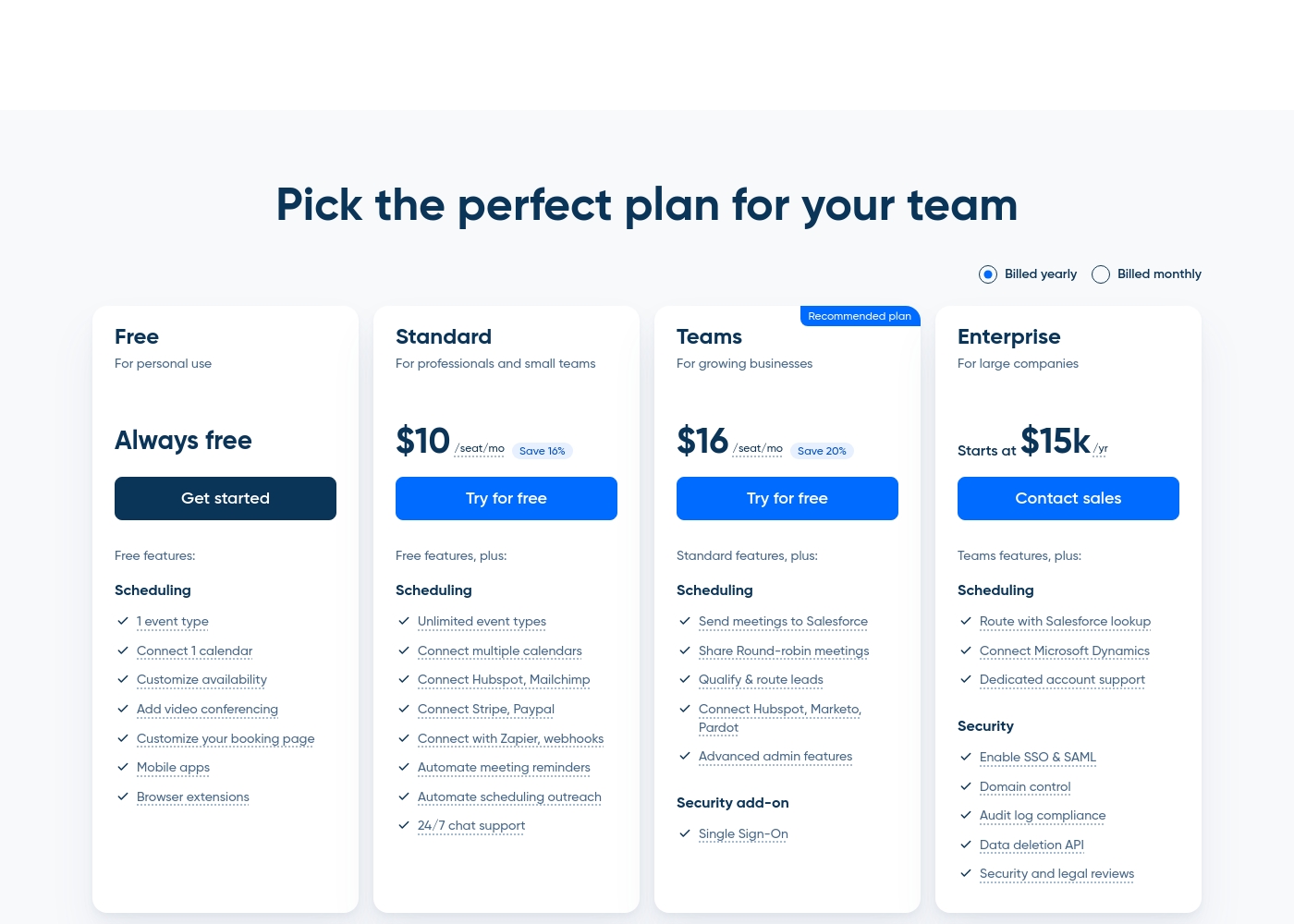
Calendly offers four main plans ranging from a permanent Free tier up to $16 per seat per month (billed yearly). The plans are Free (Always free), Standard ($10/seat/month, billed yearly), Teams ($16/seat/month, billed yearly), and Enterprise (starting at $15,000/year).
Let's explore which plan works best for your specific scheduling needs.
Free
Price: Always free Best For: Personal use Other Features:
- Connect 1 calendar
- 1 event type
- Add video conferencing
- Mobile apps and browser extensions
- 1 event type
- Connect 1 calendar
- Customize availability
- Add video conferencing
- Customize your booking page
- Unlimited event types
- Connect multiple calendars
- Connect Hubspot, Mailchimp
- Connect Stripe, Paypal
- Connect with Zapier, webhooks
- Send meetings to Salesforce
- Share Round-robin meetings
- Qualify & route leads
- Connect Hubspot, Marketo, Pardot
- Advanced admin features
- Route with Salesforce lookup
- Connect Microsoft Dynamics
- Dedicated account support
- Enable SSO & SAML
- Domain control
Let's take a closer look at what each plan offers for your booking and business management needs.
Free
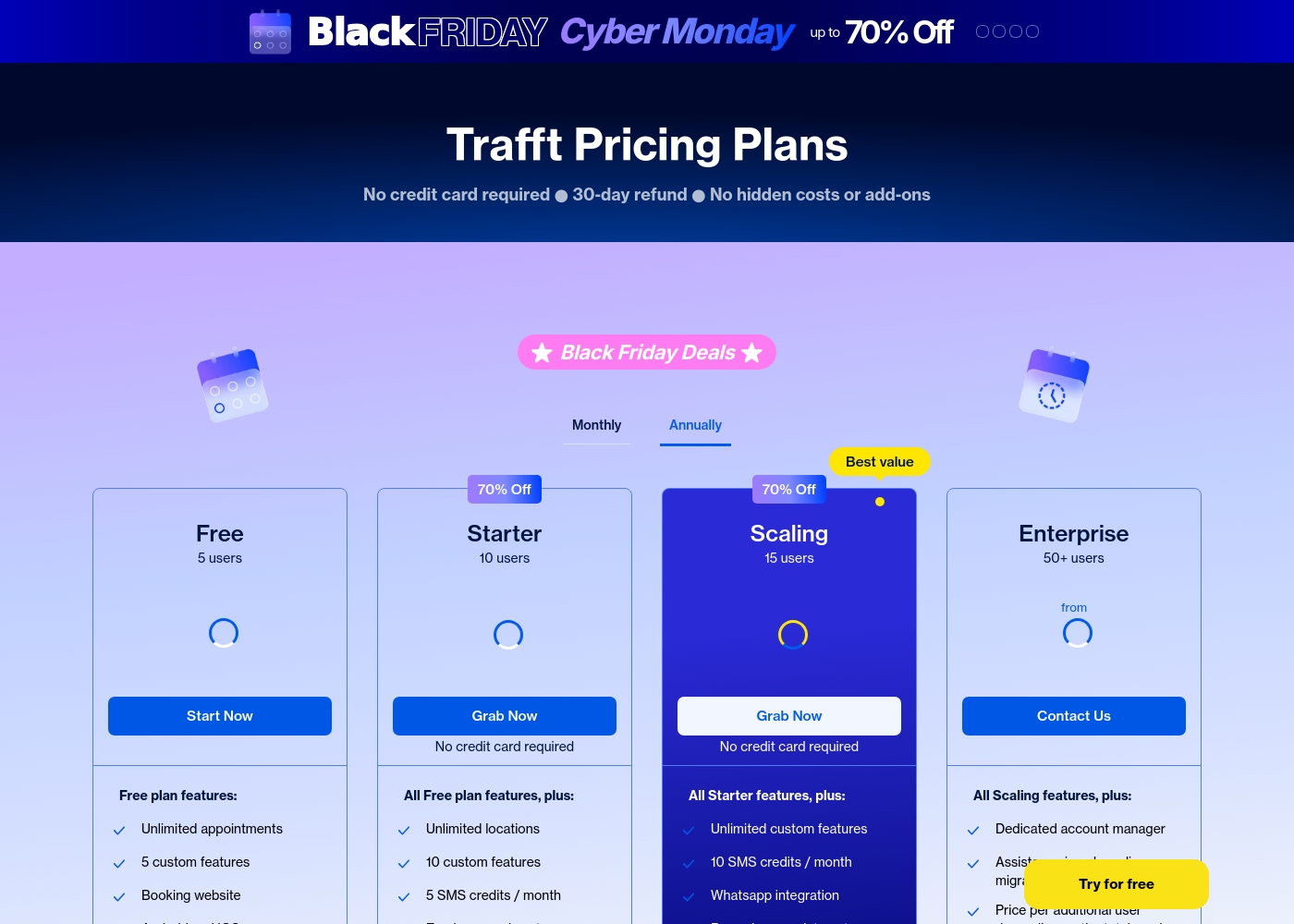
Price: Free Best For: Solo professionals or small teams needing basic functionality. Refund Policy: Not applicable (Free) Other Features:
- Unlimited appointments and booking website
- Supports Android, iOS, and WordPress.org integration
- Email and SMS notifications
- Client management and Square payments
- Syncs with Google, Outlook, and Apple calendars
This great introductory plan is forever free and supports up to 5 users and one location. It's perfect if you are just starting out and need a dependable system to handle scheduling and client communication.
- Unlimited appointments
- 5 custom features
- Booking website
- Android and iOS app
- Client Management
- Unlimited locations
- 10 custom features
- 5 SMS credits / month
- Employee Commission
- Stripe, PayPal, Square, Authorize.net, Mollie integrations
- Unlimited custom features
- 10 SMS credits / month
- Whatsapp integration
- Custom domain
- Trafft branding removal
- Dedicated account manager
- Assistance in onboarding, migration and education
- Price per additional user depending on total number
Pricing Notes
- Calendly operates on a per-seat model, meaning every user needing paid features incurs a monthly cost.
- Trafft offers flat-rate tiers that include a set number of users (up to 5, 10, 15), providing better cost control for teams.
- Both Calendly and Trafft offer highly functional permanent Free plans for individuals or small teams.
- Calendly's Enterprise plan starts at $15,000/year, catering to organizations with significant security needs.
Pricing Head-to-Head
User Reviews
Users consistently praise Calendly for its exceptional ease of use and efficiency in eliminating the classic scheduling back-and-forth. Many professionals, including consultants and educators, consider it an indispensable tool that significantly saves time, often noting the free tier is robust enough for consistent bookings.
Integrations with calendars, video tools, and payment systems are highly valued. However, sentiment is mixed regarding customer support—especially for free accounts, where response times are reportedly slow.
I've been using Calendly for three years now. It has really made my consulting business take off and be profitable. This happened through easy payment integration and streamlined scheduling.
Trafft’s external reception, primarily from Trustpilot users (4.3 stars), centers on strong value and outstanding customization. Many reviewers found it superior to alternatives like Calendly due to its robust features and aggressive pricing.
Users consistently praise the quality of the technical support, describing the team as responsive and going above and beyond to resolve issues quickly. The platform is noted for its flexibility, supporting features like multi-language operations, employee commission, and necessary third-party integrations.
I often changed scheduling programs before finding Trafft. I was spending a lot on different full packages for things I didn't need. With Trafft, I found the best options for the price since I can customize the features I need most.
Our Verdict
Choosing between Calendly and Trafft is straightforward, depending entirely on your business model. Calendly is the proven specialist for streamlining meetings and optimizing sales motions. Trafft is the operational suite built specifically for service-based businesses. Calendly’s superpower is its robust simplicity and enterprise-scale readiness. It instantly connects up to six calendars and excels at routing qualified leads into sales meetings. If you run a major B2B operation where lead conversion is paramount, Calendly dominates. Trafft focuses on becoming your all-in-one business organizer, not just a scheduler. It handles multi-location needs, manages staff calendars seamlessly, and generates invoices instantly. Trafft delivers crucial, comprehensive features that service businesses rely on. The deciding factor is complexity versus focus. If you require advanced features like staff reporting and invoicing, Trafft is your winner. If you need best-in-class security and sales team routing, stick with Calendly. Pick Calendly if your goal is internal efficiency and sales velocity at scale. Choose Trafft if you manage staff, locations, and client services where 24/7 online booking is the core of your growth.
Frequently Asked Questions
Which is better for small service businesses: Calendly or Trafft?
Trafft is much better suited for small service businesses like salons or studios. Trafft offers multi-location support, staff management, and native invoicing. Calendly focuses more on B2B meeting logistics and sales routing forms.
Can I manage multiple locations with Calendly?
No. Calendly is designed for coordinating individual or team meeting availability, not multi-venue logistics. Trafft provides full centralized management for separate, unlimited physical locations. This is a critical distinction between the two tools.
Which tool is cheaper for a team of 10 users?
Trafft offers flat-rate pricing tiers that cap your cost for 10 users. Calendly’s strict per-seat model means you pay the fee for all 10 users individually. Trafft will likely be significantly more cost-effective for that team size.
Does either software support SSO and enterprise compliance?
Calendly is the clear choice for enterprise security and compliance. Its Enterprise plan includes necessary features like SSO/SAML enablement and comprehensive audit logs. Trafft does not publicly offer these advanced governance controls.
Can I generate invoices using Calendly or Trafft?
Trafft supports native invoice generation and management for client payments. Calendly allows you to collect payment via Stripe or PayPal, but it does not generate formal invoices. This gives Trafft an edge for service providers.
Do both Calendly and Trafft offer a free plan?
Yes, both offer permanent free plans, but their limits differ significantly. Calendly's Free plan limits you to one event type. Trafft's Free plan is more generous, supporting up to five team members and unlimited bookings.
Ready to Choose?
Both tools have their strengths. Choose based on your specific needs.