busybusy vs Toggl
busybusy and Toggl track time, but they serve totally different masters. busybusy focuses on field crews and strict location accountability. Toggl excels at customizable reports for agency and office teams. Decide based on whether you need GPS accuracy or deep financial insight.
Best for: Construction and specialized trades requiring strict GPS location checks., Companies needing to document non-injuries and activity for liability protection.
Best for: Small remote teams (under 5 users) needing a free, reliable time tracker., Consultancies or agencies focused on client project billing and revenue reports.
Accurate GPS Tracking for the Field.
We recognize busybusy as a specialized time tracking solution highly optimized for construction and remote teams, providing deep operational features like GPS breadcrumbing and strong liability documentation. Overall, we find this platform offers a comprehensive, targeted toolset for reducing administrative burdens and accurately monitoring remote workforce deployment.
Pros
- A fully featured Free plan is available for unlimited users, including core GPS tracking features.
- Specifically designed for construction and remote industries, addressing niche needs like job costing and equipment tracking.
- Mandatory GPS tracking and 'Required Onsite' features ensure high time entry accuracy and accountability.
- Includes advanced liability documentation tools such as daily sign-offs and time-stamped photo storage.
Cons
- Paid plans require a separate, mandatory $40 Admin license fee.
- The comprehensive feature set may be overly detailed or complex for non-construction or office-based businesses.
- Pricing requires careful calculation due to monthly vs. annual billing plus the license fee.
Generous Free Tier, Unstable Service Reliability.
Toggl offers a feature-rich, cross-platform tracking tool emphasizing custom reports and enterprise integration for teams up to five users under the Free plan. We appreciate the clear pricing and the potential for deep profitability analysis in higher tiers. Overall, reliability concerns and extremely poor customer support repeatedly expressed by recent users indicate caution is necessary before large-scale deployment.
Pros
- Generous and permanent Free plan, supporting up to five users.
- Effective cross-platform sync across web, desktop, and mobile devices.
- Offers advanced enterprise features like SSO and integrations with Jira/Salesforce.
- Simple user interface makes basic time tracking easy to adopt.
Cons
- Extremely poor customer service, often non-responsive to urgent inquiries.
- Users report significant product deterioration, including laggy UI and data loss/bugs.
- Lacks core features needed by freelancers (e.g., tracking billed vs. unbilled time).
- Sales team has been accused of harassing users on the Free plan.
Aboutbusybusy
busybusy is the top-ranked GPS time tracking software designed specifically for construction and remote industries. This easy-to-use mobile time card app is loved by both field employees and office staff. It provides everything you need, including job costing, daily reports, and progress tracking. Even if you lose service, the app works flawlessly through its Offline Mode capability. busybusy effectively transforms standard mobile devices into powerful management tools for your entire company. ✅
AboutToggl
Toggl is time tracking software designed specifically for organizational teams. It is built around the idea that raw data must translate into actionable business insights. ✅ Toggl specializes in building custom, detailed reports directly from your team's tracking data.
This tool is especially suited for managing larger and enterprise teams. It provides the flexible reporting required for employees and projects across departments. By ensuring easy time tracking adoption, Toggl gives you the accurate data needed to make strong, confident decisions.
Highlights
Feature Comparison
Features Overview
We highlight the main differences and pick a winner for each feature.
Core Audience & Focus
busybusy targets field industries with specific needs; Toggl focuses on remote office professionals and consultants.
busybusy is built for physical, remote industries like construction and trade services. Its features center around field documentation and robust GPS integrity checks. Toggl is designed chiefly for organizations tracking tasks and client billing hours. It optimizes workflows for knowledge workers and agency teams. The two tools focus on fundamentally different labor environments. Choose busybusy if payroll integrity is your highest concern; choose Toggl for client project profitability.
GPS & Location Accuracy
busybusy provides aggressive GPS tracking controls; Toggl offers standard mobile location recording.
busybusy uses a 'Required Onsite' setting to physically prevent off-site clock-ins entirely. It also offers GPS breadcrumbing and location-based clock-in reminders for better compliance. Toggl offers basic cross-platform tracking on mobile, web, and desktop. Location checking is not applied as a strict safety or time theft prevention feature. For industries needing strict adherence to job site boundaries, busybusy is the easy winner here. This capability protects busybusy users from costly payroll errors.
Financial Reporting
Toggl specializes in custom reports for client revenue; busybusy focuses on real-time job costing data.
Toggl's Starter plan includes billable rates and team-level revenue reports for easy financial management. Premium allows fully customizable, flexible reporting ideal for deep profitability analysis. busybusy provides impressive real-time budget versus actual reports for labor and equipment. Its data supports strong job costing, filtered by up to five categories. If billing clients accurately is critical to your revenue stream, Toggl has the richer financial toolset.
Pricing Model
Toggl's pricing is straightforward per user; busybusy requires a mandatory $40 Admin license for paid tiers.
busybusy requires customers to pay a fixed $40 Admin license fee plus regular per-user costs. This fixed charge makes busybusy less cost-effective for very small teams needing Pro features. Toggl uses simpler per-user pricing starting at $9/month. It also offers a generous permanent Free plan for up to five users. Toggl’s straightforward approach coupled with a stronger Free plan usually offers better initial value.
Liability & Accountability
busybusy includes unique daily safety sign-offs; Toggl relies on standard timesheet approval workflows.
busybusy offers 'Daily Sign-Offs' which capture employee confirmation of accurate time records every day. Crucially, this daily sign-off also documents non-injuries, creating a strong liability record. Toggl includes timesheet approvals in its Premium plan, verifying hours before finalization. busybusy's focus on non-injury documentation provides specific protection against false workers' compensation claims. This is essential for high-risk workers.
Team Management
busybusy provides dedicated supervisor tools for crews; Toggl monitors remote team workload capacity.
busybusy equips supervisors with mobile tools to clock in or out an entire crew simultaneously. They can quickly assign cost codes and auto-generate detailed daily project reports in under 60 seconds. Toggl manages workload through productivity insights and capacity reports, better suited for office groups. Field supervisors in active environments will find busybusy’s highly specific crew features more functional.
Service Reliability
busybusy reports strong satisfaction; Toggl users report severe instability and non-responsive customer support.
busybusy holds a strong overall user rating of 4.3, suggesting reliable performance and feature delivery. Toggl has a very poor 2.6 user rating based on reported product deterioration and laggy UI. Many Toggl users complain their customer support is impossible to reach, sometimes ignoring cancellation requests. busybusy appears significantly more stable and trustworthy based on broad user sentiment data.
Enterprise Readiness
Toggl offers SSO and deep enterprise integrations; busybusy focuses primarily on accounting integration.
Toggl Premium includes Single Sign-On (SSO) and direct integration with systems like Salesforce and Jira. The top-tier Enterprise plan provides a dedicated Customer Success Manager for tailored setup. busybusy focuses on seamlessly integrating time and job cost data into hundreds of accounting systems. For large organizations needing IT security and core business system links, Toggl is often the better technical choice.
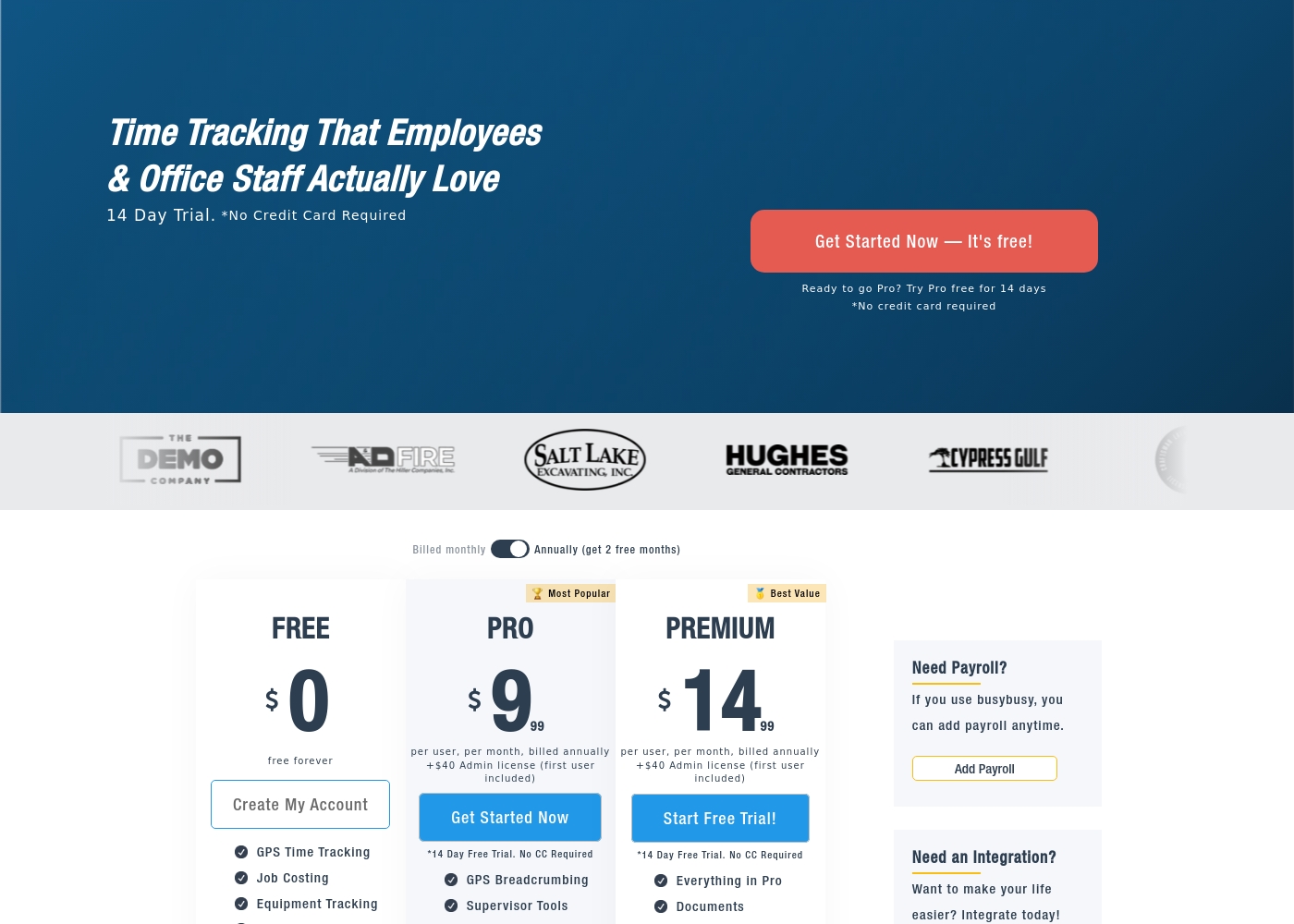
busybusy costs between $0 and $17.99 per user per month with three plans: Free at $0/month, Pro starting at $9.99 (annual), and Premium starting at $14.99 (annual).
We offer clear, tiered plans so you can choose the best fit for your team's size and specific feature requirements. Here is a breakdown of what each subscription level includes.
Free
Price: $0 per month (free forever) Best For: Basic time tracking and job monitoring for small teams. Other Features: GPS Time Tracking, Job Costing, Equipment Tracking, Unlimited Users.
- GPS Time Tracking
- Job Costing
- Equipment Tracking
- Unlimited Users
- Clock In/Out
- Everything in Free
- GPS Breadcrumbing
- Supervisor Tools
- Daily Sign-Offs
- Photos & Notes
- Everything in Pro
- Documents
- Daily Project Reports
- Progress Tracking
- Checklists & Punch Lists
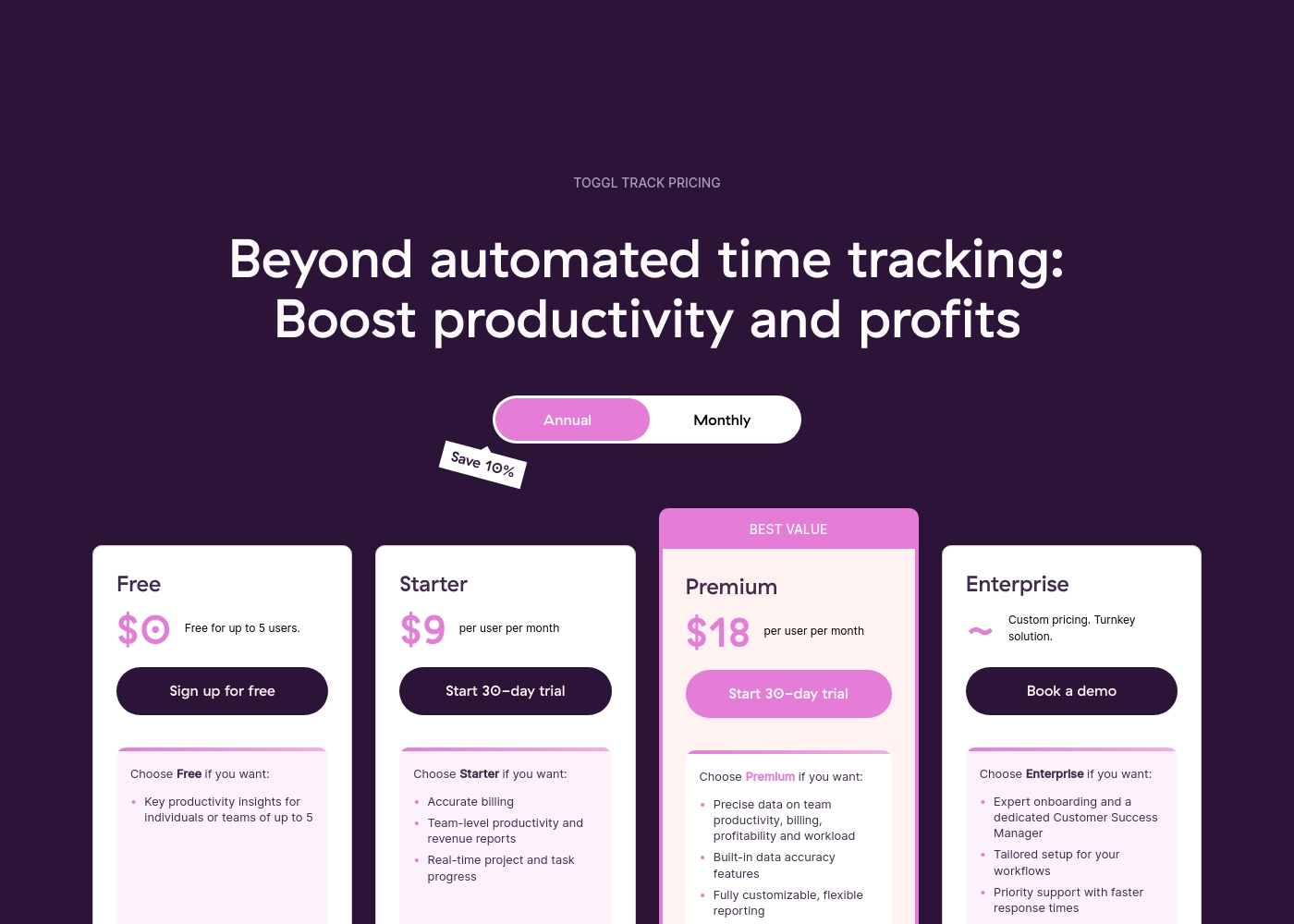
Toggl costs between $0 and Custom Pricing per month with four plans: Free at $0 (for up to 5 users), Starter at $9 per user per month, Premium at $18 per user per month, and Enterprise with custom pricing.
Let's break down what's included in each plan so you can find the perfect fit for your team. You can save 10% on paid plans by opting for annual billing.
Free
Price: $0 per month Best For: Individuals or small teams up to 5 users Other Features:
- Key productivity insights
- Time tracking on web, desktop, and mobile
- Integration with 100+ tools
- Free for up to 5 users
- Key productivity insights
- Time tracking on web, desktop, and mobile
- Productivity reports
- Calendars integrations
- Accurate billing
- Team-level productivity and revenue reports
- Real-time project and task progress
- Billable rates and project time estimates
- Team collaboration features
- Precise data on team productivity, billing, profitability and workload
- Built-in data accuracy features
- Fully customizable, flexible reporting
- Timesheet approvals and Scheduled reports
- Jira, Salesforce integrations
- Expert onboarding and a dedicated Customer Success Manager
- Tailored setup for your workflows
- Priority support with faster response times
- Custom solutions and Multiple workspaces
- Volume discounts for large teams on annual plan
Pricing Notes
- busybusy requires a mandatory $40 Admin License Fee for all paid plans, making it expensive for individuals or very small paid teams.
- Toggl offers a generous 30-day free trial on paid plans, lasting twice as long as busybusy's 14-day trial.
- Toggl provides a permanent Free plan supporting teams up to five users, a great advantage over busybusy’s feature-limited free tier.
- Toggl offers a 10% discount if you choose annual billing for the Starter or Premium plan.
Pricing Head-to-Head
User Reviews
busybusy maintains a strong presence across major review platforms, confirming its status as a widely used tool for construction and remote fieldwork, though specific user feedback snippets were not provided for this synthesis. The platform's focus on industries prioritizing labor tracking strongly suggests users value specific features aimed at improving accountability and efficiency.
For time tracking tools targeting remote field teams, users commonly emphasize core requirements like reliability (especially robust offline functionality), time entry accuracy supported by GPS technologies, and seamless integration with existing payroll systems. The product narrative highlights the importance of documentation, such as daily sign-offs and automatic GPS-stamped photo storage, indicating that the solution is designed to tackle crucial pain points surrounding liability and compliance.
Toggl presents a highly split user experience, reflected in its current poor Trustpilot rating of 2.3. While many satisfied, long-term users praise the generous free tier, multi-platform accessibility, and simplicity for basic needs, recent feedback highlights significant reliability and support failures.
Current users report severe product deterioration, including a laggy UI, bugs, lost entries, and race conditions that mess up data 📉. The most consistent critical issue involves customer support, which users describe as non-responsive, sending generic emails, or being impossible to reach.
I’ve been using the free version daily for about a year, and it’s fantastic for simple tracking. I use it for multiple projects and clients, relying on the keyboard shortcut to toggle the timer on and off. It’s definitely easy to use.
Our Verdict
Choosing busybusy versus Toggl depends entirely on your work environment: the construction site or the office desk. Both track time, but their core priorities are miles apart. If you manage remote field labor and need perfect location data, busybusy is the clear, decisive winner. busybusy excels by providing uncompromising location accountability and liability protection. It uses "Required Onsite" GPS checks to stop payroll time theft completely. Supervisors save crucial time by clocking in whole crews at once on the mobile app. busybusy also protects you with Daily Sign-Offs, documenting non-injuries every single day. Contrarily, Toggl makes financial analysis and flexible reporting its main focus for knowledge workers. The Starter plan enables accurate client billing and crucial team-level revenue tracking features. Toggl is also better set up for large-scale IT implementation, offering Single Sign-On (SSO). The key trade-off is often between physical accountability features and business intelligence tools. busybusy is specialized for accurate job costing and rigorous field documentation. Toggl is better for internal workforce capacity planning and customizable client reports. Critically, busybusy is also significantly more stable based on user reviews. Final verdict: Pick busybusy if accurate field documentation and GPS compliance are non-negotiable for your business model. Choose Toggl if your team works remotely in front of a computer and you require deep profitability reporting for clients.
Frequently Asked Questions
Which is better for construction teams: busybusy or Toggl?
busybusy is engineered specifically for construction and remote industries. It offers features like 'Required Onsite' GPS and liability protection Sign-Offs. Toggl focuses on office-based client work and financial reporting, making busybusy the better fit.
Is Toggl’s Free plan better than busybusy’s Free plan?
Yes, Toggle’s Free plan allows up to five users with key productivity insights. busybusy’s Free plan supports unlimited users but limits core reporting and lacks advanced supervisor tools. For teams under five, Toggl offers more features at $0.
Does busybusy offer team revenue reports like Toggl?
busybusy specializes in job costing, providing real-time budget vs. actual reports for labor and equipment. Toggl Starter and Premium plans are built to track billable rates and team-level revenue for complex client invoicing. Toggl is better for revenue reporting.
Why would I choose busybusy despite the $40 Admin fee?
You should choose busybusy if you need its powerful liability protection and GPS accountability features. The benefits of eliminating time theft and documenting safety greatly outweigh the small $40 Admin fee for large crews. The tool prevents significant financial and legal risk.
Which one is better for enterprise-level integrations and security?
Toggl is generally better for the enterprise environment. Its Premium plan includes Single Sign-On (SSO) and direct integration with Jira and Salesforce. busybusy focuses on seamless integration with payroll and accounting systems.
How reliable is Toggl compared to busybusy based on user reviews?
busybusy has a strong 4.3 user rating, indicating high reliability and service quality. Toggl has a poor 2.6 rating, plagued by user complaints about laggy UIs, lost data, and non-responsive customer support. busybusy appears to be the more reliable choice.
Ready to Choose?
Both tools have their strengths. Choose based on your specific needs.