BILL vs Navan
BILL and Navan are both popular platforms, but they solve very different problems. BILL focuses on automating your back-office financial operations like accounts payable. Navan, on the other hand, is built specifically to streamline corporate travel booking and expense reporting. Choosing between them depends on your biggest operational headache.
Best for: Mid-sized companies automating high-volume accounts payable, Businesses needing integrated AP, AR, and procurement
Best for: Companies with frequent business travelers, Finance teams seeking to automate expense reporting
Powerful Automation, Challenging User Experience.
We recognize BILL offers powerful financial operations features designed to significantly automate AP/AR and spend management processes. However, a large volume of user feedback documents severe deficiencies in payment reliability and accessing functional customer support channels. Overall, we advise caution due to recurring critical issues regarding transparency and the difficulty in resolving operational problems, despite the clear potential for efficiency gains.
Pros
- Automates core accounts payable and invoicing processes quickly.
- Users report significant time savings, averaging 12+ hours monthly.
- Offers automatic 2-way synchronization with leading accounting software.
- Provides consolidated management for AP, AR, and Procurement in higher-tier plans.
Cons
- Customer support is consistently cited as non-existent or impossible to contact.
- Payments suffer frequent, multi-day delays (ACH/ePayments), sometimes attributed to funds being held.
- Difficult and confusing setup process requires extensive time and effort.
- Reports of accounts being closed or credit revoked without warning or clear explanation.
A solid travel hub, with some expense hiccups.
We find Navan is a capable all-in-one platform for corporate travel and expenses, especially for small to mid-sized companies. Overall, its strong booking interface and helpful support are weighed down by inconsistent expense processing and a lack of public pricing clarity.
Pros
- Free plan available for companies up to 300 employees.
- Unified platform for both travel booking and expense reporting.
- Generally praised for a straightforward and easy-to-use interface.
- Customer support is noted as responsive and helpful in resolving issues.
Cons
- Expense reimbursements can be slow or contain processing errors.
- Enterprise pricing requires contacting sales; no transparent public rates.
- Initial setup and platform rollout may be complex for some organizations.
- May not be ideal for teams needing niche, deep accounting integrations without confirmation.
AboutBILL
BILL is the definitive financial operations platform, designed to bring simplification and automation to your business. It manages everything from accounts payable (AP) and accounts receivable (AR) to spend and expense management on a single platform.
You get an aggregated cash flow task list and one secure login. BILL offers seamless, automatic sync with your preferred accounting software, ensuring you confidently automate your entire tech stack. It's built for thousands of businesses and 6,000+ accounting firms. 💡
AboutNavan
Navan is a comprehensive platform for managing business travel and expenses. It’s designed for companies of all sizes, from small businesses to large enterprises. The platform serves various industries, including technology, healthcare, and retail. 💡 It aims to be a single solution for booking trips and handling the related costs.
Highlights
Feature Comparison
Features Overview
We highlight the main differences and pick a winner for each feature.
Core Focus
BILL automates your core financial back-office. Navan is built for corporate travel and expense management.
BILL is a financial operations platform. It handles accounts payable, accounts receivable, and spend management. You can automate bill payments, send invoices, and track expenses with a Divvy card. Navan is a travel and expense platform. Employees book flights and hotels directly in Navan. Those bookings then automatically connect to expense reports for easier processing. The key difference is BILL runs your financial engine. Navan runs your travel program. They don't directly compete. Choose BILL if your main pain is manual bill processing. Choose Navan if your main pain is booking travel and tracking receipts.
Pricing & Value
BILL charges per user. Navan offers a free plan for smaller companies.
BILL has no free option. Pricing starts at $45 per user per month for the Essentials plan. The popular Corporate plan costs $89 per user per month. You pay for every person who needs access. Navan Business is completely free for companies with up to 300 employees. It includes core travel features. Larger companies get custom pricing for the Enterprise plan. BILL's value is in financial automation ROI. Users report saving 12+ hours monthly. Navan's value is cost savings on travel and time saved on expense reports. If budget is a primary concern and you have fewer than 300 people, Navan's free tier is a major advantage. BILL requires a paid investment from day one.
Customer Support
Users report significant challenges reaching BILL's support. Navan's support gets consistently positive reviews.
BILL includes standard live chat and phone support with all paid plans. However, user reviews on Trustpilot are filled with complaints. Customers describe support as "impossible to contact" and "useless chat bots." Navan offers 24/7 support with its free plan. Enterprise customers get a dedicated Account Executive and Customer Success Manager. Reviews frequently praise the support team as "responsive" and "helpful." The difference is stark. BILL's support is a major pain point for users. Navan's support is highlighted as a strength. This could be a deciding factor. If you need reliable help when issues arise, Navan appears to be the safer choice.
Ease of Use & Onboarding
Both platforms promise simplicity. Reviews suggest BILL's setup is difficult, while Navan's is generally easier but can be complex for enterprises.
BILL's marketing emphasizes saving time. However, user reviews consistently mention a "difficult and confusing setup process." Many report it requires extensive time and effort to get started. Navan is often praised for its "straightforward and easy-to-use interface" for travelers. The booking process is intuitive. Some enterprise reviews note that initial onboarding can be complex. For a small team, Navan likely offers a quicker, smoother start. For BILL, be prepared for a significant implementation investment. The day-to-day use matters most. Navan gets high marks for its booking experience. BILL's interface is functional but not its praised feature.
Reporting & Analytics
BILL provides financial reporting for AP/AR. Navan offers customizable travel and expense reports.
BILL focuses on financial reporting. You can track cash flow, AP/AR aging, and spend by category. It syncs data with your accounting software for consolidated views. Navan provides customizable reports specifically for travel spend. You can analyze booking patterns, policy compliance, and expense trends. Its data is tied to HRIS integrations. Both provide valuable insights, but for different domains. BILL's reporting helps you manage your company's money. Navan's reporting helps you manage your travel program. The winner depends on what you need to analyze. Financial health or travel policy effectiveness?
Integration Ecosystem
BILL excels with accounting software sync. Navan focuses on HRIS and travel ecosystem integrations.
BILL's standout feature is automatic 2-way sync with leading accounting software. This ensures your books are always current. It's a key selling point for finance teams. Navan offers over 30 pre-built HRIS integrations. This connects your travel platform to employee data and payroll systems. Deeper accounting integration requires sales consultation. BILL is the winner for direct accounting software connectivity. Navan wins for connecting to your HR and payroll stack. Your existing software stack will determine which integrations are more critical to your workflow.
Mobile Experience
Both offer mobile apps. BILL's app manages bills and approvals. Navan's app is for booking and on-the-go expenses.
BILL has a mobile app that allows you to review and approve bills from anywhere. You can manage cash flow tasks on your phone. It extends core AP/AR functions to mobile. Navan's mobile app lets employees book and change travel plans while traveling. They can also submit and manage expenses from their phone. The focus is on the traveler's experience. Both provide necessary mobile functionality. BILL's app is for the finance approver. Navan's app is for the traveling employee. Neither mobile experience is described as a standout feature, but both meet essential needs for their respective users.
Scalability
BILL scales with user count and plan tier. Navan scales from free to custom enterprise plans.
BILL scales by adding more users and moving to higher-tier plans like Corporate or Enterprise. Enterprise offers custom pricing, enhanced security, and multi-location accounting. Navan scales from its free Business plan for up to 300 employees to a fully customized Enterprise plan. Enterprise adds a dedicated success manager and global coverage. Both tools are built to grow with a company. The scaling path is different. BILL scales with financial complexity and user count. Navan scales with employee count and geographic complexity. For a large, global company with complex travel needs, Navan Enterprise is a clear path. For a large company with complex AP/AR needs, BILL Enterprise is the solution.
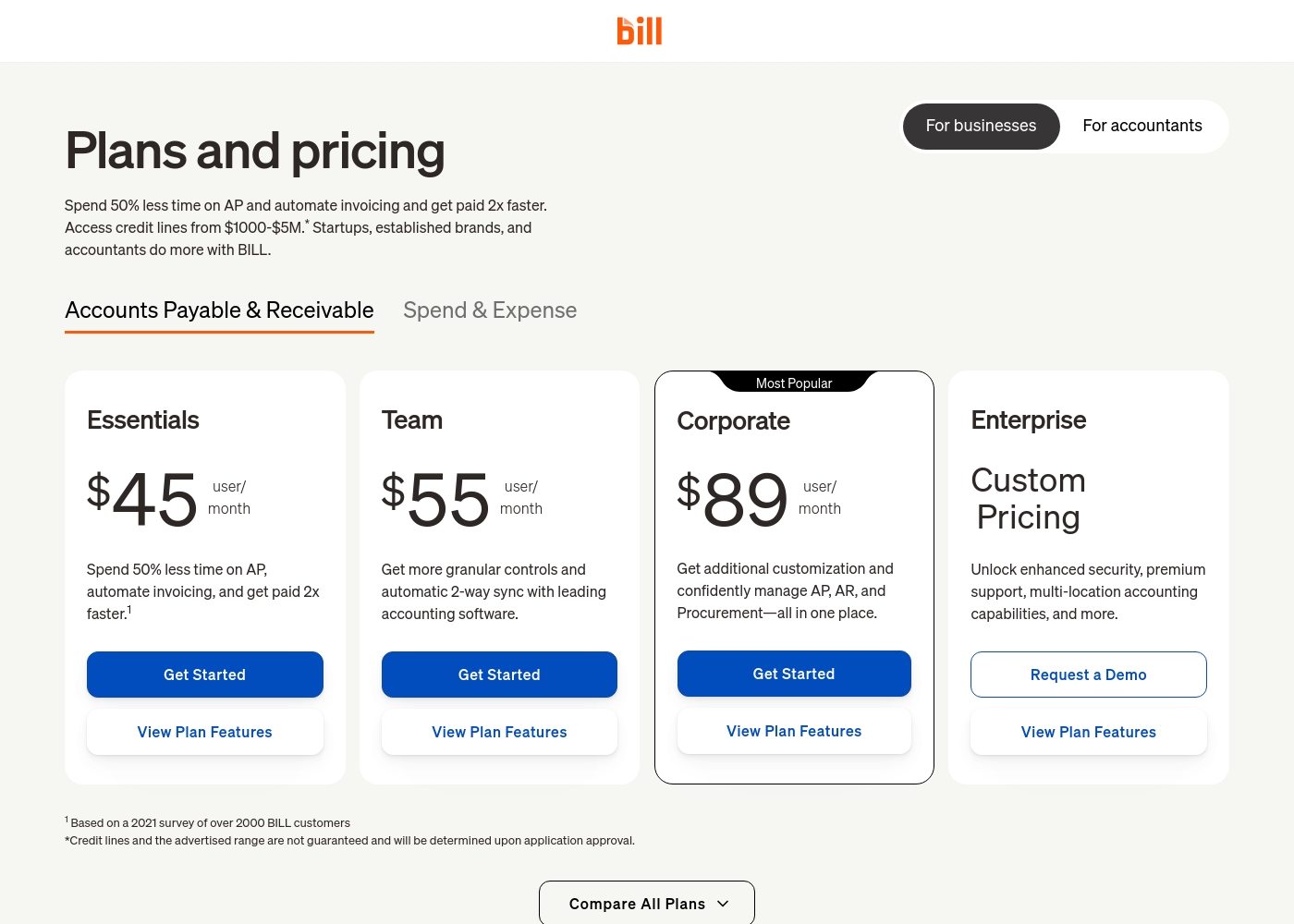
BILL costs between $45 and $89 per month with 3 fixed-price plans: Essentials at $45/user/month, Team at $55/user/month, and Corporate at $89/user/month.
Let's look closely at what each plan offers for your financial operations platform.
Essentials
Price: $45 user/month Best For: Automating core accounts payable and invoicing quickly Other Features:
- Spend 50% less time on AP.
- Automate invoicing processes effectively.
- Get paid up to 2x faster.
- Spend 50% less time on AP
- Automate invoicing
- Get paid 2x faster
- Get more granular controls
- Automatic 2-way sync with leading accounting software
- Additional customization
- Confidently manage AP, AR, and Procurement—all in one place
- Unlock enhanced security
- Premium support
- Multi-location accounting capabilities
- More
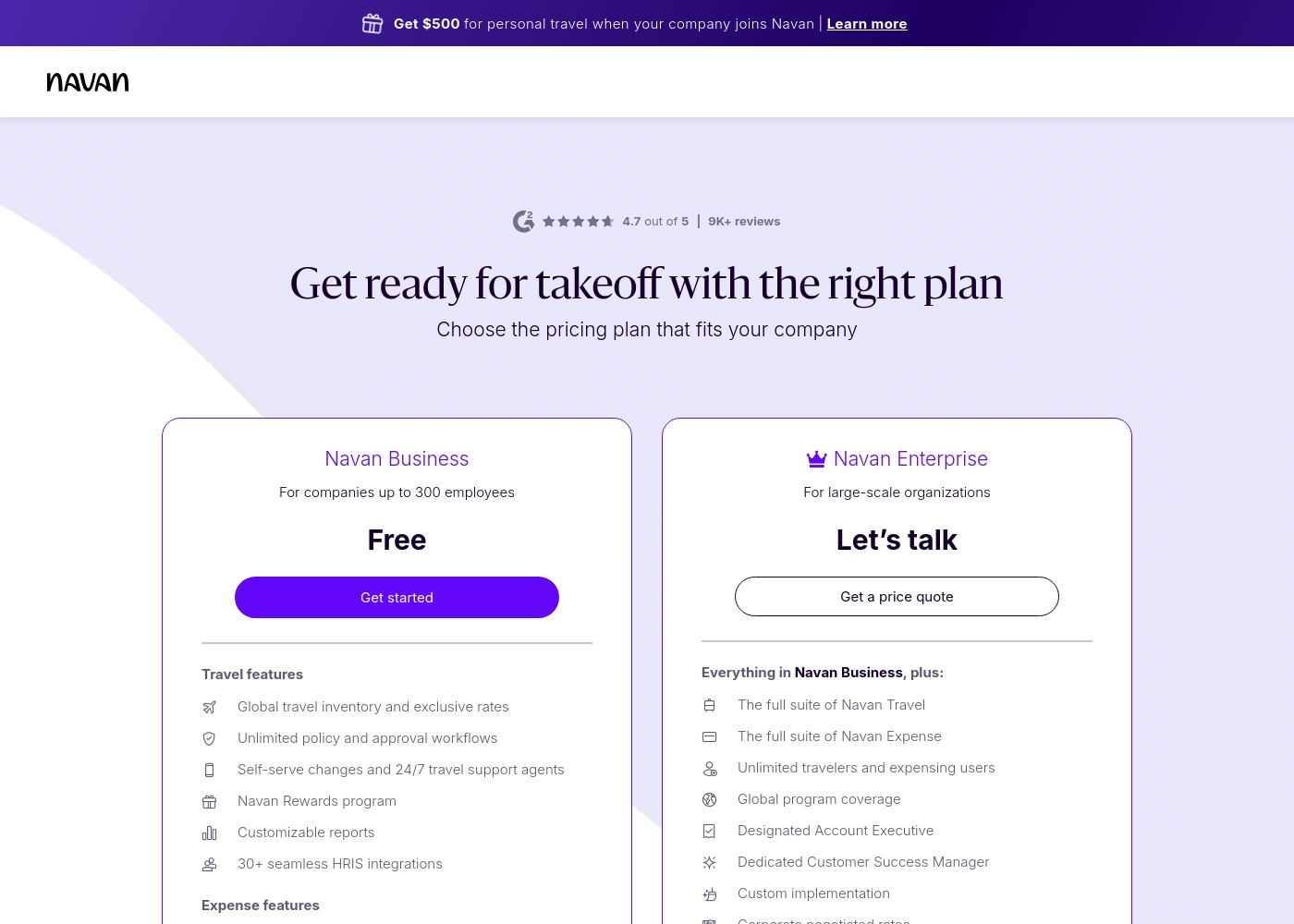
Navan costs between $0 and a custom quote with 2 plans: Navan Business at Free and Navan Enterprise at a custom price.
Here is a breakdown of the available plans and their core features for your team.
Navan Business
Price: Free Best For: Companies up to 300 employees Other Features: Global travel inventory, unlimited policy workflows, 24/7 support, Navan Rewards, 30+ HRIS integrations
- Global travel inventory and exclusive rates
- Unlimited policy and approval workflows
- Self-serve changes and 24/7 support
- Navan Rewards program
- Customizable reports
- Full suite of Navan Travel & Expense
- Unlimited travelers and expensing users
- Global program coverage
- Designated Account Executive
- Dedicated Customer Success Manager
Pricing Notes
- BILL has no free plan or free trial. All users must subscribe to a paid plan starting at $45/user/month.
- Navan offers a robust free plan (Navan Business) for companies with up to 300 employees, which includes core travel features.
- BILL's pricing is transparent but scales linearly with team size. A team of 10 on the Corporate plan costs $890/month.
- Navan's Enterprise pricing is opaque and requires contacting sales, which can be a barrier for buyers wanting quick cost estimates.
Pricing Head-to-Head
User Reviews
BILL receives significantly negative feedback on Trustpilot (2.5/5), contradicting its strong internal promises of efficiency. The most prevalent complaint is the critically nonexistent customer support.
Users report spending hours locked behind slow, unhelpful chat bots, often unable to solve basic access or payment issues. Reliability is a major concern, particularly with payments; users frequently mention significant delays in ACH/ePayments (3–4 business days), alleging the company intentionally holds funds to earn interest.
It’s basically impossible to get any support on this platform. I spent weeks just trying to get account access back. You are locked behind chat that is useless and told me three times they had resolved the issue when they hadn't.
Trustpilot reviews for Navan paint a mixed picture. 👍 Many users praise the platform's ease of use, highlighting how simple it is to book travel and manage expenses.
The responsive customer support is frequently noted as a major plus, helping resolve issues quickly. 👎 However, a recurring theme involves delays in expense reimbursements and occasional errors in processing payments.
Booking travel has never been easier. The platform is intuitive, and I love earning rewards for my business trips. It's a huge time-saver.
Our Verdict
Let's cut to the chase. BILL and Navan aren't really competitors. They solve entirely different business problems. BILL's superpower is financial automation. It's built to crush manual accounts payable, automate invoicing, and sync with your accounting software. Users report saving 12+ hours a month on AP tasks alone. Navan's superpower is simplifying corporate travel. It unifies booking flights and hotels with submitting expense reports. Employees love the easy interface, and finance teams get better policy compliance. The deciding factor is your biggest operational headache. If your team dreads processing stacks of paper bills, BILL is your answer. If your team's travel bookings and expense reports are a mess, Navan is built for you. Choose BILL if you need to automate AP/AR and have a budget for per-user software. Choose Navan if you want to streamline travel and expenses, especially if your team is under 300 people (it's free!). They're both strong tools—just for very different jobs.
Frequently Asked Questions
Which is better for small teams: BILL or Navan?
Navan is often better for small teams focused on travel, as its Business plan is free for up to 300 employees. BILL is better for small teams drowning in manual bill payments, but it requires a paid subscription starting at $45 per user per month.
Does BILL handle travel booking like Navan?
No, BILL is not a travel booking platform. Its core focus is automating accounts payable, accounts receivable, and spend management. For corporate travel booking and itinerary management, you would need a specialized tool like Navan.
Is Navan worth it if we don't travel often?
Probably not. Navan's value comes from consolidating frequent travel and expense management. If your company has minimal travel, a simpler expense tool or even your accounting software might be sufficient. Its free plan is only worthwhile if you'll use the travel booking features.
How does the pricing compare for a 50-person team?
For a 50-person team, BILL would cost at least $2,250/month on the Essentials plan. Navan would be completely free under its Business plan (for up to 300 employees). The cost difference is substantial if travel is your main need.
Which integrates better with QuickBooks?
BILL is designed for this. It offers automatic 2-way sync with leading accounting software like QuickBooks. Navan's integration with accounting systems is less direct; you would need to confirm specific compatibility with their sales team.
Can I use BILL and Navan together?
Yes, many companies use both. You could use Navan to book travel and manage those expenses, then use BILL to automate the payment of the resulting vendor invoices and other operational bills. They serve complementary functions.
Ready to Choose?
Both tools have their strengths. Choose based on your specific needs.