BILL vs Divvy
People often compare BILL and Divvy for comprehensive financial automation. BILL is a structured, paid platform focused on AP and AR workflows. Divvy offers world-class expense management software completely free of charge. You must decide if you prioritize bill processing or real-time employee spend control.
Best for: Midsize companies requiring integrated AP/AR management, Organizations needing full procure-to-pay automation in one system
Best for: Startups focused strictly on eliminating manual expense reports, Businesses prioritizing instant, real-time spend control
Powerful Automation, Challenging User Experience.
We recognize BILL offers powerful financial operations features designed to significantly automate AP/AR and spend management processes. However, a large volume of user feedback documents severe deficiencies in payment reliability and accessing functional customer support channels. Overall, we advise caution due to recurring critical issues regarding transparency and the difficulty in resolving operational problems, despite the clear potential for efficiency gains.
Pros
- Automates core accounts payable and invoicing processes quickly.
- Users report significant time savings, averaging 12+ hours monthly.
- Offers automatic 2-way synchronization with leading accounting software.
- Provides consolidated management for AP, AR, and Procurement in higher-tier plans.
Cons
- Customer support is consistently cited as non-existent or impossible to contact.
- Payments suffer frequent, multi-day delays (ACH/ePayments), sometimes attributed to funds being held.
- Difficult and confusing setup process requires extensive time and effort.
- Reports of accounts being closed or credit revoked without warning or clear explanation.
Great Features, Crippling Support Issues.
We find that BILL Spend & Expense provides a powerful and free expense management platform with excellent features like real-time control and accounting integration. However, external reliability reports surrounding poor customer support, massive payment delays, and unexpected account closures are major concerns we see repeatedly mentioned by users. Overall, we cannot recommend this platform for essential business operations until substantial improvements are made to operational reliability and customer service responsiveness.
Pros
- Expense management software is offered completely free of charge.
- Provides real-time spend visibility and customizable budget controls.
- Users can issue unlimited virtual and physical cards easily.
- Seamless integration capabilities with major accounting systems (QuickBooks, NetSuite).
Cons
- Critically poor or non-existent customer support and responsiveness.
- Frequent reports of delayed payments and intentional holding of funds (4+ business days for ACH).
- Difficult and confusing setup and onboarding processes.
- Recurring issues with reliability; accounts are blocked or closed suddenly, often without explanation.
AboutBILL
BILL is the definitive financial operations platform, designed to bring simplification and automation to your business. It manages everything from accounts payable (AP) and accounts receivable (AR) to spend and expense management on a single platform.
You get an aggregated cash flow task list and one secure login. BILL offers seamless, automatic sync with your preferred accounting software, ensuring you confidently automate your entire tech stack. It's built for thousands of businesses and 6,000+ accounting firms. 💡
AboutDivvy
BILL Spend & Expense (formerly Divvy) is an all-in-one expense management platform built for modern businesses. ✅ It blends free, world-class software with access to the BILL Divvy Card. This unique combination helps small or midsize companies achieve greater control.
It focuses on transforming spend and expense management by emphasizing control, simplicity, and savings. The ultimate goal is to eliminate manual expense reports entirely.
Highlights
Feature Comparison
Features Overview
We highlight the main differences and pick a winner for each feature.
Core Financial Function
BILL handles AP/AR; Divvy focuses strictly on controlling spending.
BILL is an integrated financial operations platform for AP, AR, and basic spend tracking. It streamlines bill approval and helps companies get paid 2x faster. Divvy (BILL Spend & Expense) is a dedicated solution for expense management and corporate cards. Its mission is to eliminate painful manual expense reporting entirely. BILL manages money flow both into and out of your business ecosystem. Divvy is solely focused on managing employee outflow and expenses. Deciding what tool you need depends on your biggest office friction point right now.
Software Pricing Model
Divvy’s software is free; BILL requires a paid per-user subscription.
BILL uses a traditional subscription model costing $45 to $89 per user monthly. Your costs scale directly with the size of your team. Divvy offers its robust expense management software completely free of charge. There are no hidden fees, contracts, or per-user seat limits. Divvy is overwhelmingly the value leader in terms of pure software access and zero user cost. BILL requires dedicating a significant budget to finance automation. The free access makes Divvy an excellent choice for startups needing powerful control immediately without high subscription costs.
Accounts Receivable (AR)
BILL fully automates AR; Divvy provides no AR capabilities.
BILL includes robust AR automation allowing businesses to send invoices effortlessly. This feature is critical for accelerating client payment times reliably. Divvy does not offer any functionality related to Accounts Receivable or customer invoicing. It is purely an expense and spend control platform. If your business manages high volumes of customer invoicing, BILL must be the platform you choose. Divvy simply does not play in the revenue collection space at all. BILL ensures the entire financial lifecycle, from invoicing to bill payment, is covered within one system.
Spend Control & Cards
Divvy focuses on real-time control; BILL integrates the concept via credit access.
BILL provides integrated spend tracking linked to the BILL Divvy Card access. It helps businesses optimize cash flow and set simple controls. Divvy's entire system is built for real-time spend visibility and customizable policy enforcement. It offers unlimited physical and secure virtual cards. Divvy offers superior granular control, enforcing budgets before employees spend the money. BILL provides the controls as an integrated benefit of the platform. If your primary goal is instantly restricting employee spending, Divvy is the superior, dedicated solution.
Procurement Management
BILL includes dedicated P2P features; Divvy focuses only on expenses.
BILL provides full procure-to-pay automation in its higher tiers (Corporate plan and up). This consolidates AP, AR, and Procurement management. Divvy operates strictly in the expense management space with no listed dedicated procurement features. It manages purchasing, but not the holistic P2P workflow. If your organization requires comprehensive oversight of the entire purchasing lifecycle, BILL is the more robust choice. The Corporate plan specifically offers this integration. This feature makes BILL more appealing to mature finance departments with complex purchasing protocols.
Customer Support
Both platforms suffer from critically poor and non-responsive customer support.
BILL receives consistent negative reviews citing non-existent support that is impossible to contact. Users are often stuck behind slow chatbots. Divvy users also report severely poor customer experiences and massive delays. Some users mention being on hold for six hours to reach staff. It is widely reported that both BILL and Divvy suffer from reliability issues, including payment delays. Both hold funds for days, allegedly to earn interest. Expect difficulty resolving complex operational issues regardless of whether you choose BILL or Divvy.
Time Saving Methodology
Both save roughly 12 hours monthly, but target different finance tasks.
BILL users report saving an average of 12+ hours monthly by automating AP/AR workflows. This time saving is aimed at the core accounting team. Divvy users also report saving about 12 hours every month on expense reporting tasks. This time saving benefits the entire employee base. BILL improves bill processing efficiency dramatically (from 30 hours to about 5 hours weekly). Divvy eliminates the need for employees to chase receipts. The efficiency gains are substantial for both but target separate organizational pain points.
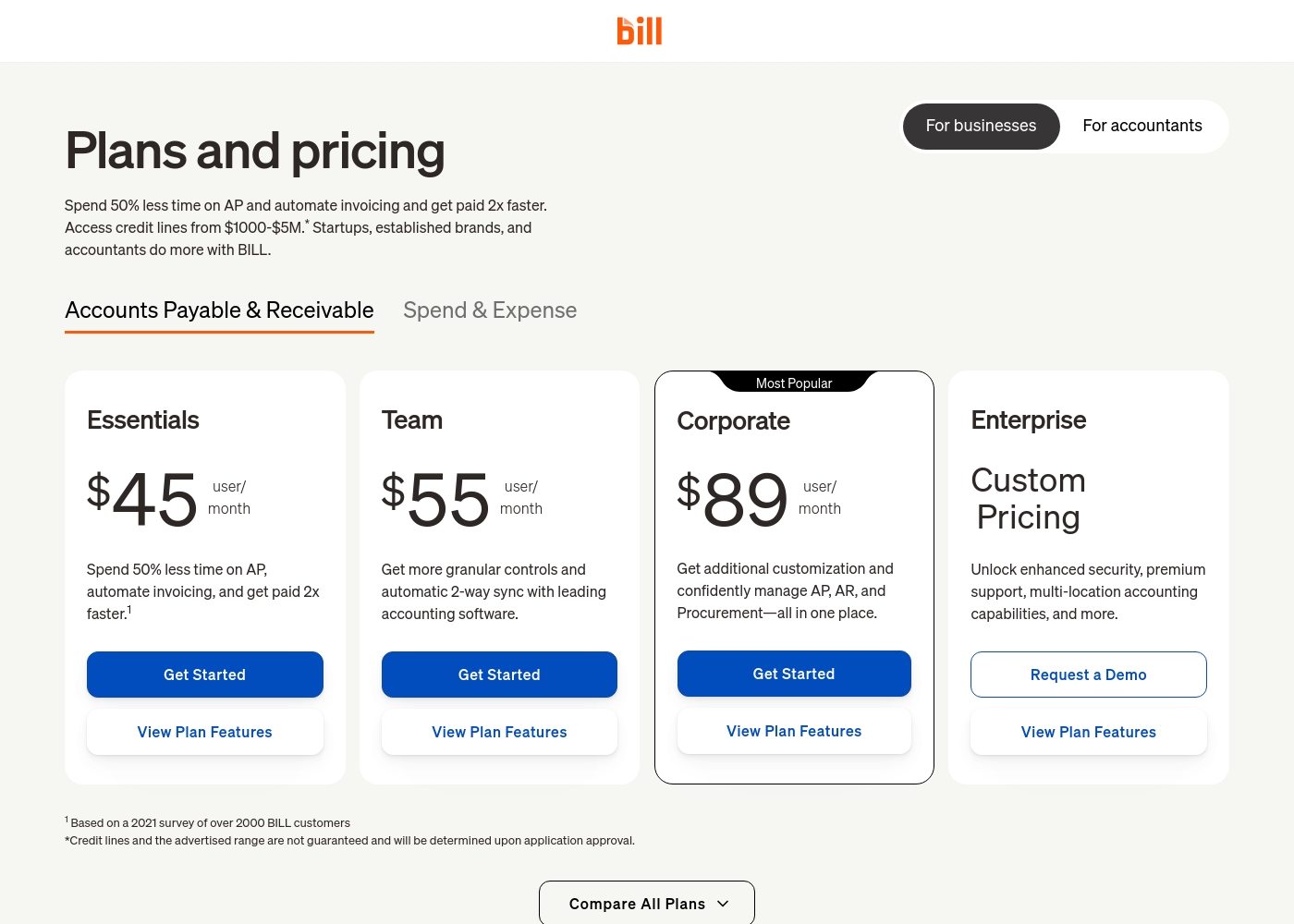
BILL costs between $45 and $89 per month with 3 fixed-price plans: Essentials at $45/user/month, Team at $55/user/month, and Corporate at $89/user/month.
Let's look closely at what each plan offers for your financial operations platform.
Essentials
Price: $45 user/month Best For: Automating core accounts payable and invoicing quickly Other Features:
- Spend 50% less time on AP.
- Automate invoicing processes effectively.
- Get paid up to 2x faster.
- Spend 50% less time on AP
- Automate invoicing
- Get paid 2x faster
- Get more granular controls
- Automatic 2-way sync with leading accounting software
- Additional customization
- Confidently manage AP, AR, and Procurement—all in one place
- Unlock enhanced security
- Premium support
- Multi-location accounting capabilities
- More
Divvy (BILL Spend & Expense) costs Free per month with one primary offering: Spend & Expense Software at Free.
The powerful software platform is offered at no charge, letting you focus on managing your business finances efficiently. Here is a breakdown of the single, comprehensive software offering.
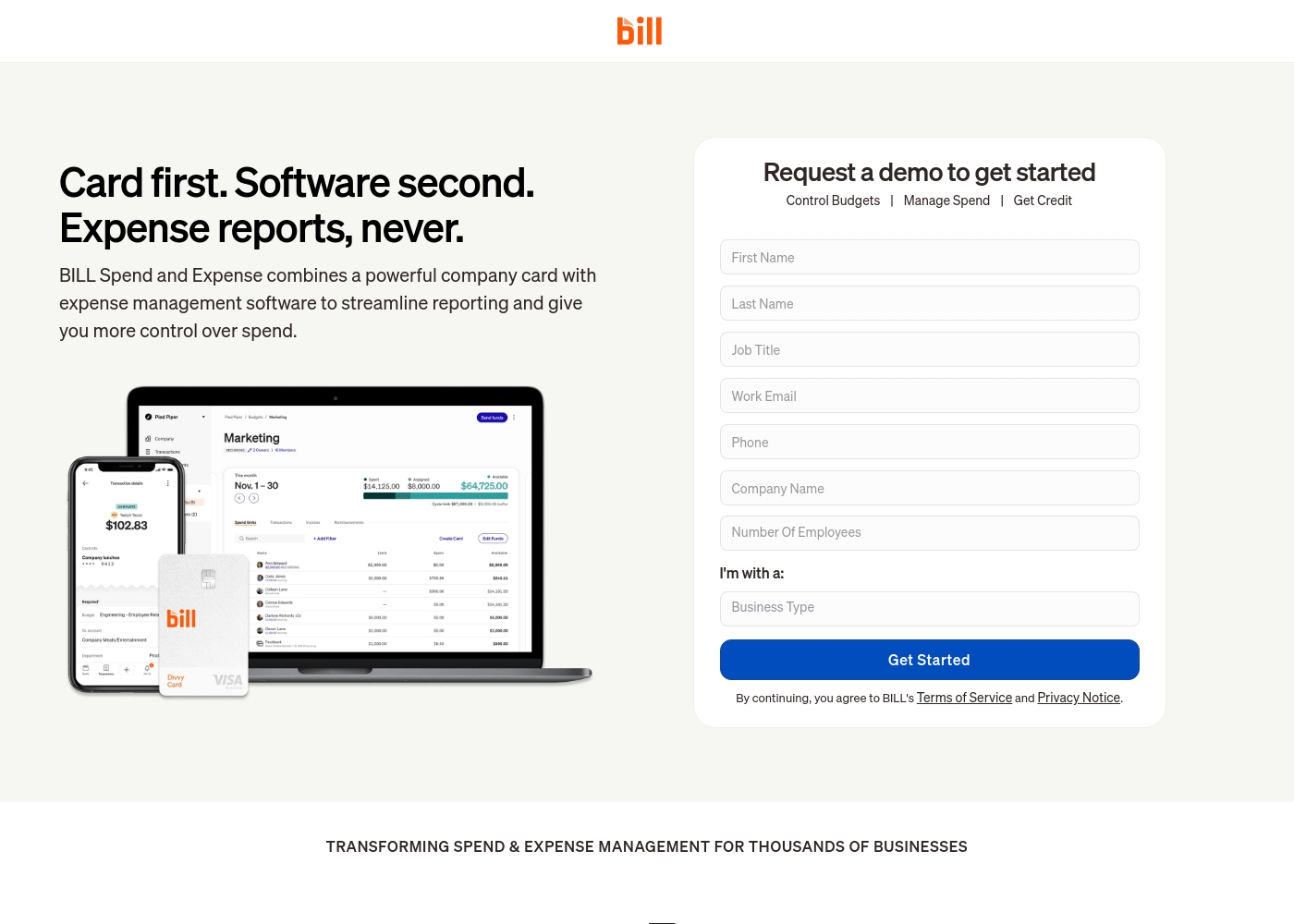
Spend & Expense Software
Price: Free Best For: Businesses seeking robust, integrated spend management and corporate credit. Other Features:
- No hidden fees or contracts.
- Unlimited physical and virtual cards.
- Highly-rated, full-featured mobile app for all users.
- Support for reimbursements and expense tracking.
- Integrates with QuickBooks, NetSuite, and Sage Intacct.
- Free software, combined with access to the BILL Divvy Card
- No hidden fees or contracts
- As many physical and virtual cards as you need
- Highly-rated, full-featured mobile app
- Real-time visibility and customizable control over spend
Pricing Notes
- Divvy's expense management software is 100% free but requires using the associated corporate card.
- BILL charges per user monthly, meaning costs increase significantly as your team scales.
- BILL subscriptions start at $45/user/month for the Essentials plan.
- Neither BILL nor Divvy explicitly offers a money-back guarantee or traditional free trial.
Pricing Head-to-Head
User Reviews
BILL receives significantly negative feedback on Trustpilot (2.5/5), contradicting its strong internal promises of efficiency. The most prevalent complaint is the critically nonexistent customer support.
Users report spending hours locked behind slow, unhelpful chat bots, often unable to solve basic access or payment issues. Reliability is a major concern, particularly with payments; users frequently mention significant delays in ACH/ePayments (3–4 business days), alleging the company intentionally holds funds to earn interest.
It’s basically impossible to get any support on this platform. I spent weeks just trying to get account access back. You are locked behind chat that is useless and told me three times they had resolved the issue when they hadn't.
The core offering of free expense software with integrated controls is attractive, yet user feedback delivers an extremely negative view of the service execution. Users report significant issues with customer support, frequently citing staff as non-responsive, difficult to reach, and lacking visibility across cases.
This critical operational failure contributes to major frustrations regarding reliability, especially around payment processing. Recurring themes include funds being held or delayed, often taking four or more business days for ACH/ePayments to clear.
This is the worst customer service experience I have ever had in my life. I spent over six hours this week on hold talking to clueless people who have no visibility into other support calls.
Our Verdict
Choosing between BILL and Divvy is less about price and more about function. Both platforms target financial workflow automation but solve very different problems. You won't find better support, as both BILL and Divvy users report critically poor experiences. BILL's superpower is centralizing core financial operations, specifically AP and AR management. It automates bill creation and helps you efficiently process payments. If you need full procure-to-pay control, BILL’s Corporate plan provides the necessary tools. Divvy's superpower lies in its free, world-class expense management software and real-time spending control. Divvy eliminates the time suck of manual employee expense reports completely. You get unlimited virtual cards instantly to maximize spending security. The deciding factor is your biggest internal financial bottleneck. BILL fixes the chaotic workflow around paying vendors and invoicing customers. Divvy fixes the problem of employees overspending and the endless receipt process. Choose BILL if integrated AP/AR automation is your priority and you budget for powerful software. Pick Divvy if you need free, robust spend control tightly linked to a corporate card solution.
Frequently Asked Questions
Which is better for core back-office finance: BILL or Divvy?
BILL is better as it’s designed as a full financial operations platform. BILL centralizes Accounts Payable (AP) and Accounts Receivable (AR) automation. Divvy focuses only on spend and expense management, not core AP/AR processes.
Does Divvy require a monthly subscription fee per user like BILL?
No, Divvy's expense management software is completely free of charge. BILL requires a subscription of $45 to $89 per user monthly. Divvy has no user seat limits or hidden costs for the software itself.
Can BILL manage Accounts Receivable (AR) or customer invoicing?
Yes, BILL includes full Accounts Receivable automation as a core function. It helps you send invoices and get paid faster. Divvy does not include any tools or features for managing customer invoicing or AR.
Why do customer reviews criticize both BILL and Divvy so heavily?
Users widely allege both platforms have non-existent customer support that is impossible to reach. Reviewers also cite frequent, multiple-day payment delays for ACH/ePayments. These critical operational failures impact user trust for both BILL and Divvy.
Which tool is better for real-time employee spend control and budgets?
Divvy is generally better suited for real-time spend control implementation. Its platform is built specifically to issue unlimited cards and enforce budgets instantly. BILL provides similar controls but focused through its broader financial platform.
What is the key difference between BILL and Divvy's integration capabilities?
Both BILL and Divvy offer automatic two-way accounting sync capabilities. Divvy specifically names Intuit QuickBooks, Oracle NetSuite, and Sage Intacct integrations. BILL only generically states it syncs with 'leading accounting software.'
Ready to Choose?
Both tools have their strengths. Choose based on your specific needs.