BigCommerce vs WooCommerce
BigCommerce vs WooCommerce is the classic e-commerce choice: managed SaaS versus open-source control. BigCommerce offers reliable infrastructure and 24/7 professional support for rapid scaling. WooCommerce delivers unmatched flexibility, powered by WordPress, but demands significant technical know-how.
Best for: E-commerce businesses needing guaranteed high uptime (99.99%) during critical peak seasons., Brands requiring built-in B2B and wholesale features for customer groups and pricing.
Best for: Web designers and experienced developers who demand total control over the source code., Businesses prioritizing absolute customization control over their hosting environment.
Robust tools meet customer service disconnect.
We observe BigCommerce heavily emphasizing high-level enterprise tools, like guaranteed 0% transaction fees and robust infrastructure for scalability. However, user reviews detail severe service issues, including unexpected server outages and deeply unresponsive customer support, even for priority users. Overall, BigCommerce provides impressive technical capability that is unfortunately undermined by inconsistent stability and poor customer experience.
Pros
- Guaranteed 0% transaction fees on the Enterprise plan.
- High reliability with 99.99% reported uptime.
- Industry-leading optimized one-page checkout available.
- Customizable, non-cookie cutter themes compared to competitors.
Cons
- Customer service is frequently reported as unhelpful, non-existent, or indifferent.
- Specific users mention significant, unexpected server downtime (e.g., 25-hour outages).
- Platform infrastructure (CMS, blog system) reportedly struggles with SEO and formatting.
- Essential features like product filters are locked behind high-tier plans.
Flexible Ecommerce Built on WordPress Power
We recognize WooCommerce's strength lies in its open-source platform, providing unmatched customization and scalability for ambitious users and developers. This flexibility, however, mandates external maintenance and a high tolerance for technical responsibility, as customer support is repeatedly cited as severely lacking. Overall, we recommend WooCommerce primarily for those with development resources or significant self-help capabilities.
Pros
- Core platform is open source, ensuring high value and low initial cost.
- Offers maximum customization and flexibility for unique stores.
- Trusted for stability and proven ability to handle large sales volumes.
- No platform commissions or subscription fees on the core product.
Cons
- Customer support is slow, non-responsive, or relies heavily on automated responses.
- Requires numerous plugins or custom coding to operate complex features (can feel bloated).
- Steep learning curve, especially concerning shipping, variations, and payment processors.
- Updates sometimes cause functionality issues or price errors.
AboutBigCommerce
BigCommerce Essentials is a top-rated ecommerce platform designed specifically for fast-growing businesses, including high-volume operations and B2B SMBs. It operates as a high-performance platform that truly scales with you. Built-in flexibility means you have the freedom to customize your store and save money at the same time. You get robust features that ensure efficient operation, allowing you to focus on expanding your brand and attracting more shoppers. ✅
AboutWooCommerce
WooCommerce is known as the most trusted ecommerce platform globally. It provides an open-source solution built on the strength of WordPress, which powers 43% of the internet. This popular combination allows you to build, sell, and scale your way, creating a store as unique as your vision. It empowers businesses and developers alike, offering a foundation for creating powerful, flexible ecommerce experiences. Whether your business is complex, simple, big, or small, WooCommerce helps you take control of your success. 💡
Highlights
Feature Comparison
Features Overview
We highlight the main differences and pick a winner for each feature.
Pricing Model
WooCommerce's core is free; BigCommerce requires a fixed monthly subscription fee.
BigCommerce operates strictly as a SaaS solution with fixed, tiered monthly costs. WooCommerce is open source and requires no mandatory subscription fees for the core software. WooCommerce users must budget heavily for robust hosting and potentially expensive required extensions. BigCommerce costs are predictable while WooCommerce costs depend on your technical needs and setup.
Customization Freedom
WooCommerce offers total control; BigCommerce provides managed flexibility.
Being open source, WooCommerce gives developers complete, unrestricted control over the entire codebase. BigCommerce offers high customization via APIs, headless readiness, and the drag-and-drop Page Builder tool. WooCommmerce customization often demands complex coding or using many plugins, potentially adding bloat. BigCommerce provides elegant, customizable themes without forcing low-level code changes.
Reliability & Uptime
BigCommerce guarantees high uptime; WooCommerce reliability relies entirely on the chosen host.
BigCommerce promises best-in-class 99.99% reported uptime and 100% uptime during crucial Cyber Week. WooCommerce's stability is completely reliant on the quality of the user’s chosen WordPress hosting provider. BigCommerce provides Tier 1 security compliance standards like PCI and ISO. Unfortunately, BigCommerce users sometimes report unexpected server outages, contradicting the high uptime guarantee.
Transaction Fees
Both BigCommerce and WooCommerce eliminate platform commission fees on sales.
BigCommerce Enterprise guarantees 0% additional platform transaction fees, allowing users to choose from 55+ providers. WooCommerce is open source and inherently charges no platform commissions on transactions. Both platforms ensure you only pay the standard rates charged by your selected payment processor. This financial structure allows both BigCommerce and WooCommerce users to maximize margin as sales grow.
Ease of Use
BigCommerce offers a simpler start for non-technical users; WooCommerce has a very steep learning curve.
BigCommerce provides a fully managed, hosted environment, simplifying core setup and daily maintenance significantly. WooCommerce requires technical expertise for initial setup, hosting configuration, and ongoing security management. BigCommerce users benefit from the intuitive drag-and-drop Page Builder and accessible customer support. New WooCommerce users must invest substantial time mastering the highly complex plugin ecosystem and architecture.
Scalability & B2B
BigCommerce offers stronger native B2B and Multi-Storefront tools compared to WooCommerce.
BigCommerce specializes in scaling, providing the Multi-Storefront feature for centralized management of multiple brands. BigCommerce includes robust native B2B features like dedicated customer groups and specialized price lists. WooCommerce can scale limitlessly but this requires premium hosting and often expensive, complex extensions. BigCommerce Enterprise features include unlimited API calls and staff accounts for huge teams.
Customer Support
BigCommerce has guaranteed 24/7 live support; WooCommerce relies on documentation and third-party support.
BigCommerce promises dedicated 24/7 live, US-based support for all essential and priority plans. However, many BigCommerce users report support is slow, unhelpful, or non-responsive, undermining their promise. WooCommerce support is primarily through documentation, community forums, or expensive support agreements with extension developers. WooCommerce users feel isolated due to the perceived lack of reliable, accessible customer service.
SEO & Content
WooCommerce leverages the world-class WordPress CMS for SEO; BigCommerce struggles with content infrastructure according to users.
WooCommerce is built on the strength of WordPress, which is excellent for content creation and search engine optimization. BigCommerce users frequently report that the platform's CMS and blogging tools make SEO difficult. WooCommerce allows powerful integration of commerce and blog content using familiar tools. BigCommerce infrastructure reportedly struggles with reliable formatting and search engine ranking.
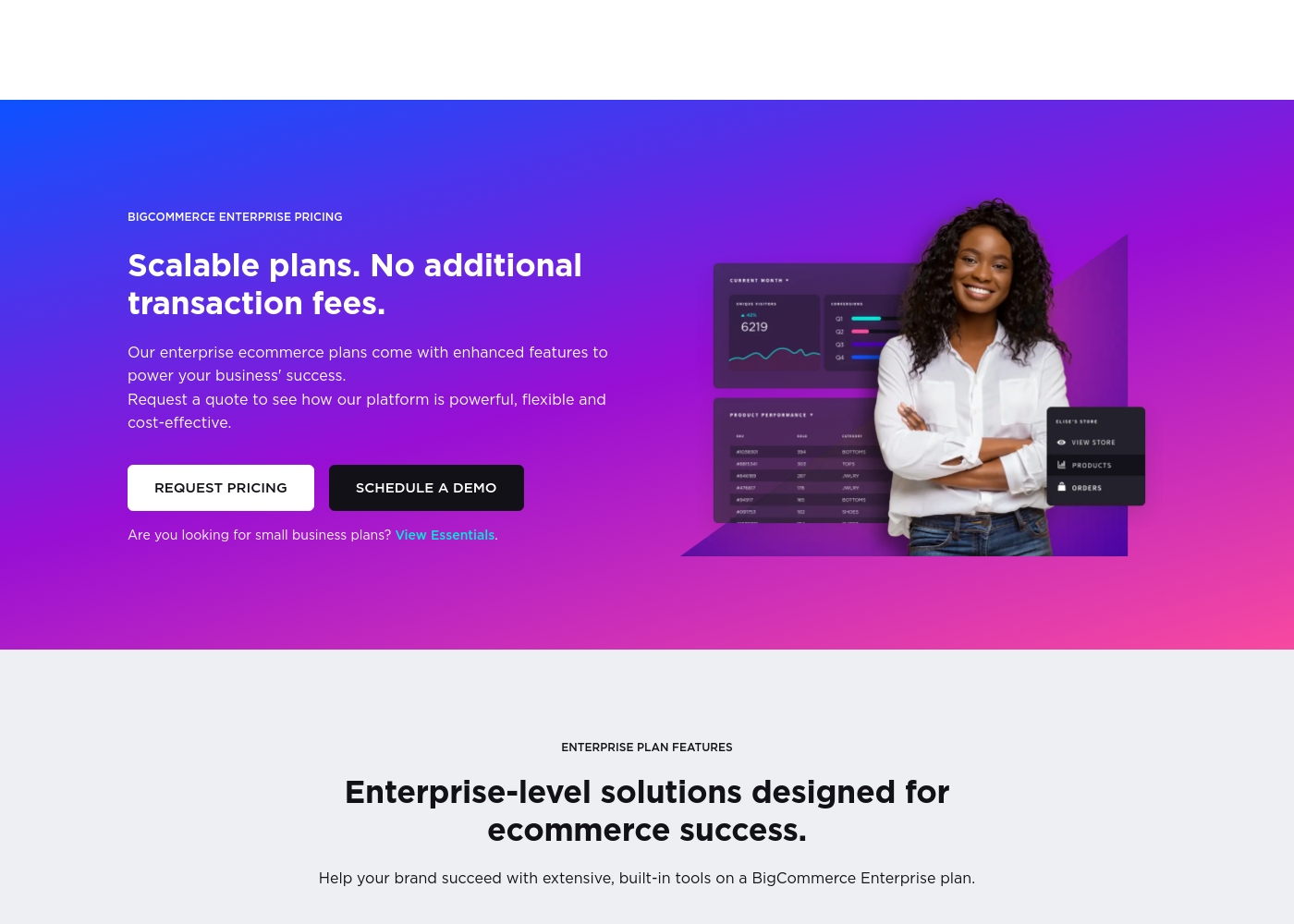
Since pricing for the most scalable options is custom, the UI requests a quote. The detailed information below relates specifically to the features included in the Enterprise service level. If you are looking for small business solutions, BigCommerce points you toward their Essentials plans.
Enterprise
Price: Request a quote Websites Supported: Multiple (via Multi-Storefront feature) Best For: Ecommerce success for mid-market and enterprise brands Other Features:
- No additional transaction fees (0%)
- Unlimited staff accounts and API calls
- 24/7 priority support (phone, chat, and ticket)
- Multi-currency support and Price lists
- Migration assistance
The Enterprise plan is tailored for large-scale operations that require maximum performance and flexibility. You benefit from highly specific features like comprehensive migration assistance and fully customizable checkout options. This plan ensures your operations run smoothly, offering robust security standards and dedicated customer success management.
- 0% additional transaction fees
- Unlimited staff accounts
- 24/7 priority support
- Multi-Storefront access
- Unlimited API calls
- Start free trial available
- Ecommerce for Growing Brands
Since WooCommerce is open source, its pricing model is highly flexible, focusing on customization rather than fixed tiers.
Core WooCommerce Platform (Open Source)
Best For: Anyone seeking maximum customization freedom and control over their platform. Other Features:
- Powered by WordPress
- Fully customizable ecommerce
- Access to hundreds of trusted extensions and themes
- Support teams across the world
- Safe and secure online payments
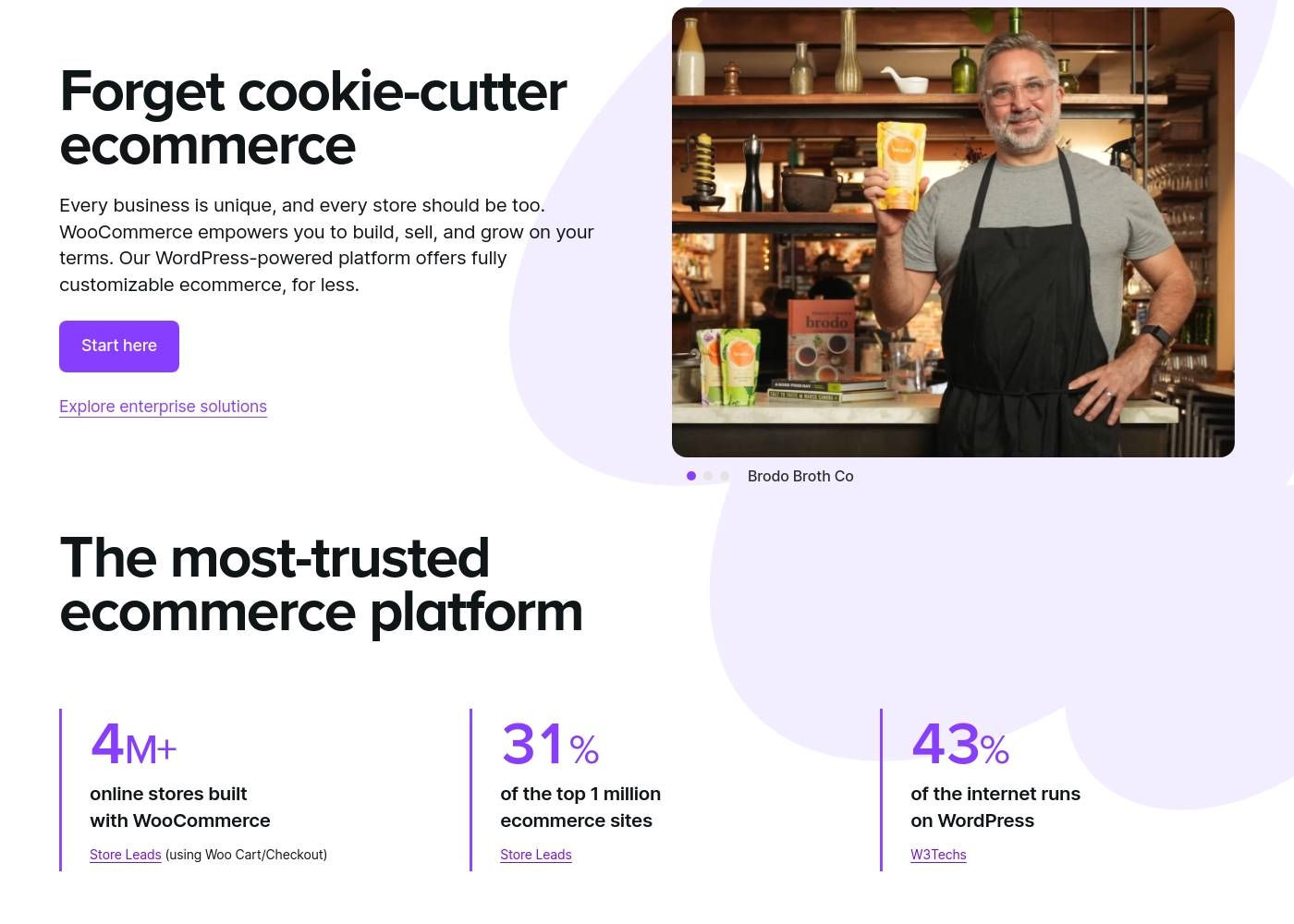
This open-source framework lets you build your unique store from the ground up. It's the best option if you want to scale your way without the limitations of fixed proprietary systems. You gain control needed to create an utterly unique brand experience for your customers. ✨
- Fully customizable ecommerce
- Powered by WordPress
- Access to hundreds of trusted extensions and themes
- Open source flexibility
- Support teams across the world
Pricing Notes
- BigCommerce Enterprise uses custom, quote-based pricing and guarantees 0% additional transaction fees on sales.
- WooCommerce's core software is free (open source), but requires separate investment in hosting and paid extensions.
- The total cost of WooCommerce is highly variable and depends entirely on the necessary add-ons and hosting performance chosen.
- BigCommerce offers a fixed, predictable expense, while WooCommerce costs are complex and entirely self-managed by the user.
Pricing Head-to-Head
User Reviews
User reviews for BigCommerce show a sharp division in experience, reflected by the low Trustpilot score (1.4). While some users find the platform intuitive and highly customizable compared to standard competitors, the dominant sentiment focuses on major technical and support failures.
Recurring complaints highlight unexpected and significant unreliability issues, with multiple reports of severe, multi-hour server outages. Furthermore, customer service is frequently described as the "worst," often failing to solve problems or responding with indifference, even for Enterprise customers.
I am on the enterprise plan and the support is completely non-existent. This platform has simply been an absolute disaster, wasting both time and money for our business. I would strongly advise others to stay away from it.
WooCommerce generates highly mixed feedback, primarily due to the severe dichotomy between its powerful, free core product and the perceived lack of service quality. Users praised its unlimited flexibility, open-source nature, and strong customization capabilities, noting it is essential for serious businesses and web developers who want maximum control without recurring platform fees.
Many established users expressed love for the product when paired with the right WordPress themes. However, the overwhelming concern centers on customer support responsiveness ❌.
Their support responsiveness is a major issue; it often takes days for them to even send a reply. This is unacceptable for mission-critical e-commerce operations. We strongly advise that businesses consider this lack of reliable support before committing.
Our Verdict
BigCommerce vs WooCommerce pits high-performance SaaS simplicity against open-source flexibility. Your final choice depends entirely on your technical comfort level. If you need guaranteed core infrastructure and high regulatory compliance, BigCommerce is the safer choice. BigCommerce excels with robust, built-in enterprise features like Multi-Storefront and 0% additional transaction fees. This platform is optimized for rapidly scaling, high-volume B2B brands. However, user reviews indicate BigCommerce support is inconsistent, and infrastructure can fail, despite their guarantees. WooCommerce, the open-source champion, offers seemingly boundless customization built on WordPress’s strength. WooCommerce requires no mandatory subscription for the core product, making the entry low for bootstrapped startups. Be warned: WooCommerce setup is technically demanding, requiring users to manage hosting, security, and complex plugins. Customer support for WooCommerce is severely criticized as slow or non-existent. Pick BigCommerce if technical management is a drain on your resources. Choose WooCommerce if you have developers and value absolute control over a predictable, managed environment.
Frequently Asked Questions
Which is cheaper: BigCommerce or WooCommerce?
WooCommerce is cheaper initially because the core platform is open source and free to use. BigCommerce requires a fixed subscription fee from day one. However, WooCommerce's total cost varies highly based on necessary extensions and robust hosting required for scaling.
Which platform is better for SEO and content marketing?
WooCommerce is significantly better for content marketing and SEO, relying on the robust WordPress architecture. BigCommerce users frequently complain that the built-in CMS and blogging systems are difficult to format. WooCommerce offers a huge advantage if you prioritize publishing high-quality, frequent content.
Does BigCommerce charge transaction fees like other hosted platforms?
No, BigCommerce guarantees 0% additional platform transaction fees on its high-tier Enterprise plan. WooCommerce also charges no platform fees since it is open source. Both platforms only charge the standard processing fees from your chosen payment gateway.
Does BigCommerce require technical skills to operate?
BigCommerce requires far less technical skill than WooCommerce because it's a managed, hosted SaaS solution. You don't manage server maintenance or security compliance. WooCommerce requires expertise in hosting, WordPress, and plugin management.
Which has better uptime reliability for major sales events like Black Friday?
BigCommerce claims superior reliability, boasting 99.99% uptime and 100% uptime during Cyber Week for ten years. WooCommerce reliability depends entirely on the stability of your chosen third-party hosting provider. BigCommerce provides a formal guarantee.
Can I manage multiple online stores with BigCommerce and WooCommerce?
Yes, both support multi-store management. BigCommerce offers the built-in Multi-Storefront feature for centralized control. WooCommerce requires significant synchronization and extension work to manage multiple distinct websites efficiently.
Ready to Choose?
Both tools have their strengths. Choose based on your specific needs.