BigCommerce vs Shopify
BigCommerce and Shopify are fierce competitors for growing brands and enterprise clients. BigCommerce is the scalable B2B powerhouse with zero transaction fees on its top tier. Shopify is the all-in-one ecosystem perfect for multi-channel sales and massive app choice. Choosing wisely depends heavily on your transaction volume and preferred sales channels.
Best for: High-volume B2B and wholesale operations, Businesses needing 0% additional transaction fees (Enterprise)

Best for: Solo entrepreneurs and small teams (Basic/Grow plans), Retailers needing integrated, seamless online and in-person POS sales
Robust tools meet customer service disconnect.
We observe BigCommerce heavily emphasizing high-level enterprise tools, like guaranteed 0% transaction fees and robust infrastructure for scalability. However, user reviews detail severe service issues, including unexpected server outages and deeply unresponsive customer support, even for priority users. Overall, BigCommerce provides impressive technical capability that is unfortunately undermined by inconsistent stability and poor customer experience.
Pros
- Guaranteed 0% transaction fees on the Enterprise plan.
- High reliability with 99.99% reported uptime.
- Industry-leading optimized one-page checkout available.
- Customizable, non-cookie cutter themes compared to competitors.
Cons
- Customer service is frequently reported as unhelpful, non-existent, or indifferent.
- Specific users mention significant, unexpected server downtime (e.g., 25-hour outages).
- Platform infrastructure (CMS, blog system) reportedly struggles with SEO and formatting.
- Essential features like product filters are locked behind high-tier plans.

Powerful Platform, Critical Service Gaps
We recognize Shopify offers an enterprise-level platform with impressive scaling tools and high-converting technology for merchants of all sizes. However, user reviews indicate systemic failures in support, billing practices, and marketplace fraud protection. Overall, Shopify provides powerful infrastructure but currently struggles to deliver a reliable, secure, or user-focused experience for many customers.
Pros
- Comprehensive commerce platform built for scaling and global growth.
- Unique Shopify Checkout converts 15% higher than competing platforms.
- Lower credit card transaction fees on Grow and Advanced plans.
- Access to Shopify Capital for loans without sacrificing equity.
Cons
- Customer support is frequently reported as unresponsive, slow, or useless (often relying on chatbots).
- Platform often fails to protect buyers and merchants from fraudulent stores.
- Frequent reports of unauthorized billing and confusing cancellation procedures.
- Complexity makes site setup difficult for non-technical beginners.
AboutBigCommerce
BigCommerce Essentials is a top-rated ecommerce platform designed specifically for fast-growing businesses, including high-volume operations and B2B SMBs. It operates as a high-performance platform that truly scales with you. Built-in flexibility means you have the freedom to customize your store and save money at the same time. You get robust features that ensure efficient operation, allowing you to focus on expanding your brand and attracting more shoppers. ✅
AboutShopify
Shopify is the powerful commerce platform designed to handle every aspect of modern selling. It serves everyone, from solo entrepreneurs launching their first product to large global enterprises. This platform manages your sales whether you are selling direct-to-consumer or handling wholesale B2B transactions. You get an organized, fully centralized Shopify Admin to control everything, from the back office to the front of the store. Millions of merchants trust Shopify; together, they have reached over $1 trillion in collective sales. ✨
Highlights
Feature Comparison
Features Overview
We highlight the main differences and pick a winner for each feature.
Transaction Fees
BigCommerce offers the potential for 0% extra fees; Shopify always charges third-party fees.
The BigCommerce Enterprise plan guarantees 0% additional transaction fees. This applies even if you use one of 55+ external payment providers. High-volume merchants save serious money by avoiding these fees. Shopify applies transaction fees if you do not use Shopify Payments. These fees range from 2% (Basic) down to 0.6% (Advanced plan). You must adopt their payment gateway to unlock optimal rates, which maintains control for Shopify. This pricing structure highlights BigCommerce's appeal to established, high-revenue businesses. Shopify users must factor in the cost of using their preferred independent payment processor. For maximum profit retention, BigCommerce wins at the Enterprise level.
Scalability & B2B
BigCommerce focuses on backend B2B scale; Shopify prioritizes unified sales channels.
BigCommerce is fundamentally structured for massive scale and B2B success. Features include Multi-Storefront management from one central back-end. Enterprise plans include robust tools for customer groups and customized price lists. Shopify offers dedicated B2B wholesale options with flexible pricing. It helps manage up to 200 inventory locations on the Plus plan. Shopify focuses more on integrating B2B sales with its core platform. BigCommerce provides unlimited staff accounts and unlimited API calls on Enterprise. This technical freedom supports complex internal integrations and high employee count. Both scale, but BigCommerce is designed for structural Enterprise growth. If running separate regional or brand storefronts is a key need, BigCommerce's Multi-Storefront is highly efficient.
App Ecosystem
Shopify has 13,000+ ready-made apps; BigCommerce prioritizes bespoke API integrations.
Shopify provides a massive, accessible ecosystem of over 13,000 installable apps. Users find fast, plug-and-play solutions for almost any challenge. This wide variety reduces reliance on external developers immediately. BigCommerce relies more heavily on its API-driven flexibility for integration. Users often engage specialized agency partners or verified Upwork freelancers. Customization is possible but often requires more setup effort and expense. Shopify is ideal for quickly adding new features without coding knowledge. BigCommerce is better for technically demanding, unique integrations. For sheer breadth and ease of use, Shopify dominates the app space.
In-Person Selling
Shopify offers unified POS and online management; BigCommerce focuses digitally.
Shopify is the 'one commerce platform' that unifies sales via Shopify POS. This feature links physical and online inventories automatically through the central Admin. This makes hybrid online/offline retail simple and effective. BigCommerce supports digital sales primarily, with features like 'Buy Online, Pick Up in Store.' It is not marketed as a dedicated unified POS system. Its core competency remains high-volume digital transactions. If you have a brick-and-mortar location that needs synchronization, Shopify is the clear winner. BigCommerce's features target pure ecommerce and wholesale distribution models.
Platform Reliability
BigCommerce provides hard uptime guarantees; Shopify’s reliability is high but unquantified.
BigCommerce reports best-in-class 99.99% uptime platform reliability. They boast 100% uptime assurance across ten years of Cyber Week sales. This stability is critical for businesses operating during peak seasons. Shopify provides secure, unlimited hosting on all plans. While performance is generally fast, specific downtime recovery guarantees are less public-facing. User reviews sometimes cite unexpected server outages and technical failures. If avoiding downtime during crucial holiday rushes is your top concern, BigCommerce offers a stronger, quantifiable promise. High-traffic sites benefit most from BigCommerce's tested infrastructure.
Customer Support
Both have poor review ratings, but BigCommerce formally structures priority assistance.
BigCommerce provides 24/7 live, US-based support for Essentials users. Enterprise clients receive dedicated 24/7 priority support and express ticket routing. This guarantees a higher structured level of response. Shopify receives widespread complaints about customer support in user reviews. Users label support as unresponsive, slow, and unhelpful when facing complex issues like payout holds. The sheer size of the user base may dilute support quality. While real-world experiences vary for both, BigCommerce clearly promises a higher touch support model for its Enterprise tier. Choose BigCommerce if you are paying for high-tier priority support access.
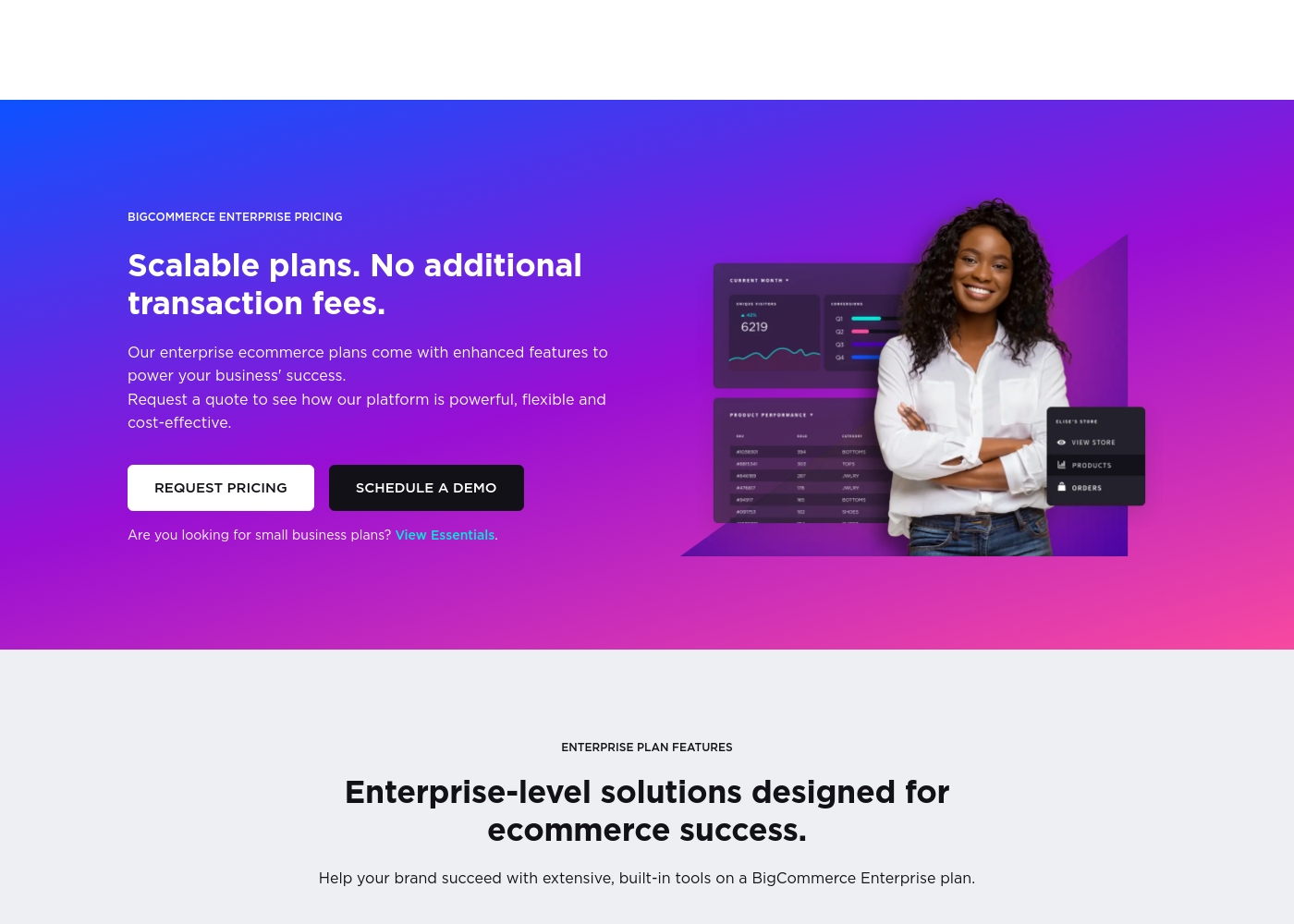
Since pricing for the most scalable options is custom, the UI requests a quote. The detailed information below relates specifically to the features included in the Enterprise service level. If you are looking for small business solutions, BigCommerce points you toward their Essentials plans.
Enterprise
Price: Request a quote Websites Supported: Multiple (via Multi-Storefront feature) Best For: Ecommerce success for mid-market and enterprise brands Other Features:
- No additional transaction fees (0%)
- Unlimited staff accounts and API calls
- 24/7 priority support (phone, chat, and ticket)
- Multi-currency support and Price lists
- Migration assistance
The Enterprise plan is tailored for large-scale operations that require maximum performance and flexibility. You benefit from highly specific features like comprehensive migration assistance and fully customizable checkout options. This plan ensures your operations run smoothly, offering robust security standards and dedicated customer success management.
- 0% additional transaction fees
- Unlimited staff accounts
- 24/7 priority support
- Multi-Storefront access
- Unlimited API calls
- Start free trial available
- Ecommerce for Growing Brands
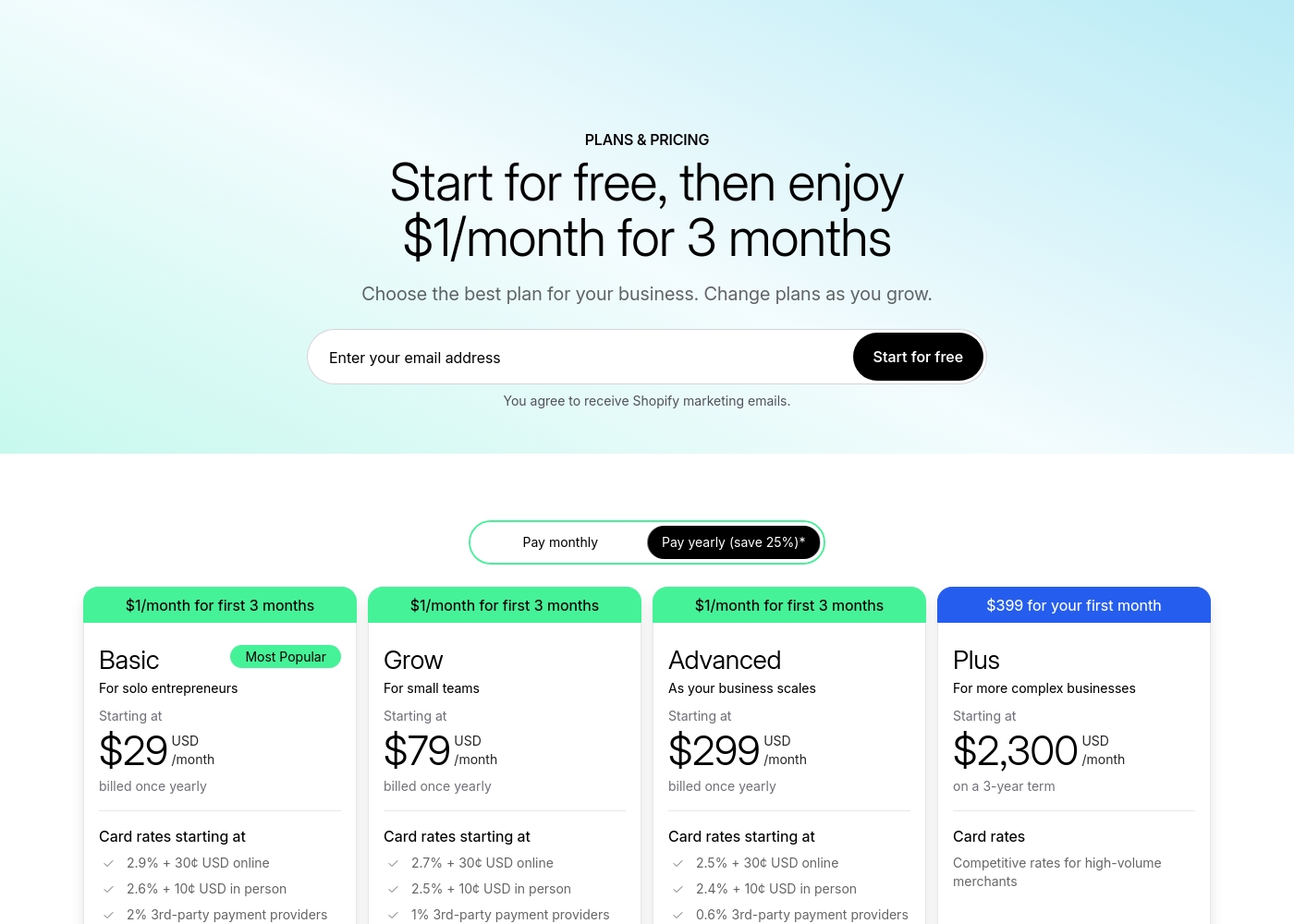
Shopify costs between $5 (Starter) and $2,300 (Plus) per month with six key plans: Starter at $5/month, Basic at $29/month (billed yearly), Grow at $79/month (billed yearly), Advanced at $299/month (billed yearly), Retail at $89/month, and Plus at $2,300/month (on a 3-year term).
Here’s a detailed look at the core subscription options designed to help your business evolve and scale.
Starter
Price: $5 USD / month Best For: Selling instantly through social media and messaging apps Other Features: Simple online store, Learn more link
- Sell instantly through social media and messaging apps
- Simple online store access
- For solo entrepreneurs - Most Popular
- 2.9% + 30¢ USD online card rates
- Up to 77% shipping discount
- 10 inventory locations
- 24/7 chat support
- For small teams
- 5 staff accounts
- 2.7% + 30¢ USD online card rates
- Up to 88% shipping discount and insurance
- 1% 3rd-party payment provider fees
- As your business scales
- 15 staff accounts
- 2.5% + 30¢ USD online card rates
- 3rd-party calculated shipping rates
- Enhanced 24/7 chat support
Pricing Notes
- BigCommerce’s Enterprise plan uses custom, quote-based pricing. This tier guarantees 0% additional transaction fees.
- Shopify offers a free plan and tiered plans from $29 to $399/month, plus the Plus plan ($2,300/month).
- Shopify charges third-party transaction fees (up to 2%) unless you use Shopify Payments.
- BigCommerce Essential plan pricing is not publicly disclosed, requiring contact with sales.
- Shopify offers a limited 3-day free trial; BigCommerce's trial length is unspecified.
Pricing Head-to-Head
User Reviews
User reviews for BigCommerce show a sharp division in experience, reflected by the low Trustpilot score (1.4). While some users find the platform intuitive and highly customizable compared to standard competitors, the dominant sentiment focuses on major technical and support failures.
Recurring complaints highlight unexpected and significant unreliability issues, with multiple reports of severe, multi-hour server outages. Furthermore, customer service is frequently described as the "worst," often failing to solve problems or responding with indifference, even for Enterprise customers.
I am on the enterprise plan and the support is completely non-existent. This platform has simply been an absolute disaster, wasting both time and money for our business. I would strongly advise others to stay away from it.
While Shopify is recognized as an exceptionally powerful commerce platform that enables aggressive scaling, external feedback indicates significant user dissatisfaction. Customers frequently cite severe issues with customer support, emphasizing that interactions are often negative, slow, or handled by unhelpful chatbots.
A major recurring theme, especially on Trustpilot, focuses on platform reliability and integrity, with many users openly classifying Shopify as a 'fraudsters paradise' that fails to protect consumers from scam stores operating on the platform. Furthermore, the pricing structure and billing accuracy generate major complaints.
The platform is expensive and gives minimal customer support. You often learn how things work by making costly mistakes. Given their high fees, they should offer much better service.
Our Verdict
Choosing between BigCommerce and Shopify isn't about which is objectively 'better.' It’s about fitting your business model to the platform’s core strength. For growing brands, it’s a detailed balancing act of fees, flexibility, and features. Both platforms receive very painful user reviews regarding customer support responsiveness. BigCommerce is the powerful, high-volume Enterprise machine. Its superpower is structural stability and cost efficiency at scale. Getting 0% additional transaction fees is a massive financial advantage for BigCommerce users. It is purpose-built for B2B wholesale and multi-storefront complexity. Shopify is the vast, flexible commerce ecosystem connecting everything. Its superpower is its massive 13,000+ app store and integrated POS system. If you need a plug-and-play solution or run hybrid retail, Shopify gives you unmatched options. Shopify is easy to launch and rapidly iterate. The deciding factor is transaction fees versus integration method. If you are high-volume and hate fees, choose BigCommerce Enterprise. If you want endless integrations and need in-person POS sync, choose Shopify. If you run an elaborate multi-brand structure, BigCommerce is structurally superior. For any retailer needing seamless physical and digital storefronts, Shopify is the platform you need.
Frequently Asked Questions
Which is cheaper for high-volume sales: BigCommerce or Shopify?
BigCommerce is likely cheaper for very high volume on the Enterprise plan. BigCommerce offers 0% additional transaction fees, saving 2%+ on every sale. Shopify charges ongoing transaction fees if you don't use Shopify Payments.
Which platform is better for physical retail: BigCommerce or Shopify?
Shopify is better due to its robust Shopify POS system. This allows seamless sync of all online and in-person inventory. BigCommerce is primarily focused on digital sales and wholesale distribution.
Which has a better app ecosystem: BigCommerce or Shopify?
Shopify wins easily with its vast ecosystem of 13,000+ apps. BigCommerce relies on custom API work and specialized agency partners. Shopify is better for quick, off-the-shelf integrations.
Does BigCommerce guarantee uptime like Shopify?
BigCommerce guarantees 99.99% uptime year-round for maximum stability. It boasts keeping 100% uptime during Cyber Week for ten years. Shopify provides secure hosting but does not publish specific guarantees.
Does BigCommerce charge extra transaction fees?
No, the BigCommerce Enterprise plan guarantees 0% additional transaction fees. This applies regardless of the chosen payment provider. Shopify charges fees unless you use their in-house payment solution.
Can I manage multiple online stores with BigCommerce or Shopify?
Yes, both can handle multiple stores, but differently. BigCommerce offers the Multi-Storefront feature for centralized management. Shopify uses its Admin and Markets feature for global reach.
Ready to Choose?
Both tools have their strengths. Choose based on your specific needs.
