BigCommerce vs Drip
BigCommerce and Drip serve different parts of the e-commerce journey. BigCommerce is your online store itself. Drip is the email marketing engine that drives sales from that store. Choosing depends on whether you need the storefront or the marketing tool.
Best for: Growing brands needing a complete, scalable online store, B2B and wholesale businesses requiring customer groups and price lists
Best for: E-commerce brands (Shopify, BigCommerce, WooCommerce), Course creators and educators
Robust tools meet customer service disconnect.
We observe BigCommerce heavily emphasizing high-level enterprise tools, like guaranteed 0% transaction fees and robust infrastructure for scalability. However, user reviews detail severe service issues, including unexpected server outages and deeply unresponsive customer support, even for priority users. Overall, BigCommerce provides impressive technical capability that is unfortunately undermined by inconsistent stability and poor customer experience.
Pros
- Guaranteed 0% transaction fees on the Enterprise plan.
- High reliability with 99.99% reported uptime.
- Industry-leading optimized one-page checkout available.
- Customizable, non-cookie cutter themes compared to competitors.
Cons
- Customer service is frequently reported as unhelpful, non-existent, or indifferent.
- Specific users mention significant, unexpected server downtime (e.g., 25-hour outages).
- Platform infrastructure (CMS, blog system) reportedly struggles with SEO and formatting.
- Essential features like product filters are locked behind high-tier plans.
Powerful for e-commerce, but check the support.
We find Drip to be a highly capable email automation platform built specifically for B2C e-commerce. Its visual builder and smart segmentation are standout features for creating personalized customer journeys. Overall, it's a strong choice for online brands, provided your team can manage the learning curve and verify support levels.
Pros
- Excellent visual workflow builder for automation
- Deep e-commerce integrations (Shopify, WooCommerce)
- Powerful, behavior-based segmentation tools
- Free migration for large lists (17,500+)
Cons
- Pricing can become expensive as contacts scale
- Some users report slow or inconsistent customer support
- Requires integration with compatible platforms
- Advanced features may have a learning curve
AboutBigCommerce
BigCommerce Essentials is a top-rated ecommerce platform designed specifically for fast-growing businesses, including high-volume operations and B2B SMBs. It operates as a high-performance platform that truly scales with you. Built-in flexibility means you have the freedom to customize your store and save money at the same time. You get robust features that ensure efficient operation, allowing you to focus on expanding your brand and attracting more shoppers. ✅
AboutDrip
Drip is an email marketing automation platform built for B2C companies that sell online. Whether you're an e-commerce brand, a course creator, or a travel provider, it gives you the tools to move beyond generic newsletters. It's designed to be a powerful yet simple engine for driving revenue through personalization. 💡
Highlights
Feature Comparison
Features Overview
We highlight the main differences and pick a winner for each feature.
Core Purpose
BigCommerce builds your store. Drip markets your products through email.
BigCommerce is a complete e-commerce platform. It handles product listings, checkout, payments, and hosting. You build your entire online business here. Drip is a specialized email marketing tool. It connects to your existing store (like Shopify or BigCommerce). It automates emails to recover carts and nurture customers. The key difference is foundational. BigCommerce is the engine. Drip is the fuel injection system. Think of it like this: BigCommerce is your physical shop. Drip is the billboard and loyalty program outside it.
Email Automation
Drip's automation is its superpower. BigCommerce's is basic.
BigCommerce includes basic marketing tools. You can send promotional emails and set up simple abandoned cart reminders. It's functional but not advanced. Drip specializes in visual workflow automation. You build multi-step email sequences based on user behavior. Templates for browse abandonment or new customer onboarding launch in minutes. The trade-off is depth versus simplicity. Drip offers complex automation. BigCommerce offers simple, built-in tools. For example, Drip can send a follow-up if someone viewed a product but didn't buy. BigCommerce's tools are less granular.
Ease of Use
Both aim for simplicity, but for different tasks.
BigCommerce offers a drag-and-drop Page Builder. Creating product pages and layouts is designed to be intuitive for store setup. The focus is on visual design. Drip's visual email builder requires no coding. You connect your store and import contacts. Building campaigns uses a straightforward interface focused on email. The learning curve differs by goal. Setting up a store in BigCommerce is a bigger project than creating an email flow in Drip. Both reduce technical barriers in their respective domains.
Pricing & Value
BigCommerce hides pricing. Drip scales with your contact list.
BigCommerce uses a quote-based model for its Enterprise plan. Essentials plans have pricing that isn't publicly listed. You need to request a quote. Drip's pricing is transparent. It starts at $39/month for 2,500 contacts. Your cost increases as your email list grows. Unlimited sends are included. The value proposition is different. BigCommerce's value is in the platform features. Drip's value is in email ROI. Watch out for Drip's scaling costs. A large list can get expensive quickly.
Scalability
BigCommerce scales for sales volume. Drip scales for audience size.
BigCommerce is built for growth. Features like Multi-Storefront let you manage multiple brands from one backend. Unlimited API calls on Enterprise support heavy traffic. Drip scales with your contact list and email volume. Pricing tiers accommodate growing audiences. It handles large segmentation and automation demands. They scale in different dimensions. BigCommerce handles more sales and stores. Drip handles more contacts and complex campaigns. A global brand would use both: BigCommerce for stores, Drip for global marketing.
Customer Support
BigCommerce offers 24/7 priority. Drip has high satisfaction but slower options.
BigCommerce Enterprise includes 24/7 priority support via phone, chat, and ticket. This is critical for store uptime issues. Drip offers email support to all. Live chat is available for plans $99/month+. They report a 97.3% satisfaction score. The trade-off is accessibility versus reported satisfaction. BigCommerce's support is more accessible. Drip's users report higher satisfaction. Response times matter for each. Store outages (BigCommerce) are urgent. Email campaign issues (Drip) are less time-sensitive.
Integration Ecosystem
Both integrate well, but with different partners.
BigCommerce connects with 55+ payment providers. It integrates with POS systems, ERP tools, and marketplaces like Amazon. Its ecosystem is commerce-focused. Drip integrates with e-commerce platforms like Shopify, BigCommerce, and WooCommerce. It also connects to booking and course platforms. Its ecosystem is marketing-focused. The difference is the core partner. BigCommerce partners with sales channels. Drip partners with marketing channels. You might use both together: Drip integrated with your BigCommerce store.
Customization
BigCommerce customizes your store. Drip customizes your message.
BigCommerce offers customizable themes and a Page Builder. You can connect WordPress for content. The customization is for your storefront's look and feel. Drip's customization is in email content and automation logic. The visual builder lets you design emails. Segmentation rules personalize who gets what. They customize at opposite ends of the funnel. BigCommerce customizes the purchase experience. Drip customizes the pre- and post-purchase communication. A brand can have a unique store (BigCommerce) and unique emails (Drip).
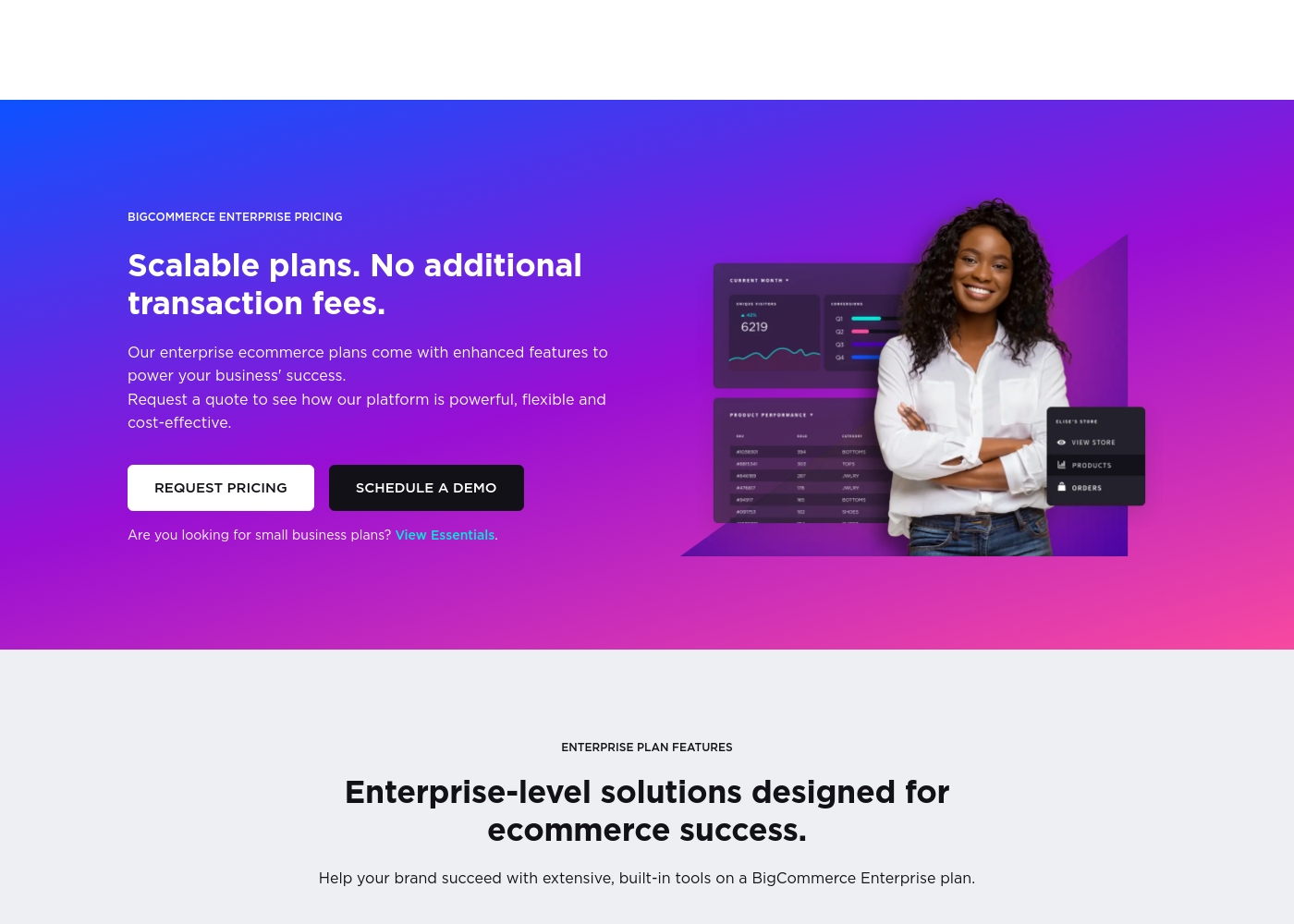
Since pricing for the most scalable options is custom, the UI requests a quote. The detailed information below relates specifically to the features included in the Enterprise service level. If you are looking for small business solutions, BigCommerce points you toward their Essentials plans.
Enterprise
Price: Request a quote Websites Supported: Multiple (via Multi-Storefront feature) Best For: Ecommerce success for mid-market and enterprise brands Other Features:
- No additional transaction fees (0%)
- Unlimited staff accounts and API calls
- 24/7 priority support (phone, chat, and ticket)
- Multi-currency support and Price lists
- Migration assistance
The Enterprise plan is tailored for large-scale operations that require maximum performance and flexibility. You benefit from highly specific features like comprehensive migration assistance and fully customizable checkout options. This plan ensures your operations run smoothly, offering robust security standards and dedicated customer success management.
- 0% additional transaction fees
- Unlimited staff accounts
- 24/7 priority support
- Multi-Storefront access
- Unlimited API calls
- Start free trial available
- Ecommerce for Growing Brands
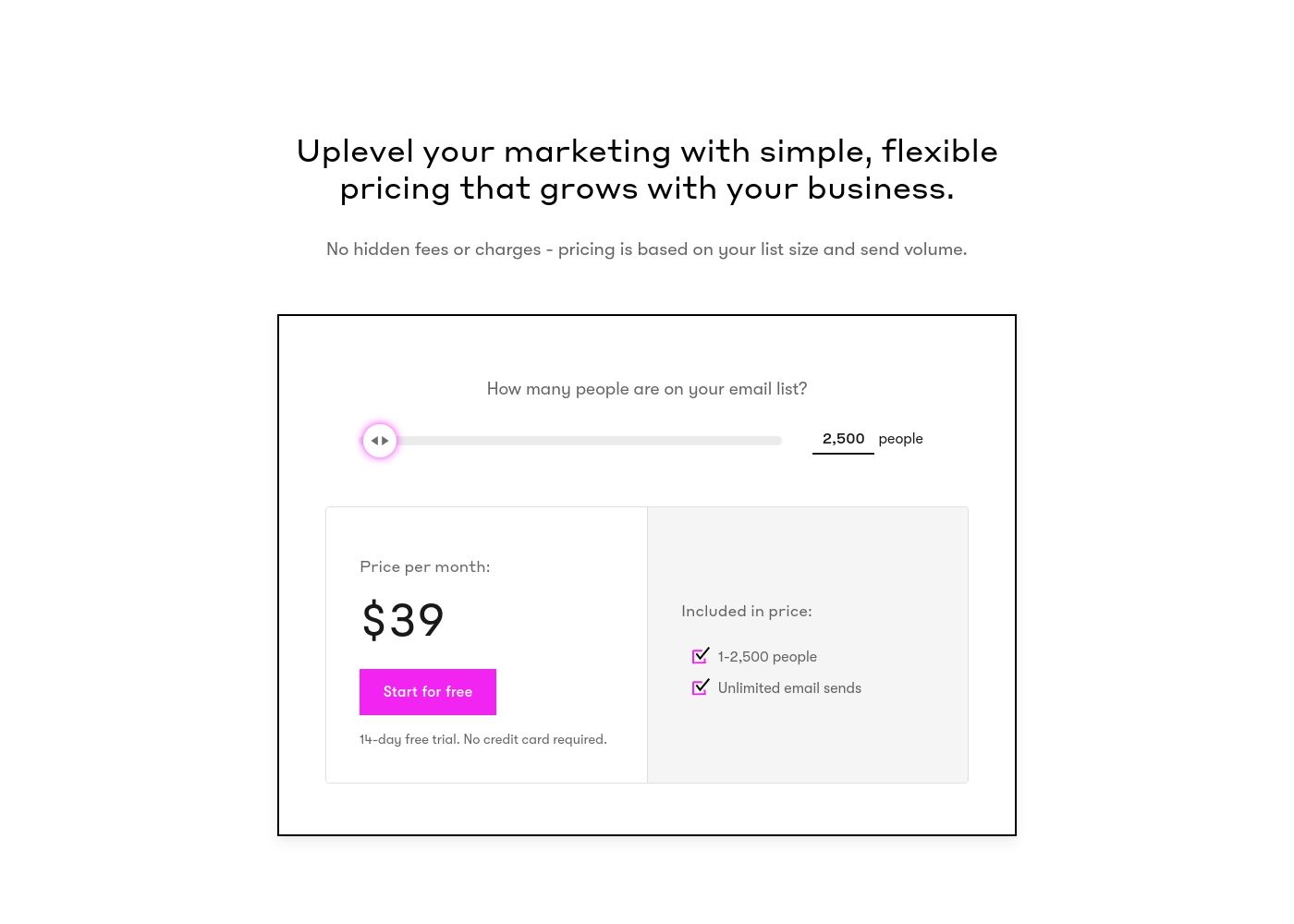
Drip pricing: Drip offers a flexible, usage-based subscription starting at $39/month for up to 2,500 people. Pricing scales based on your email list size and includes a 14-day free trial with no credit card required to start browsing its powerful automation tools tool and visual builder.
Your monthly cost increases as your audience grows, but you always get features like unlimited email sends and onsite campaigns. This ensures you only pay for what you actually use while accessing expert support and pre-built marketing playbooks right from the start.
You can cancel your subscription at any time within your billing settings if your business needs change. This model is specifically designed for e-commerce brands looking for deep segmentation and personalized customer journeys without enterprise-level complexity or hidden fees.
Pricing Notes
- BigCommerce pricing is opaque. Essentials plans exist but don't list prices publicly. Enterprise requires a sales quote.
- Drip pricing is transparent. Starts at $39/month for 2,500 contacts. Scales up as your list grows.
- BigCommerce Enterprise guarantees 0% additional transaction fees. Drip has no transaction fees.
- Drip offers a free 14-day trial. BigCommerce offers a free trial for Essentials plans.
- Value depends on use case. BigCommerce's value is in its e-commerce features. Drip's is in email marketing ROI.
Pricing Head-to-Head
User Reviews
User reviews for BigCommerce show a sharp division in experience, reflected by the low Trustpilot score (1.4). While some users find the platform intuitive and highly customizable compared to standard competitors, the dominant sentiment focuses on major technical and support failures.
Recurring complaints highlight unexpected and significant unreliability issues, with multiple reports of severe, multi-hour server outages. Furthermore, customer service is frequently described as the "worst," often failing to solve problems or responding with indifference, even for Enterprise customers.
I am on the enterprise plan and the support is completely non-existent. This platform has simply been an absolute disaster, wasting both time and money for our business. I would strongly advise others to stay away from it.
We found a mixed bag of user sentiment from Trustpilot, as the Capterra link was inaccessible. Reviews praise Drip's powerful automation and segmentation for driving revenue, with many noting its ease of use for e-commerce.
💡 On the downside, several users report frustration with customer support responsiveness and occasional platform glitches. Pricing is frequently cited as a concern, with some feeling the cost can escalate quickly as contacts grow.
Drip's automation tools are top-notch. We set up abandoned cart sequences that really boosted our recovery rate. The visual builder makes it easy to see the customer journey.
Our Verdict
This isn't a head-to-head battle. It's apples and oranges. BigCommerce builds your online store. Drip automates your email marketing. The choice isn't which is better, but which one you actually need. BigCommerce's superpower is being a rock-solid e-commerce foundation. It offers 99.99% uptime, a 0% transaction fee guarantee on Enterprise, and tools to manage multiple brands from one dashboard. It's built for the business side of selling online. Drip's superpower is turning browsers into buyers through email. Its visual workflow builder and behavior-based segmentation help brands recover carts and nurture customers automatically. It's built for the marketing side of driving sales. The deciding factor is your current need. If you need an online store, BigCommerce is the answer. If you already have a store and need better marketing emails, Drip is the tool. The verdict? Use both, likely. Build your store on BigCommerce for its reliability and scalability. Then connect Drip to automate your email marketing and recover lost sales. They solve different problems in the same e-commerce journey.
Frequently Asked Questions
Which is better for small teams: BigCommerce or Drip?
It depends on the task. Choose BigCommerce if you need to build an entire online store. Choose Drip if you have a store and need email marketing. A small e-commerce team might use both.
Does BigCommerce have email automation like Drip?
BigCommerce includes basic email marketing and simple abandoned cart reminders. Drip offers advanced, visual workflow automation for complex customer journeys. Drip is the specialist in this area.
Can I connect Drip to my BigCommerce store?
Yes. Drip lists BigCommerce as an integration partner. You can connect your BigCommerce store to Drip to sync customer data and trigger automated email campaigns based on shopping behavior.
Is Drip worth the cost for email marketing?
Drip's cost scales with your contact list. For businesses, the ROI comes from automated cart recovery and personalized campaigns. Many users report significant revenue growth from using its segmentation features.
Which platform has better customer support?
BigCommerce Enterprise offers 24/7 priority support. Drip provides email support to all, with live chat for higher-tier plans. Drip reports higher user satisfaction scores for its support quality.
Do I need technical skills to use these tools?
Both are designed for non-technical users. BigCommerce has a drag-and-drop builder for your store. Drip has a visual builder for your emails. Neither requires coding for core tasks.
Ready to Choose?
Both tools have their strengths. Choose based on your specific needs.