Beaver Builder vs Greenshift
This comparison pits the stable veteran, Beaver Builder, against the high-performance challenger, Greenshift. They represent fundamentally different ways to build WordPress sites. Beaver Builder prioritizes rock-solid reliability and agency features. Greenshift emphasizes extreme speed and modern Gutenberg integration for performance publishers.
Best for: Agencies requiring white labeling and robust long-term stability., Users who prioritize world-class, responsive customer support above all else.

Best for: Performance optimization junkies aiming for 100% Core Web Vitals scores., Advanced affiliate marketers needing built-in SEO schema and Link Hider tools.
Stable, Supported, and Serious Page Building.
We find Beaver Builder to be an extremely stable and robust WordPress solution, suitable for agencies and developers prioritizing reliability over constant feature churn. Overall, its consistently praised support system and clean, extendable code make it a premium, dependable choice for high-volume site production.
Pros
- Exceptionally responsive and helpful customer support (often replying within 24 hours).
- Stable, dependable, and reliable code base that rarely conflicts with updates (rock solid).
- Multisite capable and includes white labeling options for agencies (Professional/Unlimited tiers).
- Works seamlessly with almost every existing WordPress theme and plugin.
Cons
- Users have requested a greater variety of built-in creative modules.
- Full flexibility often requires pairing the builder with the Beaver Themer extension.
- Requires an annual subscription starting at $89 (no lifetime option).

Solid but mixed feedback
We view Greenshift as a fast, block-based animation builder for WordPress, with strong speed and on-page editing. Overall, we find it capable and performance-oriented, but external feedback shows variable pricing transparency and support responsiveness.
Pros
- Speed-first architecture with per-block asset loading
- No jQuery or extra dependencies
- 50+ blocks and templates for quick page builds
- On-page editing plus Full Site Editing
Cons
- Pricing transparency varies; exact prices aren’t consistently shown
- Some users report pushy sales experiences
- Mixed feedback on pricing value and long-term costs
- Some reviews note inconsistent pricing or onboarding experiences
AboutBeaver Builder
Beaver Builder is a trusted, powerful website builder designed to simplify WordPress development. Since 2014, it has helped users build professional websites easily, often in minutes instead of months. It serves a wide audience, including agencies needing stability, freelancers aiming for speed, and entrepreneurs who require easy updates without knowing how to code. This visual building method allows you to instantly see changes happen live on the front end of your site. You can start with pre-designed templates or build from scratch, creating any type of site, including blogs, eCommerce stores, and membership portals. 💡
AboutGreenshift
Greenshift is a unique WordPress core animation builder and full-site page builder designed for WordPress users who want to craft pages with motion right on the page. It’s described as the most complete Gutenberg Page Builder, letting you create stunning elements and animations directly in the editor without coding. It supports Full Site Editing and offers a library of blocks, templates, presets, and an advanced design toolkit to customize typography and colors.
Highlights
Feature Comparison
Features Overview
We highlight the main differences and pick a winner for each feature.
Performance & Speed
Greenshift is built for extreme speed; Beaver Builder offers reliable, fast workflow.
Beaver Builder ensures its code is clean and reliable, which usually results in fast load times. It handles built-in responsive design well and is optimized for general SEO. The speed comes mainly from proven stability. Greenshift is engineered for performance, scoring 100% Speed Grade A results. It uses unique conditional asset loading, requiring only 2kb of styles. Greenshift eliminates dependencies like jQuery, keeping resource usage minimal. This separation is clear: Greenshift actively chases elite speed scores. Beaver Builder prioritizes architectural reliability over absolute speed records. If Core Web Vitals are paramount, Greenshift’s approach is fundamentally superior. Greenshift gives publishers the highest possible performance edge in modern search rankings.
Agency & Developer Tools
Beaver Builder provides crucial white labeling; Greenshift offers powerful FSE dynamic integration.
Beaver Builder's Unlimited plan includes full white labeling to remove their branding. It offers critical Multisite capabilities for running large network installations. Agencies trust Beaver Builder for these administrative tools. Greenshift supports unlimited sites in its top tiers for agencies. It provides specialized tools like a Figma converter for design import. Greenshift focuses on maximizing Gutenberg's power with ACF dynamic field support. Beaver Builder’s inclusion of white labeling and network management features targets larger client-service firms. Greenshift targets power users wanting high performance and dynamic control. For agency logistics, Beaver Builder provides essential features. Agencies managing many varied client sites will depend heavily on Beaver Builder's Multisite and white labeling options.
Learning Curve & Interface
It’s classic drag-and-drop (Beaver Builder) versus modern Gutenberg blocks (Greenshift).
Beaver Builder uses a dedicated, highly intuitive front-end drag-and-drop interface. Users see changes live, keeping design fluid and separated from the back end. This proprietary method is easy for non-technical users to grasp. Greenshift is built directly into the WordPress ecosystem, using native Gutenberg blocks. It supports Full Site Editing (FSE) seamlessly. This provides deep controls using advanced design panels within the familiar block editor. If you want an interface completely separate from WordPress’s native editor, choose Beaver Builder. If you prefer deep integration with the standard FSE experience, Greenshift is preferable. Both are accessible visual builders. Users already familiar with the standard Gutenberg process will find using Greenshift totally seamless and highly intuitive.
Customer Support
Beaver Builder is renowned for exceptional, consistent support; Greenshift’s responsiveness is less documented.
Beaver Builder receives overwhelmingly positive praise for its customer support quality and speed. Users consistently report fast responses, often within 24 hours, and expert problem-solving. Priority Email Support is included in the Unlimited plan. Greenshift offers 'Premium Support' with all paid bundles. However, there is no public data or widespread user commentary detailing response consistency. Support quality relies on the team's capacity at any given time. Beaver Builder’s superior support quality is a frequently cited differentiator in reviews. This proven reliability provides huge value for mission-critical sites. For guaranteed rapid support, Beaver Builder is the safer choice. Agencies rely on Beaver Builder to back up client projects with dependable, speedy technical help.
Animation Capabilities
Greenshift excels with advanced, code-free animation; Beaver Builder focuses on static structure.
Beaver Builder is stable and focused on responsive design layouts. It does not include native tools for complex visual effects or on-scroll interactions. Users would need additional plugins or custom coding for advanced animation. Greenshift provides a unique, lightweight system based on the high-performant GSAP library. Users can create code-free effects like parallax, mouse effects, and text animations. This is a core feature of Greenshift. If visual complexity and modern interactions are key differentiators for your site, Greenshift is essential. This built-in capability saves time and reduces overhead. Beaver Builder simply cannot match Greenshift’s integrated animation engine.
SEO & Structured Data
Greenshift features specialized SEO schema blocks; Beaver Builder focuses on general SEO output.
Beaver Builder produces clean, SEO-optimized code and handles responsive design requirements. For advanced structured data like FAQ or Product schema, users must rely on external third-party plugins. Beaver Builder is focused on the foundational layer of SEO. Greenshift includes an SEO Pack with dedicated schema blocks for Product, FAQ, and Video snippets. These tools help sites gain rich snippets and better visibility in search results. Greenshift also includes profitable tools like the Link Hider. Greenshift offers far more built-in marketing and ranking optimization tools immediately available. This integrated approach simplifies managing structured data significantly. Greenshift provides advanced capabilities for search visibility and conversion. Affiliate marketers especially benefit from Greenshift's integrated schema and Link Hider function for maximized earnings potential.
Beaver Builder costs between $89 and $546 per year with 4 plans: Starter at $89, Plus at $179, Professional at $299, and Unlimited at $546.
We offer yearly licensing options designed for everyone, from individual bloggers to large agencies. Here is a breakdown of what each great value plan includes.
Starter
Price: $89 per year Websites Supported: 1 Site Best For: Getting Started! Refund Policy: 30-day money-back Other Features: Page Builder Plugin, Beaver Builder Theme, Beaver Themer, Loop Builder, WooCommerce Support
- Page Builder Plugin, Theme, and Themer
- WooCommerce Support
- Unlimited Staging Sites
- Access to Online Course Library
- Page Builder Plugin, Theme, and Themer
- WooCommerce Support
- Unlimited Staging Sites
- Access to Online Course Library
- Multisite Capable
- Multisite Network Settings
- All features from Plus tier
- Standard Email Support
- White Labeling
- Priority Email Support
- Advanced Online Courses
- Cloud Storage (Assistant Pro - 6 Months Free)
- Multisite Network Settings

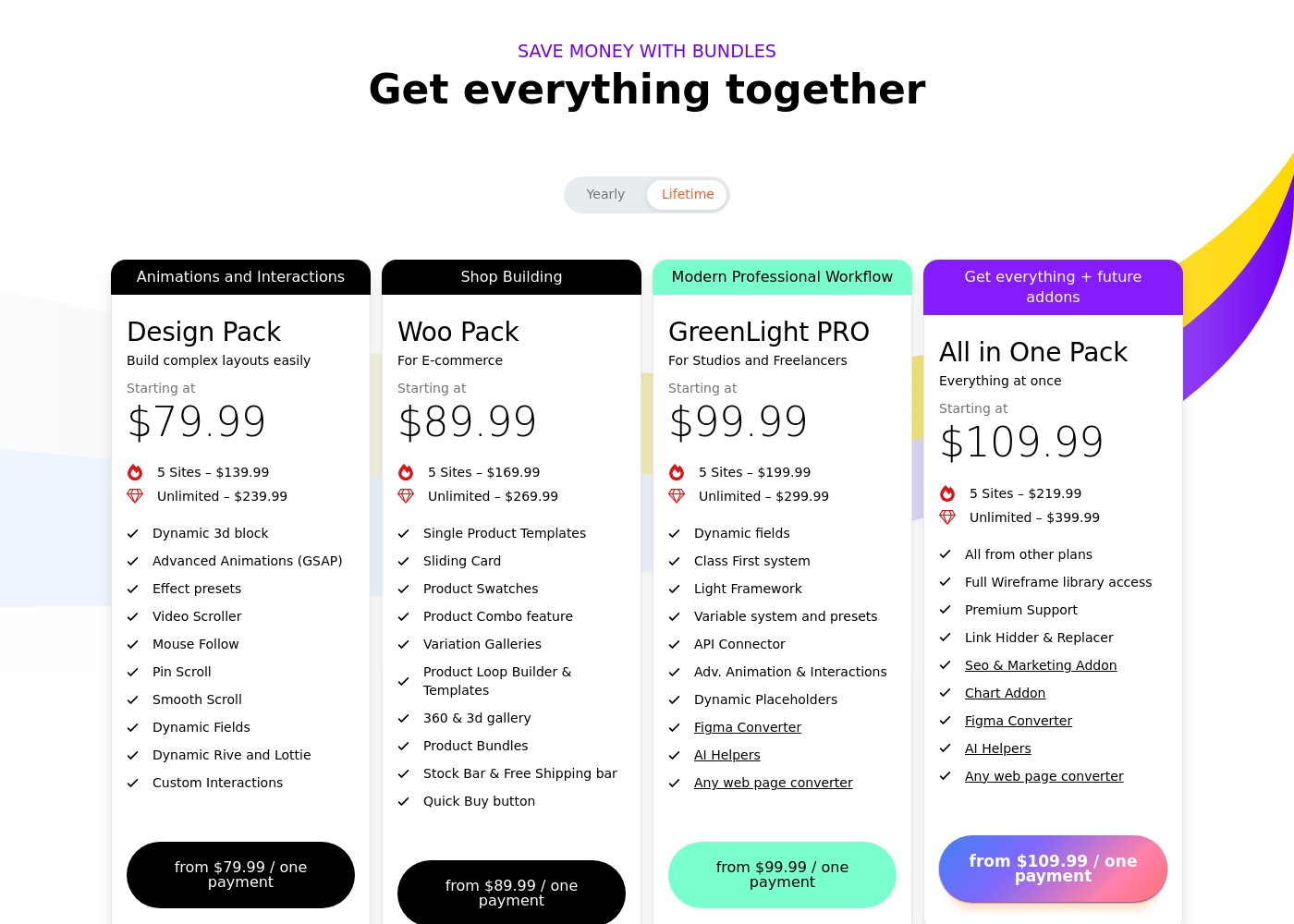
Here’s a clear look at the available bundles and who they’re for.
Design Pack
Websites Supported: 5 Sites; Unlimited Best For: Designers and developers who want a solid starter set of animation blocks Refund Policy: 14-day money-back Other Features: Dynamic 3d block; Advanced Animations (GSAP); Effect presets; Video Scroller; Mouse Follow; Pin Scroll; Smooth Scroll; Dynamic Fields; Dynamic Rive and Lottie; Custom Interactions
This package is well suited for those who want to build complex layouts with a curated set of animation blocks, while keeping the option to scale to more sites later. 🧩
- Dynamic 3d block
- Advanced Animations (GSAP)
- Effect presets
- Video Scroller
- Mouse Follow
- Single Product Templates
- Sliding Card
- Product Swatches
- Product Combo feature
- Variation Galleries
- Dynamic fields
- Class First system
- Light Framework
- Variable system and presets
- API Connector
- Everything at once
- All from other plans
- Full Wireframe library access
- Premium Support
- Link Hidder & Replacer
Pricing Notes
- Greenshift is significantly cheaper annually, starting at $39.99 versus Beaver Builder's $89 annual minimum.
- Greenshift offers highly valuable Lifetime license packages, a flexibility not provided by Beaver Builder.
- Beaver Builder pricing is site-count driven, whereas Greenshift uses feature bundles (Design, SEO, All-in-One).
- Beaver Builder offers a generous 30-day money-back guarantee, twice the length of Greenshift's 14-day policy.
- To get Beaver Builder's necessary white labeling, you must purchase the highest $546/year Unlimited plan.
Pricing Head-to-Head
User Reviews
Beaver Builder enjoys an overwhelmingly positive reception on Trustpilot, holding an Excellent 4.7-star rating. The feature consistently praised across all reviews is the exceptional customer support.
Users report that the team is highly responsive, often replying within 24 hours, knowledgeable, and frequently goes "above and beyond" to diagnose complex issues. Reliability is a core strength; the builder and the Beaver Themer extension are described as "rock solid" and totally dependable, leading to fast, stable sites with rare bugs.
I absolutely love Beaver Builder and use it with Themer for nearly every project. The support has always been great, and I enjoy how simple it makes complex building tasks.
Trustpilot reviews show a mix of praise and caution. Positive notes highlight helpful reps like Harry and Dean Roberson, who reduced costs and provided dependable guidance, and describe the on‑page, fast‑loading editing as a win.
However, some customers report pushy sales, concerns about pricing transparency, and fears about long‑term costs. Overall, Greenshift is seen as performance‑driven with a strong feature set (50+ blocks and templates) and solid support, but pricing clarity and customer experience vary.
Our experience with Green Shift Energy has been outstanding from the start. Dean Roberson provides excellent support—he’s approachable and quick to respond. As a small SME, we’ve received strong contracts and dependable guidance.
Our Verdict
Choosing between Beaver Builder and Greenshift is a core methodological decision. Are you a speed obsessed publisher embracing Gutenberg, or an agency needing absolute stability? Greenshift is the high-performance challenger focused on modern tech; Beaver Builder is the dependable, proven veteran. Beaver Builder’s superpower is its rock-solid dependability and customer support. Agencies rely on its Multisite capabilities and White Labeling found in the Unlimited plan. Its excellent support system gives clients peace of mind and rapid issue resolution. Greenshift’s superpower is peak performance and modern features, achieving 100% speed scores frequently. This is thanks to its conditional loading of just 2kb of core styles. Greenshift also includes advanced GSAP animations and built-in SEO schema that Beaver Builder lacks. The deciding factor is your editing environment: proprietary drag-and-drop or native Gutenberg FSE. Beaver Builder separates its editor visually outside the core environment. Greenshift provides seamless, lightweight power directly within the Gutenberg block framework. If you manage many clients and need agency-focused logistic tools, Beaver Builder is the essential choice. If you are a performance-obsessed entrepreneur or designer using Gutenberg, pick Greenshift for its speed and powerful modern feature set.
Frequently Asked Questions
Which is faster: Beaver Builder or Greenshift?
Greenshift is engineered for ultra-high speed and often achieves 100% Speed Grade A Scores. It uses conditional asset loading, requiring only 2kb of styles. Beaver Builder is highly stable, but Greenshift is the clearer winner for maximizing raw performance scores.
Does Beaver Builder offer a Lifetime deal like Greenshift?
No, Beaver Builder only offers annual subscription licenses ranging from $89 to $546 per year. Greenshift provides both annual bundles and a significant one-time purchase Lifetime package. For long-term savings and ownership, Greenshift is better.
Which tool is better for agencies managing client sites: Beaver Builder or Greenshift?
Beaver Builder is better for agencies due to its specialized features in upper tiers. These include crucial White Labeling and robust Multisite network capabilities. Greenshift supports unlimited sites but lacks these necessary agency administration tools.
Does Greenshift have built-in SEO schema support that Beaver Builder lacks?
Yes, Greenshift includes a specialized SEO Pack with blocks for structured data. Users can easily integrate Product, FAQ, and Event schemas for rich snippets. Beaver Builder provides general SEO optimization but requires external plugins for advanced schema.
Can I build advanced, code-free animations like parallax using Beaver Builder?
Beaver Builder does not natively feature an advanced animation framework. Greenshift includes a unique, lightweight system based on GSAP for complex effects. With Greenshift, you can easily create custom effects without any coding skills.
How does Greenshift's annual pricing compare to Beaver Builder?
Greenshift is considerably cheaper, with annual bundles starting at $39.99 for focused features. Beaver Builder's annual entry is $89 and its pricing is tiered primarily by site limit. Greenshift offers better initial pricing value.
Ready to Choose?
Both tools have their strengths. Choose based on your specific needs.
