Aweber vs GetResponse
This is a classic battle between simple reliability and massive feature depth. Aweber focuses on providing rock-solid email basics for small teams and creators. GetResponse offers a comprehensive marketing suite and strong guarantees. We break down which powerhouse deserves your crucial marketing budget.
Best for: New creators needing a perpetual Free plan entry point, Small businesses who prioritize 24/7 phone support and free migrations
Best for: E-commerce stores needing abandoned cart recovery and sales funnels, Creators monetizing knowledge via built-in online courses and webinars
Feature-rich, hampered by operational flaws.
We find AWeber provides a functional email marketing platform targeting small businesses with strong automation and AI tools. However, external feedback detailing unexpected billing practices and unannounced account suspensions raises significant concerns about user trust and service reliability. Overall, the reported operational and customer service drawbacks severely counteract the platform's solid feature set.
Pros
- Access to 24/7 support via phone, chat, and email (as advertised).
- Robust AI assistants available for drafting emails and refining subject lines.
- Flexible pricing tiers starting low for 500 contacts, available with a free trial.
- Unlimited features provided on the Plus plan, including automations and landing pages.
Cons
- Numerous reports of 'sneaky billing,' including charging for unsubscribed or inactive lists.
- Customer accounts or essential features often suspended without prior email notification.
- Users report significant difficulty securing refunds, even when canceling during the trial period.
- Arbitrary rejection of imported customer lists, leading to account suspension risks.
Exceptional support meets scalable marketing automations.
We found GetResponse to be an exceptionally powerful and affordable platform offering limitless features like autoresponders, automation workflows, and newsletters, designed specifically for scaling businesses. Customer support is consistently praised as immediate and highly knowledgeable, mitigating the platform’s initial navigation complexity. Overall, GetResponse provides superior value, high deliverability, and proactive guidance through its industry-leading onboarding calls.
Pros
- Industry-leading 24/7 customer support (fast, professional, and real people).
- Personalized onboarding calls offer detailed, tailored guidance.
- Reliable email deliverability rate (reported 99%).
- Supports unlimited newsletters, landing pages, and automations.
Cons
- Strict no-refund policy for annual subscriptions.
- Navigation can be confusing for new users starting out.
- Landing page editor interface is perceived as needing a modernization update.
- Pricing scales significantly based on contact list size.
AboutAweber
AWeber is a dedicated email and automation solution created to support small businesses. Their goal is to provide powerful tools that help you grow at a fraction of the cost of other systems. The platform focuses on making it easy to grow your customer base and increase your total revenue. ✅
It offers ready-made, eye-catching landing pages and sign-up forms that you can effortlessly add to your website. If you're ready to sell directly, you can also set up your own online store in just minutes. This complete system is designed to take your business to the next level.
AboutGetResponse
GetResponse is a scalable email marketing and automation platform designed for entrepreneurs, ecommerce stores, and Global Brands. It helps you manage and automate channels you own, like email, your website, landing pages, and SMS. You can use powerful, smart AI tools to personalize campaigns and launch products faster. It's trusted by over 350,000 customers worldwide. 💡
Highlights
Feature Comparison
Features Overview
We highlight the main differences and pick a winner for each feature.
Feature Breadth
GetResponse is a full marketing hub; Aweber focuses mainly on email fundamentals.
Aweber offers excellent email campaigns and foundational landing page builders. It provides strong AI writing assistants to optimize subject lines quickly. GetResponse bundles webinars, SMS, web push notifications, and a course creator. GetResponse is truly an all-in-one suite designed to manage all marketing channels. The primary trade-off is simplicity versus comprehensive power. Choose Aweber if you only need solid email and strong integration support.
Deliverability Reliability
GetResponse delivers emails reliably, whereas Aweber users sometimes report spam issues.
Aweber reviews mention inconsistent deliverability, with some messages landing in spam. Despite 24/7 support, deliverability issues can be frustrating for Aweber users. GetResponse proudly reports a strong 99% deliverability rate across campaigns. This high reliability minimizes missed opportunities and secures message delivery. If consistent inbox placement is your top priority, GetResponse is the safer choice. GetResponse offers Enterprise users assisted IP warm-up, boosting long-term success.
Customer Support
Both offer 24/7 support, but GetResponse receives superior user praise and high ratings.
Aweber provides 24/7 in-house support via phone, live chat, or email. Aweber also offers free migration services guided by their dedicated team. GetResponse provides 24/7 Live Chat and is called a 'game changer' by many users. GetResponse includes personalized onboarding calls and multi-language email support. While Aweber is accessible, GetResponse's exceptional support earns it a 4.6 average rating. Both platforms prioritize quick help; GetResponse users feel more guided through setup.
Scaling & Limits
GetResponse offers unlimited creation across many functions; Aweber keeps pricing simple.
Aweber’s features scale based on list size, with fewer explicit ‘unlimited’ guarantees. Its pricing is simpler, fitting small teams who want minimal fuss and clear costs. GetResponse offers unlimited newsletters, landing pages, and automation workflows. GetResponse's focus on 'limitless creation' makes it powerful for high-volume marketers. GetResponse pricing scales sharply with list size across its four feature tiers. Though GetResponse is more complex, its lack of caps provides freedom for aggressive scaling.
E-commerce Support
GetResponse offers extensive e-commerce features without transaction fees in some plans.
Aweber integrates with Stripe for payments and processes transactions through them. Aweber charges a specific per-transaction fee for its e-commerce functionality. GetResponse includes abandoned cart recovery and deep sales funnel features. GetResponse’s Creator plan handles sales without charging any transaction fees. Creators monetizing courses or digital products prefer the fee-free GetResponse structure. GetResponse is designed to drive sales with features like AI product recommendations.
Integrations Ecosystem
Aweber boasts a much larger raw number of available integration options.
Aweber advertises a massive ecosystem of over 750 available integrations. This high connection count helps small businesses link existing specialized tools. GetResponse lists 150+ total integrations for seamless data sync and operations. GetResponse focuses on deep integrations, including 30+ specifically for e-commerce. If connecting niche or less-common tools is vital, Aweber has the edge. GetResponse prioritizes seamless data integration over sheer connection volume.
Entry Point/Free Options
Aweber maintains a permanent Free plan, while GetResponse offers only a 30-day trial.
Aweber has a Free plan, making it an excellent zero-cost entry point for new creators. This lets users test core email functionality indefinitely before committing funds. GetResponse offers a robust 30-day free trial across all its paid tiers. However, GetResponse reverts to a limited free version if you don't upgrade quickly. For budget-conscious starters needing a long ramp period, Aweber is superior. GetResponse is better for users ready to test advanced features immediately during the trial.
Advanced Messaging
GetResponse offers SMS and Web Push channels; Aweber focuses solely on email and forms.
Aweber provides strong email tools, templates, and landing pages for core communication. It requires leveraging its 750+ integrations for multi-channel outreach. GetResponse includes unlimited Web Push notifications on its Marketer plan and up. GetResponse Enterprise offers native SMS marketing and mobile push notifications. This means GetResponse handles more of your multi-channel strategy natively. Customers needing a single vendor for SMS, email, and web push should pick GetResponse.
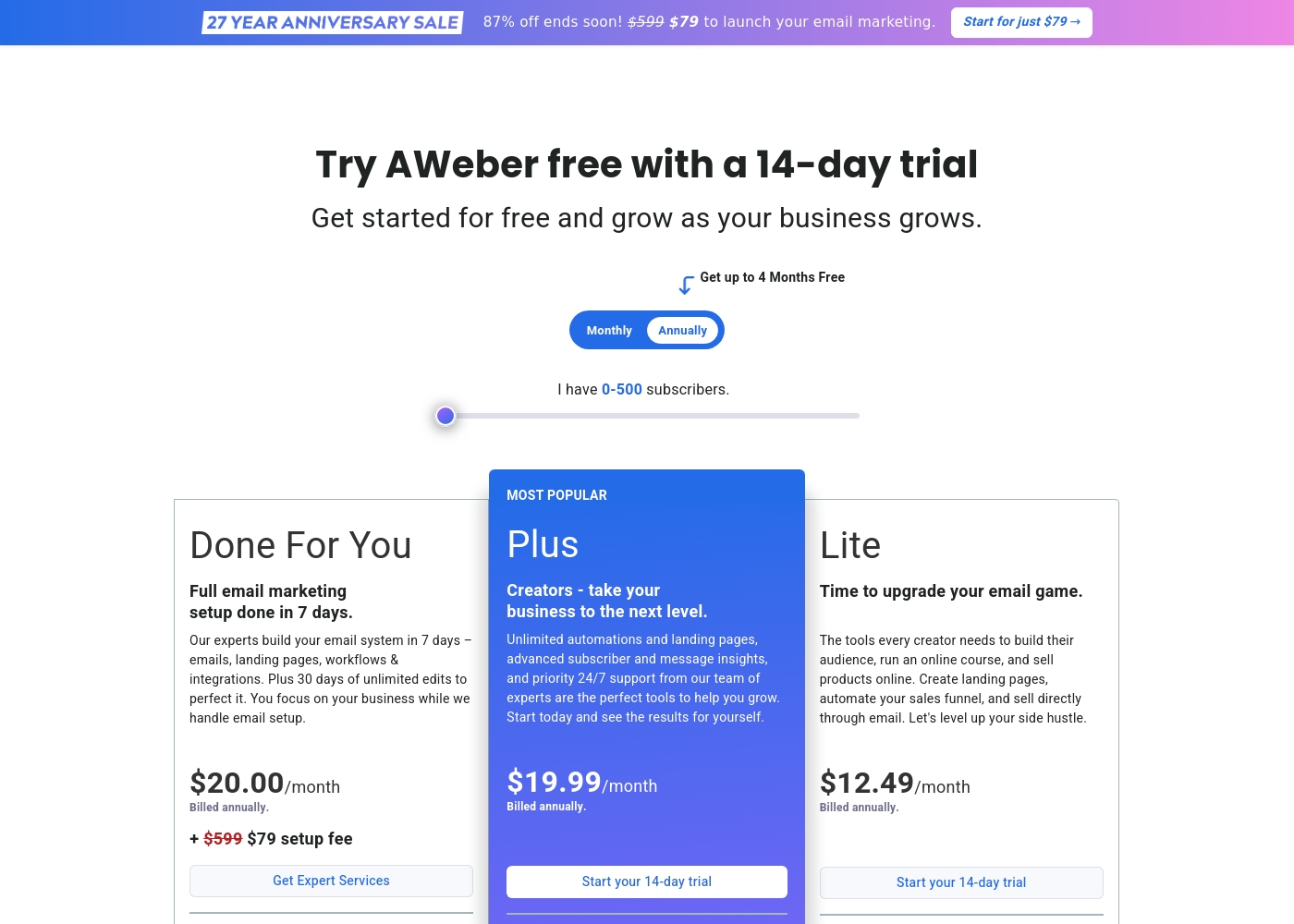
Aweber costs between $12.49/month and $20.00/month (billed annually) for 0-500 subscribers with three options: Lite at $12.49/month, Plus at $19.99/month, and Done For You at $20.00/month plus a $79 setup fee.
These pricing points reflect the annual billing option for the entry-level subscriber count. Your monthly cost will increase as your list grows beyond 500 subscribers.
Lite
Price: $12.49/month (Billed annually) Best For: Creators starting a side hustle or selling courses Other Features:
- Limited to 3 Landing pages and 3 Email automations
- 1.0% Ecommerce transaction fees
- Includes Web Push Notifications service
- Send to basic segments only
- Create landing pages, automate sales funnels, and sell directly through email
- Web Push Notifications (up to 50,000 subscribers/sends)
- Simple subscriber and message analytics
- AWeber Ecommerce (1.0% transaction fee)
- Unlimited automations and landing pages
- Advanced subscriber and message insights (analytics)
- Priority 24/7 Phone, Chat, and Email support
- Remove AWeber branding
- AWeber Ecommerce (0.6% transaction fee)
- Full email marketing setup done in 7 days by experts
- Includes emails, landing pages, workflows, and integrations built
- 30 days of unlimited edits to perfect the system
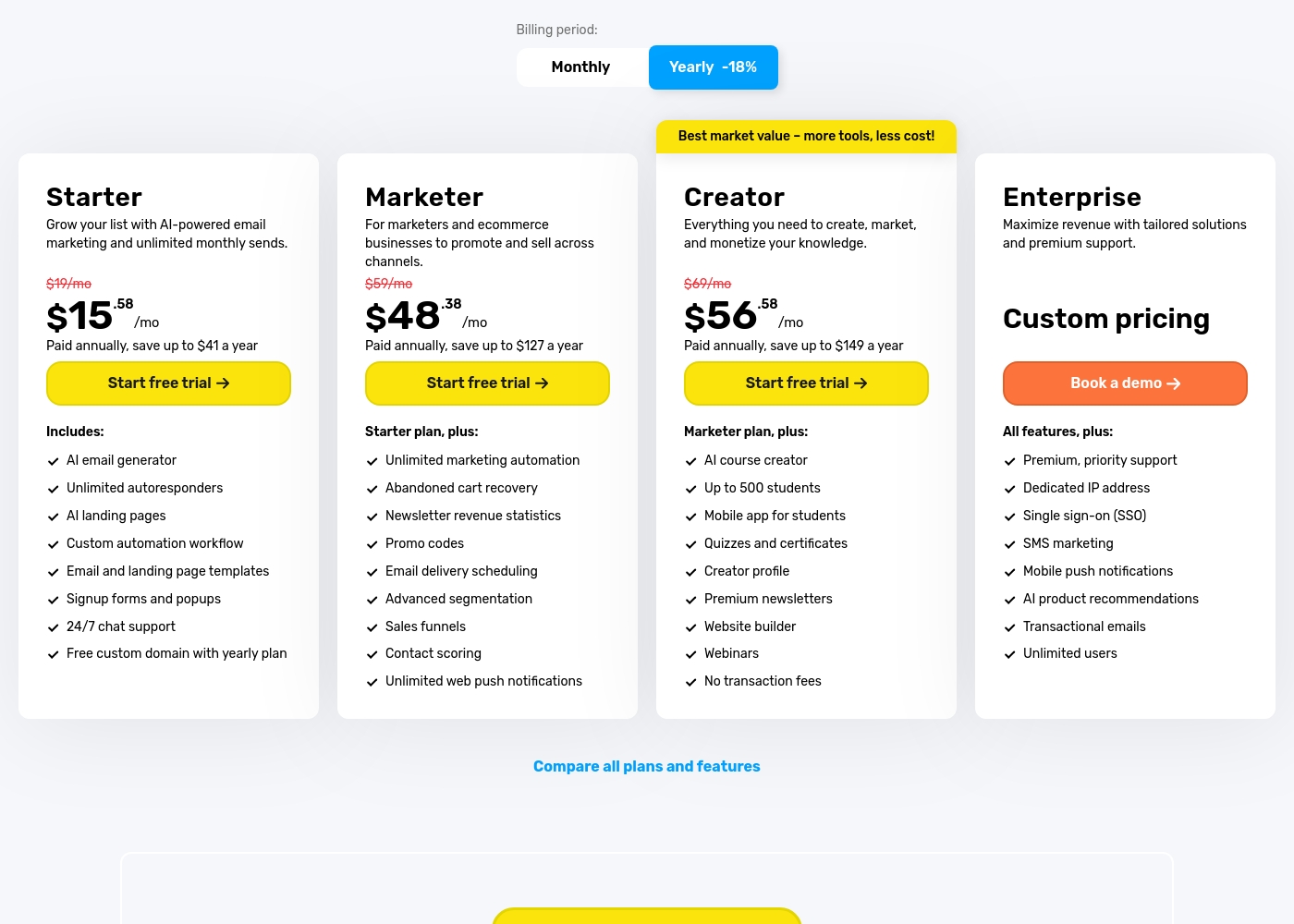
GetResponse costs between $15.58 and $56.58 per month (billed annually for a 1k list size) with four plans: Starter at $15.58/mo, Marketer at $48.38/mo, Creator at $56.58/mo, and Enterprise requiring custom pricing.
Here is a detailed look at what each plan includes. You should know that all paid plans scale their price based on the size of your specified contact list.
Starter
Price: $15.58/month (Billed annually) or $19/month (Monthly) Websites Supported: 5 active websites Best For: Growing your list and AI-powered email marketing Other Features:
- AI email generator and AI landing pages
- Unlimited autoresponders and monthly sends
- Custom automation workflow (limited to 1)
- 24/7 chat support
- Free custom domain with yearly plan The Starter package is perfect if you’re focusing on essential email marketing functions and building your subscriber list quickly. This entry-level tier allows for collaboration among 3 users and provides the core tools needed to run effective email campaigns.
- AI email generator
- Unlimited autoresponders
- AI landing pages
- 24/7 chat support
- Custom automation workflow (1)
- Unlimited marketing automation
- Abandoned cart recovery
- Sales funnels
- Advanced segmentation
- Unlimited web push notifications
- AI course creator (up to 500 students)
- Webinars
- Premium newsletters
- Website builder
- No transaction fees
- Dedicated IP address
- SMS marketing
- Premium, priority support
- Unlimited users
- Single sign-on (SSO)
Pricing Notes
- Aweber offers a perpetual Free plan, which is ideal for cost-conscious creators starting out.
- GetResponse pricing scales significantly based on the size of your contact list.
- Aweber applies a transaction fee for sales processed through its e-commerce integration.
- GetResponse's Creator plan allows selling online courses with zero transaction fees.
- GetResponse reviews warn of a strict no-refund policy, especially on annual subscriptions.
- Aweber is simpler in structure, while GetResponse has four distinct tiers based on required features.
Pricing Head-to-Head
User Reviews
User feedback drawn from Trustpilot highlights significant issues, focusing primarily on billing transparency and account management practices. Users frequently cite instances of unexpected charges and "sneaky billing," such as being billed for unsubscribed contacts or experiencing price jumps after promotional periods ended.
Some customers reported that charges continued well after they attempted to cancel annual subscriptions. Customer support experiences are highly polarized; although AWeber advertises award-winning 24/7 service, several reviewers detail unhelpful interactions, arbitrary account suspensions (often related to list importing issues), and frustrating difficulty obtaining refunds even during specified trial periods, leading to claims of "unethical" practices.
I have been an AWeber client for a while and usually I'm quite happy with their offering. Their helpline is reliable and quick whenever I do need assistance with campaigns. This long-term relationship suggests consistent service quality has been provided.
GetResponse consistently earns high marks for its exceptional customer support and expansive features. Users frequently describe the 24/7 live chat as fast, professional, and composed of knowledgeable human agents who go the extra mile.
A recurring highlight is the personalized, live onboarding call, which many reviewers called a "GAME CHANGER" for accelerating setup and understanding the complex feature set. Customers find the platform user-friendly, noting the effectiveness of drag-and-drop tools for emails and landing pages, alongside reliable autoresponders and marketing automation features that drive increased ROI.
Get Response is awesome! Like anything new, it takes some time to get set up and used to things, but the customer support is second to none in helping out and quickly answering all my questions along the way.
Our Verdict
Choosing between Aweber and GetResponse depends entirely on your current business size and goals. If you need simple, reliable email marketing basics, Aweber is a great choice. GetResponse is a clear winner if you require a comprehensive, feature-rich powerhouse for aggressive scaling. Aweber’s superpower is its approachable simplicity and high raw integration count of 750+. It offers robust foundational tools and the security of 24/7 phone support. Aweber also provides a generous Free plan, excellent for new businesses watching their budget closely. GetResponse’s ultimate strength lies in its expansive feature set and superior reliability. It guarantees a 99% deliverability rate, vital for revenue-generating emails. GetResponse adds webinars, SMS, and AI course creation, making it a true all-in-one suite. The deciding factor is complexity versus capability, and deliverability assurance. If a simple workflow and phone support are critical, stick with Aweber. If you need sales funnels and multi-channel marketing, the GetResponse feature depth justifies the complexity. For serious scaling, e-commerce, or course creation, GetResponse provides better value. Aweber remains the friendlier option for those prioritizing quick setup and a massive ecosystem of integrations.
Frequently Asked Questions
Which platform offers better email deliverability: Aweber or GetResponse?
GetResponse guarantees a high 99% deliverability rate, minimizing messages lost to spam folders. Aweber users occasionally report inconsistent deliverability issues in reviews. GetResponse is the safer choice if deliverability is a high concern.
Does Aweber have advanced features like SMS marketing or webinars like GetResponse?
No, Aweber focuses on email, landing pages, and forms. GetResponse offers native advanced features like webinar hosting and SMS marketing in its higher-tier plans. You would need third-party integrations to match these features on Aweber.
Which is better for small businesses just starting out: Aweber or GetResponse?
Aweber is usually better for small businesses due to its simplicity and permanent Free plan. GetResponse only offers a 30-day trial before requiring a paid subscription. Aweber is easier to learn initially for basic email marketing.
How do the e-commerce costs differ between Aweber and GetResponse?
Aweber charges a transaction fee on sales processed through its integrated payment system. GetResponse's Creator plan allows users to sell online courses and content with zero transaction fees. GetResponse provides richer e-commerce support features.
Which platform offers truly unlimited automation workflows?
GetResponse offers unlimited automation workflows starting on its Marketer plan. Aweber provides standard automation, but GetResponse is specifically built around limitless creation. This makes GetResponse better for complex lead nurturing journeys.
I need free migration assistance; which software should I choose?
Aweber explicitly offers a free migration service with a dedicated migration team. GetResponse offers assisted IP warm-up for Enterprise clients but does not strongly advertise free migration assistance for standard plans.
Ready to Choose?
Both tools have their strengths. Choose based on your specific needs.