Assembly vs Practice Better
Assembly and Practice Better are both client management hubs, but they serve very different industries. Assembly is built for general professional services, while Practice Better is tailored for health and wellness. Here’s how to pick the right one for your practice.
Best for: Accounting, law, and consulting firms seeking a unified client hub., Marketing and creative agencies wanting a branded client portal.
Best for: Health coaches and wellness practitioners, Therapists and counselors scaling beyond 1:1 sessions
Solid all-in-one client portal
Overall, we find Assembly to be a strong, user-friendly platform for professional firms aiming to centralize client management and present a polished brand. It delivers on its core promise of a modern portal but may require consideration for specific integration needs or advanced customization.
Pros
- Intuitive, modern interface that is easy for clients and staff to navigate.
- Comprehensive all-in-one platform replacing scattered emails, files, and invoices.
- Strong branding and white-labeling options, especially on higher-tier plans.
- Includes key features like invoicing, messaging, and eSignatures without add-ons.
Cons
- Pricing escalates significantly for team seats and advanced features like HIPAA.
- Some users report navigation friction or layout issues when accessing specific features under time pressure.
- Integration options may require setup work if your specific software isn't listed.
- Not ideal for very simple or infrequent client interactions due to pricing structure.
Solid all-in-one for scaling practices.
We found Practice Better to be a robust, centralized platform that effectively streamlines admin, scheduling, and client engagement for health professionals. Overall, it's a strong choice for practitioners looking to grow their business through online programs, though the pricing and learning curve may require careful consideration.
Pros
- Unified client portal and mobile app for engagement
- Integrated scheduling reduces administrative back-and-forth
- Built-in tools for creating and selling online courses/programs
- Generally praised for responsive and helpful customer support
Cons
- Pricing can be a consideration, especially for those on a tight budget
- Some users report a learning curve for advanced features
- Potential limitations with specific third-party integrations
- May be complex for practices needing very niche scheduling solutions
AboutAssembly
💡 Assembly is a client portal and back-office platform for professional service firms. It's built for businesses in accounting, law, marketing, real estate, and tech. The goal is to replace clutter with a single, client-friendly hub.
AboutPractice Better
Practice Better is an all-in-one software platform designed for health and wellness professionals. It's for coaches, practitioners, and therapists who want to streamline their business. The platform centralizes your client portal, scheduling, programs, and communication tools. 📈
Highlights
Feature Comparison
Features Overview
We highlight the main differences and pick a winner for each feature.
Client Portal
Both offer a client portal, but Assembly's is a modern, branded website, while Practice Better's is a health-focused hub with a companion app.
Assembly provides a sleek, customizable client portal. It acts as a branded home for clients to connect, pay, and share files. The portal is a key part of its "all-in-one" promise for service firms. Practice Better's portal is designed for health journeys. It centralizes resources, care plans, and session notes for client accountability. It's complemented by a dedicated mobile app for on-the-go access. Assembly's portal feels like a professional business hub. Practice Better's portal is more of a personal wellness coach. The key difference is the mobile app and program integration. For a law firm, Assembly's portal offers a polished, professional first impression. For a nutritionist, Practice Better's portal helps clients stick to their plan between sessions.
Scheduling & Booking
Practice Better includes robust, built-in scheduling for client self-booking, while Assembly focuses on client management, not appointment booking.
Assembly's core strength is centralizing client data, not scheduling. It doesn't offer a native booking system for clients to self-serve appointments. You'd need an external tool. Practice Better has flexible scheduling tools right out of the box. Clients can book appointments, reducing back-and-forth emails. Automated reminders help minimize no-shows for practitioners. This is a fundamental difference in purpose. Practice Better is built for appointment-based businesses. Assembly is built for project-based or ongoing client service relationships. A therapist's workflow relies heavily on scheduling. Assembly wouldn't meet that core need without integrations, while Practice Better solves it natively.
Course & Program Creation
Practice Better excels at creating and selling online programs, a feature not offered by Assembly's client management focus.
Assembly is not designed for productizing knowledge into courses. Its "Storefront" feature is for selling service packages, not educational content. It lacks course-building tools. Practice Better is built to help practitioners scale beyond 1:1. You can create fixed-date, self-paced, or evergreen programs. It's a core revenue stream feature. This is a major capability gap. If selling digital education is part of your business model, Practice Better is the clear choice. Assembly is not a competitor in this category. A wellness coach launching a 6-week group program can do it end-to-end in Practice Better. They'd need a separate platform like Teachable if using Assembly.
Invoicing & Payments
Both handle payments, but Assembly includes invoicing, contracts, and eSignatures in one flow, while Practice Better integrates with payment processors.
Assembly includes invoicing, billing, and 1-click pay links as core features. You can combine an eSignature request with a payment link in one client message. Practice Better handles billing for appointments and program purchases. It integrates with processors like Stripe. Payments are part of the client portal experience. Assembly's strength is bundling legal and financial documents (contracts, invoices) together. Practice Better's billing is more transactional, tied to bookings and programs. For a consulting firm sending a proposal, contract, and retainer invoice, Assembly's combined workflow is powerful. For a yoga studio selling class packs, Practice Better's system is simpler.
Compliance & Security
Both offer HIPAA compliance, but Practice Better includes it on all paid plans, while Assembly reserves it for higher tiers.
Assembly's HIPAA compliance, including a signed BAA and audit logs, is only available on the Advanced ($399/mo) and Enterprise plans. It's a premium feature. Practice Better states that all its paid plans are HIPAA, PIPEDA, and GDPR compliant. Security is a baseline feature across the platform for health data. The difference is accessibility. For a small therapy practice, Practice Better makes compliance affordable. With Assembly, achieving the same level requires a significant budget commitment. A solo therapist on a budget can be compliant from day one with Practice Better. They'd need the Advanced plan with Assembly to meet the same regulatory standard.
Integrations
Practice Better offers more integrations on lower tiers, while Assembly's API and Zapier access start on the mid-range Professional plan.
Assembly's integration story begins at the Professional plan ($149/mo). This includes API access and connections via Zapier and Make. Lower tiers have limited connectivity. Practice Better provides over 20 integrations across plans, including Google Calendar, Zoom, and health-specific tools. Zapier access allows for thousands of custom connections. Practice Better offers a more connected ecosystem out of the box at lower price points. Assembly's integration power is gated behind a higher paywall. If you rely on Zoom and a specific EMR, Practice Better likely has a direct integration. With Assembly, you might need to use Zapier to connect the same tools.
Scalability for Teams
Assembly scales for larger teams with seat limits, while Practice Better's Team plan is designed for small group practices with added collaboration tools.
Assembly offers tiered plans for teams, starting with 3 users on Professional and scaling to custom limits on Enterprise. Additional seats cost extra (e.g., +$39/user). Practice Better's Team plan starts with two practitioner licenses and offers features like team scheduling, shared calendars, and custom roles. Additional licenses are $50/month. Assembly appears built for larger, multi-department firms (e.g., a 50-person law office). Practice Better's team features are focused on collaborative clinical care. A marketing agency with 10 project managers might fit Assembly's model better. A group practice with 5 therapists collaborating on client files would benefit from Practice Better's clinical team features.
Learning Curve
Assembly emphasizes quick setup and a modern interface, while Practice Better offers more features, which may introduce a steeper initial learning curve.
Assembly is praised for its intuitive, modern interface that's easy for both staff and clients to navigate. The goal is a low-friction setup. Practice Better, as a more comprehensive platform with scheduling, courses, and portals, inherently has more to learn. Some users note a learning curve for advanced features. Assembly seems designed for faster time-to-value on core client management. Practice Better requires more investment upfront to leverage its full suite of business tools. A firm wanting to replace email tomorrow might get up and running faster with Assembly. A practitioner wanting to digitize their entire business model will spend more time configuring Practice Better.
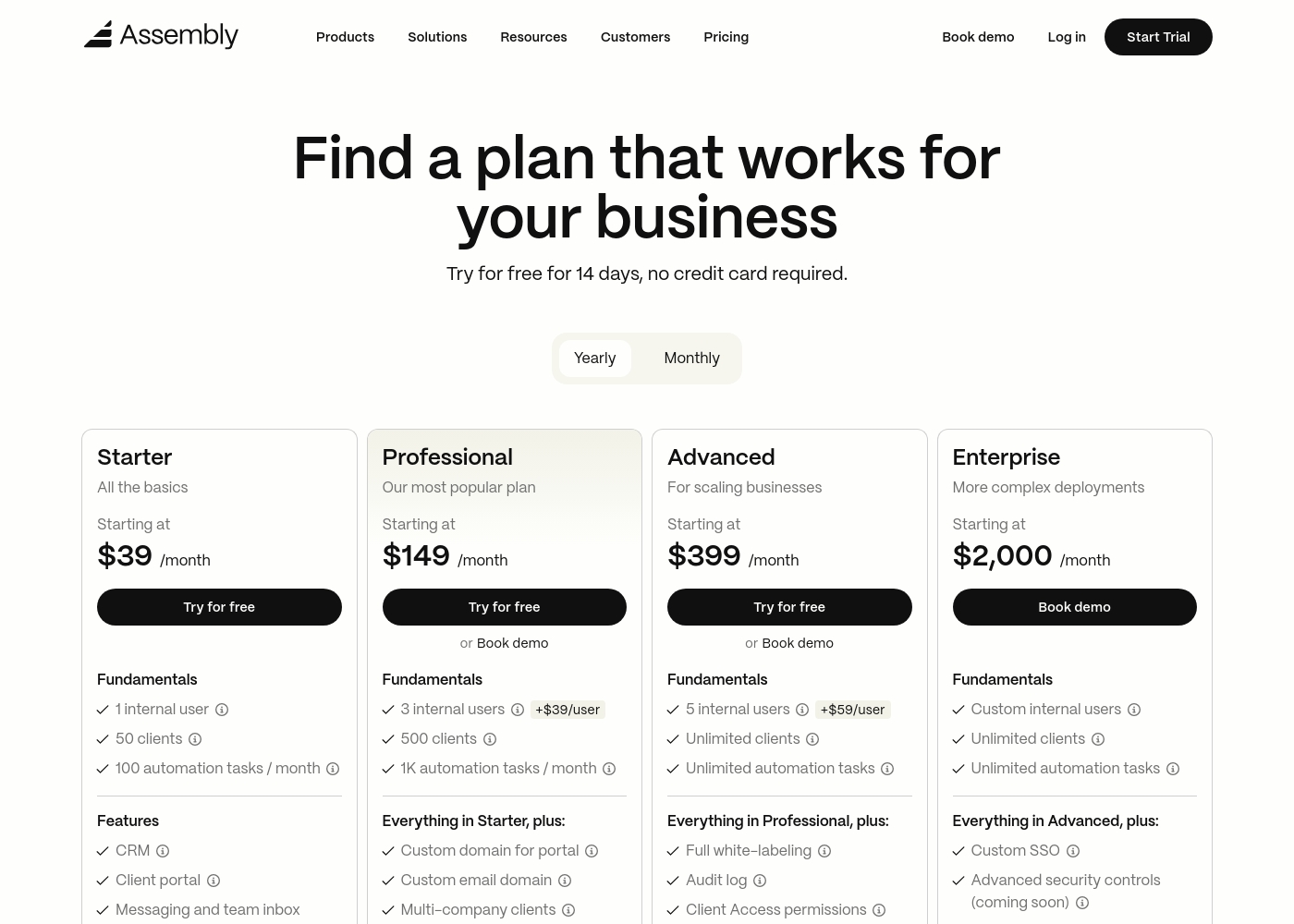
Assembly costs between $39 and $2,000 per month with 4 plans: Starter at $39, Professional at $149, Advanced at $399, and Enterprise at $2,000.
Take a look at the feature breakdown for each tier below.
Starter
Price: $39 / month Best For: Solo entrepreneurs and small service providers Refund Policy: 30-day satisfaction guarantee Other Features: CRM, white-labeled client portal, messaging, invoicing, and task management.
- CRM
- Client portal
- Messaging & inbox
- Invoices & pay links
- Proposals & contracts
- Custom domain
- API & Zapier/Make
- Multi-company clients
- Low payment fees
- Full white-labeling
- Audit log
- HIPAA compliance
- Client access permissions
- Custom SSO
- Sandbox workspace
- Dedicated success manager
- Technical advisor
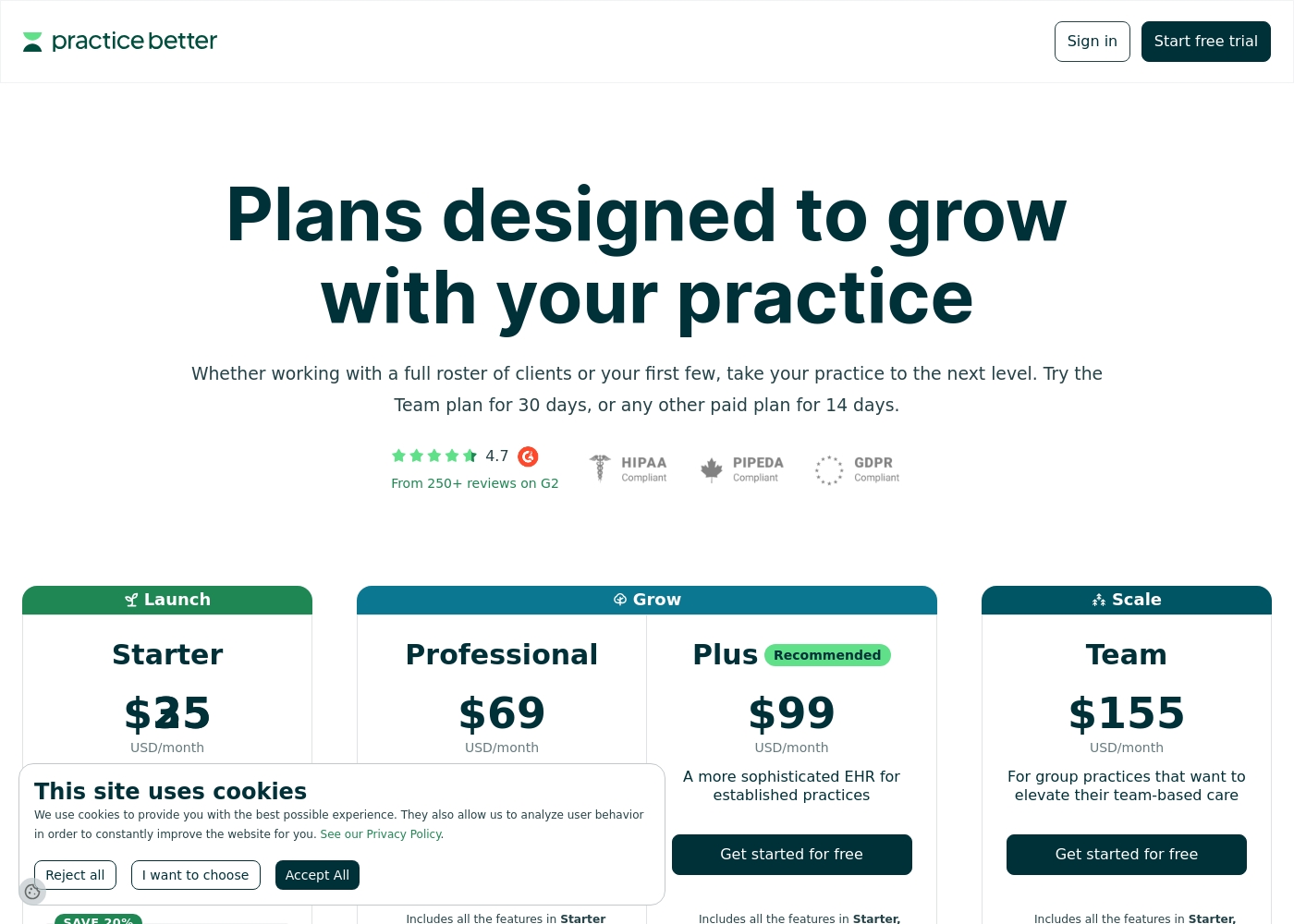
Practice Better pricing: Practice Better offers a range of plans from a free starter tier to advanced team scales starting at $25/month. Pricing varies based on client volume and advanced features like automations and group programs, with a 20% discount on annual billing for most plans.
All paid plans include a free trial to help you get started comfortably. Choose a path that fits your current client load and grow as your practice expands with no long-term contracts required at any level.
Practice Better makes it easy to switch or cancel your subscription at any time as your needs change throughout your professional journey. Each plan supports practitioners at different stages from students to multi-provider clinics and established group practices worldwide.
Pricing Notes
- Assembly's pricing jumps significantly when adding team seats or needing HIPAA compliance.
- Practice Better offers a free Sprout plan for up to 3 clients, making it easier to start.
- Assembly includes a 30-day money-back guarantee after the 14-day trial; Practice Better does not list one.
- Both offer annual billing discounts. Practice Better explicitly states 20% off.
- Practice Better's paid plans start lower but can exceed Assembly's mid-tier pricing for advanced features.
Pricing Head-to-Head
User Reviews
From our research on Trustpilot and Capterra, users consistently praise Assembly for its modern, intuitive interface and the ease with which it centralizes client communication. The platform is frequently described as a clean, all-in-one hub that simplifies operations.
However, some users on Capterra note occasional friction in navigation under time pressure and desire more robust customization. Support responsiveness and the value of included features like invoicing and portals are highlighted as major positives, while pricing for higher tiers is seen as a consideration for scaling firms.
Assembly's interface is quick to navigate and simple to operate. It has been great for keeping our client recognition tasks organized in one place without a steep learning curve.
Users on Trustpilot consistently praise Practice Better for its user-friendly interface and comprehensive all-in-one features, noting how it simplifies scheduling, client communication, and program delivery. 👍 Customer support receives high marks for being responsive and helpful, especially during onboarding. However, some reviewers mention a learning curve for more complex features and express a desire for more affordable pricing, particularly for solo practitioners or those just starting out. The platform is valued for its reliability and client engagement tools, but integration limitations with certain third-party apps are occasionally cited as a drawback.
The platform is incredibly intuitive, and the client portal has transformed how I engage with clients between sessions. It feels professional and keeps everything in one place, saving me hours of admin time each week.
Our Verdict
This isn't a direct head-to-head battle. Assembly and Practice Better are built for fundamentally different types of businesses. Assembly's superpower is creating a polished, professional client experience for service firms. It bundles a branded portal, invoicing, contracts, and eSignatures into one sleek hub. It's perfect for making a strong first impression. Practice Better's superpower is being the operating system for a health or wellness practice. It combines scheduling, a client app, and course creation tools. It's designed to manage the entire client journey between and during sessions. The deciding factor is your industry and core workflow. If you run a project-based service firm and need to centralize client docs and payments, choose Assembly. If you run an appointment-based health practice and need to sell digital programs, choose Practice Better. For most professional service firms, Assembly is the better client portal. For health and wellness practitioners looking to scale, Practice Better is the essential tool. Know your niche, and the choice becomes clear.
Frequently Asked Questions
Which is better for a small therapy practice: Assembly or Practice Better?
Practice Better is generally better for a therapy practice. It includes HIPAA compliance on all paid plans and essential scheduling tools. Assembly would require the expensive Advanced plan to meet the same compliance and lack native appointment booking.
Can I sell online courses with Assembly like I can with Practice Better?
No, you cannot. Assembly is focused on client portals and management for service firms. It does not offer tools to create or sell online educational courses or programs, which is a core feature of Practice Better.
Is Assembly's client portal more customizable than Practice Better's?
Assembly offers more advanced customization, like full white-labeling and custom domains, but only on its Advanced and Enterprise plans. Practice Better provides a professional portal with branding options, but with less granular control over the entire experience.
Which platform offers a free plan to get started?
Practice Better offers a free Sprout plan for up to 3 clients. Assembly does not have a free plan; it offers a 14-day free trial followed by a 30-day money-back guarantee.
Do both Assembly and Practice Better work well on mobile?
Practice Better has a dedicated mobile app for clients. Assembly does not currently have a standalone mobile app, relying on a responsive web portal accessed via a mobile browser.
How do their integrations compare for tools like Zoom and QuickBooks?
Practice Better includes direct integrations for tools like Zoom on lower-tier plans. Assembly's integrations (via Zapier or API) start on the Professional plan. You may need to check if your specific tools are directly supported.
Ready to Choose?
Both tools have their strengths. Choose based on your specific needs.