Asana vs Infinity
Asana and Infinity are both powerful project managers, but they serve very different market needs. Asana focuses on enterprise scale, governance, and AI-powered workflow management. Infinity prioritizes budget optimization, offering high customization at a fraction of Asana's per-user cost.
Best for: Enterprise organizations needing HIPAA or SIEM compliance, Companies requiring sophisticated resource management and portfolio visibility
Best for: Budget-conscious teams looking for maximum annual cost savings, Small to mid-sized businesses (SMBs) replacing expensive tools like Airtable
Great features, poor customer support.
We find that Asana offers powerful project management features, excellent organizational scalability, and a generous free plan suitable for small teams. However, recurring external reports indicate severe problems with customer service responsiveness and billing transparency, heavily detracting from the product’s core strengths. Overall, we recommend caution for small businesses or any organization prioritizing reliable, direct customer support.
Pros
- Powerful free tier available for individuals and small teams (up to 10 users).
- Flexible design for managing tasks, projects, and team workflows efficiently.
- Supports excellent scalability, trusted by many Fortune 100 companies.
- Advanced features like Gantt charts and Timeline views are available starting on the Starter plan.
Cons
- Customer service is widely reported as non-existent, slow, or dependent on ineffective chatbots.
- Numerous complaints regarding deceptive auto-renewal practices and unauthorized charges.
- Refund requests are frequently denied, increasing costs for unintended subscriptions.
- Users often lose access or tasks when attempting to downgrade from a paid trial to the free plan.
High Customization, Low Cost, Manage Everything.
We find Infinity offers excellent functional depth and strong customization features for managing complex projects at a very competitive price point. Overall, we see it as a high-value, flexible alternative for teams looking to significantly reduce their annual expenditure on operational software.
Pros
- Provides powerful and highly customizable work management features.
- Designed to generate significant cost savings over expensive competitors.
- Offers advanced project views (Gantt, Chart, Document) in Pro plan.
- Includes the comprehensive 360° Business Architect framework.
Cons
- Reported issues regarding frustrating UI/UX design by some users.
- Currently has very limited public review data available for assessment.
- No visible standalone free plan or standard free trial offered.
- Discounts require choosing the per-seat annual billing commitment.
AboutAsana
Asana is an online platform built specifically to manage your team’s work, projects, and tasks. It supports powerful Human + AI collaboration.
This AI component understands your specific business context, helping to move your most important work forward efficiently. Because it's a centralized ecosystem, it easily brings all doers and stakeholders together in one place. 💡
AboutInfinity
Infinity is designed as an economical alternative for organizations managing their growth and operations. It provides a way to significantly cut costs compared to other expensive market tools. Based on your plan, the software supports customizable numbers of workspace areas and collaborators.
Beyond basic functionality, you can also leverage specialized Professional Services. This support, available for a modest one-time fee, helps integrate these solutions smoothly into your workflow. ✨
Highlights
Feature Comparison
Features Overview
We highlight the main differences and pick a winner for each feature.
Pricing Model & Value
Infinity is dramatically cheaper, saving teams thousands in annual subscription fees.
Asana's entry-level Starter plan begins at $10.99 per user per month annually. Costs scale significantly higher for mid-level features like Resource Management. Infinity’s equivalent paid Basic plan starts much lower at just $6 per user per month. Even the Pro plan is only $9 per user per month. Infinity is deliberately marketed for budget optimization and cutting expensive tool subscriptions. Asana charges a premium for its enterprise scale and governance features. If maximizing functional features while minimizing budget is the goal, Infinity provides unparalleled value.
Scalability & Enterprise
Asana is built for global Fortune 100 scale; Infinity supports growing SMBs.
Asana is used by 85% of Fortune 100 companies, proving its massive scalability. It offers Enterprise+ tiers for regulatory reporting and thousands of seats. Infinity offers specialized packages for Unlimited members and Agency accounts for scaling. Its focus is on operational frameworks rather than organizational governance. Asana provides objectives management and comprehensive resource allocation tools across departments. Infinity does not explicitly offer these high-level portfolio controls. For regulatory compliance or orchestrating global work, Asana is the established, proven standard.
AI & Automation
Asana integrates dedicated AI, while Infinity relies on standard rules and its framework.
Asana provides access to its specialized Asana AI Studio starting in the Starter plan. The AI handles routine context work, accelerating project completion. Asana also includes unlimited automation rules and a specific Process Generator tool. This capability helps standardize complex, recurring internal activities efficiently. Infinity lists 'Automations' but does not specify built-in AI capabilities or an AI studio. It leverages the 360° Framework for strategic operational guidance. Teams prioritizing leveraging artificial intelligence for contextual project work should choose Asana immediately.
Customer Support
Infinity offers hands-on setup help; Asana’s highly criticized support is often non-existent.
Asana only offers 24/7 dedicated support on its highest-cost Enterprise tier. General user reviews widely criticize slow responses or reliance on frustrating chatbots for self-service. Infinity provides specialized Professional Services available for a one-time charge of $199. This service helps migrate data and ensures smooth implementation. Infinity’s one-time setup fee offers fixed-cost, hands-on help, a clear value proposition. Asana forces lower-tier users into painful, unhelpful self-service. If dependable human support or specialized setup is critical, Infinity is the better and safer investment.
Customization vs. Structure
Infinity is highly customizable like a database; Asana focuses on standardized process templates.
Infinity is designed for high customization, allowing teams to mimic or replace tools like Airtable or Trello. This flexibility supports unique workflows. Asana focuses intently on standardizing processes across departments using its Process Generator. This promotes crucial consistency across large organizations. Infinity gives users the adaptability to build workflows exactly as they need them. Asana prefers strong, powerful, and standardized organizational structures. Teams needing to adapt their project manager deeply to unique internal processes benefit most from Infinity's flexibility.
Access & Guarantees
Asana offers a strong free plan; Infinity provides a risk-free money-back guarantee.
Asana offers a generous, free 'Personal' tier available for up to 10 users. This includes unlimited tasks and projects, making it great for individuals. Infinity does not offer a visible standalone free plan or standard free trial for their paid tiers. You must purchase to access features. Infinity protects every new user with a strong 14-day money-back guarantee policy. Asana explicitly states they offer zero refunds once payment starts. For individuals or small teams on a zero budget, Asana's feature-rich free plan is the undisputed first choice.
Data Governance
Asana provides comprehensive compliance required for regulated industries like healthcare.
Asana’s Enterprise+ plan supports critical requirements like HIPAA compliance and SIEM integration. Security features include 256-bit encryption for data at rest. Infinity does not list specific compliance or detailed high-level security features like HIPAA or audit logs. Its core focus is on functional utility and cost savings. Asana is built to meet the rigorous security demands of large, regulated corporations globally. Infinity’s security assurances are far less transparent in the available data. For businesses operating in finance or healthcare needing top-tier security, Asana is the only viable option here.
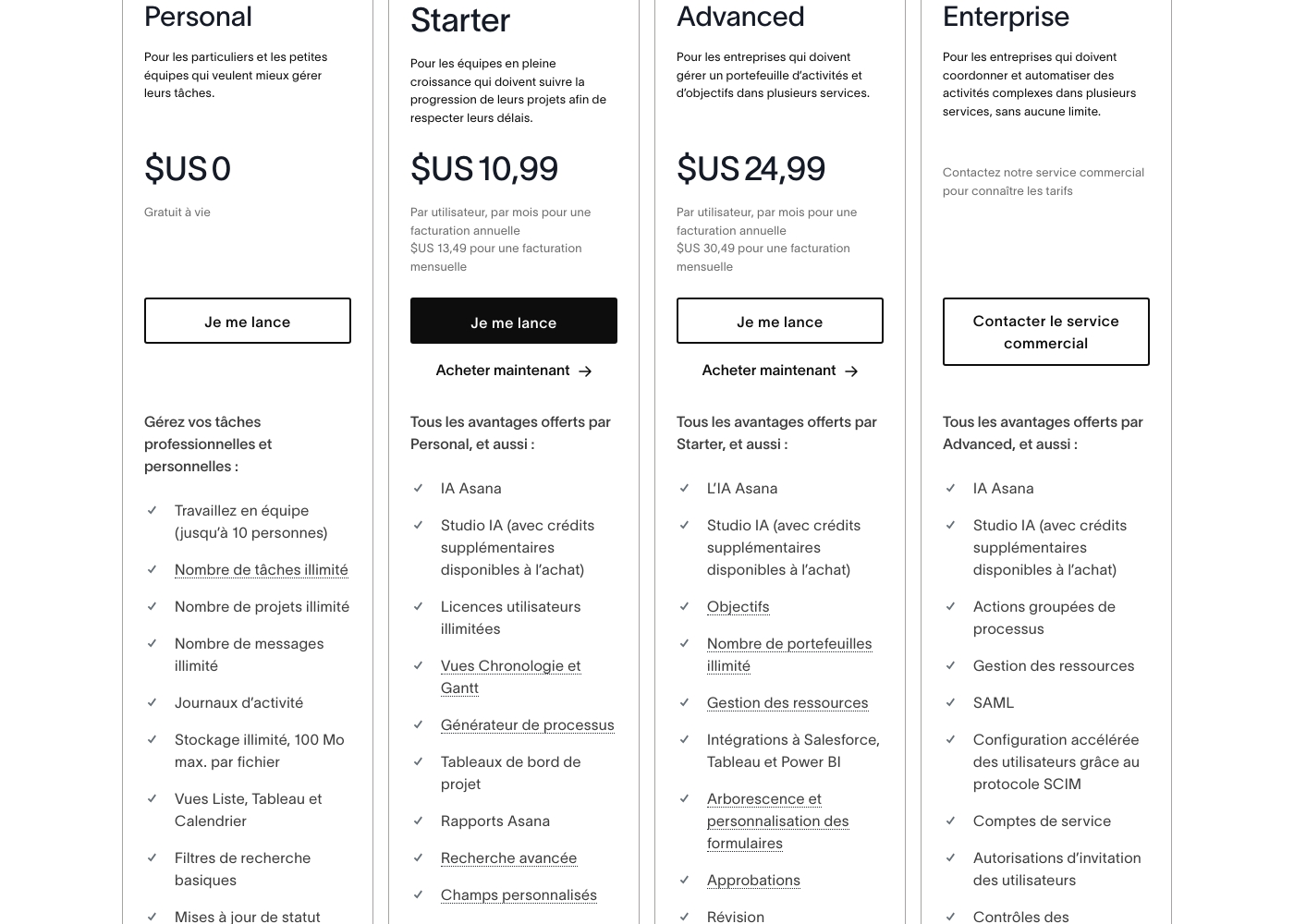
Asana costs between $US 0 and $24.99 per user per month (annual billing) with 5 plans: Personal at $US 0, Starter at $US 10.99, Advanced at $US 24.99, Enterprise at Contact Sales, and Enterprise+ at Contact Sales.
Here is a breakdown of what each plan offers your team.
Personal
Price: $US 0 (Free for life) Best For: Individuals and small teams wanting better task management Other Features:
- Work in teams (up to 10 people)
- Unlimited tasks, projects, and messages
- Unlimited storage (100 MB max. per file)
- List, Board, and Calendar views
- Basic search filters
- Work in teams (up to 10 people)
- Unlimited tasks, projects, and messages
- Unlimited storage (100 MB max. per file)
- List, Board, and Calendar views
- Basic search filters
- Unlimited user licenses
- Asana AI Studio access
- Timeline and Gantt Views
- Process Generator
- Advanced Search and Custom Fields
- Objectives and unlimited portfolios
- Resource Management
- Integrations to Salesforce, Tableau, and Power BI
- Form customization and approvals
- Native time tracking
- Bulk process actions
- SAML and SCIM for accelerated user configuration
- Service accounts
- 24/7 support
- Custom branding
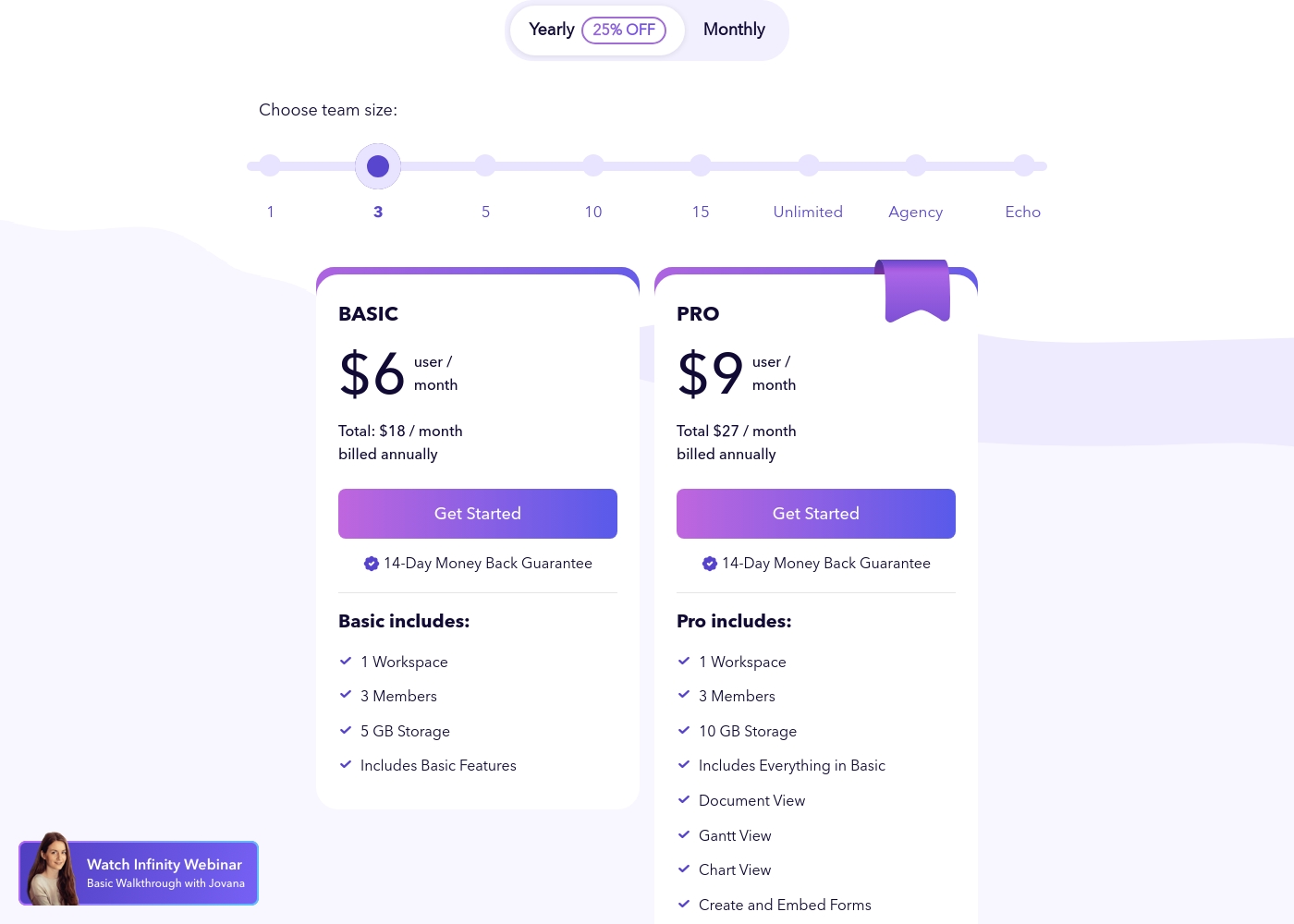
Infinity costs between $18 and $27 per month (billed annually) with two primary plans visible: Basic at $18/month and Pro at $27/month (for a 3-member team).
These plans utilize a per-user, per-month pricing structure when billed annually. You benefit from a 25% discount by selecting the yearly option.
Basic
Price: $6 user/month (Total $18/month, billed annually) Refund Policy: 14-Day Money Back Guarantee Other Features: 1 Workspace, 3 Members, 5 GB Storage, Includes Basic Features
- 1 Workspace
- 3 Members
- 5 GB Storage
- Includes Basic Features
- 1 Workspace
- 3 Members
- 10 GB Storage
- Includes Everything in Basic
- Document View
Pricing Notes
- Infinity is dramatically cheaper; its Pro plan ($9/user/month) costs less than Asana's entry-level Starter plan ($10.99/user/month).
- Asana offers a powerful free plan for up to 10 users, an option Infinity lacks entirely.
- Asana explicitly offers zero refunds once a paid subscription has started.
- Infinity secures subscriptions with a strong 14-day money-back guarantee, allowing risk-free evaluation.
- Infinity offers specialized Professional Services for a one-time charge of $199 instead of high, ongoing support fees.
Pricing Head-to-Head
User Reviews
External feedback, predominantly showcased through Trustpilot, reveals widespread dissatisfaction among users, giving the service a significantly low overall rating. Customers frequently criticize the subscription and billing practices, often citing unexpected auto-renewals or unauthorized charges occurring months after cancellation or trial expiration. The inability to secure refunds, even in cases of clear error, is a major pain point.
🚨 The most significant complaint centers on support responsiveness. Reviewers report slow service, sometimes waiting a week for an email reply, reliance on frustrating chatbots, and difficulties contacting a human representative. While some users acknowledge the base product is flexible and has good design features, the company's operational infrastructure and seeming focus on larger enterprises leaves smaller businesses feeling neglected, leading many to label the experience customer-hostile or deceptive.
The app itself is great, offering good design, projects, and flexible team spaces. However, the customer service experience is awful. The only way to talk to CS is often through slow, ineffective emails.
Infinity currently presents a very small public feedback pool, limiting a thorough assessment of recurring themes like long-term reliability or support performance. Based on the limited sentiment available (3.5 stars across only two Trustpilot reviews), users clearly recognize the platform's core strength: its ultimate flexibility and power as a work management solution.
One reviewer highly praised Infinity as flexible software that performs great and effectively replaces competitive products like Airtable and Trello. However, the existing feedback also includes a crucial, concrete critique regarding adoption and user experience.
This is really great software that offers impressive flexibility. It easily handles all our work needs. We are using it to replace older platforms like Airtable and Trello, and it performs wonderfully.
Our Verdict
The decision between Asana and Infinity comes down to prioritizing budget or enterprise governance. If you are a large, regulated business, Asana is the clear winner for scale. If you are a value-driven or scaling SMB, Infinity will keep your accountants happy. Asana's strength lies in serving massive, complex organizations globally. It provides essential governance features like resource management and portfolio tracking across business units. Asana also leads with integrated AI tools and supports critical compliance needs like HIPAA within its Enterprise+ tiers. Infinity's superpower is offering high functionality at an extremely low price point. Teams can get advanced features like Gantt and Chart views for only $9 per user per month. Infinity also includes the robust 360° Business Architect framework, guiding operational scaling. The key deciding factor is the cost and support trade-off. Infinity costs less than half of Asana and offers dedicated, paid setup support. Asana charges significantly more for its scale and is notorious for having inaccessible customer support for lower-tier users. Select Asana if you need organization-wide standardization, AI power, and maximum governance control. Choose Infinity if you require deep customization and robust project features while achieving significant, risk-free cost savings.
Frequently Asked Questions
Which is better for small teams: Asana or Infinity?
Asana is better for small teams due to its excellent free Personal plan for up to 10 users. Infinity does not offer a free plan, requiring immediate paid subscription access. However, Infinity offers a 14-day money-back guarantee for risk-free evaluation.
Can Infinity fully replace expensive project tools like Asana?
Infinity is designed to be an economical alternative for teams replacing expensive tools like Airtable or Trello. It provides high customization and advanced views like Gantt charts. Infinity lacks Asana’s dedicated resource management and enterprise compliance features.
Does Asana have a better integration ecosystem than Infinity?
Yes, Asana has a much larger and more specified integration ecosystem. Asana connects with over 300 enterprise tools, including Salesforce and Tableau. Infinity lists integrations but is not specific about supported third-party applications.
Which platform offers better data security and compliance features?
Asana offers superior data security and governance, supporting HIPAA compliance and SIEM integration. This is available in its highest Enterprise+ tier. Infinity does not publicly list these specialized compliance features in their plans.
Is Infinity worth the cost if I need advanced views like Gantt charts?
Yes, Infinity is an exceptional value if you need advanced planning views. Infinity unlocks Gantt View and Chart View in its Pro plan for only $9/user/month. You must pay $10.99/user/month for Asana's equivalent Starter plan.
How does Asana's AI compare to Infinity's operational framework?
Asana provides a dedicated Asana AI Studio to handle routine work and add context. Infinity focuses on guidance through its 360° Business Architect framework. Infinity’s framework includes mentorship and strategic lessons to help scale operations.
Ready to Choose?
Both tools have their strengths. Choose based on your specific needs.