Apollo.io vs Leadfeeder
People often compare these two giants in the sales tech space. Apollo.io is designed as a full-stack sales execution and data engine. Leadfeeder focuses purely on identifying website visitor intent and company data. One is a swiss army knife; the other is a specialized sales radar system.
Best for: Sales teams needing a fully integrated outbound sequencing engine., Businesses requiring instant access to a massive 210M+ B2B contact database.
Best for: Sales and Marketing teams with high volume of anonymous website traffic., Companies prioritizing passive lead identification and buying intent signals.
Powerful Features, Troubled Execution.
We recognize Apollo.io for its ambitious vision as an end-to-end AI sales platform with a deep, proprietary contact database. However, external user feedback reveals significant deficiencies in core areas like support and data reliability. Overall, the powerful feature set is currently undermined by difficult usability, frequent bugs, and serious concerns regarding privacy and customer care.
Pros
- Robust free-forever plan ($0) with included annual credits.
- Access to a massive, unified B2B contact and company database.
- Consolidates prospecting, outreach, and data enrichment functions.
- Advanced AI tools enable personalization and optimization at scale.
Cons
- Customer support is widely reported as consistently unresponsive and ineffective.
- Severe user complaints regarding contact data accuracy and email verification failures.
- Platform reliability issues include slow loading and frequent, disruptive UI changes.
- Multiple serious allegations of scraping user data without consent.
Advanced B2B Lead Identification, High Risk.
We found Leadfeeder offers powerful B2B visitor identification features, including robust filtering and unique remote employee recognition capabilities. However, we note consistent customer reports detailing unresolved CRM integration failures and problematic auto-renewal billing policies that undermine its fundamental value proposition. Overall, the powerful features are currently overshadowed by serious concerns regarding support responsiveness.
Pros
- Highest company recognition rate available, identifying remote workers.
- Quick setup requiring a simple Google Analytics connection.
- Robust filtering system using over 50 firmographic and behavioral signals.
- Allows identification of companies engaging with ad campaigns.
Cons
- Reportedly flawed and unresolved two-way Dynamics CRM integration features.
- Aggressive annual auto-renewal policy lacking timely notification reminders.
- Customer support is frequently criticized as non-existent or unhelpful.
- High subscription cost scaling based significantly on volume of identified companies.
AboutApollo.io
Apollo is built as an end-to-end AI sales platform. It serves as a unified Go-To-Market Platform designed for running your complete sales cycle on unified customer data. This platform provides all the necessary features, integrations, and training you need to grow your business effectively. Apollo is ideal for Sales Leaders, Account Executives, Founders, and Marketers looking for a centralized command center. 💡
AboutLeadfeeder
Leadfeeder is a powerful tool designed to help salespeople, marketers, and agencies find hidden opportunities in their web traffic. Its unique technology scans incoming traffic and identifies the companies visiting your website based on their IP address. This works even if employees are working from home. Once identified, the tool helps you uncover exactly what those companies are interested in, confirming their true buying intent. This crucial data processing meets all necessary GDPR legislation requirements. ✅
Highlights
Feature Comparison
Features Overview
We highlight the main differences and pick a winner for each feature.
Core Sales Strategy
Apollo.io is a full-stack outbound sales sequence engine. Leadfeeder is specialized inbound intent data software.
Apollo.io provides the database, outreach tools, and AI insights needed for end-to-end sales execution. It manages prospecting through follow-up tasks. Leadfeeder focuses laser-like on identifying anonymous website visitors using IP addresses. Leadfeeder quickly turns window shoppers into actionable company leads. The key difference is that Apollo.io is built for *doing* the outbound work. Leadfeeder is built for *gathering* high-quality, passive intent intelligence. If you need to unify your tech stack and execute sequences seamlessly, Apollo.io is the intended solution.
B2B Data Access
Apollo.io offers 210M+ contacts; Leadfeeder limits contact exports to 25 per month.
Apollo.io gives instant access to its massive database of over 210 million B2B contacts and 35 million companies. Prospecting is credit-based, allowing high-volume outreach with Apollo.io. Leadfeeder uses a robust global database mainly to look up contact details *after* a company is identified visiting your site. Users of Leadfeeder are limited to 25 contact export credits per month, a major constraint for high-volume teams. If you need to build contact lists from scratch, Apollo.io consistently provides superior access and volume. Leadfeeder is for enriching existing intent leads, not mass list building. Apollo.io is the clear winner for teams prioritizing high-volume database prospecting.
Outbound Automation
Apollo.io includes a native sequencing tool; Leadfeeder requires integration for outreach.
Apollo.io is built to launch personalized multichannel campaigns in minutes using its native sequence tools and AI optimization. It handles email, calling, and task management. Leadfeeder’s primary role is identifying the visitor and delivering that intent data to your sales team. Leadfeeder requires integration with other outreach tools to execute automated sequences. For a unified system that handles everything from finding to contacting, Apollo.io is the obvious choice. Leadfeeder focuses only on the intelligence gathering stage. Teams needing an all-in-one sales engagement hub will find Apollo.io satisfies that requirement directly.
Website Intent ID
Leadfeeder excels at visitor identification; Apollo.io does not offer this specialized capability.
Leadfeeder boasts the highest company recognition rate, identifying anonymous traffic including remote employees. It applies 50+ intent filters to score activity. This specialized identification functionality is the cornerstone of Leadfeeder's offering. Apollo.io does not offer this core capability to identify anonymous website visitors in real-time. If understanding who is visiting your site—even before they submit a form—is crucial, Leadfeeder is essential. Apollo.io relies on third-party intent data or user input. Leadfeeder allows sales teams to prioritize follow-up based on real-time website behavior.
Pricing Structure
Apollo.io is per user; Leadfeeder is usage-based with unlimited users.
Apollo.io uses a stiff per-seat subscription model combined with annual credit allowances for data access. For smaller teams, Apollo.io may be a high per-user cost. Leadfeeder’s pricing scales based on the volume of unique companies identified visiting your website monthly. Leadfeeder includes unlimited users in every plan, which saves money for large teams. If your website traffic is low, Leadfeeder is extremely cost-effective with unlimited users. High-traffic websites will pay significantly more using Leadfeeder. Teams focused on growth should weigh Leadfeeder's traffic cost against Apollo.io’s per-seat cost.
Learning Curve
Leadfeeder is simple and fast to set up; Apollo.io is complex and frustrating to master.
Leadfeeder offers a quick setup, often requiring just a simple Google Analytics connection to start identifying visitors immediately. User onboarding is quick. Apollo.io is complex due to consolidating prospecting, outreach, and enrichment into one platform. Users report a steep learning curve. Constant UI changes in Apollo.io further disrupt the workflow and increase frustration, according to user feedback. Leadfeeder provides a much smoother initial experience. For rapid organizational adoption, Leadfeeder is likely the safer and easier choice for most teams.
Data Reliability Concerns
Both platforms face substantial user complaints regarding critical data issues and support failures.
External reviews strongly criticize Apollo.io for poor data accuracy, noting that even 'verified' emails frequently bounce. Apollo.io also struggles with slow loading and platform instability. Leadfeeder users report very high company recognition rates but face unresolved technical glitches with two-way CRM integration. Support responsiveness is a major issue for Leadfeeder. Leadfeeder seems more reliable in its core function (identification), but Apollo.io handles more diverse data types. Users should proceed cautiously with both tools, given the consistent negative review sentiment regarding support.
Enterprise Readiness
Apollo.io offers custom enterprise plans; Leadfeeder is volume-capped at 40,000 companies/month.
Apollo.io provides specialized Custom Plans tailored for enterprises like Fortune 500 companies. These include advanced security, governance, and necessary API access. Leadfeeder scales its usage-based pricing up to identifying 40,000 unique companies per month. This cap might limit Leadfeeder's utility for massive, global websites. If enterprise-level security, governance, and tailored API integrations are non-negotiable, Apollo.io is the better option. Leadfeeder is better suited for high-growth B2B companies under the enterprise level requiring intent data.
Apollo.io offers plans based on your scaling needs, from individuals to large enterprises. Let's explore the available options so you can find the best fit for your sales engine.
Free
Price: $0 per year Best For: Exploring the Apollo platform to find leads, engage prospects, and close deals. Other Features:
- 1,200 credits per user per year
- 2 Sequences available
- Prospecting, Gmail & Salesforce Extensions
- Basic Filters
- Can only use Gmail email accounts for campaigns
This plan is great for individuals or small teams just starting out with outbound sales. You get access to Apollo’s powerful core data and basic outreach tools completely free forever, as the FAQ confirms this is the "Starter plan which is free forever." It's an excellent way to test the waters.
- 1,200 credits per user per year
- 2 Sequences
- Prospecting, Gmail & Salesforce Extensions
- Basic Filters
- Connect Microsoft Office or other email providers
- Higher credit limits (up to 1M credits/year for Unlimited Paid plans)
- Access to purchase additional credits
- Full feature set of selected plan
- API Access for advanced integrations
- Tailored security and governance
- Suitable for large enterprises (Fortune 500 confirmed)

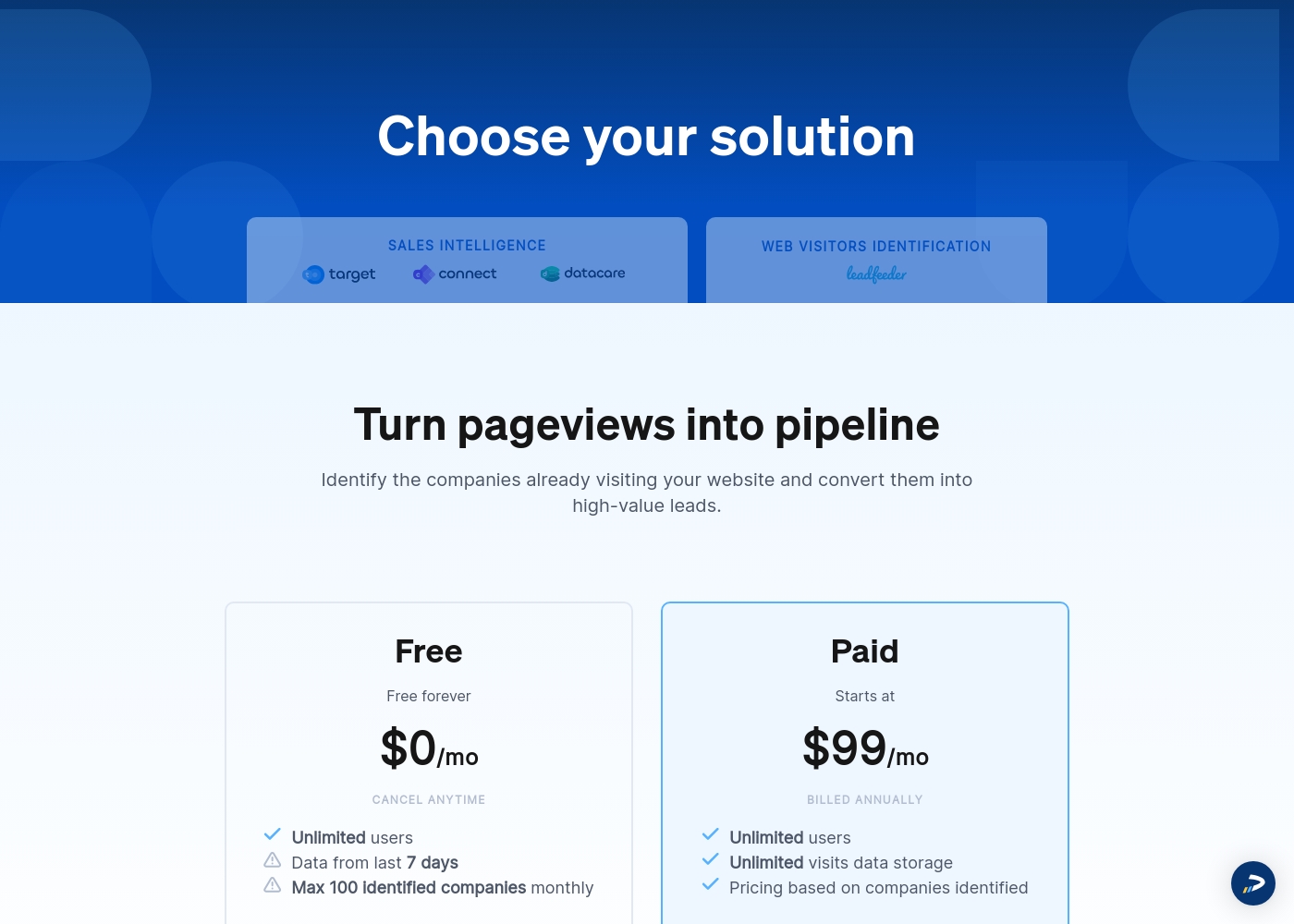
Leadfeeder costs between $0 and $99 per month (billed annually) with two plans: Free at $0 per month and Paid starting at $99 per month.
Here is a breakdown of what you get with each of the available identification solutions.
Free
Price: $0 per month Websites Supported: One per subscription (as subscriptions are priced per website) Best For: Small websites, evaluation, or testing the core feature set Refund Policy: Not applicable (It's free forever) Other Features: Unlimited users, data from the last 7 days, cancel anytime
- Free forever
- Unlimited users
- Verified company details (limited)
- Visitor data storage for the last 7 days
- Unlimited users
- Unlimited visits data storage
- All identified companies access
- Verified company details (firmographics & contact details)
- 25 contact export credits
Pricing Notes
- Apollo.io operates on a per-user model, while Leadfeeder includes unlimited users in all plans.
- Leadfeeder pricing scales based heavily on the monthly volume of companies identified visiting the site.
- If you need to connect MS Office or other corporate email accounts, you must purchase a paid plan from Apollo.io.
- Leadfeeder offers a lower entry point ($99 annual) but the cost can quickly become very high for high-traffic websites.
- Apollo.io offers up to 1 Million credits annually on Unlimited Paid plans, making high-volume prospecting highly feasible.
Pricing Head-to-Head
User Reviews
While Apollo.io promises a powerful AI sales engine, external reviews highlight significant execution problems. The overall sentiment is dissatisfied, driven primarily by poor or absent customer support responsiveness.
Many users report submitting multiple tickets for foundational issues, such as API problems and sequence failures, without receiving timely or helpful resolution. A major concern revolves around the core data reliability: users frequently cite issues with contact information accuracy.
I paid for service but could never get the system to actually work. I submitted multiple help tickets with no resolution. The lack of support was incredibly disappointing, and the one video meeting I got never addressed the issue.
The customer feedback available paints a highly polarized picture of Leadfeeder. While users appreciate the core functionality—its ability to identify visiting companies and connect quickly with Google Analytics—recent experiences highlight significant operational and support issues.
Many users found the tool useful for generating leads when paired with high website traffic. However, recurring negative comments focus heavily on the financial practices.
Leadfeeder is a very useful tool and an honest company. It helps us correctly identify website visitors, which allows us to add high-quality prospects to our sales database. The support team has been genuinely helpful throughout our time using the product.
Our Verdict
This decision hinges entirely on where your sales team needs the most help getting started. Apollo.io is focused on outbound execution; Leadfeeder is focused on inbound intent gathering. If you need one comprehensive, all-in-one platform for sequencing and rich data, Apollo.io is usually the winner. Apollo.io's superpower is its sheer database size, offering instant access to over 210 million contacts. It allows teams to launch personalized, multichannel sequences and enrich CRM data effortlessly. However, prepare for Apollo.io's steep learning curve and user complaints about data inaccuracy and poor support. Leadfeeder shines by immediately turning your website's anonymous visitors into qualified company leads. Leadfeeder is simpler to implement and provides unlimited users, which helps large passive teams. Crucially, Leadfeeder helps confirm buying intent by tracking which pages specific companies visit. The deciding factor is database access versus high-intent signals. Choose Leadfeeder if your website drives high traffic that needs analyzing for intent intelligence. Choose Apollo.io if you need to build contact lists from scratch and execute multi-step automation sequences. For most growing sales teams relying heavily on prospecting outreach, Apollo.io offers the better unified end-to-end sales platform. If your pipeline relies on passive signal monitoring, stick with the specialized ability of Leadfeeder.
Frequently Asked Questions
Which tool is better for small, high-growth teams: Apollo.io or Leadfeeder?
If you are focusing on cold outreach and contact sourcing, Apollo.io is better for its database access. If your website drives volume, Leadfeeder provides higher quality intent leads. Leadfeeder includes unlimited users, which is a huge scalability benefit. Apollo.io's per-user model might be restrictive later.
Does Leadfeeder offer automated email outreach and sequencing like Apollo.io?
No, Leadfeeder is specialized in identifying website visitors and intent data, not outreach execution. You must integrate Leadfeeder with your CRM or existing sales platform for sequencing. Apollo.io is a unified platform that includes native, high-volume sequencing tools.
Can Apollo.io identify companies visiting my website anonymously?
No, that specialized function is Leadfeeder’s primary core capability and biggest strength. Apollo.io focuses on building contact lists and enriching data once you have identified a prospect. Leadfeeder uses IP technology to turn anonymous page views into corporate sales intelligence.
Which tool is cheaper for a large enterprise sales team?
If your website traffic is low, Leadfeeder might be cheaper since it offers unlimited users at a fixed usage rate. Apollo.io charges per user seat and often requires expensive Custom Plans for full enterprise governance. High-traffic websites can face dramatically higher costs using Leadfeeder’s usage-based model.
What is the critical difference in the data quality users report?
Apollo.io users complain that verified email contacts often bounce and data accuracy is severely inconsistent. Leadfeeder users generally confirm company identification is high but sometimes find the contact leads too generic. Data reliability is a serious user-reported issue for both Apollo.io and Leadfeeder.
Regarding data compliance, which tool is safer for B2B intelligence?
Leadfeeder explicitly states its operations comply with GDPR and CCPA legislation requirements. Apollo.io does not clearly confirm this, and external reviews report serious allegations of scraping data without consent. If compliance is your top priority, Leadfeeder has a much clearer public legal stance.
Ready to Choose?
Both tools have their strengths. Choose based on your specific needs.