Adobe Commerce vs Sellfy
Adobe Commerce and Sellfy target wildly different e-commerce worlds. Adobe Commerce is built for massive enterprise scale and B2B complexity. Sellfy focuses on creators needing simplicity, low costs, and zero platform transaction fees.
Best for: Enterprise organizations needing specialized B2B functionality., Global companies managing multiple brands, languages, and regional sites.
Best for: Individual creators selling digital downloads and online courses., Anyone needing integrated print-on-demand services without upfront inventory costs.
Powerful, scalable, but opaque.
We found Adobe Commerce to be a feature-rich platform ideal for complex, multi-market enterprises needing B2B and B2C capabilities from one system. Its AI tools and cloud performance are standout strengths. Overall, it's a robust solution, but the custom pricing model and required sales consultation may be hurdles for smaller businesses.
Pros
Cons
Zero fees, simple selling for creators.
We found Sellfy to be an incredibly efficient, all-in-one platform tailored for creators who prioritize simplicity and cost savings. Its zero-transaction-fee model and built-in marketing tools offer exceptional value, starting at just $22 per month when billed annually. Overall, we confidently recommend Sellfy for easily scaling digital or physical product sales while maintaining total control.
Pros
- No platform transaction fees, improving profitability immediately.
- Extremely fast setup and user-friendly interface for first-time sellers.
- Supports digital, subscriptions, physical, and high-quality print-on-demand products.
- Includes essential growth tools like affiliate marketing and conversion features.
Cons
- Limited payment processing options (primarily Stripe and PayPal Business).
- Store designer offers basic functionality for advanced users seeking complex customization.
- Users report difficulty when trying to implement additional languages.
- Custom shipping labels cannot be fully branded.
AboutAdobe Commerce
Adobe Commerce is a comprehensive e-commerce platform for businesses of all sizes, especially mid-market and enterprise. It provides the tools to build and manage online stores, whether you're selling to consumers (B2C), other businesses (B2B), or both. 🛒 It’s built to be flexible, scalable, and intelligent, helping you create personalized shopping experiences.
AboutSellfy
Sellfy is an ideal, all-in-one platform built specifically for skilled creators and modern online businesses. It focuses on simplicity without sacrificing the results you need. If you hate complexity, Sellfy makes getting started easy.
You can upload and sell almost anything right away. This includes digital downloads like courses, music, art, and videos. You can also manage complex needs like physical products inventory or use the simple print-on-demand service. Sellfy helps you replace multiple tools with one efficient dashboard. 💡
Highlights
Feature Comparison
Features Overview
We highlight the main differences and pick a winner for each feature.
Pricing Model
Adobe Commerce requires custom quotes, while Sellfy uses transparent, monthly subscription tiers.
Adobe Commerce uses complex custom, quote-based pricing only. Costs depend on specific transactional needs and required technical resources. Buyers must contact the Adobe sales team for any pricing information. Sellfy offers clear subscription tiers ranging from $22 to $119 per month (annual billing). Pricing scales based on expected annual sales volume, up to $200,000. The trade-off is predictability versus enterprise scaling potential. Sellfy is affordable and understandable immediately. Adobe Commerce is an enterprise investment; Sellfy is an accessible operating cost for creators.
Enterprise Scale
Adobe Commerce handles 200,000+ orders per hour; Sellfy manages stores up to $200,000 annual sales.
Adobe Commerce is built for limitless growth and massive peak scale. Its architecture supports over 200,000 orders every hour easily. The platform uses powerful auto-scaling capabilities. Sellfy scales based on defined revenue caps, maxing out at $200,000 in yearly sales on the Premium plan. Exceeding this cap may result in a 2% overage fee. If volume is your biggest concern, Adobe Commerce is the only viable choice here. Sellfy is clearly designed for smaller, individual limits. Adobe Commerce secures complex organizations; Sellfy maximizes profitability for individual creators initially.
B2B Functionality
Adobe Commerce offers specialized B2B tools; Sellfy focuses purely on direct consumer sales (B2C).
Adobe Commerce includes robust B2B features like customer-specific catalogs and quoting tools. It simplifies purchasing with automated approval processes and quick ordering. This supports complex organizational buying needs. Sellfy does not offer dedicated corporate or B2B buying features. It focuses on streamlined sales of digital and physical goods to individuals. For any business requiring accounts, roles, or negotiated quotes, Adobe Commerce is mandatory. Sellfy lacks the infrastructure for this. If B2B is even a minor part of your revenue stream, you need the advanced tools of Adobe Commerce.
Transaction Fees
Sellfy charges zero platform transaction fees; Adobe Commerce pricing is custom and requires inquiry.
Sellfy proudly guarantees 0% platform transaction fees on all subscription levels. This greatly maximizes creator profitability immediately. You only pay standard processor fees to Stripe or PayPal. Adobe Commerce does not explicitly state platform transaction fees. Fees are typically bundled into the custom quote for enterprise users. Sellfy clearly prioritizes profit retention for creators. Its zero-fee policy is a major advantage for high-volume, lower-margin items. For creators obsessed with profit margins on sales up to $200k, Sellfy offers a massive financial benefit.
Customization & Extensibility
Adobe Commerce is an API-first composable platform; Sellfy offers basic themes and website embeds.
Adobe Commerce uses a composable, API-first architecture designed for developers. It allows deep integration with existing ERP and CRM systems via starter kits. This permits limitless custom projects. Sellfy offers store customization using themes and an intuitive Store Customizer tool. It also allows embedding the store interface into any existing website via simple widgets. Adobe Commerce is built for developers who need to rewrite functions. Sellfy is built for creators who hate coding. If you need specific, highly bespoke functionality, Adobe Commerce is the clear choice for extensibility and full control.
Digital Product Focus
Sellfy is optimized for digital files and subscriptions; Adobe Commerce handles digital goods within an enterprise framework.
Sellfy is built to sell digital downloads, music, courses, and subscriptions seamlessly. It supports large files up to 20GB on the Premium plan. This is a core feature. Adobe Commerce supports digital products but is geared toward complex physical goods logistics and large catalogs. Digital sales are secondary to enterprise capability. Sellfy shines by including specific tools like integrated print-on-demand and subscription models directly. Customers report an easy experience. A creator starting today can launch their first digital product much faster and cheaper using Sellfy.
Security & Compliance
Adobe Commerce meets enterprise security requirements; Sellfy offers standard SSL encryption.
Adobe Commerce is a certified PCI Level 1 Solution Provider, mandatory for large payment processing. It is also SOC 2 compliant. A HIPAA-ready option is available for single-tenant users. Sellfy utilizes standard SSL encryption technology to protect customer data during transactions. It does not advertise high-level enterprise compliance certifications. For businesses handling extremely high volumes or sensitive data, Adobe Commerce provides necessary regulatory compliance. If your legal team requires high-level certifications, Adobe Commerce is the only platform that provides this peace of mind.
Adobe Commerce costs are not explicitly stated for its three primary plans: Adobe Commerce as a Cloud Service, Adobe Commerce on Cloud, and Adobe Commerce Optimizer.
Take a look at the specific packages below to see which infrastructure fits your company best.
Adobe Commerce as a Cloud Service (SaaS)
Price: Not explicitly stated Websites Supported: Not explicitly stated Best For: B2C and B2B businesses wanting a complete, multi-tenant cloud solution. Refund Policy: Not explicitly stated Other Features: Transaction processing, B2B commerce operations, Global expansion, Multi-tenant cloud service, Automatic feature updates
- Transaction processing
- B2B commerce operations
- Global expansion
- Multi-tenant cloud service
- Automatic updates
- Single-tenant dedicated infrastructure
- API-first extensibility
- High-performance storefront
- 24/7 support
- PCI Level 1 compliance
- AI-powered search
- Product recommendations
- Catalog management
- Multi-tenant cloud service
- Merchandising reports

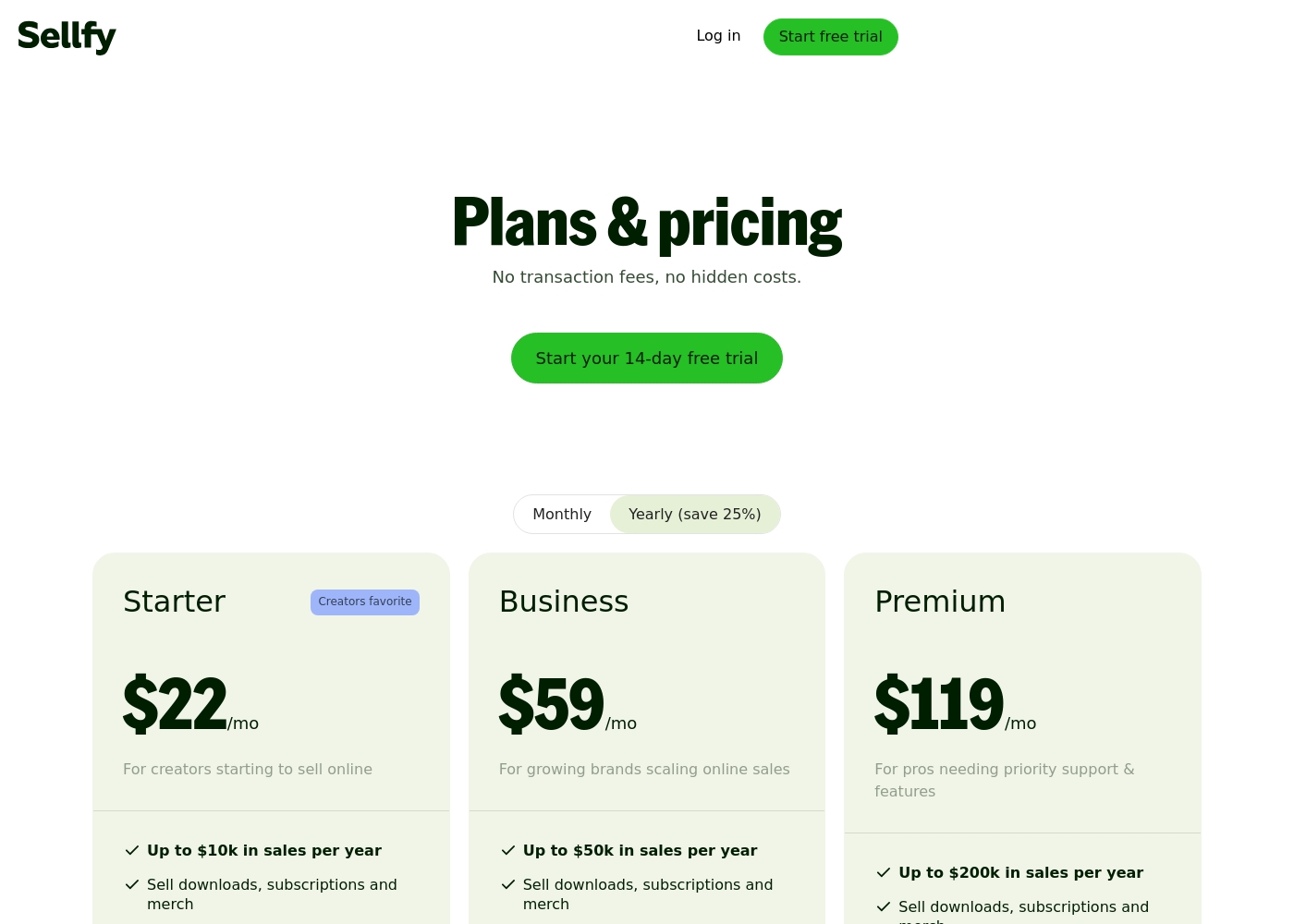
Sellfy costs between $22 and $119 per month (when billed yearly) with three plans: Starter at $22/month, Business at $59/month, and Premium at $119/month.
These plans are designed to scale alongside your business growth. When you choose annual billing versus monthly, you will save 25% on your total subscription cost.
Starter
Price: $22/mo (billed annually) or $29/mo (monthly) Best For: Creators starting to sell online Refund Policy: 30-day money-back guarantee Other Features:
- Up to $10k in sales per year
- Unlimited products (downloads, subscriptions, merch)
- Email marketing with 2,000 free credits
- Maximum product file size is 10GB
- 0% transaction fees
- Sell downloads, subscriptions, and merch
- Unlimited products
- Email marketing (2,000 credits)
- Core marketing features
- 0% transaction fees
- All core features
- Email marketing (10,000 credits)
- Custom fields
- Growth features (Product upselling, Cart abandonment, Affiliate marketing)
- 0% transaction fees
- All Business features
- Email marketing (50,000 credits)
- Advanced options
- Product and design migration
Pricing Notes
- Adobe Commerce requires detailed consultation for custom pricing quotes for all three plans.
- Sellfy offers predictable monthly pricing based on yearly sales volume, up to $200k annually.
- Sellfy guarantees 0% platform transaction fees, significantly boosting creator profit margins.
- Adobe Commerce offers no stated free trial or explicit money-back guarantee.
- Sellfy provides a generous 14-day free trial plus a 30-day money-back guarantee on paid plans.
Pricing Head-to-Head
User Reviews
Finding reliable, public user reviews for Adobe Commerce on Trustpilot or Capterra proved challenging. The Capterra link returned a security error, and no Trustpilot profile was available.
Based on this, we cannot synthesize a balanced review from external snippets. We must rely solely on the provided product information, which highlights AI-powered discovery, scalable cloud architecture, and strong B2B/B2C flexibility. However, the lack of accessible third-party feedback means we cannot comment on real-world accuracy, support responsiveness, or pricing value.
Reviewers overwhelmingly praise Sellfy for its user-friendliness and affordable structure, highlighting that setup, product uploading, and sales management are quick and easy, even for first-time sellers. Customers frequently mention the platform’s great pricing, noting it's more affordable than competitors because it charges no transaction fees.
Users value its comprehensive features, which successfully support digital products, subscriptions, and even reliable print-on-demand services. Customer support is consistently commended for being helpful and responsive; specific staff members received praise for their timely assistance.
This is the best platform I’ve tried for my mini business. It offers a full set of features for digital, physical, and print-on-demand products. The functionality, speed, and instant money transfer are all perfect.
Our Verdict
This comparison is ultimately about enterprise power versus creator simplicity. Both Adobe Commerce and Sellfy are best-in-class, but they serve entirely different markets. You must decide the current scale and complexity of your business first. Adobe Commerce dominates the enterprise landscape with unmatched scale and architecture. It's built for global B2B and B2C organizations handling massive traffic spikes. Adobe Commerce can reliably process over 200,000 orders per hour easily. This solution also offers crucial features like PCI Level 1 compliance and official B2B quoting tools. Sellfy is the clear winner for individual creators and small businesses. Its primary advantage is financial simplicity: 0% transaction fees forever. Sellfy provides an all-in-one shop for digital products, subscriptions, and even integrated print-on-demand. The crucial deciding factor is architecture and budget. If you require deep API customization from a development team, choose Adobe Commerce. If you must minimize costs and launch a simple store immediately, Sellfy wins easily. Select Adobe Commerce if you run a multi-site global corporation needing B2B tools and high compliance. Choose Sellfy if you are a creator focused on selling digital products below the $200k annual sales mark.
Frequently Asked Questions
Which is better for selling digital downloads: Adobe Commerce or Sellfy?
Sellfy is better as it’s designed specifically for creators selling digital products. Sellfy supports very large files up to 20GB and includes subscriptions. Adobe Commerce is capable but geared toward enterprise catalogs and complex physical goods.
Does Sellfy offer the same high-level security as Adobe Commerce?
No. Adobe Commerce offers superior, enterprise-grade compliance. It is a certified PCI Level 1 provider and SOC 2 compliant. Sellfy utilizes standard SSL encryption necessary for securing standard transactions.
How does the pricing transparency differ between Adobe Commerce and Sellfy?
Sellfy uses clear, affordable subscription tiers based on sales volume. Adobe Commerce only provides custom pricing quotes after contacting the sales team. Sellfy is significantly more transparent and accessible for new sellers.
Can small businesses afford Adobe Commerce?
Sellfy is highly affordable for small businesses, with plans starting low. Adobe Commerce is designed for enterprise budgets, requiring custom quotes, making it too expensive for most small or solo operations.
Which tool is easier to integrate with my existing website: Adobe Commerce or Sellfy?
Sellfy is much easier to integrate onto an existing site. You can use simple widgets or buttons to embed the shopping experience anywhere without complex coding. Adobe Commerce integration requires deep API design.
Which is better for B2B sales: Adobe Commerce or Sellfy?
Adobe Commerce is purpose-built for B2B sales with dedicated features. This includes negotiated online quotes and automated purchase approval processes. Sellfy focuses solely on direct-to-consumer sales models.
Ready to Choose?
Both tools have their strengths. Choose based on your specific needs.