Adobe Commerce vs BigCommerce
Adobe Commerce and BigCommerce both specialize in high-volume, enterprise e-commerce solutions. Adobe Commerce offers deep customization for companies needing specialized architecture and speed. BigCommerce focuses on high reliability, zero platform transaction fees, and B2B growth. Selecting the right one depends heavily on your cost tolerance and need for proprietary AI.
Best for: Global enterprise organizations requiring HIPAA/security customization, B2B companies needing live quote negotiation features
Best for: High-volume brands transitioning from mid-market platforms, Companies prioritizing zero transaction fees on all sales
Powerful, scalable, but opaque.
We found Adobe Commerce to be a feature-rich platform ideal for complex, multi-market enterprises needing B2B and B2C capabilities from one system. Its AI tools and cloud performance are standout strengths. Overall, it's a robust solution, but the custom pricing model and required sales consultation may be hurdles for smaller businesses.
Pros
Cons
Robust tools meet customer service disconnect.
We observe BigCommerce heavily emphasizing high-level enterprise tools, like guaranteed 0% transaction fees and robust infrastructure for scalability. However, user reviews detail severe service issues, including unexpected server outages and deeply unresponsive customer support, even for priority users. Overall, BigCommerce provides impressive technical capability that is unfortunately undermined by inconsistent stability and poor customer experience.
Pros
- Guaranteed 0% transaction fees on the Enterprise plan.
- High reliability with 99.99% reported uptime.
- Industry-leading optimized one-page checkout available.
- Customizable, non-cookie cutter themes compared to competitors.
Cons
- Customer service is frequently reported as unhelpful, non-existent, or indifferent.
- Specific users mention significant, unexpected server downtime (e.g., 25-hour outages).
- Platform infrastructure (CMS, blog system) reportedly struggles with SEO and formatting.
- Essential features like product filters are locked behind high-tier plans.
AboutAdobe Commerce
Adobe Commerce is a comprehensive e-commerce platform for businesses of all sizes, especially mid-market and enterprise. It provides the tools to build and manage online stores, whether you're selling to consumers (B2C), other businesses (B2B), or both. 🛒 It’s built to be flexible, scalable, and intelligent, helping you create personalized shopping experiences.
AboutBigCommerce
BigCommerce Essentials is a top-rated ecommerce platform designed specifically for fast-growing businesses, including high-volume operations and B2B SMBs. It operates as a high-performance platform that truly scales with you. Built-in flexibility means you have the freedom to customize your store and save money at the same time. You get robust features that ensure efficient operation, allowing you to focus on expanding your brand and attracting more shoppers. ✅
Highlights
Feature Comparison
Features Overview
We highlight the main differences and pick a winner for each feature.
Pricing Model
BigCommerce offers predictable transactional costs, while Adobe Commerce pricing is completely bespoke and opaque.
Adobe Commerce does not list any standard pricing tiers for its three packages. All costs are entirely customized based on your volume and feature requirements. You must contact their sales team for any pricing information. BigCommerce Enterprise uses a quote-based model but publicly guarantees 0% additional platform transaction fees. This dramatically improves cost predictability for high-volume merchants. Lower Essentials tiers operate on standard monthly subscription prices. The key difference is transparency and fee structure avoidance. BigCommerce is clear about transactional costs, while Adobe Commerce is a full custom negotiation. If cost predictability is vital, BigCommerce provides a clearer path to savings. If you are a high-volume merchant, BigCommerce's zero transaction fee guarantee provides immense long-term value. Adobe Commerce clients must negotiate all costs upfront.
AI Personalization
Adobe Commerce includes deep, native AI tools baked in; BigCommerce relies on external integrations.
Adobe Commerce leverages AI to match customers to products faster and boost resulting sales. It offers 13 types of AI-powered product recommendations natively. Features include personalized search results and category merchandising. BigCommerce focuses more on conversion infrastructure like its optimized one-page checkout experience. Advanced AI personalization features must be sourced and integrated via third-party extensions. Adobe Commerce wins by integrating deep AI capabilities directly into the core platform experience. This eliminates the cost and complexity of linking external optimization tools. Using Adobe Commerce's native AI helps boost Average Order Value (AOV) immediately upon launch. It is designed to maximize revenue from your existing traffic.
B2B Capabilities
Adobe Commerce offers deep negotiation features; BigCommerce focuses on customer segmentation.
Adobe Commerce provides specialized B2B tools, including support for company accounts with multiple users and roles. It allows sellers to negotiate complex quotes entirely online. Buyers can also utilize quick-ordering options for efficiency. BigCommerce supports B2B and wholesale through features like defining customer groups and price lists. This allows for tailoring product access and pricing specifically for key business buyers. Adobe Commerce provides a more active transactional environment, including quote negotiation and automated purchase approvals. BigCommerce is excellent for setting up standardized, personalized wholesale portals. If your B2B sales cycle requires active seller involvement and dynamic pricing adjustments, Adobe Commerce is better suited. Both tools support basic B2B segmentation needs.
Peak Performance
Adobe Commerce cites order volume capacity; BigCommerce guarantees high annual uptime reliability.
Adobe Commerce is built on a distributed architecture with strong auto-scaling capabilities. It’s validated to processes over 200,000 orders per hour during peak sales events like flash sales. This ensures robust handling during massive spikes. BigCommerce guarantees best-in-class 99.99% uptime year-round for maximum stability. Critically, BigCommerce has maintained 100% uptime during Cyber Week for ten straight years. The core difference is the metric: Adobe Commerce emphasizes speed and transaction volume capacity. BigCommerce emphasizes flawless availability during the biggest sales periods. High-frequency flash sales where speed is crucial favor Adobe Commerce’s capacity. Steady, reliable performance during seasonal spikes favors BigCommerce.
Security & Compliance
Both platforms are PCI Level 1 compliant; Adobe Commerce uniquely offers a path to HIPAA readiness.
Adobe Commerce is a certified PCI Level 1 Solution Provider and SOC 2 compliant, meeting high transaction security standards. It features advanced threat detection and Web Application Firewalls (WAF). BigCommerce also maintains Tier 1 security compliance, including PCI DSS 3.2 Level 1, ISO, and SOC. It offers robust data security alignment (GDPR, CCPA). The critical distinction is the dedicated HIPAA-ready option available as an add-on for Adobe Commerce's PaaS configuration. This is vital for regulated industries. Companies needing the highest level of regulatory compliance, particularly involving health data, should strongly favor the single-tenant PaaS option from Adobe Commerce.
Multi-Store Management
Both systems handle multiple storefronts efficiently; Adobe Commerce is based on a single instance.
Adobe Commerce leverages a flexible multisite architecture to support multiple brands, regions, and currencies. You manage all storefronts from a single administrative interface. Resources like content can be easily shared or customized per site. BigCommerce uses its Multi-Storefront feature to manage diverse sites from one centralized back-end. This is highly useful for rapidly expanding into new regions or launching new product brands efficiently. Whether using Adobe Commerce or BigCommerce, you gain full control over multiple distinct shopping experiences. Both remove the necessity of running separate administrative platforms. This feature allows businesses to localize branding and pricing efficiently without multiplying administrative overheads.
API & Extensibility
Both are fully API-first platforms supporting advanced headless commerce requirements.
Adobe Commerce is built as an API-first, composable platform, simplifying integration with existing legacy systems. Developers benefit from integration starter kits for systems like ERP, CRM, and PIM. The tools support rapid innovation. BigCommerce Enterprise is fully headless-ready and offers unlimited API calls for maximum flexibility. This allows seamless data synchronization and integration with complex third-party infrastructure. Both platforms are designed for modern development teams prioritizing customized, decoupled storefronts. Neither tool creates limitations on integration complexity or frequency. If you need to connect your commerce operation to custom ERPs or complex inventory systems, both Adobe Commerce and BigCommerce provide the architecture required.
Trial Availability
BigCommerce offers a free trial option; Adobe Commerce mandates an enterprise commitment.
Adobe Commerce requires immediate engagement with the sales team, as there is no publicly advertised free trial. You must negotiate a custom contract based on your specific needs. BigCommerce allows users to start a free trial for its Essentials plans, reducing immediate financial risk. They also offer Launch Coaches to help new customers set up their stores effectively. For smaller or growing businesses, BigCommerce offers a pathway to test the platform before committing resources. Adobe Commerce is designed purely for committed enterprise ventures. If you want to pilot the platform or get hands-on experience without a multi-year contract commitment, BigCommerce is the only choice.
Adobe Commerce costs are not explicitly stated for its three primary plans: Adobe Commerce as a Cloud Service, Adobe Commerce on Cloud, and Adobe Commerce Optimizer.
Take a look at the specific packages below to see which infrastructure fits your company best.
Adobe Commerce as a Cloud Service (SaaS)
Price: Not explicitly stated Websites Supported: Not explicitly stated Best For: B2C and B2B businesses wanting a complete, multi-tenant cloud solution. Refund Policy: Not explicitly stated Other Features: Transaction processing, B2B commerce operations, Global expansion, Multi-tenant cloud service, Automatic feature updates
- Transaction processing
- B2B commerce operations
- Global expansion
- Multi-tenant cloud service
- Automatic updates
- Single-tenant dedicated infrastructure
- API-first extensibility
- High-performance storefront
- 24/7 support
- PCI Level 1 compliance
- AI-powered search
- Product recommendations
- Catalog management
- Multi-tenant cloud service
- Merchandising reports

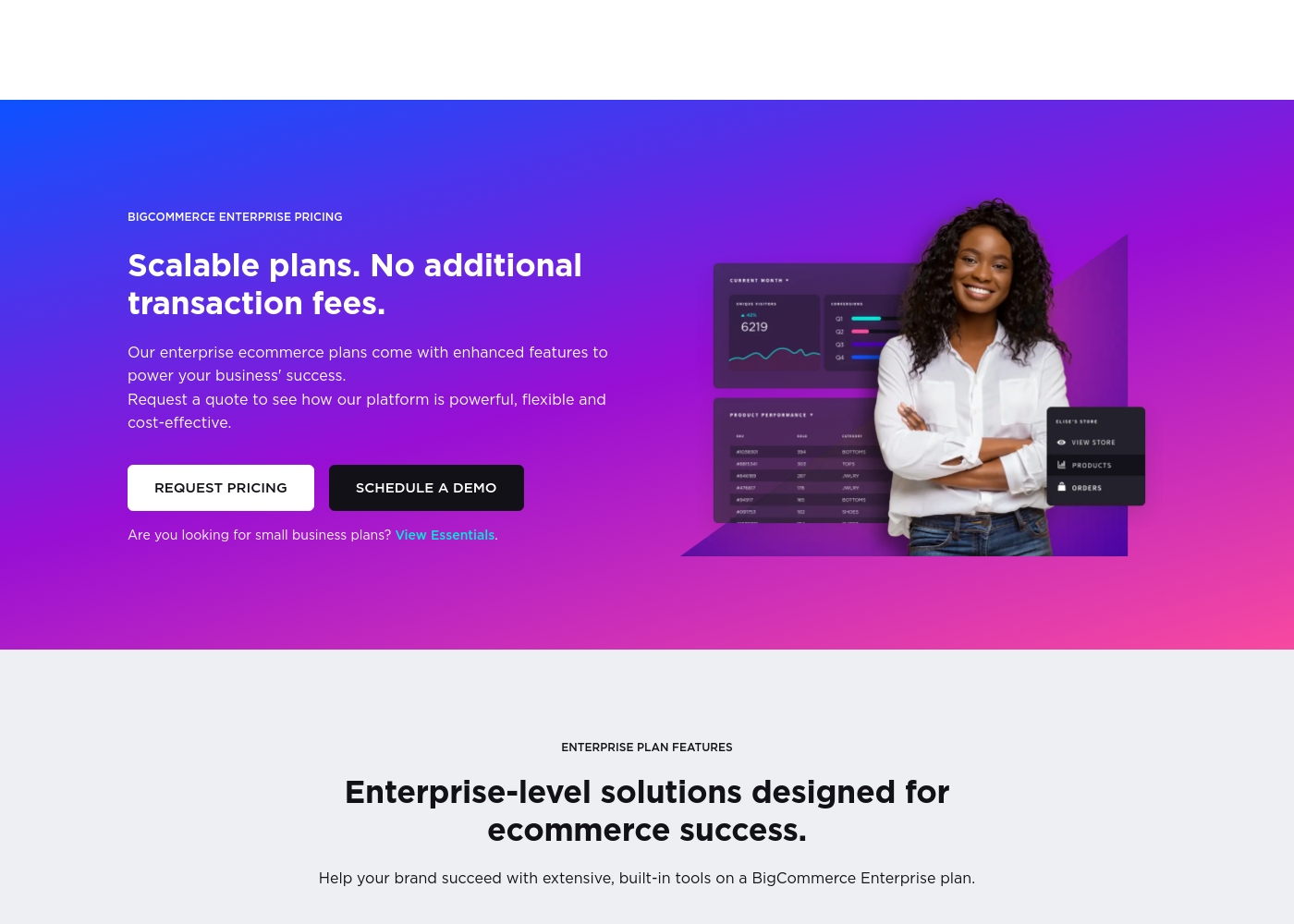
Since pricing for the most scalable options is custom, the UI requests a quote. The detailed information below relates specifically to the features included in the Enterprise service level. If you are looking for small business solutions, BigCommerce points you toward their Essentials plans.
Enterprise
Price: Request a quote Websites Supported: Multiple (via Multi-Storefront feature) Best For: Ecommerce success for mid-market and enterprise brands Other Features:
- No additional transaction fees (0%)
- Unlimited staff accounts and API calls
- 24/7 priority support (phone, chat, and ticket)
- Multi-currency support and Price lists
- Migration assistance
The Enterprise plan is tailored for large-scale operations that require maximum performance and flexibility. You benefit from highly specific features like comprehensive migration assistance and fully customizable checkout options. This plan ensures your operations run smoothly, offering robust security standards and dedicated customer success management.
- 0% additional transaction fees
- Unlimited staff accounts
- 24/7 priority support
- Multi-Storefront access
- Unlimited API calls
- Start free trial available
- Ecommerce for Growing Brands
Pricing Notes
- Adobe Commerce pricing is entirely custom and opaque; you must contact sales for a quote.
- BigCommerce Enterprise guarantees 0% additional transaction fees, saving high-volume merchants significant money.
- BigCommerce offers a free trial for its lower-tier Essentials plans.
- Adobe Commerce does not offer a free trial or public prices for any of its enterprise packages.
Pricing Head-to-Head
User Reviews
Finding reliable, public user reviews for Adobe Commerce on Trustpilot or Capterra proved challenging. The Capterra link returned a security error, and no Trustpilot profile was available.
Based on this, we cannot synthesize a balanced review from external snippets. We must rely solely on the provided product information, which highlights AI-powered discovery, scalable cloud architecture, and strong B2B/B2C flexibility. However, the lack of accessible third-party feedback means we cannot comment on real-world accuracy, support responsiveness, or pricing value.
User reviews for BigCommerce show a sharp division in experience, reflected by the low Trustpilot score (1.4). While some users find the platform intuitive and highly customizable compared to standard competitors, the dominant sentiment focuses on major technical and support failures.
Recurring complaints highlight unexpected and significant unreliability issues, with multiple reports of severe, multi-hour server outages. Furthermore, customer service is frequently described as the "worst," often failing to solve problems or responding with indifference, even for Enterprise customers.
I am on the enterprise plan and the support is completely non-existent. This platform has simply been an absolute disaster, wasting both time and money for our business. I would strongly advise others to stay away from it.
Our Verdict
This comparison pits specialized enterprise architecture against optimized commerce infrastructure. If you require truly bespoke software and custom security rules, look at Adobe Commerce. BigCommerce is the stronger choice for high-volume stores prioritizing predictable costs and high availability. Both platforms deliver industry-leading features for massive scale. Adobe Commerce's superpower is its deep customization and proprietary AI personalization tools baked in. It easily handles complex requirements, like HIPAA readiness or managing millions of SKUs from a single console. B2B firms will maximize efficiency using the built-in quick ordering and online quote negotiation tools. BigCommerce stands out by guaranteeing 0% additional platform transaction fees for all Enterprise customers. Its 99.99% uptime promise and Multi-Storefront capabilities make scaling worry-free. BigCommerce is the best if predictable costs are more crucial than maximum underlying architectural customization. The core factor is the trade-off between architectural complexity and fiscal certainty. Adobe Commerce delivers unparalleled, customized enterprise scale but at an opaque price point. BigCommerce offers vital cost control, though you must weigh the platform reliability issues cited in customer reviews. Choose Adobe Commerce if you run a regulated enterprise or process 200,000+ orders per hour during flash sales. Pick BigCommerce if you want zero transaction fees, guaranteed uptime, and the ability to launch multiple brands easily.
Frequently Asked Questions
Which platform is better for zero transaction fees: Adobe Commerce or BigCommerce?
BigCommerce is strongly better here, guaranteeing 0% additional platform transaction fees on its Enterprise plan. This saves high-volume merchants a significant amount of money annually. Adobe Commerce does not publicly specify its transactional fee structure.
Can I try Adobe Commerce or BigCommerce before committing?
You can try BigCommerce via a free trial offered for its Essentials plans, reducing your initial risk. Adobe Commerce does not offer any free trial or publicly listed prices for its custom enterprise solutions. You must engage with sales directly.
Which platform offers better B2B tools for negotiation and complex accounts?
Adobe Commerce offers slightly better, dedicated B2B tools including online quote negotiation and automated approval processes. BigCommerce is excellent for segmenting customers and providing specialized personalized pricing.
Is Adobe Commerce or BigCommerce more customizable for complex requirements?
Adobe Commerce is arguably more customizable through its PaaS package, offering a dedicated, single-tenant environment. This allows for specialized infrastructure needs like HIPAA-ready compliance features. BigCommerce focuses on flexibility via unlimited API calls.
Which platform has better guaranteed uptime: Adobe Commerce or BigCommerce?
BigCommerce guarantees 99.99% uptime for the platform and maintained 100% uptime during Cyber Week for ten years. Adobe Commerce emphasizes performance, stating it can handle 200,000+ orders per hour but offers no specific annual uptime guarantee.
How does the pricing model differ between Adobe Commerce and BigCommerce?
Adobe Commerce uses strictly custom, quote-based pricing depending on your volume and features. BigCommerce also uses quote-based pricing for Enterprise, but guarantees against transaction fees. BigCommerce also offers standard subscription tiers for smaller plans.
Ready to Choose?
Both tools have their strengths. Choose based on your specific needs.