ActivePieces vs Splunk
ActivePieces and Splunk solve different problems entirely. ActivePieces automates workflows and connects apps with AI. Splunk is a powerful data platform for security and observability. Choosing the right one depends entirely on what you're trying to build.
Best for: Teams needing app-to-app workflow automation, Businesses adopting AI-first automation strategies
Best for: Enterprise security operations centers (SOCs), IT operations teams troubleshooting complex systems
Powerful Automation, Complex Pricing
We find ActivePieces to be a technologically superior tool that rivals Zapier and Make, excelling in handling complex, AI-first workflows and offering excellent cost efficiency. Overall, while the core automation engine and feature set are industry-leading and SOC 2 Type II compliant, the platform's relationship with its community has been significantly strained by retroactive policy and pricing changes.
Pros
- AI-first automation featuring agents and 470 connectors.
- High flexibility with no-code canvas and powerful Code module for custom JS libraries.
- Considered cost-effective and cheaper than competitors like Zapier and n8n.
- Includes enterprise-ready features like flow versioning and auto retry for failures.
Cons
- Lack of transparency regarding sudden, substantial pricing structure changes.
- Early supporters felt betrayed by perceived changes to lifetime deals.
- Users were automatically downgraded from paid plans to trial plans without notification.
- Inconsistent customer support response for issues not reported on GitHub.
Powerful but complex data platform.
We find Splunk offers a robust, unified platform for security and observability with extensive integrations and scalability. However, its pricing structure is opaque and usage-based, which can make cost planning challenging. Overall, it's a strong choice for enterprises needing deep data analysis, but smaller teams may find it complex and expensive.
Pros
- Unified platform for security and observability.
- Over 2,000 integrations with various data sources.
- AI and automation for threat response.
- Handles massive data volumes at scale.
Cons
- Opaque pricing requires consultation with sales.
- Can be complex to set up and learn.
- Usage-based models may lead to unpredictable costs.
- External review access was blocked, limiting user sentiment data.
AboutActivePieces
ActivePieces delivers the full ecosystem for AI automation and agents. It focuses on connecting smart agents, no-code flows, and a central data store called Tables. This impressive platform is trusted by companies ranging from startups all the way to Fortune 50 organizations. You can easily start using ActivePieces on the cloud, or choose to self-host with Docker for ultimate control. Whether you are building complex AI agents or setting up simple automations, the system makes it smart and easy. 💡
AboutSplunk
Splunk is a unified platform for security and observability. It's designed for teams that need to search, analyze, and act on data from any source. Whether you're a security analyst hunting threats or an engineer troubleshooting app performance, it brings everything together in one place. ✨
Highlights
Feature Comparison
Features Overview
We highlight the main differences and pick a winner for each feature.
Core Purpose
ActivePieces automates tasks between apps. Splunk analyzes data from any source.
**ActivePieces** is an automation platform. It connects your apps and lets AI agents perform tasks automatically. You build flows using a visual no-code canvas. It's designed to make your team's work run on autopilot. **Splunk** is a data platform. It ingests logs, metrics, and traces from your entire tech stack. It's built for searching, analyzing, and acting on massive volumes of machine data in real time. The key difference is focus. ActivePieces is for *doing* things automatically. Splunk is for *understanding* what's happening across your systems. They solve different problems.
AI Capabilities
ActivePieces has AI agents that act. Splunk uses AI to detect threats.
**ActivePieces** puts AI at the center. You can build smart agents that think and act across your apps. They access over 470 tools. You can even let the AI write custom code for you. **Splunk** uses AI for security and insights. It powers high-fidelity alerts that filter out noise. AI helps automate incident response workflows. It's focused on making security teams faster. ActivePieces AI is for *execution*. Splunk AI is for *detection and analysis*. One automates actions, the other illuminates data.
Ease of Use
ActivePieces uses a visual builder. Splunk requires learning a query language.
**ActivePieces** is built for simplicity. The core is a drag-and-drop visual builder. If you can make a flowchart, you can build an automation. The learning curve is gentle. **Splunk** is powerful but complex. To get value, you need to learn its search processing language (SPL). This is a specialized skill. Setup and configuration can also be involved. ActivePieces is more accessible for non-technical users. Splunk has a steeper learning curve, favoring technical teams.
Integration Ecosystem
Splunk has more integrations for data sources. ActivePieces has a solid library for app connections.
**ActivePieces** offers 470+ "pieces." These connect popular business apps like Slack, Google Sheets, and CRMs. The library grows via community contributions. It covers core workflow needs. **Splunk** boasts over 2,000 integrations. It connects to virtually any data source: databases, cloud services, firewalls, and custom apps. It's designed to ingest data from everywhere in your stack. Splunk's ecosystem is broader for *data ingestion*. ActivePieces is tailored for *app-to-app action*.
Pricing & Value
ActivePieces has a clear free tier. Splunk pricing is opaque and usage-based.
**ActivePieces** uses simple, usage-based pricing. You get 10 free active flows forever. After that, it's $5 per active flow per month. You pay for what you use. **Splunk** pricing is customized. You contact sales for a quote. Costs are based on data volume or activity metrics. This can be unpredictable for budgets. ActivePieces offers predictable, transparent value. Splunk can be expensive but scales for massive enterprise needs.
Security & Compliance
ActivePieces is SOC 2 Type II compliant. Splunk is an enterprise security leader.
**ActivePieces** is built for security. It's officially SOC 2 Type II compliant. The core is open source for transparency. Ultimate plans add SSO and audit logs. **Splunk** is a cornerstone of enterprise security. It's used by leading organizations worldwide. It helps prove compliance by analyzing audit logs across all systems. It's a trusted platform for sensitive data. Both are secure. Splunk has a longer track record in enterprise security operations.
Scalability
Splunk is built for massive data volumes. ActivePieces scales for automation needs.
**ActivePieces** scales for team and workflow demands. Its pricing is per active flow. It handles complex automations for businesses from startups to Fortune 50. The focus is on workflow scale. **Splunk** is built for data scale. It ingests and analyzes petabytes of data. It handles the demands of global networks and AI infrastructure. It's designed for massive operational scale. Splunk handles raw *data volume*. ActivePieces handles *operational complexity*.
Customer Support
ActivePieces offers email support. Splunk support details are not public.
**ActivePieces** provides email support on its Standard plan. The community is active on GitHub for bug reports. Response times are not explicitly guaranteed. **Splunk** does not list support details publicly. You need to contact sales for SLAs and support plans. Support is likely comprehensive but enterprise-focused. ActivePieces has transparent, accessible support tiers. Splunk's support model is likely more robust but less visible.
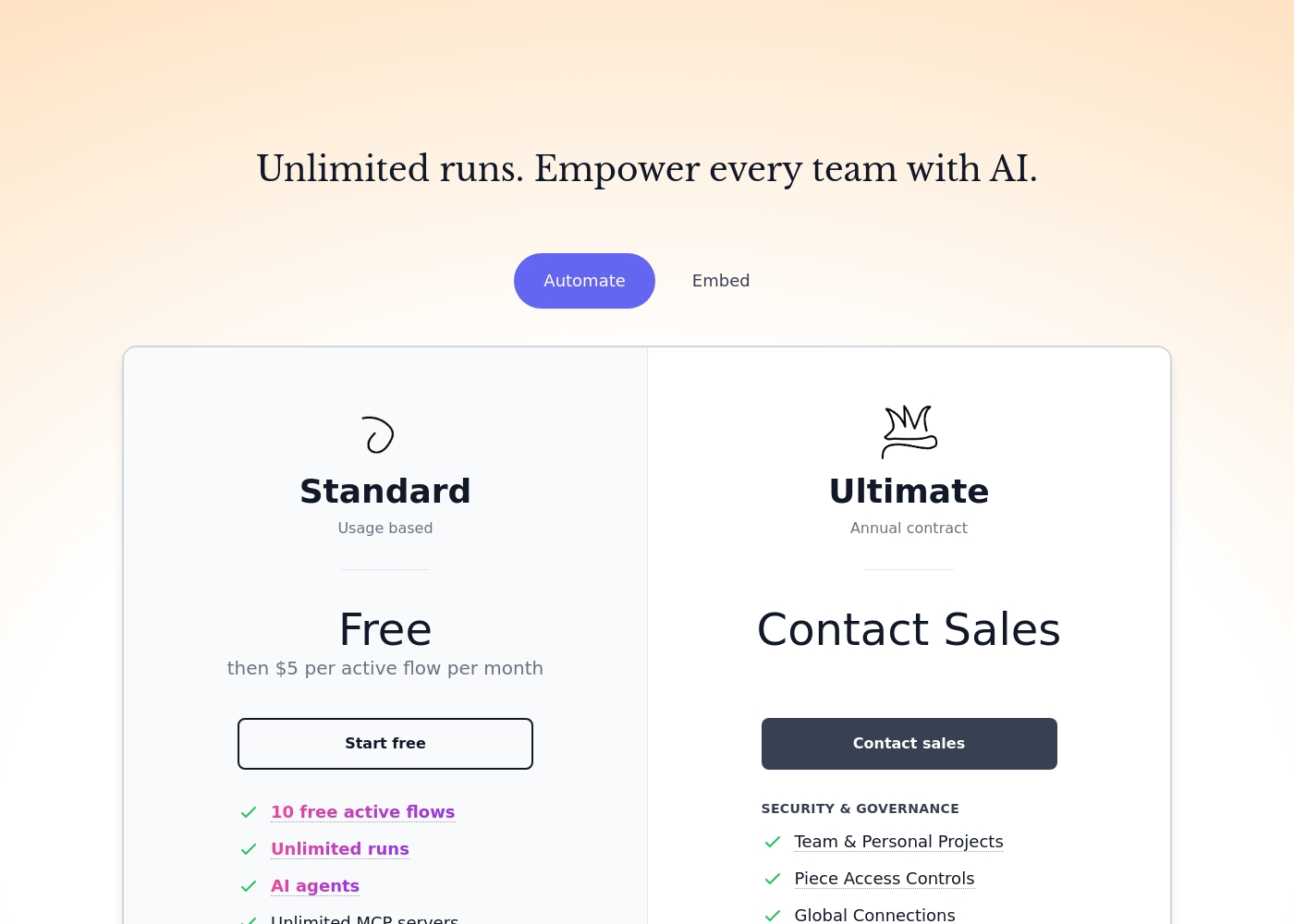
ActivePieces cloud plans start Free, then cost $5 per active flow per month, with enterprise tier pricing requiring a sales inquiry. Two managed plans are available: Standard (Free then $5 per active flow per month) and Ultimate (Contact Sales, Annual contract).
Here is a look at the specific features included in each plan type.
Standard
Price: Free then $5 per active flow per month Other Features:
- 10 free active flows
- Unlimited runs
- AI agents
- Unlimited MCP servers
- Unlimited tables
- Email support
- 10 free active flows
- Unlimited runs
- AI agents
- Unlimited MCP servers
- Unlimited tables
- Security & Governance
- Team & Personal Projects
- Piece Access Controls
- Global Connections
- Custom RBAC
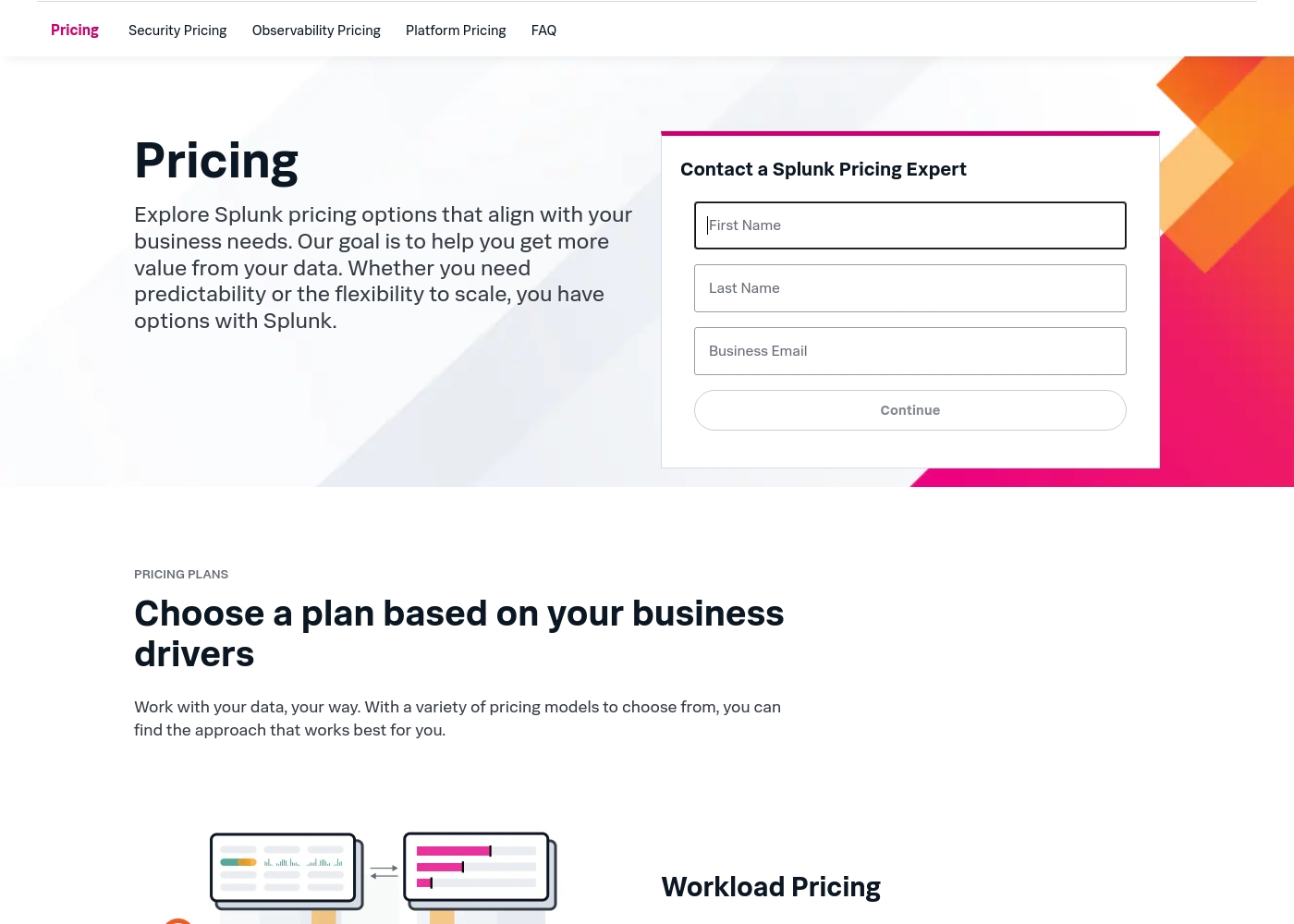
Take a look at the different ways you can manage your data costs below.
Ingest Pricing
Best For: Teams needing predictable costs for high-volume data ingestion Other Features: Simple predictable approach, Economical search scaling, Broad data ingestion
This plan is a great fit if you want a straightforward bill based on the amount of data you bring into the platform. It makes it easy to run extra searches without worrying about hidden fees. It's built for consistency and long-term planning.
- Search and analyze machine data
- Expanded use cases on ingested data
- Standard data ingestion
- Metric time series (MTS)
- Traces analyzed per minute
- Sessions monitoring
- Uptime requests
Pricing Notes
- ActivePieces has a permanent free tier with 10 active flows. Splunk only offers a time-limited free trial.
- ActivePieces uses transparent, per-flow pricing. Splunk's usage-based pricing requires a sales consultation.
- ActivePieces is generally more affordable for small to medium teams. Splunk is an investment for large-scale data needs.
- ActivePieces Ultimate plan requires an annual contract. Splunk pricing is customized per agreement.
Pricing Head-to-Head
User Reviews
We see a nuanced divide in user feedback for ActivePieces on Trustpilot, reflecting both its powerful technical capabilities and its governance challenges. Users consistently praise the platform as a powerful, cost-effective alternative to established competitors like Zapier and Make.
Reviewers note its simple integration process, short learning curve, and ability to handle intricate, heavy-lifting workflows effectively. Many users appreciate the solid community support and quick response when submitting platform bugs via GitHub.
I moved nearly all my Zaps from Zapier with no issues. Their pricing is truly amazing and much cheaper than key competitors. They even allow connecting multiple Gmail accounts to one workflow, which is a limiting factor on n8n.
Based on the provided external sources, we couldn't retrieve detailed user reviews for Splunk due to access restrictions. Trustpilot and Capterra both returned verification or security pages, preventing us from gathering specific sentiment on accuracy, ease of use, support, or pricing.
This means our review is based solely on the official product information and pricing details provided. We recommend checking these review sites directly for the latest user feedback before making a decision.
Our Verdict
ActivePieces and Splunk aren't really competitors—they're specialists for different jobs. Picking the wrong one would be like using a hammer to turn a screw. **ActivePieces** is your automation specialist. It excels at connecting apps and making them talk to each other. Its superpower is AI-first automation, letting you build smart agents with a simple, no-code canvas. **Splunk** is your data detective. It's built to ingest and analyze massive streams of information. Its superpower is unified security and observability, giving you one view across your entire tech stack. The deciding factor is your primary challenge. Do you need to automate repetitive tasks and connect your business apps? Choose ActivePieces. Do you need to monitor, search, and secure vast amounts of machine data? Splunk is your tool. For most small to medium teams building workflows, **ActivePieces** is the clear, affordable choice. For large enterprises needing deep data analysis and security monitoring, **Splunk** is the proven, powerful platform.
Frequently Asked Questions
Which is better for small teams: ActivePieces or Splunk?
ActivePieces is generally better for small teams. It has a free tier and is designed for workflow automation, which is often a small team's need. Splunk is complex, expensive, and targets large-scale data analysis.
Can ActivePieces do data analysis like Splunk?
No, ActivePieces is not a data analysis tool. It's for automating actions between apps. Splunk is purpose-built to search, analyze, and visualize massive volumes of machine data.
Is Splunk worth the extra cost over ActivePieces?
It depends on your problem. If you need to automate tasks between apps, ActivePieces is more cost-effective. If you need to analyze security logs or monitor IT infrastructure at scale, Splunk's capabilities are necessary and worth the investment.
Which tool has a gentler learning curve?
ActivePieces has a much gentler learning curve. Its visual builder is intuitive for non-technical users. Splunk requires learning its Search Processing Language (SPL), which has a steep learning curve.
Can I self-host ActivePieces?
Yes, ActivePieces offers a free, open-source Community Edition you can self-host using Docker. Splunk is primarily a cloud-based platform with no self-hosting option mentioned.
How does pricing work for each tool?
ActivePieces has transparent, usage-based pricing: free for 10 active flows, then $5 per flow monthly. Splunk's pricing is customized and opaque, based on data volume or activity, requiring a sales consultation.
Ready to Choose?
Both tools have their strengths. Choose based on your specific needs.