ActivePieces vs Freshservice by Freshworks
ActivePieces and Freshservice by Freshworks solve completely different problems. ActivePieces automates tasks across apps with AI agents. Freshservice by Freshworks unifies IT service and asset management. Your choice depends on whether you need workflow automation or a service desk.
Best for: Technical teams automating workflows across 470+ apps, Startups and SMBs needing cost-effective, usage-based automation
Best for: IT teams seeking to consolidate tools and streamline service delivery, Organizations wanting to deploy AI agents for common service requests
Powerful Automation, Complex Pricing
We find ActivePieces to be a technologically superior tool that rivals Zapier and Make, excelling in handling complex, AI-first workflows and offering excellent cost efficiency. Overall, while the core automation engine and feature set are industry-leading and SOC 2 Type II compliant, the platform's relationship with its community has been significantly strained by retroactive policy and pricing changes.
Pros
- AI-first automation featuring agents and 470 connectors.
- High flexibility with no-code canvas and powerful Code module for custom JS libraries.
- Considered cost-effective and cheaper than competitors like Zapier and n8n.
- Includes enterprise-ready features like flow versioning and auto retry for failures.
Cons
- Lack of transparency regarding sudden, substantial pricing structure changes.
- Early supporters felt betrayed by perceived changes to lifetime deals.
- Users were automatically downgraded from paid plans to trial plans without notification.
- Inconsistent customer support response for issues not reported on GitHub.
Solid AI-powered ITSM platform.
We find Freshservice offers a powerful, unified platform for consolidating IT service and asset management. Its AI integration and ease of use are standout features for modernizing IT operations. Overall, it's a strong choice for teams seeking to move beyond legacy tools and work more proactively.
Pros
- Unified platform for ITSM, ITAM, and ESM reduces tool sprawl.
- AI agents automate repetitive tasks within the agent's workflow.
- Emphasizes a user-friendly interface and rapid deployment.
- Transparent, scalable pricing models help predict costs.
Cons
- Detailed public pricing page can be difficult to find for quick comparison.
- Complex custom integrations may require extensive marketplace setup.
- May include unnecessary enterprise features for very small businesses.
- More than a simple ticket-only tool, which adds some complexity.
AboutActivePieces
ActivePieces delivers the full ecosystem for AI automation and agents. It focuses on connecting smart agents, no-code flows, and a central data store called Tables. This impressive platform is trusted by companies ranging from startups all the way to Fortune 50 organizations. You can easily start using ActivePieces on the cloud, or choose to self-host with Docker for ultimate control. Whether you are building complex AI agents or setting up simple automations, the system makes it smart and easy. 💡
AboutFreshservice by Freshworks
Freshservice is an AI-powered platform for IT and enterprise service management. It’s built for organizations that want to streamline their service desk, manage assets, and automate operations in one place. The core idea is to unify service delivery and asset context, eliminating the need for disconnected tools. It targets businesses looking for a modern, intelligent alternative to traditional ITSM software. ✅
Highlights
Feature Comparison
Features Overview
We highlight the main differences and pick a winner for each feature.
AI Automation vs AI Service
ActivePieces builds AI agents for any workflow. Freshservice by Freshworks builds AI for IT service requests.
ActivePieces creates AI agents that can think and act across 470+ apps. These agents handle complex, multi-step automations autonomously. They can access external models like Claude via MCPs. Freshservice by Freshworks uses AI agents to resolve common IT requests. They guide human agents within the service desk workflow. The goal is faster resolution of tickets and requests. The key difference is scope. ActivePieces automates business processes across your entire stack. Freshservice by Freshworks focuses specifically on improving IT service delivery. For example, ActivePieces could automate lead routing across your CRM, email, and Slack. Freshservice by Freshworks would automate password resets or software access requests.
Integration Ecosystem
ActivePieces offers 470+ connectors. Freshservice by Freshworks focuses on core IT tool integrations.
ActivePieces provides access to over 470 integration pieces. This library covers AI tools, accounting, BI, communication, and sales apps. It expands daily through community contributions. Freshservice by Freshworks connects via its marketplace. It focuses on key IT tools like Slack, Microsoft Teams, and Jira. The scope is narrower but targeted for IT workflows. ActivePieces wins on sheer quantity and breadth. Freshservice by Freshworks wins if you only need deep integration with specific IT platforms. ActivePieces is better for connecting your entire digital stack. Freshservice by Freshworks is better for enriching your ITSM tool.
User Interface & Builder
Both offer no-code builders. ActivePieces emphasizes visual flow design, while Freshservice by Freshworks focuses on service desk simplicity.
ActivePieces provides a dedicated no-code canvas for building automations. You visually connect pieces and add logic like conditions and loops. It also lets you switch to code when needed. Freshservice by Freshworks interface centers on the service desk. It includes built-in workflows for common IT tasks. The design prioritizes ease of use for agents and employees. ActivePieces is more flexible for custom automation logic. Freshservice by Freshworks is more guided for specific IT processes. Choose ActivePieces for complex, multi-app workflows. Choose Freshservice by Freshworks for streamlined ticket and request management.
Enterprise Security & Compliance
Both are SOC 2 Type II compliant. ActivePieces adds open source flexibility and whitelabeling.
ActivePieces is SOC 2 Type II compliant. Its open source core allows full customization and self-hosting. The Ultimate plan adds SSO, custom RBAC, and audit logs. Freshservice by Freshworks also meets SOC 2 standards. It emphasizes secure data centers and EU-US Privacy Shield compliance. Enterprise plans include advanced security features. ActivePieces offers more control for security-conscious teams. Freshservice by Freshworks offers proven enterprise-grade security within its SaaS platform. Both are suitable for organizations with strict compliance needs.
Pricing & Value
ActivePieces uses usage-based pricing. Freshservice by Freshworks uses per-agent pricing.
ActivePieces Standard plan starts free with 10 active flows. Then it costs $5 per active flow per month. No per-user fees apply for runs. Freshservice by Freshworks plans start at $19 per agent monthly. Billing is per agent seat, with monthly or annual options. This model scales with team size. ActivePieces can be cheaper for small teams or low-flow usage. Freshservice by Freshworks cost scales predictably with agent count. For 5 agents using 20 flows, ActivePieces might cost $50. Freshservice by Freshworks would cost $95+ for the same period.
Learning Curve & Onboarding
ActivePieces requires learning automation concepts. Freshservice by Freshworks focuses on rapid IT deployment.
ActivePieces offers 'ActivePieces 101' for quick starts. The community and GitHub provide support. Some users note a learning curve for complex flows. Freshservice by Freshworks provides built-in workflows for fast setup. It emphasizes rapid time-to-value with guided processes. The interface is designed for simplicity. Freshservice by Freshworks likely has a gentler onboarding for IT teams. ActivePieces may require more upfront learning for advanced automations. Both offer resources, but Freshservice by Freshworks is more guided for its specific use case.
Scalability
ActivePieces scales by flow usage. Freshservice by Freshworks scales by agent seats.
ActivePieces scales with your automation needs. Costs increase with active flows, not users. This can be efficient for high-automation, low-headcount teams. Freshservice by Freshworks scales with your support team. Each new agent adds a fixed cost. This is predictable but can get expensive for large teams. ActivePieces is more scalable for technical teams. Freshservice by Freshworks is more scalable for growing support teams. A 50-person company might prefer ActivePieces if it has 5 support agents.
Customer Support
Both offer email support. ActivePieces emphasizes community, while Freshservice by Freshworks offers enterprise options.
ActivePieces Standard plan includes dedicated email support. The community and GitHub are active for bug reports. Ultimate plan gets enterprise support. Freshservice by Freshworks provides support across all plans. Specific SLAs require contacting sales. Enterprise plans offer premium support tiers. Both provide adequate support. Freshservice by Freshworks may offer more structured enterprise support options. For day-to-day issues, both have responsive channels.
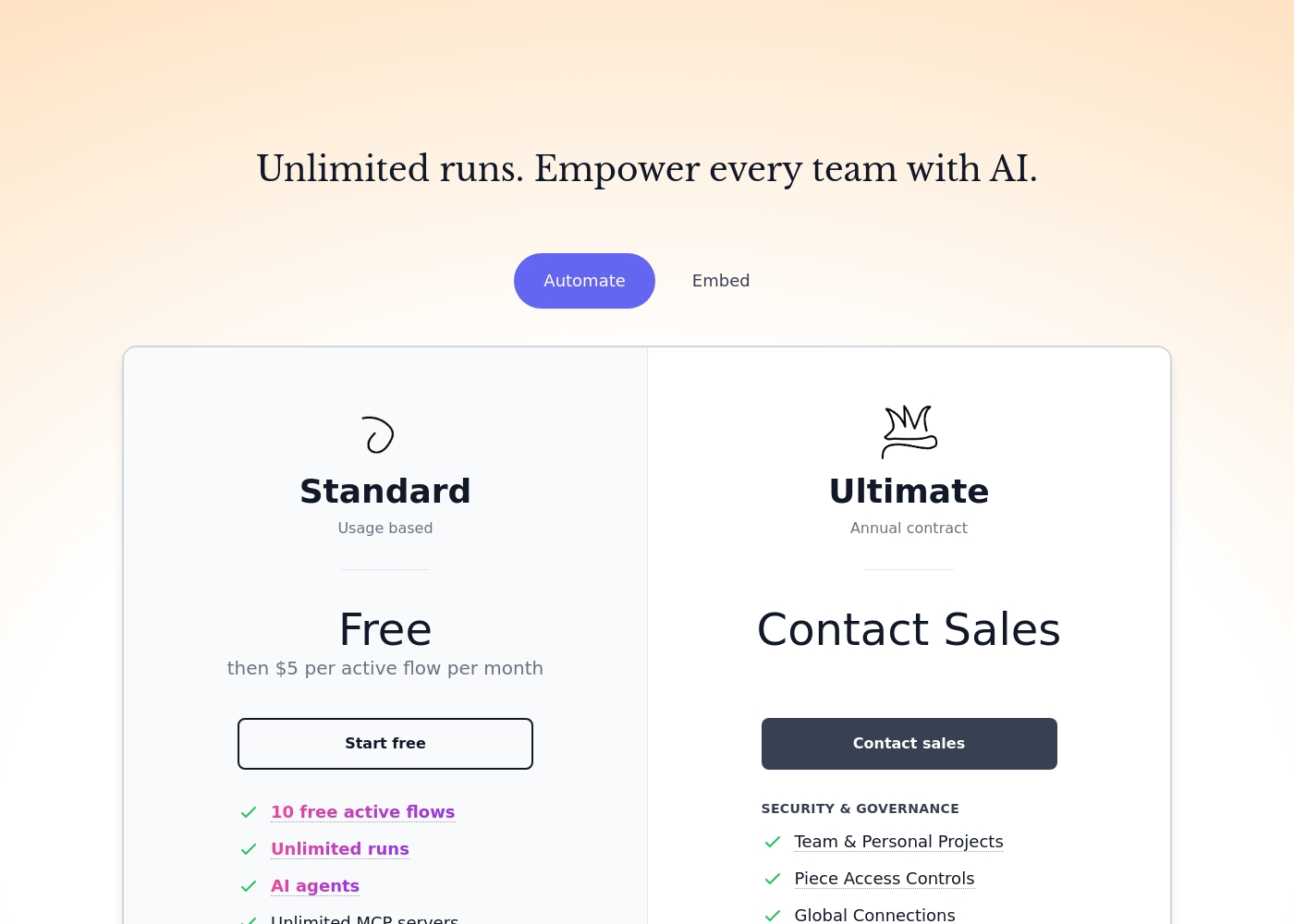
ActivePieces cloud plans start Free, then cost $5 per active flow per month, with enterprise tier pricing requiring a sales inquiry. Two managed plans are available: Standard (Free then $5 per active flow per month) and Ultimate (Contact Sales, Annual contract).
Here is a look at the specific features included in each plan type.
Standard
Price: Free then $5 per active flow per month Other Features:
- 10 free active flows
- Unlimited runs
- AI agents
- Unlimited MCP servers
- Unlimited tables
- Email support
- 10 free active flows
- Unlimited runs
- AI agents
- Unlimited MCP servers
- Unlimited tables
- Security & Governance
- Team & Personal Projects
- Piece Access Controls
- Global Connections
- Custom RBAC
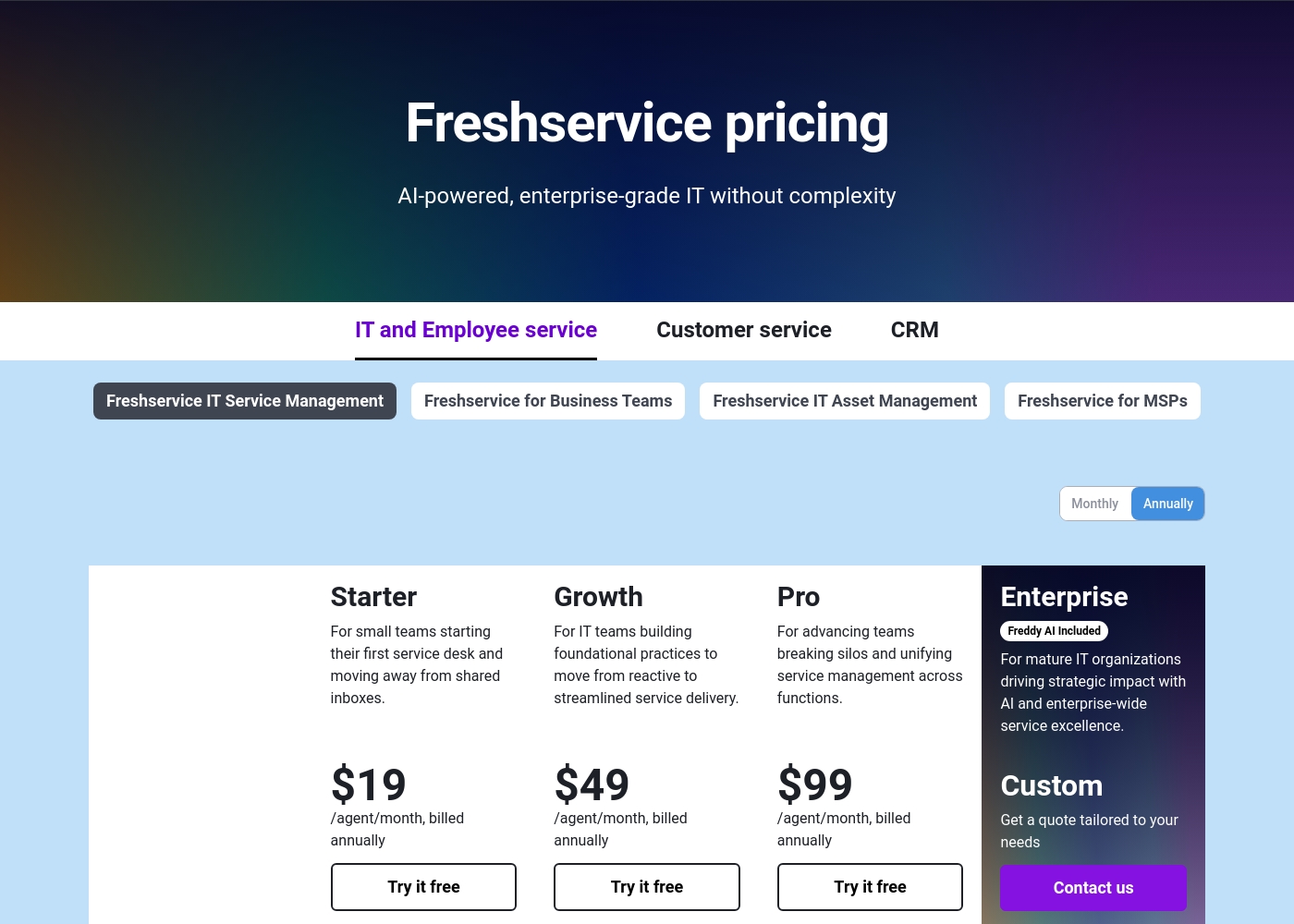
Freshservice by Freshworks pricing: Freshservice by Freshworks offers four scalable plans starting at $19 per agent, billed annually. Pricing is based on agent seats and advanced AI or management features, with both monthly and annual billing options available to fit different business sizes and needs.
Pricing Notes
- ActivePieces Standard plan is free for 10 active flows, then $5 per flow per month. No per-user fees.
- Freshservice by Freshworks offers a 14-day free trial with all features. Plans start at $19 per agent monthly.
- ActivePieces Ultimate plan requires an annual contract and sales consultation.
- Freshservice by Freshworks Enterprise plan is customized and includes advanced AI sessions.
- ActivePieces can be more cost-effective for teams with many automations but few users.
- Freshservice by Freshworks costs scale directly with team size, making budgeting predictable.
Pricing Head-to-Head
User Reviews
We see a nuanced divide in user feedback for ActivePieces on Trustpilot, reflecting both its powerful technical capabilities and its governance challenges. Users consistently praise the platform as a powerful, cost-effective alternative to established competitors like Zapier and Make.
Reviewers note its simple integration process, short learning curve, and ability to handle intricate, heavy-lifting workflows effectively. Many users appreciate the solid community support and quick response when submitting platform bugs via GitHub.
I moved nearly all my Zaps from Zapier with no issues. Their pricing is truly amazing and much cheaper than key competitors. They even allow connecting multiple Gmail accounts to one workflow, which is a limiting factor on n8n.
Based on available external sources, we found a significant limitation in gathering public sentiment for this specific review. The Trustpilot link provided was inaccessible due to a verification error, and no Capterra data was supplied. Consequently, we cannot synthesize a balanced external review summary from real user feedback on platforms like Trustpilot or Capterra at this time. Our assessment is therefore based solely on the provided product information.
Our Verdict
This isn't a close race—it's a tool-for-the-job decision. ActivePieces and Freshservice by Freshworks solve entirely different problems. ActivePieces's superpower is flexible, AI-first automation. It connects over 470 apps and lets agents think across your entire stack. You can build complex workflows without writing code, or dive into code when needed. Freshservice by Freshworks's superpower is unified IT service management. It consolidates tickets, assets, and operations onto one platform. Its AI works within your service desk to resolve common requests faster. The deciding factor is your core need. Choose ActivePieces if you must automate tasks across your whole digital ecosystem. Choose Freshservice by Freshworks if you must streamline IT service delivery and asset management. For most teams, the path is clear. Pick ActivePieces to automate business processes. Pick Freshservice by Freshworks to manage IT operations.
Frequently Asked Questions
Which is better for small teams: ActivePieces or Freshservice by Freshworks?
ActivePieces is likely better for small, technical teams. Its free plan covers 10 active flows with no per-user fees. Freshservice by Freshworks starts at $19 per agent, which adds up faster for small teams.
Does ActivePieces have IT asset management like Freshservice by Freshworks?
No, ActivePieces focuses on workflow automation and data tables. Freshservice by Freshworks includes enterprise-grade IT asset management with an auto-updating CMDB. They serve different purposes.
Is Freshservice by Freshworks worth the extra cost over ActivePieces?
It depends on your needs. Freshservice by Freshworks is worth it if you need unified ITSM, asset management, and enterprise support. ActivePieces is cheaper if you primarily need cross-app automation.
Can I self-host ActivePieces while Freshservice by Freshworks is cloud-only?
Yes, ActivePieces offers a self-hosted Community Edition via Docker. Freshservice by Freshworks is a cloud-only SaaS platform. This is a key difference for data control preferences.
Which platform has better AI capabilities for my use case?
ActivePieces AI agents automate tasks across any connected app. Freshservice by Freshworks AI is optimized for IT service requests and agent guidance. Choose based on whether you need general workflow AI or IT-specific AI.
How does pricing scale with team growth for each platform?
ActivePieces pricing scales with active flows, not users. Costs stay low even with many users. Freshservice by Freshworks costs increase with each agent seat. Growth costs are predictable but linear.
Ready to Choose?
Both tools have their strengths. Choose based on your specific needs.