ActiveCampaign vs Mailchimp
People are torn between powerful automation and simple, affordable marketing. ActiveCampaign excels at deep automation; Mailchimp shines in ease of use. Here’s how to pick the right one.
Best for: Growing agencies needing complex automations, Remote teams handling multi-channel campaigns
Best for: Solo founders or small teams on a budget, SMBs starting with email marketing and AI content
Powerful Automation, but Expect Price Hikes.
We recognize ActiveCampaign as a top-tier autonomous marketing platform offering complex, unlimited automation actions and deep integration capabilities across its 1,000+ partners. However, we must address the widespread user concerns regarding unpredictable price hikes, slow web interface performance, and challenging support accessibility. Overall, if reliable performance and consistent pricing are prioritized, users should proceed with caution despite the powerful feature set.
Pros
- Powerful, user-friendly email automation and campaign scheduling tools.
- Active Intelligence uses AI agents to guide campaign strategy and execution.
- Extensive ecosystem with 1,000+ available app integrations.
- Full paid plans include dedicated onboarding coaching and free list migration.
Cons
- Recurring reports of slow, buggy web interface performance and unreliability.
- Significant and frequent price increases concern long-term customers.
- Customer support is difficult to reach, often lacking professional human assistance or phone options.
- Users report unauthorized or 'quiet' billing issues and difficulty cancelling.
Industry-Leading Features, Unstable Support Network
We find Mailchimp offers an industry-leading suite of email marketing features, backed by strong automation and valuable AI tools for content optimization. Overall, the platform is an excellent choice for businesses needing robust design and testing capabilities, provided they anticipate potential friction with customer service and complex billing structures.
Pros
- Intuitive UI and drag-and-drop builder simplify campaign design.
- Powerful automation features help save significant time for marketers.
- Valuable reporting tools offer insights and industry benchmarking.
- Generative AI features help improve content, including subject lines.
Cons
- Customer support is frequently cited as nonexistent, unhelpful, or slow to respond.
- Billing practices are reported as predatory, with unexpected charges for slight overages.
- Users often face technical access issues, especially with two-factor authentication.
- The interface is sometimes described as clunky or difficult to navigate.
AboutActiveCampaign
ActiveCampaign is the #1 Autonomous Marketing Platform designed for growth. It moves beyond simple automation; it figures out your next best move and then executes it for you.
This platform uses Active Intelligence to put AI agents to work. These agents amplify your team's output on content creation, execution, and performance analysis ✨. It’s for everyone, from solo entrepreneurs to growing agencies and mid-market companies, helping businesses in over 170 countries scale smarter and faster.
AboutMailchimp
Mailchimp is recognized as the leading platform focused on email marketing and advanced automations. It's built to help businesses boost income by mastering digital outreach. With over 11 million global users and 22 years of experience, it’s a trusted choice for selling more.
This robust platform is ideal for businesses seeking seamless conversion tools, including integrated SMS campaigns. You can start sending your first email risk-free, and you don't even need a credit card to begin. Users on Standard or Premium plans may access a personalized product tour to start confidently. 💡
Highlights
Feature Comparison
Features Overview
We highlight the main differences and pick a winner for each feature.
UI & Onboarding
Both offer onboarding; ActiveCampaign provides a personal coach, and migration help.
ActiveCampaign gives a personal onboarding coach with paid plans. It offers free migration of lists, automations, and pages. Mailchimp provides onboarding on Standard and Premium, including sessions in multiple languages for Premium. The key trade-off is depth of guided setup versus language options. Real-world impact: teams start faster with ActiveCampaign, while Mailchimp users get structured onboarding.
Automation Power
ActiveCampaign has the Autonomous Marketing engine; Mailchimp has strong AI-driven automations.
ActiveCampaign supports complex journeys with AI-assisted execution and predictive sending. Mailchimp offers advanced automations plus AI features for content and optimization. The trade-off is depth and control versus ease of use. Real-world impact: Pit Boss Grills used precise tagging to drive revenue with automation.
Cross-Channel Messaging
ActiveCampaign includes true cross-channel messaging; Mailchimp centers on email plus SMS add-ons.
ActiveCampaign reaches audiences across email, SMS, WhatsApp, and more. Mailchimp supports integrated email and SMS via add-ons in select countries. The key trade-off is built-in cross-channel power versus optional SMS in specific regions. Real-world impact: campaigns stay consistent across inboxes and mobile messages.
AI & Personalization
Both offer AI features, but AI depth differs between platforms.
ActiveCampaign uses Active Intelligence and AI agents for strategy and execution. Mailchimp provides Generative AI features for content and subject lines. The trade-off is sophisticated automation control versus generative content ease. Real-world impact: faster content creation and smarter segment targeting.
Integrations
ActiveCampaign connects to many apps; Mailchimp offers strong but fewer integrations.
ActiveCampaign touts 1000+ integrations, including enterprise tools. Mailchimp lists 300+ integrations, including Shopify and Google Analytics. The trade-off is breadth versus depth of specific connectors. Real-world impact: you can pull in store data and automate end-to-end journeys easier with ActiveCampaign.
Pricing & Value
Pricing differs widely; nonprofits get generous discounts on both sides.
ActiveCampaign pricing hinges on contacts with nonprofit 20% off. Enterprise starts at $145/mo for 1,000 contacts. Mailchimp starts free, with Essentials from $13/mo and Standard from $20/mo; nonprofits get 15% off. The trade-off: higher upfront cost versus lower entry price and free tiers. Real-world impact: budget-conscious teams may prefer Mailchimp for initial growth.
Support & Reliability
Support quality and reliability vary by tier for ActiveCampaign; Mailchimp has mixed reviews.
ActiveCampaign offers tiered support, with a dedicated team on Enterprise. Mailchimp has 24/7 Email & Chat on several plans; phone support reserved for Premium. The trade-off: predictability and response times vary by plan. Real-world impact: large teams get quicker help with ActiveCampaign; some users struggle with Mailchimp support.
Security & Compliance
ActiveCampaign emphasizes HIPAA support and SSO; Mailchimp's posture is less documented here.
ActiveCampaign supports HIPAA across Email Contacts plans and offers SSO on Enterprise. Mailchimp’s HIPAA coverage isn’t specified in the data. The trade-off: higher-security features with ActiveCampaign, fewer explicit claims from Mailchimp. Real-world impact: regulated teams may prefer ActiveCampaign for compliance basics.
Migration & Setup
Migration options exist on both sides; ActiveCampaign has free migration; Mailchimp offers Premium Migration.
ActiveCampaign provides free list/template/automation migration on paid plans. Mailchimp offers Premium Migration Services for high-volume onboarding in select countries. The trade-off: cost and scope of migration services vary. Real-world impact: smoother transitions with ActiveCampaign; Premium migrations reduce risk for large teams.
Templates & Design
Both platforms offer templates, with Mailchimp leaning into design templates and AI help.
ActiveCampaign emphasizes powerful personalization and a robust editor for emails. Mailchimp highlights customizable templates and AI-assisted content creation. The trade-off: design flexibility versus automation depth. Real-world impact: teams can ship polished campaigns quickly on Mailchimp while building complex journeys in ActiveCampaign.
ActiveCampaign offers four email marketing plans: Starter, Plus, Pro, and Enterprise. The Enterprise plan starts at $145 per month when billed annually for 1,000 email contacts.
These tiers are designed to fit your needs, growing with the size of your audience and the complexity of your marketing strategy.
Starter
Best For: Get started with personalized email marketing campaigns. Other Features:
- 1 user included.
- Standard and inline web forms.
- Limited segmentation and reporting.
- Marketing automation limited to 5 actions per automation.
- 1 user
- Email campaigns & newsletters
- Web forms (Standard & inline only)
- 5 actions per automation
- Emails only A/B testing
- 1 user
- Landing pages
- Unlimited automation actions
- Standard segmentation
- Standard ecommerce integrations
- 3 users
- Emails & automations A/B testing
- Advanced segmentation
- AI-powered automation builder
- 200 active business goals
- 5 users
- Premium segmentation and custom objects
- Single Sign-On (SSO)
- Dedicated account team
- Premium CRM integrations
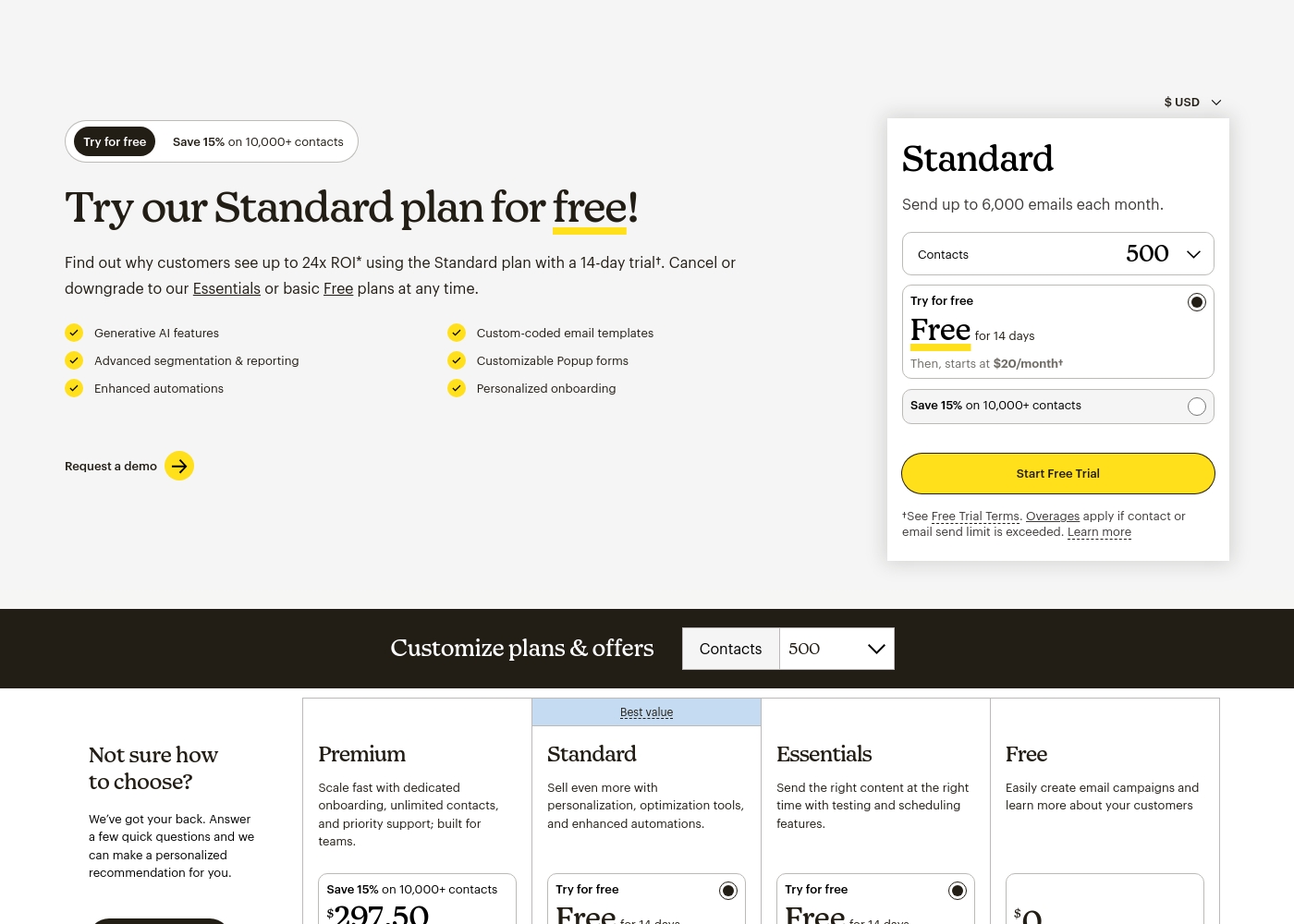
Mailchimp costs between $0 and $350 per month with four main plans: Free at $0, Essentials starting at $13/month, Standard starting at $20/month, and Premium requiring contact with sales for high volume quotes.
Here are the details about what each plan offers. Please note that prices shown here are typically for the minimum 500 contacts tier, or where noted, discounted rates for higher contact tiers.
Free
Price: $0/month Best For: Easily creating email campaigns and learning about your customers. Other Features:
- 1,000 emails per month maximum (500/day limit)
- 1 Seat (User)
- 1 Audience
- Email support for the first 30 days
- Easily create email campaigns
- Learn more about your customers
- Email support for first 30 days
- Send the right content at the right time
- Testing and scheduling features
- 24/7 Email & Chat Support
- Up to 3 users
- Sell even more with personalization
- Optimization tools
- Enhanced automations
- Generative AI features
- Custom-coded email templates
- Scale fast with dedicated onboarding
- Unlimited contacts
- Priority support; built for teams
- Generative AI Features
- Role-based Access (5 Roles)
Pricing Notes
- ActiveCampaign nonprofit discount: 20% off.
- ActiveCampaign has zero setup fees on month-to-month plans.
- Mailchimp offers a 14-day free trial on Standard and Essentials.
- Mailchimp pricing scales with contacts; overage charges apply if limits are exceeded.
- Mailchimp supports Pay As You Go credits for occasional sending.
- High-volume Mailchimp plans can be custom-quoted beyond 250,000 contacts.
Pricing Head-to-Head
User Reviews
ActiveCampaign users frequently commend the platform for its powerful and flexible marketing automation suite, noting high user-friendliness when building email campaigns and advanced workflows. Many appreciate its strong integration capabilities (including key ecommerce platforms and Zapier) and the ability to launch complex campaigns quickly.
Some reviewers cited excellent initial support, including quick, accurate responses and valuable onboarding coaching included with paid plans. However, significant external feedback reveals notable pain points, especially concerning cost.
I’ve been a customer for about six years, and ActiveCampaign was initially wonderful for my social impact business. However, as a small business owner, their fees have increased significantly, forcing me to reconsider my plan due to cost.
Mailchimp receives polarized external feedback, highlighting a split between excellent product features and frustrating support experiences. Users consistently praise the platform's intuitive interface and ease of use, confirming that the drag-and-drop builder and extensive automation features are significant time savers for growing businesses.
Reviewers often appreciate the quality of available templates and the platform's robust integrations with CRM and website systems. However, a major concern revolving around customer support is widely reported.
The UI is easy to navigate, and the drag-and-drop email building feature is extremely well designed and simple to use. We use Mailchimp for all our prospective and current customer campaigns. It saves us a lot of time in production.
Our Verdict
Bottom line: for most teams, it’s a tie. ActiveCampaign shines with deep automation and cross-channel reach, while Mailchimp wins on ease, cost, and onboarding. If you need ultra-tight workflows and enterprise security, choose ActiveCampaign. If you want friendly onboarding and a generous free tier, start with Mailchimp. For many growing teams, start with Mailchimp to validate your strategy, then consider ActiveCampaign as you scale.
Frequently Asked Questions
Which is better for small teams: ActiveCampaign or Mailchimp?
Mailchimp is often better for very small teams. ActiveCampaign offers deeper automation, but it’s more complex. Start with Mailchimp if you want a gentle learning curve and a free plan.
Does ActiveCampaign have SMS marketing like Mailchimp?
ActiveCampaign supports cross-channel messaging including WhatsApp. SMS is not highlighted as a standard feature. Mailchimp offers SMS as an add-on in select countries. If SMS is critical, Mailchimp provides a path, ActiveCampaign may not.
Is Mailchimp worth the extra cost over ActiveCampaign?
Mailchimp starts cheaper with a free plan. ActiveCampaign costs rise with contacts and features. If you value deep automation, ActiveCampaign can justify the price.
Can I migrate from ActiveCampaign to Mailchimp easily?
ActiveCampaign offers free migration when moving to its platform. Mailchimp provides Premium Migration Services for high-volume onboarding. Plan for setup; there isn’t a universal one-click path.
Is HIPAA compliance available with ActiveCampaign?
Yes—HIPAA support exists across all ActiveCampaign Email Contacts plans. Mailchimp’s HIPAA coverage isn’t specified here. Check your use case to be safe.
Do nonprofits get discounts on pricing?
ActiveCampaign offers a 20% nonprofit discount. Mailchimp offers a 15% nonprofit discount. Compare the value for your needs.
Ready to Choose?
Both tools have their strengths. Choose based on your specific needs.