Splunk vs ZeroWork
Splunk and ZeroWork solve very different problems. Splunk analyzes massive machine data for security and IT. ZeroWork automates repetitive web tasks without code. Choosing depends entirely on your goal.
Powerful but complex data platform.
We find Splunk offers a robust, unified platform for security and observability with extensive integrations and scalability. However, its pricing structure is opaque and usage-based, which can make cost planning challenging. Overall, it's a strong choice for enterprises needing deep data analysis, but smaller teams may find it complex and expensive.
Pro
- Unified platform for security and observability.
- Over 2,000 integrations with various data sources.
- AI and automation for threat response.
- Handles massive data volumes at scale.
Contro
- Opaque pricing requires consultation with sales.
- Can be complex to set up and learn.
- Usage-based models may lead to unpredictable costs.
- External review access was blocked, limiting user sentiment data.
Automazione Robusta per Chi Non Scrive Codice
Pro
- Builder visivo altamente intuitivo; non richiede esperienza di codifica.
- Affidabilità eccezionale grazie al sofisticato rilevamento anti-bot.
- Potenti funzionalità di integrazione, inclusi webhook e richieste HTTP.
- Funzionalità generose nei piani, incluso runtime illimitato e chiamate API.
Contro
- È richiesto un investimento di tempo iniziale per padroneggiare la creazione di attività complesse.
- Il supporto clienti prioritario è riservato alla fascia Business e superiori.
Informazioni suSplunk
Splunk is a unified platform for security and observability. It's designed for teams that need to search, analyze, and act on data from any source. Whether you're a security analyst hunting threats or an engineer troubleshooting app performance, it brings everything together in one place. ✨
Informazioni suZeroWork
ZeroWork è uno strumento RPA incredibilmente potente ma facile da usare, progettato per automatizzare quasi tutte le interazioni web. Combina capacità complesse—come il scraping dei dati o l'arricchimento delle liste—con semplici strumenti visivi. Non hai bisogno di scrivere codice per iniziare. Invece, crei potenti automazioni utilizzando la sua interfaccia visiva drag-and-drop. È costruito per qualsiasi utente che necessiti di un sistema robusto senza avere un background tecnico approfondito. 💡
Punti salienti
Confronto delle funzionalità
Panoramica funzionalità
Evidenziamo le principali differenze e scegliamo un vincitore per ogni funzionalità.
Core Purpose & Interface
Splunk is a data analytics powerhouse for IT/security. ZeroWork is a visual web automation builder.
Splunk's interface centers on search queries and dashboard creation. You analyze logs, metrics, and traces from your entire stack. It's built for deep investigation. ZeroWork uses a visual drag-and-drop canvas. You connect steps to build 'TaskBots' that interact with websites. No coding is needed for core functionality. The key difference is complexity vs simplicity. Splunk processes raw data streams. ZeroWork executes predefined web actions. For example, Splunk might correlate firewall logs to find a threat. ZeroWork might automatically post a comment on 50 LinkedIn profiles.
Data Handling & Scale
Splunk ingests petabytes of machine data. ZeroWork handles task-specific data transformations.
Splunk ingests logs, metrics, and traces from thousands of sources at massive scale. It's designed for enterprise-level data volumes. ZeroWork processes data as part of a TaskBot flow. It can scrape, filter, and transform data, but focuses on workflow efficiency, not raw ingestion. Splunk's scale is about storage and analysis capacity. ZeroWork's scale is about the number of bots and scheduling frequency. A global bank uses Splunk to monitor all transaction systems. A marketer uses ZeroWork to enrich 1,000 leads daily.
Automation & Workflows
Splunk automates security responses. ZeroWork automates web interactions.
Splunk uses automation for threat detection and incident response. It can trigger playbooks to isolate threats automatically. ZeroWork automates repetitive web tasks like form filling, scraping, or posting. You build these workflows visually. Splunk's automation is reactive to security events. ZeroWork's automation is proactive for business tasks. Splunk might automatically quarantine a malicious host. ZeroWork might automatically update ad spend in a dashboard.
Integration Ecosystem
Splunk has a massive marketplace. ZeroWork uses webhooks for key integrations.
Splunk offers over 2,000 pre-built apps and add-ons in Splunkbase. These cover specific tools and use cases. ZeroWork integrates via webhooks on paid plans. You can trigger bots from tools like Zapier or Make. It also has unlimited API calls within tasks. Splunk's ecosystem is broader and pre-configured. ZeroWork's integrations are more about connecting your automation to other apps. You can find a Splunk app for your specific firewall. You can use a ZeroWork webhook to start a bot when a new lead enters HubSpot.
Anti-Detection & Security
ZeroWork excels at avoiding bot detection. Splunk focuses on cybersecurity.
ZeroWork has built-in anti-bot detection prevention. It uses fingerprint obfuscation and proxy support for secure multi-account automation. Splunk is a security platform itself. It detects and responds to cyber threats using AI and correlation. This is an apples-to-oranges comparison. One prevents bans from websites; the other prevents data breaches. ZeroWork helps you scrape a site safely. Splunk helps you secure the infrastructure that runs your site.
Learning Curve & Usability
ZeroWork is designed for quick learning. Splunk has a steeper, more complex learning path.
ZeroWork users often build their first TaskBot within hours. The visual builder and documentation are praised for simplicity. Splunk requires learning its Search Processing Language (SPL). Mastering dashboards and complex queries takes significant time. ZeroWork prioritizes ease of use for non-technical users. Splunk prioritizes powerful capabilities for technical users. A solo entrepreneur can start automating with ZeroWork today. A data engineer might spend weeks becoming proficient in Splunk.
Pricing Transparency
ZeroWork lists clear tiered prices. Splunk requires a sales consultation.
ZeroWork's pricing is transparent: $15, $37, $75 per month. You know exactly what you pay based on your plan. Splunk's pricing is usage-based and requires contacting sales. Costs depend on data volume or activity metrics. ZeroWork offers predictable monthly costs. Splunk's costs can scale with your data usage, potentially unpredictably. You can sign up for ZeroWork's Starter plan in minutes. You need to negotiate a contract with Splunk's sales team.
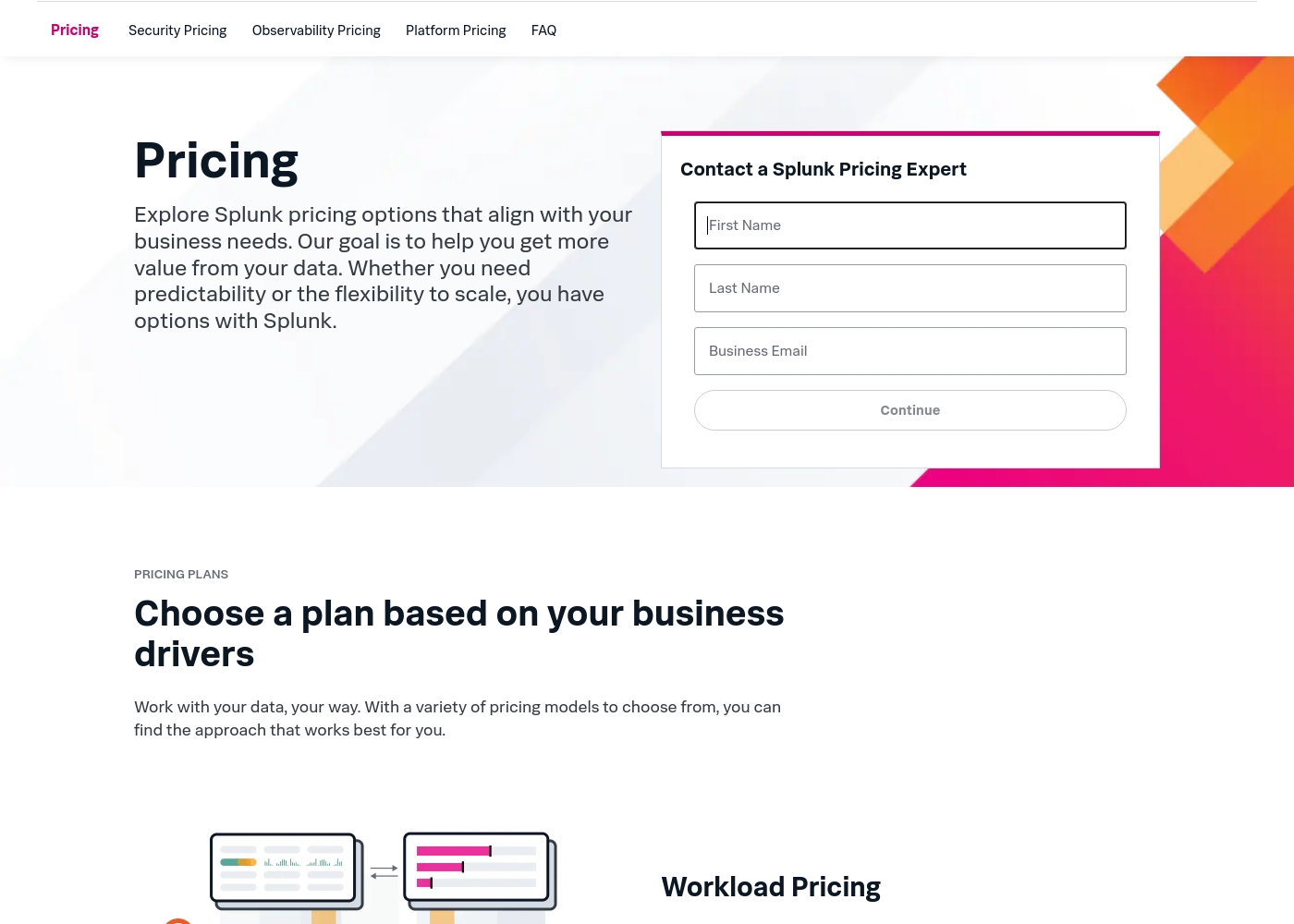
Splunk costs are Not explicitly stated per year with 2 plans: Ingest Pricing at Not explicitly stated, Activity-based Pricing at Not explicitly stated.
Take a look at the different ways you can manage your data costs below.
Ingest Pricing
Price: Not explicitly stated Websites Supported: Not explicitly stated Best For: Teams needing predictable costs for high-volume data ingestion Refund Policy: Not explicitly stated Other Features: Simple predictable approach, Economical search scaling, Broad data ingestion
- Search and analyze machine data
- Expanded use cases on ingested data
- Standard data ingestion
- Metric time series (MTS)
- Traces analyzed per minute
- Sessions monitoring
- Uptime requests
ZeroWork costa tra $15/mese e prezzi personalizzati, offrendo quattro piani a pagamento: Starter a $15/mese, Pro a $37/mese, Business a $75/mese ed Enterprise con prezzi personalizzati.
Ecco una chiara ripartizione di ciò che ottieni con ogni piano di automazione zero-code.
Starter
Prezzo: $15/mese Siti web supportati: Non specificato esplicitamente Ideale per: Utenti che iniziano il loro percorso di automazione o gestiscono attività quotidiane di base Politica di rimborso: Non specificato esplicitamente Altre funzionalità:
- Fino a 20 TaskBot disponibili
- Attività pianificate giornalmente
- Runtime e esecuzioni parallele illimitati
- Chiamate API illimitate all'interno dell'esecuzione dei TaskBot
- Supporto della community su Discord
- Schedule daily
- Unlimited runtime
- Unlimited parallel runs
- Unlimited API calls within TaskBot runs
- Community support on Discord
- Everything in Starter
- Schedule every hour
- Webhooks to trigger TaskBot runs from Zapier, Make, Pabbly or other apps
- Everything in Pro
- Schedule every 5 minutes
- Priority email support
- Everything in Business
- Custom SLA
- Dedicated success manager
- Team training
- Custom invoicing
Pricing Notes
- Splunk's pricing is opaque and requires sales consultation, making budget planning difficult upfront.
- ZeroWork offers clear, predictable monthly pricing starting at just $15/month.
- Splunk's usage-based model could lead to unexpected costs during data volume spikes.
- ZeroWork's Business plan ($75/mo) offers the fastest scheduling (every 5 minutes) and unlimited TaskBots.
Pricing Head-to-Head
Recensioni degli utenti
Based on the provided external sources, we couldn't retrieve detailed user reviews for Splunk due to access restrictions. Trustpilot and Capterra both returned verification or security pages, preventing us from gathering specific sentiment on accuracy, ease of use, support, or pricing.
This means our review is based solely on the official product information and pricing details provided. We recommend checking these review sites directly for the latest user feedback before making a decision.
ZeroWork riceve feedback esterni estremamente positivi dagli utenti, mantenendo un punteggio elevato di 4,7 stelle su Trustpilot. I recensori lodano costantemente l'eccezionale usabilità della piattaforma, notando che anche coloro con conoscenze tecniche limitate o senza esperienza di codifica possono creare rapidamente TaskBot avanzati.
Molti utenti evidenziano la vasta documentazione di aiuto e i video crash course, che aiutano ad accelerare la curva di apprendimento necessaria. Lo strumento è spesso descritto come super veloce e altamente affidabile, con un sofisticato rilevamento anti-bot che consente una gestione sicura di più account.
Ho sempre usato estensioni di web scraper di base, ma ZeroWork è molto più avanzato. È comunque molto fattibile, anche con la mia limitata conoscenza tecnica. Ora posso sottoporre a scraping pagine altamente sofisticate in modo fluido e affidabile.
Il nostro verdetto
Splunk and ZeroWork aren't really competitors—they solve different problems entirely. It's like comparing a microscope to a hammer. Splunk's superpower is unified visibility. It ingests and analyzes massive data streams from your entire IT stack. If you're hunting security threats or debugging app performance, Splunk connects the dots. ZeroWork's superpower is accessible automation. It lets non-coders build powerful web bots quickly. You can scrape data, manage ad accounts, or post content without writing a single line of code. The deciding factor is your goal. Do you need to analyze complex machine data? Choose Splunk. Do you need to automate repetitive web tasks? Choose ZeroWork. For most individuals and small teams automating daily work, ZeroWork is the clear winner. For enterprises monitoring critical infrastructure, Splunk is the only choice that fits.
Domande frequenti
Can Splunk do web automation like ZeroWork?
No, Splunk is not designed for web automation. It analyzes log data and metrics for security and IT. ZeroWork is a dedicated web automation tool for tasks like scraping and posting.
Is ZeroWork secure for scraping data?
Yes, ZeroWork has built-in anti-bot detection prevention. It uses fingerprint obfuscation and proxies to help you automate securely and avoid bans.
Which tool is cheaper for a small business?
ZeroWork is significantly cheaper for small teams. Its plans start at $15/month. Splunk's pricing is based on data volume and requires a custom quote from sales.
Do I need to know how to code for either tool?
For ZeroWork, no. You use a visual builder. For Splunk, basic searching doesn't require code, but advanced analysis uses its query language, SPL.
Can Splunk connect to our other business apps?
Yes, Splunk has over 2,000 pre-built integrations. It can pull data from almost any source, including databases, cloud services, and business applications.
How fast can I start automating with ZeroWork?
Many users build their first working TaskBot within a few hours. The visual interface and documentation are designed for a quick start.
Pronto a scegliere?
Entrambi gli strumenti hanno i loro punti di forza. Scegli in base alle tue esigenze specifiche.