Splunk vs Typewise
Splunk and Typewise tackle massive problems, but in totally different worlds. Splunk is your security and IT command center for machine data. Typewise is an AI supervisor that automates customer conversations across your entire support stack.
Powerful but complex data platform.
We find Splunk offers a robust, unified platform for security and observability with extensive integrations and scalability. However, its pricing structure is opaque and usage-based, which can make cost planning challenging. Overall, it's a strong choice for enterprises needing deep data analysis, but smaller teams may find it complex and expensive.
Ventajas
- Unified platform for security and observability.
- Over 2,000 integrations with various data sources.
- AI and automation for threat response.
- Handles massive data volumes at scale.
Desventajas
- Opaque pricing requires consultation with sales.
- Can be complex to set up and learn.
- Usage-based models may lead to unpredictable costs.
- External review access was blocked, limiting user sentiment data.
IA potente para las conversaciones con tus clientes.
Ventajas
- Promete un lanzamiento inicial rápido de 15 minutos.
- El modelo de precios se basa en resultados, a partir de $1 por resolución.
- Se integra profundamente con más de 200 plataformas como Salesforce y Zendesk.
- Permite crear flujos de trabajo con instrucciones en lenguaje natural.
Desventajas
- La retroalimentación externa señala una curva de aprendizaje potencialmente pronunciada.
- El precio basado en el éxito puede resultar costoso para equipos de muy alto volumen.
- Algunos usuarios reportan problemas ocasionales de fiabilidad con tareas complejas.
- El valor completo puede requerir una integración y configuración significativas.
Acerca deSplunk
Splunk is a unified platform for security and observability. It's designed for teams that need to search, analyze, and act on data from any source. Whether you're a security analyst hunting threats or an engineer troubleshooting app performance, it brings everything together in one place. ✨
Acerca deTypewise
✨ Typewise es una plataforma de orquestación de IA para equipos orientados al cliente. Está diseñada para departamentos de soporte, ventas y comercio que desean utilizar la IA en toda su operación. La plataforma actúa como un supervisor inteligente, trabajando a través de tu CRM, facturación, base de conocimiento y más para gestionar flujos de trabajo complejos.
Aspectos destacados
Comparación de características
Resumen de Funcionalidades
Destacamos las principales diferencias y elegimos un ganador para cada característica.
Core Purpose
Splunk is a deep analytics platform for IT data. Typewise is an AI automation layer for customer-facing teams.
**Splunk** turns machine data chaos into clear insights. It helps security teams hunt threats and engineers troubleshoot performance across any stack. **Typewise** acts as an intelligent supervisor. It connects your CRM, billing, and knowledge systems to automate support, sales, and commerce tasks. The key difference is their domain. Splunk excels at understanding what your technology is doing. Typewise excels at automating what your teams are doing with customers.
Pricing & Value
Splunk's cost is tied to data volume. Typewise's cost is tied to resolved customer issues.
**Splunk** uses usage-based pricing. You're charged for data ingested or observability activities. This can lead to unpredictable costs as your data grows. **Typewise** starts at $1 per successful resolution. You only pay for outcomes, making ROI very clear from day one. It aligns cost directly with productivity gains. This is a major trade-off. Splunk's model scales with your IT infrastructure. Typewise's model scales with your team's workload and efficiency.
Ease of Setup
Typewise promises a 15-minute launch. Splunk is a complex platform that requires careful planning.
**Splunk** is a powerful enterprise tool. Setting it up for security or observability often involves configuring data sources, creating dashboards, and building alerts. It's not a quick plug-and-play. **Typewise** focuses on rapid deployment. You connect your tools and can have your first AI agent handling a pilot queue within minutes. The learning curve is about defining workflows, not technical setup. For immediate time-to-value, Typewise wins decisively. Splunk's investment pays off in deep, long-term analytical power.
Integration Ecosystem
Both offer extensive integrations, but for different worlds.
**Splunk** boasts over 2,000 integrations. It pulls data from virtually any machine source—databases, cloud services, apps, and custom logs. **Typewise** connects to 200+ core platforms like Salesforce and Zendesk. Its architecture also supports thousands more connectors for broader tech stack integration. Splunk's integrations are about data ingestion. Typewise's integrations are about reading and taking action across business systems. Your needs determine which is more valuable.
Automation & AI
Splunk automates security responses. Typewise automates customer workflows with human oversight.
**Splunk** uses AI for high-fidelity threat detection and automated incident response. Its automations help contain breaches quickly. **Typewise** features Hybrid Intelligence. It automates routine tasks but brings in humans for approval on complex steps, balancing speed and quality. Splunk's AI protects your infrastructure. Typewise's AI improves your customer experience. Both use AI, but for fundamentally different outcomes.
Reporting & Insights
Splunk provides deep analytics on system data. Typewise tracks customer service outcomes.
**Splunk** offers powerful search and analytics. You can create custom dashboards to monitor security posture, app performance, and business metrics from machine data. **Typewise** provides an Insights Hub. It tracks resolution rates, CSAT, and intent insights to measure AI performance and business impact. Splunk's insights are for operational intelligence. Typewise's insights are for customer experience intelligence. Each provides clear value in its domain.
Ideal Team Size
Splunk serves large enterprises with complex IT. Typewise serves support teams of various sizes.
**Splunk** is trusted by leading enterprises. Its scalability and complexity make it best for mid-to-large organizations with significant data needs and budgets. **Typewise** can work for a small team automating a few queues. It also scales for large operations. Its outcome-based pricing is accessible to start with. Splunk requires an enterprise-scale commitment. Typewise can offer immediate value to a single department.
Learning Curve
Both tools require learning. Splunk's curve is about data, Typewise's is about workflow design.
**Splunk** has a steep learning curve for its search language (SPL) and platform configuration. Mastering it unlocks immense power. **Typewise** requires learning how to define effective workflows in plain English and manage the Hybrid Intelligence settings. It's more about business logic than technical skills. One demands technical data skills; the other demands process design thinking. Your team's strengths will dictate which is easier to adopt.
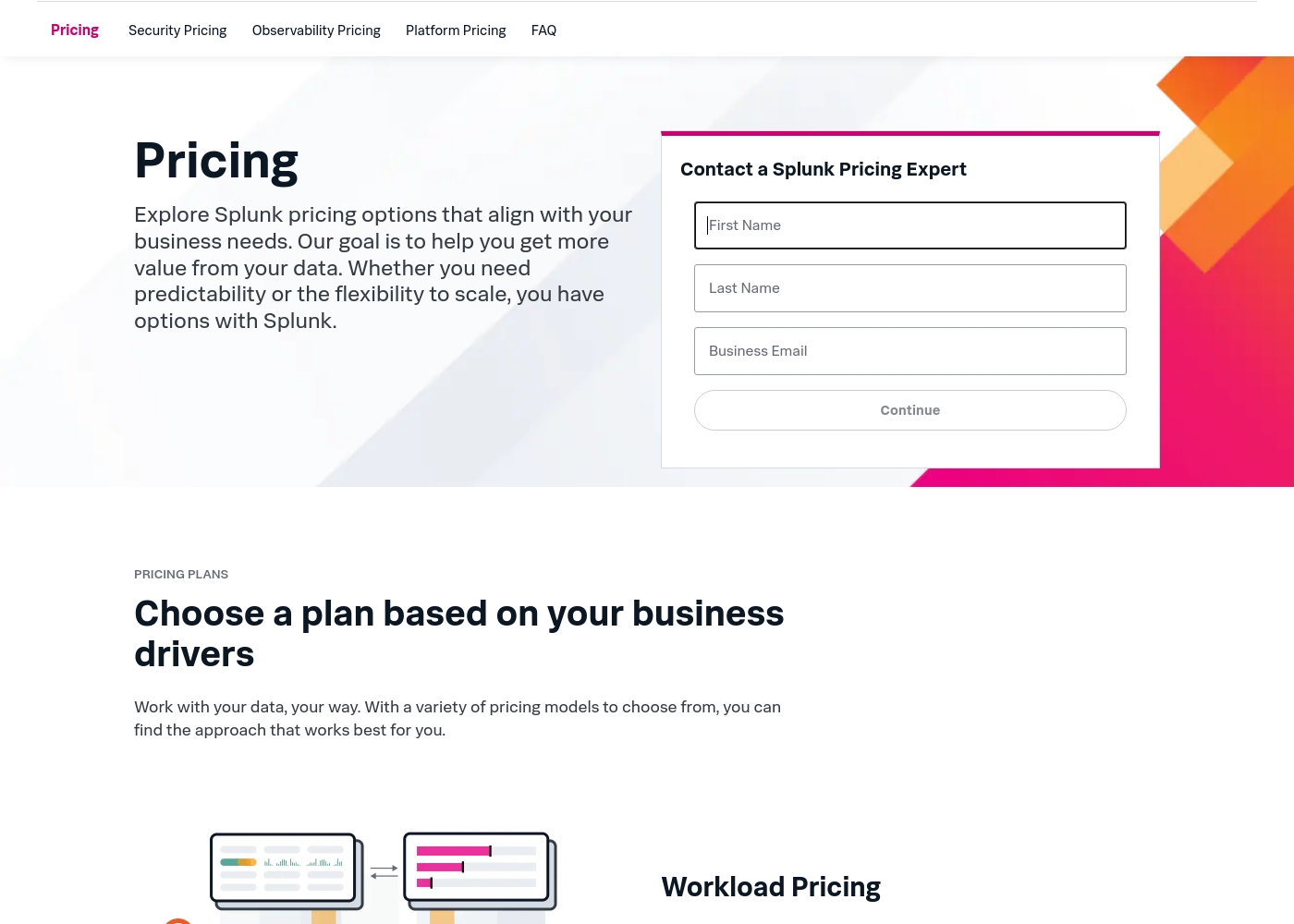
Splunk costs are Not explicitly stated per year with 2 plans: Ingest Pricing at Not explicitly stated, Activity-based Pricing at Not explicitly stated.
Take a look at the different ways you can manage your data costs below.
Ingest Pricing
Price: Not explicitly stated Websites Supported: Not explicitly stated Best For: Teams needing predictable costs for high-volume data ingestion Refund Policy: Not explicitly stated Other Features: Simple predictable approach, Economical search scaling, Broad data ingestion
- Search and analyze machine data
- Expanded use cases on ingested data
- Standard data ingestion
- Metric time series (MTS)
- Traces analyzed per minute
- Sessions monitoring
- Uptime requests
Typewise cuesta desde $1 por resolución con 1 plan: Precios basados en el éxito a $1 por resolución.
Aquí tienes un desglose de cómo funciona nuestro precio para tu equipo.
Precios basados en el éxito
Precio: Desde $1 por resolución Sitios web Soportados: No especificado explícitamente Ideal para: Equipos de soporte al cliente y ventas que buscan automatizar resoluciones de forma responsable. Política de Reembolso: No especificado explícitamente Otras Características: Orquestación Multiagente, Centro de Conocimiento y Acciones, Inteligencia Híbrida, Evaluaciones Automatizadas, Seguimiento del rendimiento del resultado
- Orquestación Multiagente
- Instrucciones en Lenguaje Natural
- Inteligencia Híbrida y Aprobaciones
- Centro de Conocimiento y Acciones
- Seguimiento del rendimiento del resultado
Pricing Notes
- Splunk's pricing is opaque and requires sales consultation. Costs can be unpredictable with data spikes.
- Typewise offers clear, outcome-based pricing starting at $1 per resolved issue. You pay for results, not seats.
- Typewise's model can be more cost-effective for teams focused on automating specific, measurable tasks.
- Splunk's model is better suited for organizations whose primary cost driver is data volume, not per-ticket outcomes.
Pricing Head-to-Head
Reseñas de usuarios
Based on the provided external sources, we couldn't retrieve detailed user reviews for Splunk due to access restrictions. Trustpilot and Capterra both returned verification or security pages, preventing us from gathering specific sentiment on accuracy, ease of use, support, or pricing.
This means our review is based solely on the official product information and pricing details provided. We recommend checking these review sites directly for the latest user feedback before making a decision.
El sentimiento externo limitado de Trustpilot sugiere una visión generalmente positiva de Typewise, centrándose en su potente IA para correo electrónico y chat. Los usuarios aprecian las mejoras de precisión significativas y el ahorro de tiempo que aporta a las comunicaciones diarias.
Sin embargo, algunos señalan que la curva de aprendizaje puede ser pronunciada al principio y el modelo de precios puede parecer caro para equipos más pequeños o usuarios ocasionales. Observamos menciones recurrentes de un soporte receptivo cuando es necesario, pero también comentarios sobre fallos de fiabilidad ocasionales con solicitudes muy complejas.
Typewise ha transformado la forma en que gestionamos los correos electrónicos de los clientes. Las sugerencias de la IA son increíblemente precisas y nos ahorran horas cada día. Se siente como tener un asistente súper inteligente en nuestra bandeja de entrada.
Nuestro Veredicto
This isn't a close race; it's a comparison of tools for different jobs. Splunk and Typewise solve massive but separate problems. Splunk is your enterprise IT brain, while Typewise is your customer service AI arm. Splunk's superpower is making sense of chaos. It ingests data from thousands of sources to help you find security threats and performance issues. If you're a large enterprise drowning in machine data, Splunk is the command center you need. Typewise's superpower is automating conversations. It plugs into your support stack to handle routine tasks, letting humans focus on complex issues. If your team is buried in tickets, Typewise can provide immediate relief. The deciding factor is your pain point. Choose Splunk if your core problem is visibility into your technology's health and security. Choose Typewise if your core problem is the efficiency and cost of your customer-facing teams. Final verdict: For most comparison shoppers, these aren't competitors. If you need security analytics, pick Splunk. If you need AI-powered support automation, pick Typewise. Your team's mission will make the right choice obvious.
Preguntas Frecuentes
Is Splunk for IT teams and Typewise for customer support teams?
Yes, that's the clearest distinction. Splunk is built for security analysts, DevOps, and SREs managing infrastructure. Typewise is built for support agents, sales, and operations teams handling customer interactions.
Which is easier to get started with: Splunk or Typewise?
Typewise is significantly faster to deploy. You can launch your first AI agent in about 15 minutes. Splunk requires substantial setup, configuration, and learning to be effective.
Does Typewise offer the same data analysis as Splunk?
No. Splunk provides deep analytics and search for machine data at scale. Typewise's analytics focus on customer service outcomes like resolution rates and CSAT, not IT infrastructure metrics.
Can I use Splunk for customer support automation?
Splunk is not designed for that. Its strengths are log analysis, security, and IT observability. For automating support ticket workflows, a specialized tool like Typewise is the right choice.
Which pricing model is cheaper: Splunk or Typewise?
It depends on your volume. Typewise's $1/resolution model is predictable for support teams. Splunk's usage-based pricing can be more cost-effective for massive data if negotiated, but often becomes expensive.
Do Splunk and Typewise integrate with Salesforce?
Typewise has a deep, native integration designed to read and take action within Salesforce. Splunk can ingest data from Salesforce logs for analysis, but it doesn't automate workflows within it like Typewise.
¿Listo para elegir?
Ambas herramientas tienen sus fortalezas. Elige según tus necesidades específicas.