VMmanager vs Vultr
VMmanager and Vultr are both powerful cloud platforms, but they serve very different masters. VMmanager is a specialized automation engine for running a hosting business. Vultr is a broad cloud compute provider focused on raw power and cutting-edge AI hardware.
Best for: Hosting providers automating VPS/VDS rental businesses, IT teams building internal IaaS cloud platforms
Best for: Developers and enterprises running AI/ML and HPC workloads, Companies needing instant access to cutting-edge GPU clusters
Powerful automation for serious scale.
VMmanager is a robust platform for automating large-scale virtualization for hosting providers and enterprises. We find it highly capable for managing complex infrastructures and provisioning VPS services. Overall, it's a strong choice for organizations needing deep automation and scalability, but its custom pricing and mixed support feedback mean it's best for those who can navigate enterprise sales.
Pros
- Proven stability for managing thousands of VMs across hundreds of servers.
- Strong automation for VPS provisioning, billing integration, and self-service portals.
- High availability features like failover clusters and distributed load balancing.
- Flexible licensing for both hosting businesses and corporate internal clouds.
Cons
- Pricing is not public, requiring custom quotes which can lack transparency.
- External reviews report issues with aggressive price increases and licensing terms.
- Support responsiveness is inconsistent, with some users reporting slow second-line help.
- May be overly complex for small businesses needing only a few virtual machines.
Advanced Tech, Highly Problematic Support.
We recognize Vultr offers powerful, high-specification resources optimized for AI and HPC workloads, providing immediate access to cutting-edge global infrastructure. However, the user feedback clearly indicates severe instability regarding operational support, verification processes, and network reliability. Overall, Vultr is a high-risk provider where world-class technology is significantly undermined by pervasive customer service and account management failures.
Pros
- Access to cutting-edge AI and HPC hardware (NVIDIA HGX B200, AMD Instinct).
- Global reach with 32 cloud data center locations worldwide.
- Flexible hourly and monthly usage-based billing starting at $2.50/month.
- Managed services like Kubernetes Engine and databases are available.
Cons
- Customer support is consistently slow, unhelpful, ticket-based, and unresponsive.
- Arbitrary account suspensions and service terminations occur frequently (e.g., due to CPU spikes).
- Unreasonable, invasive mandatory verification steps (requiring ID, credit card photos).
- Reported difficulties obtaining refunds, especially for cryptocurrency deposits.
AboutVMmanager
VMmanager is a platform for automating virtual infrastructure rental businesses. 💡 It's built for hosting providers and IT teams who need to manage hardware and container virtualization. The platform helps you provision IaaS and SaaS services automatically, giving users a self-service dashboard to manage their own machines.
AboutVultr
Vultr provides a powerful full-stack cloud compute platform. It offers services ranging from configurable virtual machines to highly accelerated dedicated servers 💡. This platform is ideal for developers and enterprises focused on high-performance computing and complex AI model deployment. You can spin up general purpose or optimized configurations in under 60 seconds.
Highlights
Feature Comparison
Features Overview
We highlight the main differences and pick a winner for each feature.
Core Purpose
VMmanager automates hosting businesses. Vultr provides raw cloud compute power.
VMmanager is built for hosting providers. It automates VPS provisioning, billing, and client self-service portals. It's an all-in-one platform to run a virtual machine rental business. Vultr is a cloud compute provider. It lets you spin up virtual machines and dedicated servers for any purpose. You manage everything yourself through a console and API. The key difference is automation vs. flexibility. VMmanager handles the business operations. Vultr gives you the hardware and leaves the rest to you.
Pricing & Transparency
Vultr offers transparent, low-cost pay-as-you-go. VMmanager requires a custom quote.
Vultr has published prices. You can start a cloud VM for as little as $2.50 per month. You pay hourly or monthly for exactly what you use. VMmanager does not publish pricing. You must contact sales for a custom quote based on your physical CPU core count. This lacks transparency. The trade-off is clear. Vultr is predictable and low-barrier. VMmanager's cost is unknown until you talk to sales.
Scalability & Management
VMmanager scales massive on-premise clusters. Vultr scales globally in seconds.
VMmanager is designed for massive internal scale. A single installation can manage over 22,000 VMs across 350 physical servers. It automates load balancing across your own hardware. Vultr scales through its global network of 32 data centers. You can deploy a new instance anywhere in the world in under 60 seconds. Scalability is elastic and instant. VMmanager is for scaling what you own. Vultr is for renting scalable power worldwide.
High Availability & Support
VMmanager offers built-in fault tolerance. Vultr's support is widely criticized.
VMmanager includes enterprise features for reliability. It supports failover clusters, automated load distribution (DRS), and built-in backups. This keeps services running if hardware fails. Vultr's support is a major pain point. Reviews consistently describe it as slow, unresponsive, and ticket-based. Users report arbitrary account suspensions. VMmanager provides a self-healing platform. Vultr provides powerful hardware with risky support.
AI & HPC Capabilities
Vultr is a leader in AI compute. VMmanager has no GPU or AI features.
Vultr offers immediate access to cutting-edge hardware. You can reserve NVIDIA HGX B200 and AMD Instinct GPUs. It provides managed services for AI deployment. VMmanager focuses entirely on virtualization management. It has no mention of GPU support, AI tools, or high-performance computing clusters. For AI and HPC, Vultr is the only option. VMmanager is not in this game.
User Experience & Learning Curve
Vultr is simple to start. VMmanager is complex but purpose-built.
Vultr offers a straightforward console. You can create a basic server in minutes. The learning curve is low for developers familiar with cloud platforms. VMmanager is a complex, feature-rich platform. It's designed for system administrators. Setting up and configuring it requires significant expertise. Vultr is for quick starts. VMmanager is for building a complete, automated infrastructure.
Let's look at each option below to find the perfect fit for your setup. We will break down what makes each plan unique for your team.
VMmanager Hosting
Price: Custom quote based on physical cores Websites Supported: Contact sales to confirm individual system and VM limits Best For: Hosting and service providers Refund Policy: Contact sales to confirm trial terms or refund options Other Features: Automatic VPS provisioning, Multi-tenant architecture, KVM virtualization, LXC/LXD containers, Built-in self-service portal
If you run an active virtual machine rental or hosting business, you'll love this tier. It helps you automate manual tasks like VPS provisioning and billing systems integration so you can focus on scale. You can customize services easily using the developer-friendly REST API. Automated host connection makes deployment simple and fast. Real-time metrics show exactly how your hardware performs every single day. 🚀
- Automatic provisioning of VPS from 4 seconds
- Multi-tenant architecture
- KVM virtualization
- Lightweight LXC/LXD containers
- Built-in self-service portal
- All features of the VMmanager Hosting plan
- Automatic load distribution capability (DRS)
- Ability to work with NAS
- Distributed switch
- Ability to work with linked clones
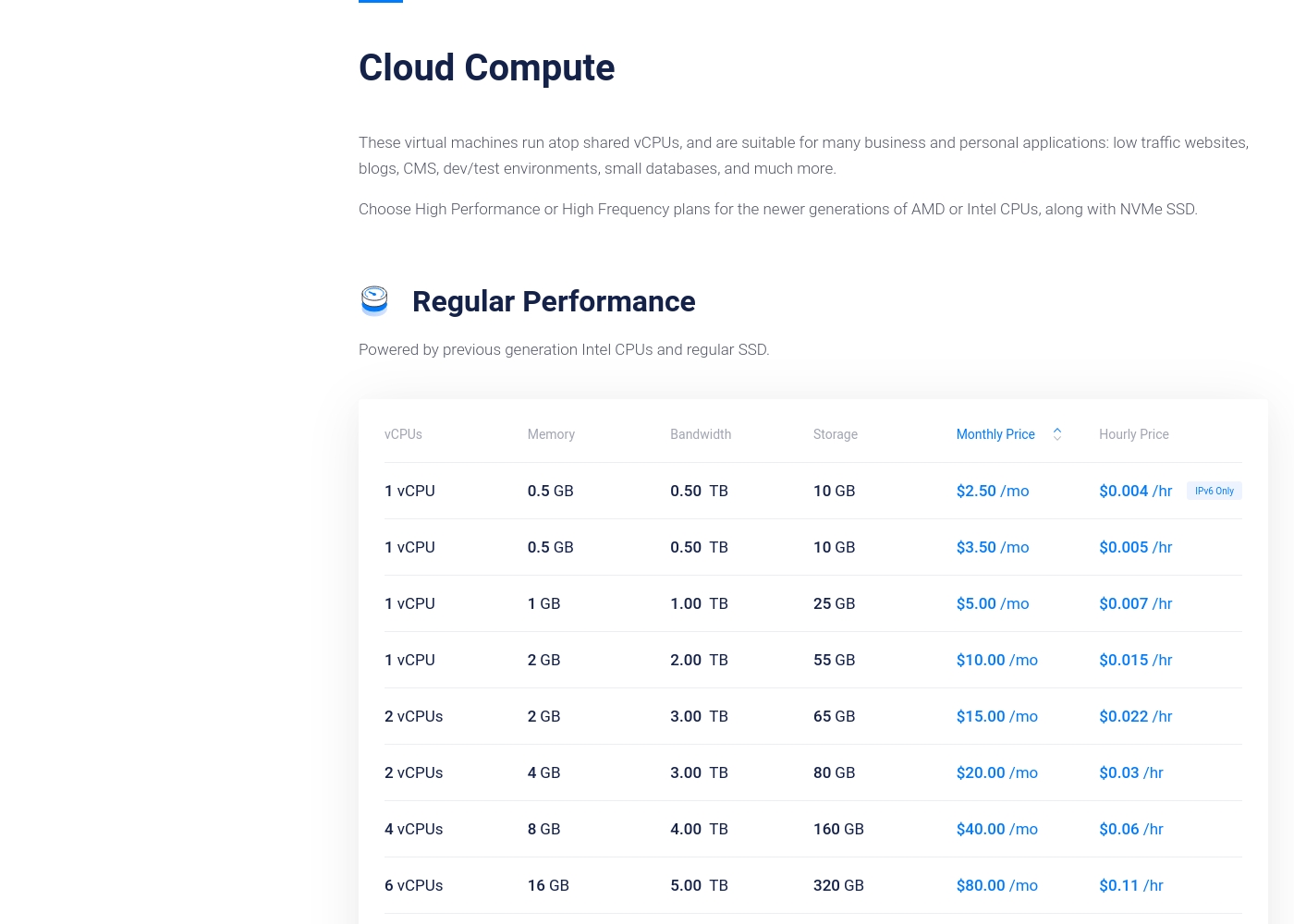
Vultr costs between $2.50 and $80.00 per month for Regular Performance Cloud Compute, featuring eight plans starting with the 1 vCPU / 0.5 GB configuration at $2.50/month.
Vultr’s Cloud Compute offerings are built on virtual machines using shared vCPUs. These machines are a great fit for everyday tasks like running low-traffic websites, simple databases, or small development environments. We've outlined a few of the available options below.
1 vCPU / 0.5 GB (IPv6 Only)
Price: $2.50 /month ($0.004 /hr) Best For: Basic testing or staging environments Other Features:
- 0.5 GB Memory
- 10 GB Storage
- 0.50 TB Bandwidth
- Powered by previous generation Intel CPUs
- 1 vCPU
- 0.5 GB Memory
- 10 GB Storage
- 0.50 TB Bandwidth
- 1 vCPU
- 1.0 GB Memory
- 25 GB Storage
- 1.00 TB Bandwidth
- 6 vCPUs
- 16 GB Memory
- 320 GB Storage
- 5.00 TB Bandwidth
Pricing Notes
- VMmanager pricing is opaque and requires contacting sales. Costs depend on your physical CPU core count.
- Vultr has transparent, published pricing. The cheapest cloud instance starts at $2.50/month.
- Vultr charges extra for add-ons: 20% for auto-backups, $10/month for DDoS protection.
- Vultr charges $0.01/GB for bandwidth overage. VMmanager's bandwidth costs are not specified.
- VMmanager offers a 30-day free trial. Vultr has no trial; you pay for what you use from the start.
Pricing Head-to-Head
User Reviews
External reviews for VMmanager are mixed. On Trustpilot, the overall rating is low (2.4/5) 😕, with users citing concerns about aggressive price increases, unresponsive support for some issues, and perceived billing problems.
However, positive reviews praise the software's core functionality and helpful support team. One user noted, "really enjoying VMmanager...
Been using VMmanager now for over a month and have been really impressed, the support team is on hand and helpful with any issues. The software itself makes up for it, especially with new features and bug fixes that get rolled out monthly.
Vultr receives poor external ratings, especially on Trustpilot (2.1), where customer experiences are highly polarized. While some users acknowledge Vultr's competitive pricing and the overall power of the servers, these positive attributes are frequently overshadowed by critical operational failures.
The most common complaint centers on terrible customer support which is described as slow, unresponsive, and strictly ticket-based. Users commonly report arbitrary account suspensions or terminations, often triggered by hitting unstated CPU usage limits or frivolous DMCA claims 😔.
The bad reviews here don't reflect my nine years of experience. I've been a customer for a long time only hosting one mail and web server. The initial offerings consistently held a great value, and the support used to be easy to reach.
Our Verdict
This isn't a fair fight. VMmanager and Vultr are built for completely different jobs. Picking one over the other depends entirely on what you're trying to build. VMmanager's superpower is automation. It's a complete platform to run a hosting business. It automates VPS provisioning in 4 seconds, manages billing, and gives your clients a self-service portal. It's for building a service on top of infrastructure. Vultr's superpower is raw power. It gives you instant access to global cloud compute and cutting-edge AI hardware like the NVIDIA HGX B200. It's for renting powerful machines to run your own workloads. The deciding factor is your goal. If you're selling virtual servers, you need VMmanager's automation. If you're training AI models, you need Vultr's GPU clusters. Choose VMmanager if you're a hosting provider automating your business. Choose Vultr if you're a developer or enterprise needing high-performance cloud compute and AI hardware.
Frequently Asked Questions
Is VMmanager a cloud provider like Vultr?
No. VMmanager is a platform for managing your own virtualization infrastructure. Vultr is a cloud provider that rents you computing resources from their global network.
Which is cheaper for running a single website?
Vultr is likely cheaper and simpler. You can get a basic cloud VM for $2.50/month. VMmanager is for managing entire hosting businesses, not individual sites.
Can I use Vultr for my hosting company's infrastructure?
You could rent Vultr's servers, but you'd need another tool to automate provisioning and billing. VMmanager is designed specifically for that hosting business automation.
Which has better support for AI workloads?
Vultr, by far. It offers immediate access to NVIDIA and AMD GPU clusters. VMmanager is a virtualization management platform with no AI or GPU capabilities.
Is VMmanager or Vultr more reliable?
Based on reviews, VMmanager appears more reliable for its use case. Vultr's reviews frequently mention network instability, instance failures, and poor support during outages.
Which is easier to set up?
Vultr is easier for a quick start. You can create a server in minutes. VMmanager is a complex platform requiring significant configuration and expertise to deploy.
Ready to Choose?
Both tools have their strengths. Choose based on your specific needs.