Sendcloud vs ShipStation
Sendcloud and ShipStation are industry leaders in shipping automation, but they target different markets. Sendcloud excels in its European carrier network and exceptional post-purchase branding. ShipStation shines with vast integrations and high-volume batch printing for US-based sellers. Deciding which to choose depends entirely on your geography and core fulfillment needs.
Best for: European e-commerce businesses scaling across borders, Companies prioritizing a fully branded post-purchase customer experience
Best for: US-based multi-channel sellers with complex integration needs, High-volume shippers needing to rapidly batch print 500+ labels
Comprehensive shipping automation for e-commerce.
Sendcloud provides a robust, highly-integrated shipping platform crucial for scaling e-commerce operations throughout Europe. We found the combination of extensive carrier access, high reliability, and instrumental specialist support delivers significant operational advantages. Overall, this is a top-tier choice for businesses ready to automate their fulfillment process and enhance the post-purchase experience.
Pros
- Smooth, highly intuitive user interface and streamlined workflow.
- Access to competitive rates from 160+ carriers on a single platform.
- Dedicated and instrumental onboarding support mentioned repeatedly by users.
- Saves hours via comprehensive batch label creation and automation.
Cons
- Some users report difficulty contacting general customer support staff.
- Recent shift to a subscription model disliked by long-term customers.
- Defaulting to certain expensive carriers (like DPD) can increase costs unexpectedly on certain accounts.
Powerful Shipping Automation, Weak Customer Support.
We find ShipStation offers powerful automation and deep carrier discounts, streamlining logistics for handling high volumes efficiently. Overall, while the technical capacity and feature set are strong, prospective users must be aware that the platform is regularly criticized for slow, unhelpful customer support and opaque billing practices.
Pros
- Seamless integration with unlimited selling channels (Starter plan and up).
- Access industry-leading carrier discounts (up to 90% off FedEx rates).
- Automates repetitive tasks, allowing users to batch print up to 500 labels.
- Robust automation rules like rate shopping simplify workflow significantly.
Cons
- Customer support is consistently reported as slow, outsourced, and ineffective.
- Users report critical failures with the two-factor authentication (MFA) login process.
- Concerns regarding unexpected fees, pricing opacity, and sharp subscription increases.
- Filing claims or securing refunds for lost packages or billing adjustments is often difficult.
AboutSendcloud
Sendcloud is Europe’s #1 shipping software, trusted by over 25,000 growing e-commerce businesses. It is designed specifically to simplify and streamline the entire parcel delivery process for you.
This platform uses an end-to-end strategy called “Connected Shipping.” It helps you manage needs from the product checkout right through to handling returns. You can easily connect your existing sales channels using over 100 integrations, including Shopify and WooCommerce.
It handles the boring, repetitive tasks so you can focus on strategy. You get quick access to 160+ carriers like DHL, UPS, and FedEx. This means you can ship smarter, faster, and more reliably without relying on extra staff or complex logistics. ✨
AboutShipStation
ShipStation is a centralized logistics solution designed for businesses looking to streamline and scale their operations. It connects to over 400 existing integrations, linking your stores and providing access to more than 180 carrier partners. This single sign-on platform helps simplify your entire order fulfillment process. ShipStation actively manages everything from importing orders to tracking shipments. It is built to grow with you, supporting operations scaling to as many as 15,000 orders a day. ✅
Highlights
Feature Comparison
Features Overview
We highlight the main differences and pick a winner for each feature.
Market Focus & Carrier Network
Sendcloud dominates the European market; ShipStation is superb for broad global integrations.
Sendcloud offers immediate access to 160+ carriers, specializing in excellent European performance. Users can effortlessly compare options based on transit time or price before dispatching. This network allows Sendcloud users to expand reliably into new international markets. ShipStation connects to 180+ partners and 400+ integrations, offering immense connectivity breadth. US-based sellers benefit from major carrier savings up to 90% via ShipStation rates. ShipStation acts as a massive central hub for most global e-commerce software. If you ship primarily within Europe, the Sendcloud carrier network is immediate and tailored. If you need wide-ranging US savings and integration depth, ShipStation is the clear choice. Both platforms provide access to deeply discounted shipping rates for users. Sendcloud heavily focuses on enabling global expansion from European bases with automated customs documentation.
High-Volume Fulfillment
ShipStation offers superior batch printing capabilities for maximum daily throughput.
Sendcloud focuses on streamlined, single-click label creation and automation rules. The Pro plan supports a very high volume of 30,000 labels per month. Sendcloud’s efficiency comes from minimizing steps during label creation. ShipStation is engineered for rapid, intense volume processing. It allows users to batch print up to 500 labels simultaneously in one pass. Users report printing up to 15x more labels per hour using ShipStation's automation. For massive, concentrated bursts of label printing required by large warehouses, ShipStation edges out Sendcloud. Sendcloud is highly automated for steady volume, but ShipStation handles sheer batch quantity better. If your primary goal is maximizing label output in short periods, ShipStation delivers the necessary functionality.
Branding & Returns
Sendcloud places a greater strategic emphasis on the post-purchase branding experience.
Sendcloud highlights the ability to deliver a 5-star branded customer experience every step of the way. This includes fully customized tracking pages and communication with your logo and voice. Sendcloud users gain a professional, automated self-service returns portal for their customers. ShipStation also offers branding for emails, packing slips, tracking pages, and its returns portal. ShipStation ensures a consistent, on-brand message after checkout across all channels. It centralizes customer communication around shipping. While both offer robust features, Sendcloud often wins specific praise for implementing white-label tracking and branding. Sendcloud makes the post-purchase journey a highly visible marketing opportunity. Turning shipping from a cost center into a customer loyalty builder is easier with Sendcloud's dedicated focus on the process.
User Scalability
Sendcloud offers unlimited user accounts, making it better for large, growing teams.
Sendcloud understands that enterprise operations require flexible seating arrangements for staff. The top-tier Pro plan with Sendcloud includes unlimited user accounts. Lower tiers scale generously, starting with 3 users on the Lite plan. ShipStation caps the number of users even on its highest Premium tier plan. The maximum seating available through ShipStation’s standard plans is 15 users. This structure may necessitate multiple accounts or workarounds for vast teams. For organizations expecting rapid hiring or needing access for dozens of warehouse or customer service staff, Sendcloud is superior. Unlimited user seating means lower administrative overhead for managers. ShipStation forces strict user management or requires contacting sales for enterprise solutions. If your internal team is large or frequently expanding, the unlimited user capacity of Sendcloud provides better administrative simplicity.
Integration Ecosystem
ShipStation offers significantly broader connectivity with over four times the integrations.
Sendcloud provides seamless integration with over 100 systems, including major platforms like Shopify and WooCommerce. If a native integration is missing, Sendcloud supports CSV uploads or API access. This covers most standard e-commerce needs efficiently. ShipStation boasts connection to 180+ integration partners, totaling over 400 integrations across channels. This breadth makes ShipStation an ideal central hub for highly diversified multi-channel sellers. ShipStation is excellent for consolidating many niche marketplaces and systems. ShipStation is the connectivity champion, featuring a vastly larger pool of supported software and systems. Businesses needing to manage highly complex or niche tech stacks should look to ShipStation first. Sendcloud serves most standard e-commerce shops well, but ShipStation has the sheer ecosystem size for complexity.
Pricing Structure
Sendcloud’s hybrid pricing offers better value for growing businesses with varying shipment volume.
Sendcloud uses a base subscription plus a lowering fee per label created (starting at €0.10). This model ensures users only pay a small fee above their monthly allotment. The permanent Free plan is robust and useful for starters. ShipStation uses a purely subscription model driven by monthly order volume, ranging up to $2025/month. While it includes the service fee, the top-tier cost is significantly higher than Sendcloud’s highest tier. ShipStation's initial entry-level plans use affordable, order-based tiers. Sendcloud’s structure provides predictability with lower processing costs as volume increases on higher tiers. ShipStation’s high-cost top tier makes it less appealing for very large operations compared to Sendcloud's enterprise focus. The hybrid model of Sendcloud offers a tighter control over costs for scaling businesses compared to ShipStation's commitment to high volume subscription tiers.
Customer Support Quality
Sendcloud receives stronger user comments regarding helpful onboarding and dedicated support.
Sendcloud users repeatedly praise the dedicated and instrumental onboarding support received from specialists. Pro customers receive a dedicated Customer Success Manager for strategic guidance. This suggests high-touch support at critical stages. ShipStation offers tiered support, from chatbot on the Free plan to phone support on Standard. However, user reviews frequently mention inconsistent support quality, login security issues, and challenging claims processes. ShipStation support can be hit or miss. While both offer multiple support channels, user sentiment favors the specialized guidance and praised onboarding of Sendcloud. Trusting your shipping platform requires reliable help. Sendcloud appears to invest more in proactive customer relationship management, according to user feedback and review sentiment.
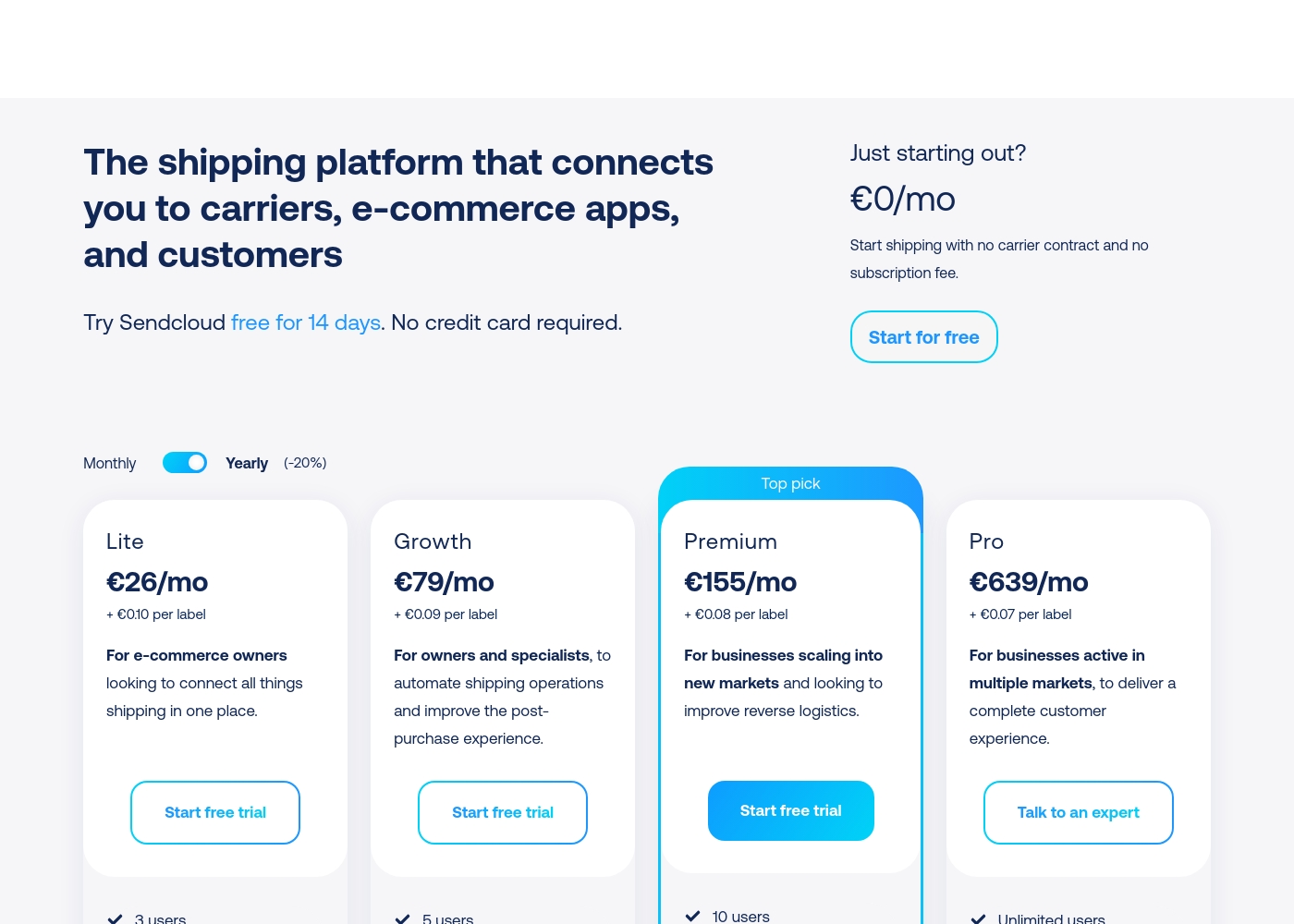
Sendcloud costs between €0 and €639 per month with 5 plans: Free at €0/mo, Lite at €26/mo, Growth at €79/mo, Premium at €155/mo, and Pro at €639/mo.
Sendcloud offers flexible plans designed to grow with your e-commerce business, starting completely free. Let's explore the individual tiers to see which features fit your shipping processes best.
Free
Price: €0/mo Websites Supported: Max. 2 integrations Best For: First steps in the e-commerce world. Other Features:
- No subscription fee.
- Includes 1 user.
- Must use Sendcloud’s discounted shipping rates.
- Provides discounted rates from major carriers.
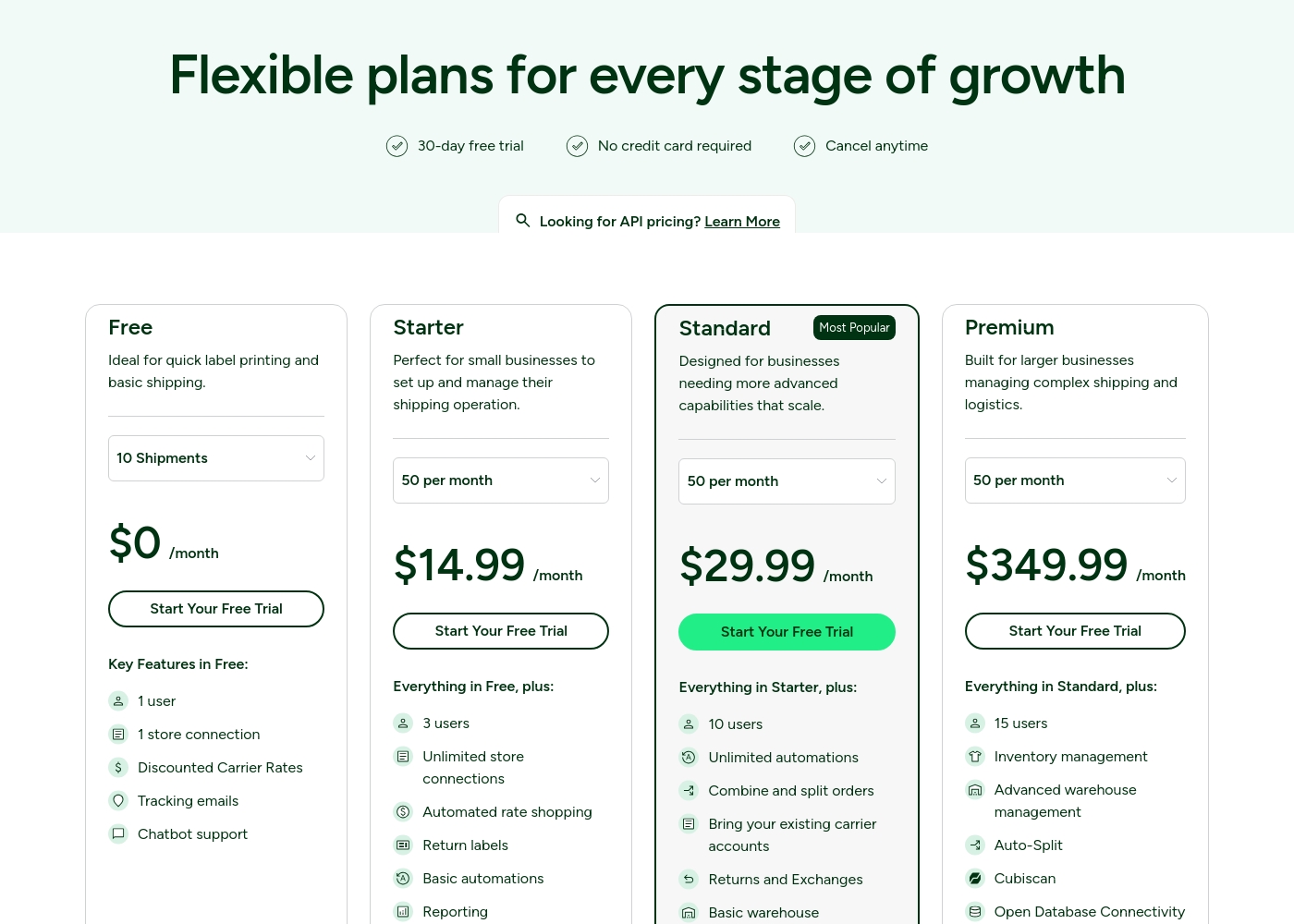
ShipStation costs between $0 and $349.99 per month with four plans: Free at $0/month, Starter at $14.99/month, Standard at $29.99/month, and Premium at $349.99/month.
Here's a look at the features included with each plan tier.
Free
Price: $0 per month Websites Supported: 1 Best For: Quick label printing and basic shipping. Refund Policy: Not applicable Other Features:
- 1 user
- Discounted Carrier Rates
- Tracking emails automatically sent
- Chatbot support included
- 1 user
- 1 store connection
- Discounted Carrier Rates
- Tracking emails
- Chatbot support
- 3 users
- Unlimited store connections
- Automated rate shopping
- Return labels
- Basic automations
- 10 users
- Unlimited automations
- Combine and split orders
- Bring your existing carrier accounts
- Returns and Exchanges
- 15 users
- Inventory management
- Advanced warehouse management
- Auto-Split
- Cubiscan
Pricing Notes
- Sendcloud uses a hybrid model: a fixed subscription fee plus a small per-label fee (€0.07–€0.10).
- ShipStation’s pricing is based primarily on monthly order volume, resulting in a much higher potential cost on the top tiers ($2025/month).
- If Sendcloud users exceed their included label quota, they pay an extra €0.15 on top of their plan’s standard processing fee.
- Sendcloud offers a 14-day free trial; ShipStation offers a longer 30-day free trial on paid plans.
- ShipStation offers a reassuring 90-day money-back guarantee, which Sendcloud does not explicitly state.
Pricing Head-to-Head
User Reviews
Sendcloud maintains a strong reputation, reflected in its 4.1-star rating across thousands of reviews. Users consistently praise the platform's ability to simplify shipping operations, highlighting a clean, intuitive, and highly reliable interface that saves significant time, often automating tasks that previously took hours.
The greatest strengths noted are the excellent and fast integrations with over 160 carriers, effectively turning shipping management into "one-stop shopping." Onboarding receives phenomenal feedback, with numerous users specifically naming agents who provided excellent, specialized support. While many find the pricing competitive, especially the free plan, a few growing businesses expressed frustration about the recent introduction of paid monthly fees or finding carrier defaults (like DPD) too costly.
Onboarding was brilliant; I couldn't fault a single thing. Our specialist was excellent and knew everything about the platform. Without that guidance, we certainly would have struggled and gone elsewhere.
ShipStation receives mixed yet clearly polarized feedback. Many users praise the platform for its efficiency, noting the seamless integration with various selling channels and the significant time saved when printing labels and managing high shipment volumes.
Customers frequently highlight the convenience of features, such as creating return labels and accessing competitive, discounted shipping rates. Positive experiences often mention excellent onboarding sessions led by helpful, specific representatives.
This was one of the best business decisions this year! Implementing ShipStation and shipping directly from our home office has been a total game-changer. It is an easy, seamless solution that saves us so much time.
Our Verdict
Choosing between Sendcloud and ShipStation boils down to location and fulfillment type. Both offer incredible automation and crucial cost savings on labels. You need to identify which platform’s superpowers align with your business goals. Sendcloud’s superpower is providing comprehensive European logistics and seamless customer branding. It offers unlimited user scalability, perfect for fast-growing teams. Sendcloud’s hybrid pricing is appealing for controlling costs while volumes increase. ShipStation excels in sheer integration breadth and brutal efficiency for US-centric high volume. Its ability to batch print 500 labels at once is unmatched. ShipStation is the ultimate consolidation hub for multi-channel sellers needing 400+ distinct integrations. The deciding factor is usually your geography and integration priority versus user complexity. If you are European or prioritize user management and branding, Sendcloud is your tailored solution. If you are US-based and need maximum integration flexibility and high-volume batch processing, ShipStation prevails. If you run an e-commerce store in Germany, choose Sendcloud for localized power and excellent support. If you run multiple Shopify and Amazon stores from a warehouse in the US, ShipStation’s integration ecosystem is ideal.
Frequently Asked Questions
Which is better for international shipping, Sendcloud or ShipStation?
Sendcloud specializes in European logistics and automatically generates necessary customs paperwork. This makes Sendcloud excellent for businesses shipping from Europe globally. ShipStation manages international shipping through its broad carrier integrations.
Does ShipStation have unlimited users like Sendcloud?
No, ShipStation limits high-tier plans to 15 users maximum. Sendcloud offers unlimited user seating on its Pro plan, making it better for large organizations. This is a critical difference for administrative scalability.
Which software offers better integration options?
ShipStation is the winner here, providing connections to over 400 integrations and 180+ partners. Sendcloud offers a robust 100+ native integrations, suitable for most standard setups. ShipStation is ideal for highly complex multi-channel needs.
Is Sendcloud’s pricing cheaper than ShipStation?
Sendcloud’s hybrid model (subscription + low per-label fee) often offers better value for money. ShipStation's top-tier subscription costs can exceed $2000 monthly. Sendcloud provides highly transparent, usage-based scaling costs.
Should a US multi-channel business choose Sendcloud or ShipStation?
A US multi-channel business should generally choose ShipStation due to its strong US carrier savings and vast integration market. ShipStation is built to centralize orders from many North American selling channels. Sendcloud’s network is primarily focused on the EU.
Can I use my own carrier contracts with both platforms?
Yes, you can use your existing negotiated carrier contracts with both Sendcloud (on paid plans) and ShipStation. Both platforms also provide access to their own pre-negotiated discounted rates. This flexibility helps optimize shipping costs.
Ready to Choose?
Both tools have their strengths. Choose based on your specific needs.