Sendcloud vs ShipEngine
Sendcloud and ShipEngine are both strong shipping platforms for growing teams. Sendcloud shines in EU automation and branded post-purchase moments. ShipEngine is API-first, great for developers and high-volume merchants.
Best for: Small to mid-sized EU-based ecommerce teams needing automated labeling and branded tracking, Stores that want 100+ integrations and 160+ carriers in one platform
Best for: Developers embedding shipping into custom apps or WMS/ERP systems, High-volume shippers (>25k shipments/month) needing enterprise-grade API and support
Comprehensive shipping automation for e-commerce.
Sendcloud provides a robust, highly-integrated shipping platform crucial for scaling e-commerce operations throughout Europe. We found the combination of extensive carrier access, high reliability, and instrumental specialist support delivers significant operational advantages. Overall, this is a top-tier choice for businesses ready to automate their fulfillment process and enhance the post-purchase experience.
Pros
- Smooth, highly intuitive user interface and streamlined workflow.
- Access to competitive rates from 160+ carriers on a single platform.
- Dedicated and instrumental onboarding support mentioned repeatedly by users.
- Saves hours via comprehensive batch label creation and automation.
Cons
- Some users report difficulty contacting general customer support staff.
- Recent shift to a subscription model disliked by long-term customers.
- Defaulting to certain expensive carriers (like DPD) can increase costs unexpectedly on certain accounts.
Pros
Cons
AboutSendcloud
Sendcloud is Europe’s #1 shipping software, trusted by over 25,000 growing e-commerce businesses. It is designed specifically to simplify and streamline the entire parcel delivery process for you.
This platform uses an end-to-end strategy called “Connected Shipping.” It helps you manage needs from the product checkout right through to handling returns. You can easily connect your existing sales channels using over 100 integrations, including Shopify and WooCommerce.
It handles the boring, repetitive tasks so you can focus on strategy. You get quick access to 160+ carriers like DHL, UPS, and FedEx. This means you can ship smarter, faster, and more reliably without relying on extra staff or complex logistics. ✨
AboutShipEngine
At its core, ShipEngine is a modern, reliable shipping API. Think of it as the central brain that connects all your shipping tasks. It’s built for developers and the merchants they support. You can plug it into your existing systems—like a marketplace, warehouse management tool, or a custom app—and get everything shipping in minutes. 💡 It’s designed to be the engine that powers your entire logistics operation.
Highlights
Feature Comparison
Features Overview
We highlight the main differences and pick a winner for each feature.
Integrations & Carriers
Sendcloud offers 100+ integrations and 160 carriers. ShipEngine focuses on 200+ carriers.
Sendcloud connects 100+ systems, including Shopify and WooCommerce. It imports orders automatically and supports 160 carriers for diverse shipping. ShipEngine connects 200+ carriers and emphasizes a developer-friendly API with Elements to embed features quickly. The key difference is breadth of integrations versus raw carrier depth. In practice, a store can centralize shipping with Sendcloud, while a developer team can leverage ShipEngine for broad carrier access. This matters when you’re choosing between turnkey automation and customizable shipping fluorescence.
Rate Shopping & Discounts
Sendcloud uses pre-negotiated discounted rates; ShipEngine specializes in rate comparison across many carriers.
Sendcloud gives access to pre-negotiated rates and lets paid plans use existing carrier contracts. ShipEngine offers rate comparison across over 200 carriers and delivers discounted rates through its network. The key difference is how discounts are delivered: built-in contracts versus live rate shopping. Real-world, Store A saves by using Sendcloud’s negotiated rates; Store B saves via ShipEngine's rate comparisons across many options.
API & Developer Experience
ShipEngine is API-first with Elements and a sandbox; Sendcloud also provides an API.
Sendcloud exposes an API for custom integrations and supports importing orders. ShipEngine offers SDKs, a free sandbox, and a tool called Elements to embed features in minutes. The trade-off is that ShipEngine tends to favor developer-driven workflows, while Sendcloud leans toward turnkey automation. In practice, developers win with ShipEngine; business teams win with Sendcloud for speed.
Returns & Post-Purchase
Both platforms support returns, but with different UX approaches.
Sendcloud provides an automated, self-service returns portal that customers use directly. ShipEngine enables printing return labels and post-shipment tracking, helping automate returns in workflow. The difference is branding and self-service emphasis, with Sendcloud prioritizing a branded customer journey and ShipEngine prioritizing automation tooling. Real-world impact: faster refunds and smoother reverse logistics for mid-size operations.
Branding & Customer Experience
Sendcloud emphasizes branded tracking pages and customer communications.
Sendcloud allows branded tracking pages and real-time updates that reflect your brand voice. ShipEngine focuses on checkout clarity and accurate costs through its rate-shopping and taxes features, delivering strong data-driven UX. The trade-off is branding depth versus data accuracy and checkout optimization. In practice, brands leaning on customer loyalty benefit more from Sendcloud; technical shops benefit from ShipEngine.
International & Compliance
Sendcloud supports eight core EU nations; ShipEngine enables global coverage via many carriers.
Sendcloud handles international tasks like customs paperwork and ships from eight EU nations. ShipEngine provides access to 200+ carriers for global coverage and rate options. The difference is EU-focused versus global scalability. EU-based stores should lean Sendcloud for local compliance; global shippers should consider ShipEngine for reach.
Pricing & Trials
Sendcloud uses a hybrid pricing model with a free plan; ShipEngine has a free plan plus paid tiers.
Sendcloud offers Free, Lite, Growth, Premium, and Pro plans, with per-label fees shrinking at higher tiers. ShipEngine starts free and offers Advanced at $75/month with per-label overage and specific API usage caps. The key difference is cost structure: volume-based for ShipEngine vs blended for Sendcloud. Practical cue: test both with their trials to estimate true cost for your volume.
Automation & Workflows
Both platforms automate core fulfillment tasks with strong automation features.
Sendcloud provides automation rules to streamline fulfillment and bulk label creation. ShipEngine automates labeling, data consolidation, and customs docs, plus the Elements tool for quick UI integration. The real distinction is scope: Sendcloud excels in post-purchase automation; ShipEngine excels in API-driven workflow automation. Use case: ecommerce ops favor Sendcloud; developers favor ShipEngine.
Support & Onboarding
Both offer robust support, with different tiered experiences.
Sendcloud includes general support across plans, with Growth adding phone support and Pro giving a dedicated Customer Success Manager. ShipEngine provides 24/7 email, with live chat hours, and Enterprise offers a dedicated Implementation manager plus scheduled calls. The choice depends on how much human help you want and at what scale. If you value onboarding, Sendcloud and ShipEngine both deliver—just in different flavors.
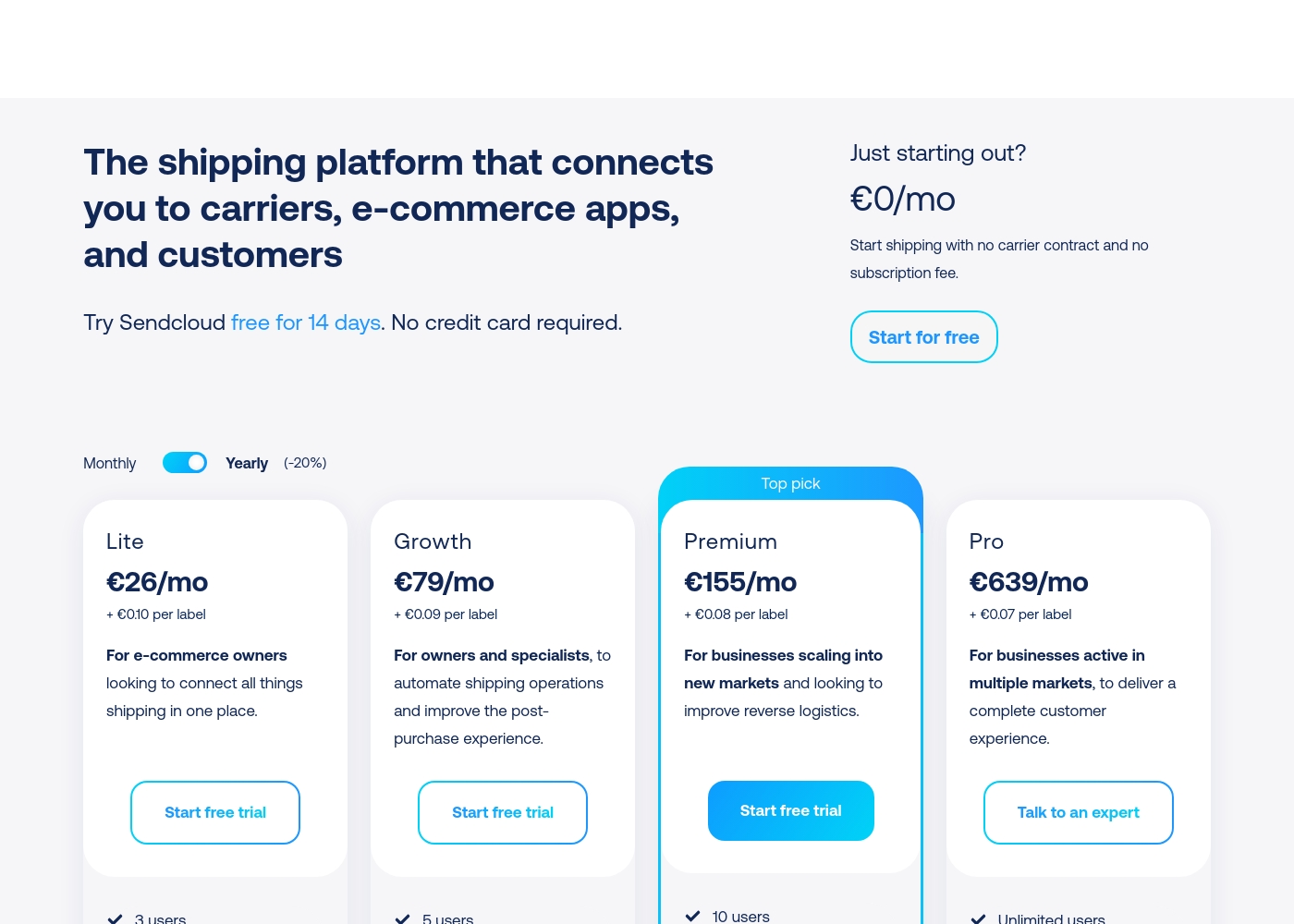
Sendcloud costs between €0 and €639 per month with 5 plans: Free at €0/mo, Lite at €26/mo, Growth at €79/mo, Premium at €155/mo, and Pro at €639/mo.
Sendcloud offers flexible plans designed to grow with your e-commerce business, starting completely free. Let's explore the individual tiers to see which features fit your shipping processes best.
Free
Price: €0/mo Websites Supported: Max. 2 integrations Best For: First steps in the e-commerce world. Other Features:
- No subscription fee.
- Includes 1 user.
- Must use Sendcloud’s discounted shipping rates.
- Provides discounted rates from major carriers.
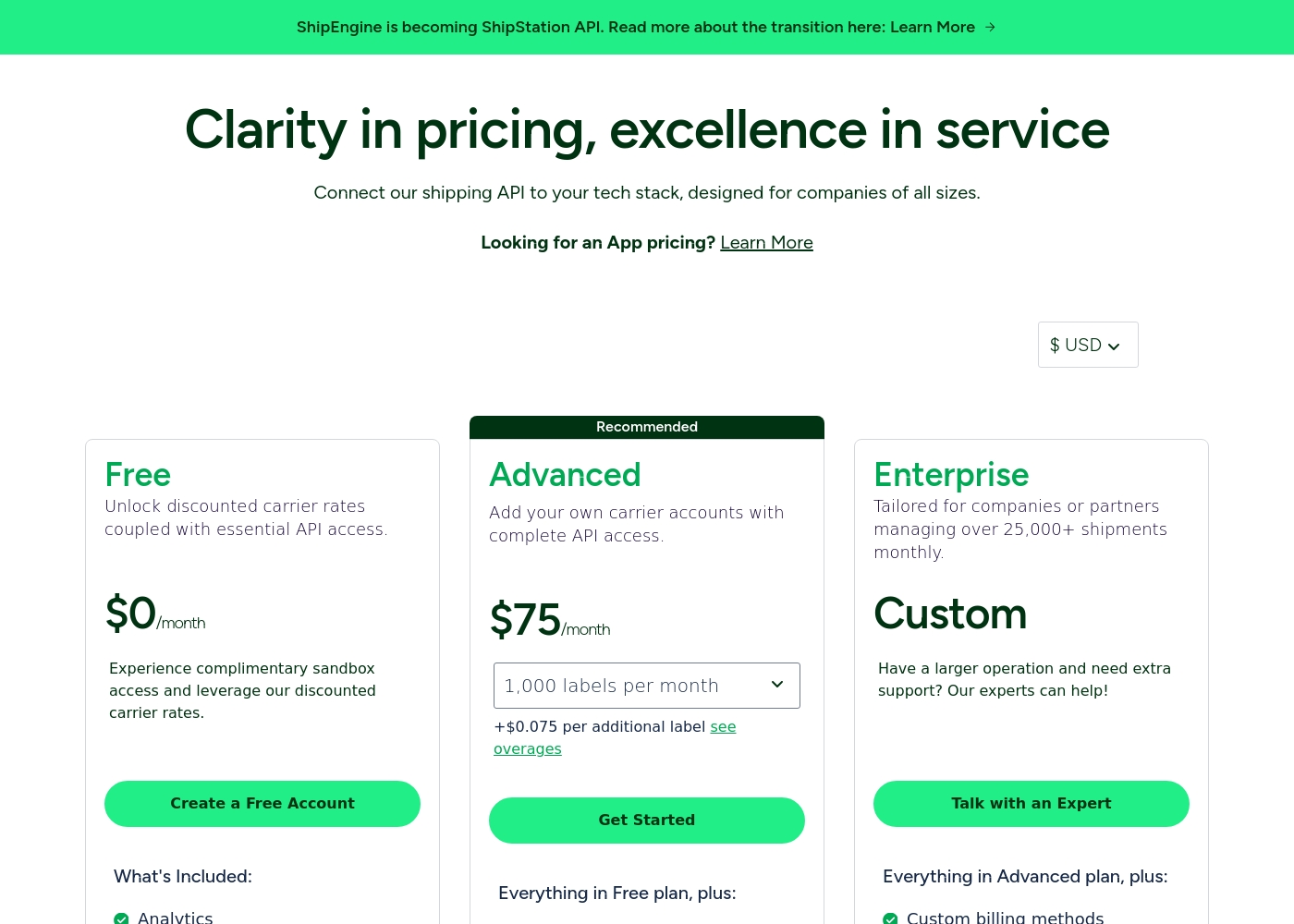
ShipEngine pricing: ShipEngine offers a transparent pricing structure starting with a free tier and scaling to usage-based paid plans starting at $75/month. You can choose to stick with ShipEngine's carrier rates for free or bring your own accounts with an Advanced plan.
house. Note: ShipEngine is transitioning to ShipStation API.
Individual plan names and features are detailed below. Tracking and address validation API calls may incur additional costs based on volume.
Pricing Notes
- Sendcloud: per-label fee starts at €0.10 on Lite and €0.07 on Pro; €0.15 overage beyond plan.
- Plans include 400–30,000 labels per month; no setup fee on paid tiers.
- ShipEngine: Free plan with discounted carrier rates; Advanced starts at $75/month for 1,000 labels.
- Advanced adds taxes, duties, address validation, and PUDO search; Enterprise is custom.
- Sandbox available for ShipEngine; 14-day trial for Sendcloud.
Pricing Head-to-Head
User Reviews
Sendcloud maintains a strong reputation, reflected in its 4.1-star rating across thousands of reviews. Users consistently praise the platform's ability to simplify shipping operations, highlighting a clean, intuitive, and highly reliable interface that saves significant time, often automating tasks that previously took hours.
The greatest strengths noted are the excellent and fast integrations with over 160 carriers, effectively turning shipping management into "one-stop shopping." Onboarding receives phenomenal feedback, with numerous users specifically naming agents who provided excellent, specialized support. While many find the pricing competitive, especially the free plan, a few growing businesses expressed frustration about the recent introduction of paid monthly fees or finding carrier defaults (like DPD) too costly.
Onboarding was brilliant; I couldn't fault a single thing. Our specialist was excellent and knew everything about the platform. Without that guidance, we certainly would have struggled and gone elsewhere.
Our Verdict
Bottom line: it’s a tie for many teams, but the choice hinges on your workflow. Sendcloud beats for EU automation and branded post-purchase experiences. ShipEngine wins for developers who want a fast, API-driven shipping backbone. If you’re deciding today, pick Sendcloud for turnkey EU shipping and branding, or ShipEngine if you need deep API access and high-volume capacity. For most growing shops, map your priorities: branding and simplicity versus API power and scale, then test the free plans.
Frequently Asked Questions
Which is better for small teams: Sendcloud or ShipEngine?
If you want quick setup and strong post-purchase branding, Sendcloud is a solid fit. If your team prioritizes API access and developer-friendly workflows, ShipEngine wins. Start with the free plans to compare hands-on.
Does Sendcloud have address validation like ShipEngine?
Sendcloud’s documentation doesn’t explicitly list address validation. ShipEngine includes address validation as part of its Advanced plan features. If address accuracy matters, ShipEngine is the safer bet.
Is ShipEngine worth the extra cost over Sendcloud?
For developer-heavy, high-volume needs, ShipEngine’s API, Elements, and PUDO search deliver value. If you want turnkey EU automation and branding, Sendcloud offers strong value at multiple tiers.
Can I migrate from Sendcloud to ShipEngine easily?
Migration specifics aren’t detailed here. Check each provider’s migration guides and API tooling to plan data transfer and onboarding.
Does ShipEngine support over 200 carriers?
Yes. ShipEngine provides access to 200+ global carriers through a single integration, plus rate shopping.
What is the free trial for each platform?
Sendcloud offers a 14-day free trial. ShipEngine provides a 30-day sandbox trial to test APIs and endpoints.
Ready to Choose?
Both tools have their strengths. Choose based on your specific needs.