Semrush vs ThorData
Semrush and ThorData are both powerful digital tools, but they solve completely different problems. Semrush is an all-in-one marketing platform for SEO, ads, and content. ThorData is a specialized proxy service for developers and data collection. Here's which one fits your needs.
Best for: Marketing agencies managing multiple client SEO and content projects, Enterprise organizations with 500+ employees needing comprehensive marketing data
Best for: Developers building applications that need to scrape websites reliably, Data scientists conducting market research or competitor analysis from specific locations
Powerful data, challenging user experience.
We found Semrush to be an undeniably powerful, AI-driven platform for comprehensive competitive research and SEO strategy at scale. It offers immense infrastructure with vast keyword and backlink data, supporting advanced enterprise needs like dedicated API access. Overall, users must carefully navigate the automated subscription and cancellation requirements, as widespread billing issues severely detract from the software’s technical strength.
Pros
- AI-powered platform provides precise competitive insights.
- Massive database featuring 43 trillion backlinks and 27 billion keywords.
- Offers integrated toolkits for SEO, Content, Social, and Advertising.
- Suitable for large organizations; Business Plan includes API access.
Cons
- Widespread reports of hidden auto-renewal fees and unexpected charges.
- Cancellation process is intentionally complicated and difficult to find.
- Customer support is consistently reported as unresponsive and unhelpful.
- Fees are charged for adding every new website or project.
Solid Proxy Service for Scalable Data
We find ThorData offers a robust, developer-focused proxy and scraping solution with flexible pay-as-you-go pricing. The platform provides a wide range of proxy types and global targeting options, which is great for large-scale data collection projects. Overall, it's a capable tool for developers needing reliable, high-volume web access.
Pros
- Flexible pay-as-you-go pricing with low entry points (e.g., $0.75/IP).
- Offers residential, mobile, and static ISP proxies plus a Web Scraper API.
- Developer-friendly with simple integration and code samples for popular languages.
- Provides free trial access to test main product lines.
Cons
- Lack of verifiable external user reviews limits our understanding of real-world support and reliability.
- Complex, usage-based billing might be confusing for some users initially.
- Information on specific plan tiers and detailed feature comparisons is not fully clear from the pricing page.
- The promotional tone of the website content makes it hard to gauge limitations objectively.
AboutSemrush
Semrush is the leading AI-Powered Marketing Platform trusted by the world’s leading brands. It provides specific toolkits for nearly every marketing task, from Local optimization to AI PR. It helps 10 million marketing professionals manage their digital strategy effectively. This platform is truly the growth engine for Enterprises, offering critical, actionable data backed by immense scale. ✅
AboutThorData
ThorData is a proxy and data collection service. It gives you access to a global network of IP addresses to mask your online requests. 💡
This service is for developers, data scientists, and businesses who need to scrape websites, gather market data, or test applications from different locations.
Highlights
Feature Comparison
Features Overview
We highlight the main differences and pick a winner for each feature.
Core Purpose
Semrush is a full marketing platform. ThorData is a proxy service for web scraping.
Semrush gives marketers a 360-degree view of SEO, content, ads, and social media. It's built to help businesses grow their online presence with data-driven insights. ThorData provides residential and datacenter proxies for developers. Its purpose is to help you scrape websites and collect data reliably without getting blocked. The key difference is that Semrush analyzes your website's performance. ThorData provides the infrastructure to access other websites for data collection. If you need to improve your own search rankings, Semrush is the tool. If you need to gather data from the web, ThorData is the service.
Data & Database
Semrush has massive marketing data. ThorData has a global network of IP addresses.
Semrush's database is enormous: 27 billion keywords and 43 trillion backlinks. This data powers competitive analysis, keyword research, and site audits across 142 geo databases. ThorData's strength is its IP network. It offers residential, datacenter, and mobile proxies to mask your online requests. You can target data from virtually any country or city. The trade-off is that Semrush's data is about your website and competitors. ThorData's data is about accessing other websites securely. For SEO and marketing analytics, Semrush's database is unmatched. For large-scale data collection, ThorData's network is essential.
User Interface
Semrush has a complex dashboard with many tools. ThorData is simple and developer-focused.
Semrush's interface can feel overwhelming. It has integrated toolkits for SEO, Content, Social, and Advertising. New users may need time to learn where everything is. ThorData's dashboard is straightforward. It's built for developers and focuses on managing proxies and billing. The interface is less complex because it does fewer things. The key difference is that Semrush tries to do everything in one place. ThorData focuses on doing one thing well: providing proxy access. For a marketing team, Semrush's all-in-one interface is powerful. For a developer, ThorData's simplicity saves time.
Collaboration & Team Features
Semrush supports team projects. ThorData is designed for individual developers.
Semrush supports up to 40 projects on the Business plan. It includes features like Share of Voice monitoring and migration from third-party tools for agencies. ThorData doesn't mention team or collaboration features. It's a usage-based service for developers and data scientists. There's no mention of multiple user seats or team management. The trade-off is that Semrush is built for teams managing multiple clients or websites. ThorData is built for individuals or small teams doing data collection. For agencies with 10-50 people, Semrush's project limits matter. For a solo developer, ThorData's pay-as-you-go model is simpler.
Automation & Workflows
Semrush automates SEO and content tasks. ThorData automates web scraping challenges.
Semrush automates keyword tracking, site audits, and content optimization. It scores content in real time and helps you create SEO-ready articles with AI. ThorData automates data collection with tools like ScraperAPI and WebUnlocker. These handle retries, CAPTCHAs, and anti-bot protection automatically. The difference is that Semrush automates marketing tasks. ThorData automates the technical challenges of web scraping. For a content marketer, Semrush's automation saves hours. For a developer, ThorData's automation prevents data collection failures.
Reporting & Analytics
Semrush provides detailed marketing reports. ThorData offers usage dashboards.
Semrush provides comprehensive reports on SEO, traffic, competitors, and ad performance. You can track keyword rankings, backlink growth, and content metrics across projects. ThorData's analytics focus on usage. The dashboard lets you track data transfer, manage invoices, and monitor proxy performance. There's no marketing analytics. The key difference is that Semrush analyzes your website's performance. ThorData analyzes your data collection usage. For marketing decisions, Semrush's reports are essential. For managing data costs, ThorData's dashboard is useful.
Mobile Experience
Both tools are primarily desktop-based. Semrush has no mobile app. ThorData is for developers.
Semrush doesn't mention a mobile app. It's a web-based platform designed for desktop use by marketing teams. Mobile access isn't a key feature. ThorData is built for developers who work on computers. It provides code samples for Python, Node.js, and PHP. There's no mobile interface. The trade-off is that neither tool prioritizes mobile. Semrush is for desktop marketing work. ThorData is for desktop development work. For marketers, Semrush's desktop interface is standard. For developers, ThorData's API and code samples are what matter.
Customer Support
Semrush support is reported as unresponsive. ThorData support is unclear.
Semrush support is frequently criticized. Users report long response times, complicated cancellation, and unhelpful staff. Many feel misled by auto-renewal charges. ThorData's support details are missing. The website mentions developer-friendly tools but doesn't state response times or SLAs. It's hard to evaluate. The key difference is that Semrush's support problems are well-documented. ThorData's support quality is unknown. For critical issues, Semrush's support reputation is a concern. For ThorData, you'd need to test their support yourself.
Integration Ecosystem
Semrush integrates with marketing tools. ThorData integrates with development languages.
Semrush offers API access on the Business plan. It integrates with marketing workflows and third-party tools. It's designed for enterprise use. ThorData provides integration examples for Python, Node.js, PHP, and Go. It's built for developers to connect to their own applications and scripts. The trade-off is that Semrush integrates with marketing platforms. ThorData integrates with developer code. For marketing teams, Semrush's API access is valuable. For developers, ThorData's language support is essential.
Pricing Model
Semrush has tiered subscriptions. ThorData has pay-as-you-go usage.
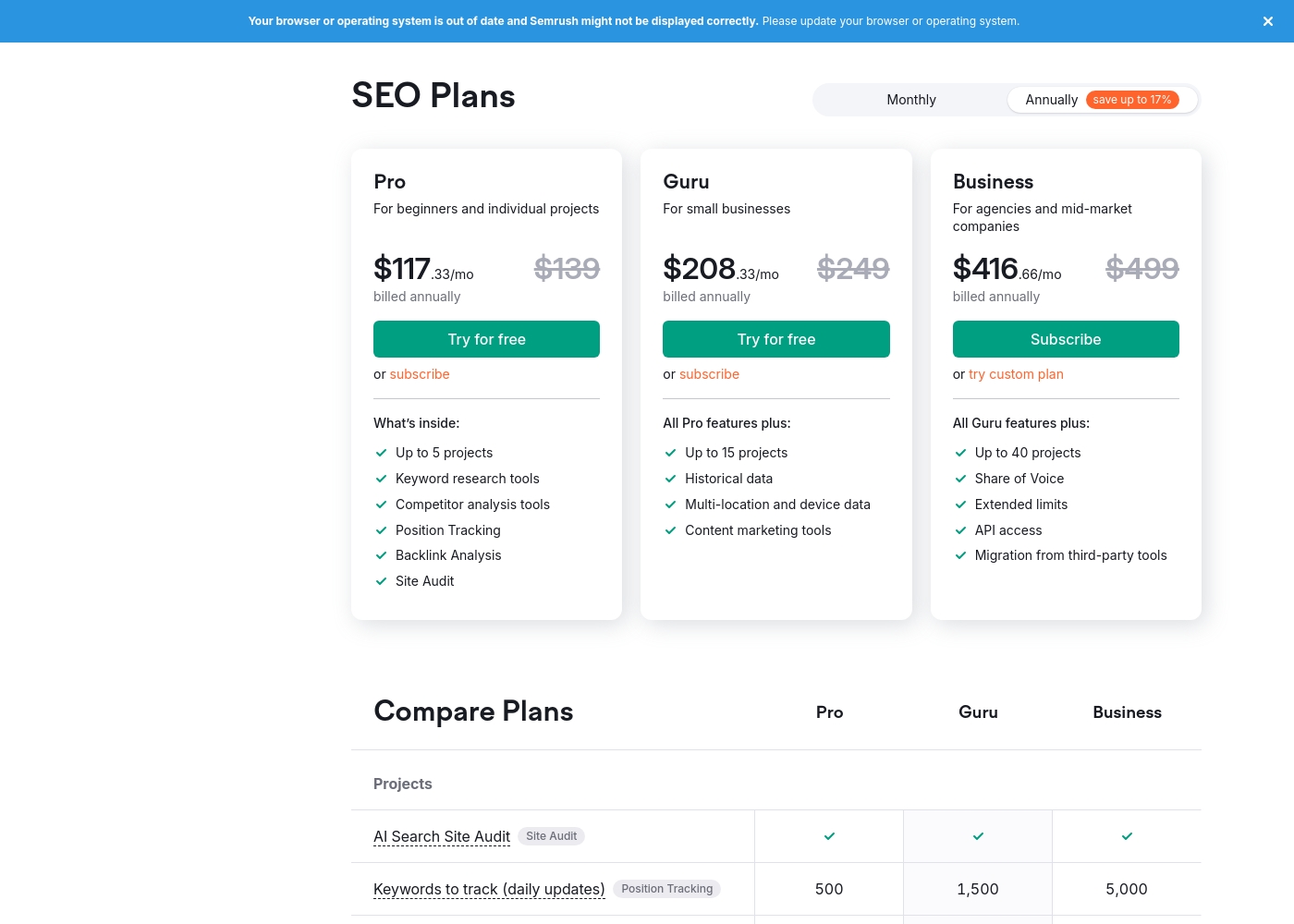
Semrush has three plans: Pro ($117-139/mo), Guru ($208-249/mo), and Business ($417-499/mo). Annual billing saves up to 17%. Prices are based on projects and keywords. ThorData uses pay-as-you-go pricing. Residential proxies are billed per GB. Static ISP proxies are billed per IP. Prices start at $0.75/IP or $1.05/GB. The key difference is that Semrush charges for access to features and data. ThorData charges for data transfer and IP usage. For predictable monthly costs, Semrush's subscriptions are clearer. For variable usage, ThorData's pay-as-you-go is flexible.
Learning Curve
Semrush is complex for beginners. ThorData is simpler for developers.
Semrush can be overwhelming. It has many toolkits and features. New users may need time to learn SEO, content, and advertising modules. ThorData is simpler for developers. It provides code samples and a dashboard focused on proxy management. The learning curve is shorter. The difference is that Semrush requires marketing knowledge. ThorData requires basic coding skills. For a marketing newbie, Semrush's complexity is a challenge. For a developer, ThorData's simplicity is a benefit.
Customization
Semrush offers limited customization. ThorData allows proxy configuration.
Semrush's customization is within its toolkits. You can adjust keyword tracking and project settings. But you can't customize the platform's core functions. ThorData allows you to configure proxy settings. You can choose authentication methods and target specific locations. This customization is built for developers. The trade-off is that Semrush's customization is about marketing data. ThorData's customization is about technical proxy setup. For a marketer, Semrush's settings are sufficient. For a developer, ThorData's configuration is necessary.
Security
Semrush focuses on data security. ThorData focuses on proxy authentication.
Semrush provides secure data handling for marketing information. It's built for enterprises with compliance needs. API access is controlled. ThorData offers flexible authentication: username/password or IP whitelisting. This is crucial for secure data collection from web sources. The difference is that Semrush's security is about protecting your data. ThorData's security is about protecting your web access. For enterprise compliance, Semrush's security features matter. For developer security, ThorData's authentication methods are key.
Performance & Reliability
Semrush delivers consistent marketing data. ThorData ensures reliable data collection.
Semrush is powered by a massive database that processes 27 billion keywords. It's designed for consistent performance across marketing tasks. ThorData provides a vast network of IPs to ensure requests don't fail. It's built for reliable, large-scale data collection without blocks. The key difference is that Semrush's reliability is about data accuracy. ThorData's reliability is about connection stability. For SEO analysis, Semrush's performance is trusted. For web scraping, ThorData's network reliability is essential.
Semrush costs between $117.33 and $499 per month with three plans: Pro at $117.33, Guru at $208.33, and Business at $416.66, all based on annual billing.
Here is a detailed look at what is included in each of Semrush's three SEO plans.
Pro
Price: $117.33/mo billed annually ($139 monthly) Websites Supported: Up to 5 projects Best For: Beginners and individual projects Other Features: Keyword research tools, Backlink Analysis, 500 keywords tracked daily, Competitor analysis tools, Site Audit
- Up to 5 projects
- Keyword research tools
- Competitor analysis tools
- Position Tracking (500 keywords daily)
- Backlink Analysis
- All Pro features plus
- Up to 15 projects
- Historical data
- Multi-location and device data
- Content marketing tools
- All Guru features plus
- Up to 40 projects
- Share of Voice
- Extended limits
- API access
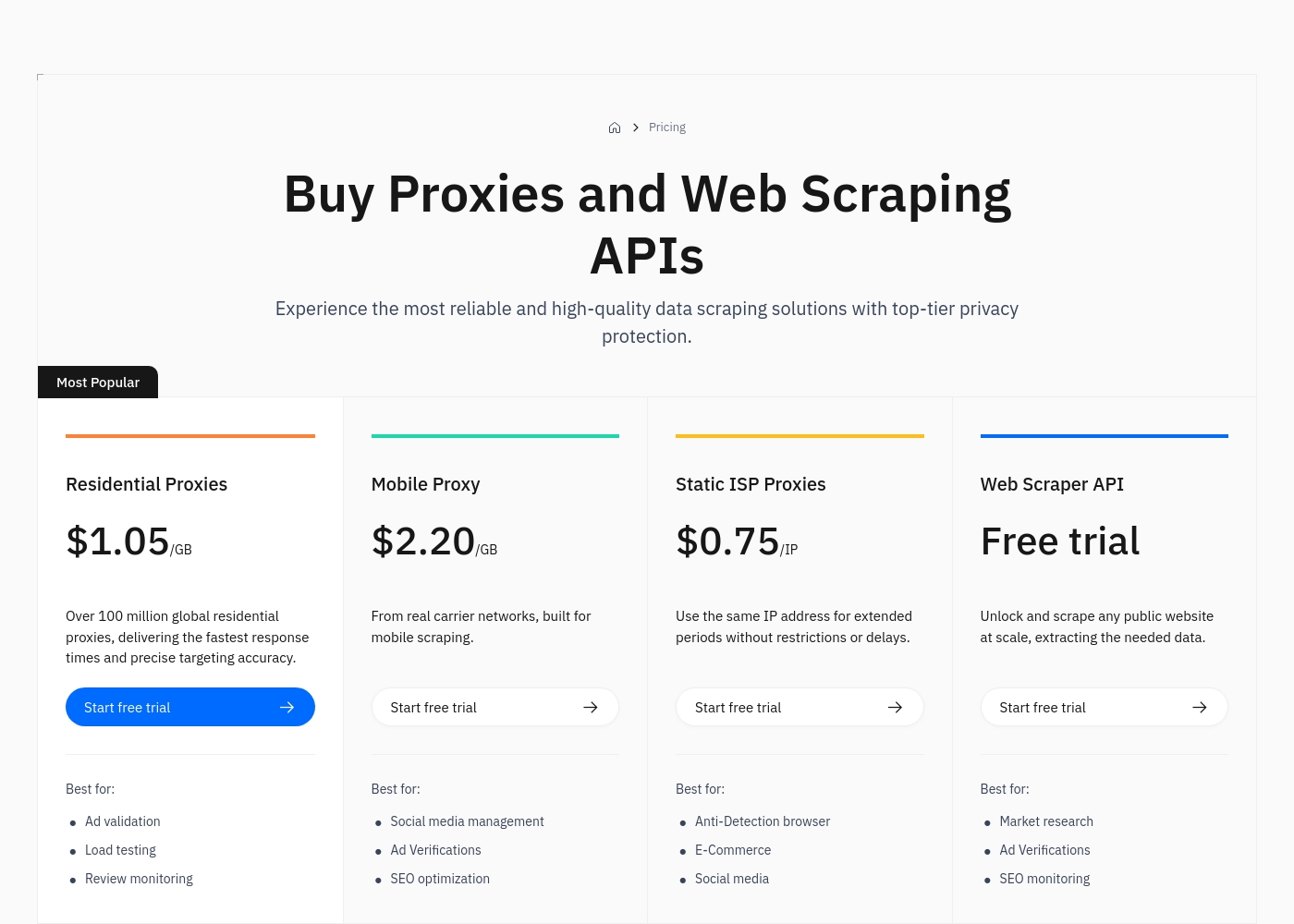
ThorData pricing: ThorData offers pay-as-you-go and trial-based plans for proxies and scraping APIs starting as low as $0.75 per IP or $1.05 per GB. Billing is usage-based or quantity-based depending on the specific proxy type you select for your data needs.
This allows you to pay for exactly what you need without high upfront costs or complex monthly commitments for the primary services listed on the pricing page. It's built for scale and flexibility right from the start.
You'll find options for residential, mobile, and static ISP proxies as well as a specialized Web Scraper API to handle complex public data extraction tasks without friction. The platform even offers free trial access across its main product lines to help you get started quickly and safely.
Pricing Head-to-Head
User Reviews
Semrush is widely recognized as a powerful platform tool, but external sentiment currently focuses heavily on operational dissatisfaction. Reviewers frequently describe the software as technically strong but cite pervasive transparency issues related to pricing and subscriptions.
Many users report feeling misled by the "free trial" structure, often citing automatic, unauthorized charges and significant difficulty canceling their subscriptions. The required cancellation process is often described as complicated, hidden, and sometimes 'illegal,' resulting in recurring charges, even for those who canceled minutes late.
I signed up for a free trial and was charged $139.95 automatically without clear consent or transparent terms of service disclosure. I feel completely misled and scammed by this company.
We were unable to access ThorData's Trustpilot or Capterra reviews for this analysis due to verification and access issues. ⚠️ Therefore, we cannot provide a balanced summary of external user sentiment regarding specific themes like accuracy, support, or value. Our assessment is based solely on the website's provided content and pricing structure.
Our Verdict
Semrush and ThorData aren't really competing tools. They solve different problems entirely. Semrush's superpower is its massive marketing database. It has 27 billion keywords and 43 trillion backlinks. This makes it unbeatable for SEO, content strategy, and competitive analysis. ThorData's superpower is its proxy network. It provides reliable access to websites for data scraping. You can target data from any country or city to avoid blocks. The deciding factor is your goal. If you need to improve your website's search rankings, Semrush is the tool. If you need to collect data from other websites, ThorData is the service. For most marketers and agencies, Semrush is the better choice. For developers and data scientists, ThorData is the right tool. It's that simple.
Frequently Asked Questions
Can I use Semrush for web scraping like ThorData?
No, Semrush is not designed for web scraping. It's an SEO and marketing platform that analyzes your own website and competitors. For web scraping and data collection, ThorData's proxy services are the right tool.
Is ThorData worth the extra cost over Semrush?
They serve different purposes. Semrush costs $117-499/month for marketing tools. ThorData costs $0.75/IP or $1.05/GB for data collection. You can't compare them directly.
Which tool is better for small teams: Semrush or ThorData?
Semrush's Pro plan works for small marketing teams. ThorData's pay-as-you-go model works for small development teams. Choose based on whether you need SEO tools or web scraping proxies.
Does Semrush have a free trial like ThorData?
Yes, Semrush offers a 7-day free trial for Pro and Guru plans. ThorData also offers free trial access to its main products. Both let you test before committing.
Can I migrate from Semrush to ThorData easily?
They're not interchangeable tools. You can't migrate from Semrush to ThorData because they serve different purposes. Semrush is for marketing analytics. ThorData is for web scraping infrastructure.
Which has better customer support: Semrush or ThorData?
Semrush's support is frequently criticized for being unresponsive. ThorData's support details are unclear. Neither has a strong reputation for customer service based on available data.
Ready to Choose?
Both tools have their strengths. Choose based on your specific needs.