Semrush vs SEOcrawl
Semrush and SEOcrawl are drastically different SEO platforms fighting for your attention. Semrush is the massive, 360-degree competitive intelligence powerhouse. SEOcrawl is a specialist focused entirely on maximizing Google Search Console data. If you need everything, pick Semrush, but if GSC limitations are your pain, check SEOcrawl.
Best for: Marketing agencies needing comprehensive competitive intelligence and PPC tools, Enterprises requiring an integrated platform for SEO, Content, Social, and Ads
Best for: Large websites consistently hitting the Google Search Console 1,000-row data export limit, SEO specialists prioritizing deep GSC data retention and analysis
Powerful data, challenging user experience.
We found Semrush to be an undeniably powerful, AI-driven platform for comprehensive competitive research and SEO strategy at scale. It offers immense infrastructure with vast keyword and backlink data, supporting advanced enterprise needs like dedicated API access. Overall, users must carefully navigate the automated subscription and cancellation requirements, as widespread billing issues severely detract from the software’s technical strength.
Pros
- AI-powered platform provides precise competitive insights.
- Massive database featuring 43 trillion backlinks and 27 billion keywords.
- Offers integrated toolkits for SEO, Content, Social, and Advertising.
- Suitable for large organizations; Business Plan includes API access.
Cons
- Widespread reports of hidden auto-renewal fees and unexpected charges.
- Cancellation process is intentionally complicated and difficult to find.
- Customer support is consistently reported as unresponsive and unhelpful.
- Fees are charged for adding every new website or project.
Strong GSC reporting; high risk involved.
We found SEOcrawl excels at transforming unwieldy Search Console data into effective business intelligence, notably by eliminating the frustrating 1000-row limit and providing superb visualization. Overall, while the core technology is strong, we must caution potential buyers regarding persistent, documented concerns about customer support reliability and subscription integrity.
Pros
- Eliminates the standard Google 1000-row data export limit.
- Provides excellent visualization and a simple UX/UI for deep GSC data.
- Automation features save time on keyword reporting and rank tracking.
- Supports usage up to 100 million clicks per month (Next Level plan).
Cons
- Reports of unreliable and non-existent customer support.
- Users claim packages were downgraded and promised features were reduced.
- High annual cost for features mainly derived from free GSC data.
- Severe concerns raised by users regarding founder trustworthiness and business ethics.
AboutSemrush
Semrush is the leading AI-Powered Marketing Platform trusted by the world’s leading brands. It provides specific toolkits for nearly every marketing task, from Local optimization to AI PR. It helps 10 million marketing professionals manage their digital strategy effectively. This platform is truly the growth engine for Enterprises, offering critical, actionable data backed by immense scale. ✅
AboutSEOcrawl
SEOcrawl is a powerful SEO solution recognized for its strength in Reporting and Business Intelligence. It functions as an interactive dashboard, designed specifically to help users maximize the utility of their Google Search Console data. This tool is built to accelerate analysis and bring simplicity to complex data sets. If you manage many projects or simply need quick, clear insights, SEOcrawl streamlines your entire workflow. 💡
Highlights
Feature Comparison
Features Overview
We highlight the main differences and pick a winner for each feature.
Scope and Toolset
Semrush is a massive 360-degree marketing solution; SEOcrawl is a GSC data specialist.
Semrush provides interconnected toolkits for SEO, PPC, Content, and Social Media. It leverages a massive dataset of 43 trillion backlinks for competitive analysis. Semrush gives you a complete view of your entire digital presence. SEOcrawl focuses strictly on maximizing Google Search Console (GSC) data utility. Its strength is reporting, visualization, and automation derived from your own traffic data. SEOcrawl does not include tools for content creation or social media. The difference is breadth versus specialized data depth using distinct data sources. Semrush provides external competitive intelligence you cannot find elsewhere. SEOcrawl provides deep internal site analysis. If you only need optimized GSC reports for client dashboards, SEOcrawl is enough. If you need keyword research or advanced gap analysis, choose Semrush.
GSC Data Limits
SEOcrawl eliminates the frustrating 1,000-row GSC export limit. Semrush does not.
Semrush provides position tracking and analytics using its proprietary data core. Users often still face the native GSC data limitations when pulling raw reports. Semrush focuses on its internal large-scale indexing. SEOcrawl’s primary value is removing the standard 1000-row GSC data export limit. You capture every single keyword and URL associated with your traffic. SEOcrawl provides massively improved data retention for long-term pattern analysis. If accessing the full, unfiltered query list from GSC is crucial, SEOcrawl is the winner. Semrush does not solve this specific Google limitation. Large e-commerce sites with huge keyword volume will find SEOcrawl immediately beneficial for comprehensive data access.
Competitive Research
Semrush is built for competitive analysis; SEOcrawl offers zero external research capabilities.
Semrush allows users to analyze any competitor's traffic, PPC ads, and keyword rankings. Its AI-powered engine uses 43 trillion backlinks for powerful gap analysis. Semrush is the definitive tool for competitive strategic planning. SEOcrawl works only with sites verified in your Google Search Console account. The tool cannot track or analyze external competitor sites whatsoever. It is strictly an internal analytical reporting tool. Semrush is fundamentally a surveillance tool used to audit and beat your rivals. SEOcrawl maximizes reporting on data you already own about your site's performance. This is the difference between offense and defense. Agencies rely on Semrush to win pitches by conducting detailed competitive audits on prospective clients' rivals.
Pricing Flexibility
Semrush provides monthly and annual billing; SEOcrawl enforces a strict annual commitment.
Semrush offers flexibility, allowing users to choose between monthly and annual subscription options. Annual billing saves users up to 17% compared to the month-to-month rate. Its tiered model is based on usage limits like keyword tracking volume. SEOcrawl requires a strict annual payment commitment across all three tiers, from €792 upwards. There are no monthly options available for users wanting shorter-term contracts. Pricing scales based on monthly click volume. The forced annual financial commitment for SEOcrawl represents a higher initial risk for users. Semrush offers a lower barrier to entry for cautious budgeters. If testing the tool for three months before committing is important, Semrush allows this easily through its monthly plans.
AI Functionality
Semrush integrates LLM tracking and AI toolkits. SEOcrawl focuses only on GSC data retrieval.
Semrush includes AI PR and AI SEO toolkits to track brand features by Large Language Models (LLMs). This helps marketers proactively optimize for the shift to AI Search. Semrush also provides AI insights within its massive data core. SEOcrawl's scope is limited to surfacing existing GSC data through advanced reporting. It does not provide any features related to content creation, optimization, or LLM visibility. It is strictly analytical. For future-proofing your content strategy against the rise of generative search, Semrush provides essential tools. SEOcrawl is not designed to handle these modern content challenges. Brands worried about SGE or direct LLM answers stealing traffic must use Semrush’s specialized tracking features.
Scalability (Projects)
SEOcrawl supports a massive 200 projects, while Semrush is capped at 40.
Semrush scales up to 40 projects in the highest Business plan tier. It prioritizes the depth of data and features within those 40 projects. The platform focuses on high-volume rank tracking (5,000 keywords daily). SEOcrawl supports up to 200 projects in its Next Level plan, ideal for white-label agencies. Its limits are based on overall traffic volume (100M clicks/month), not daily keyword queries. This is massive project capacity. For raw client site management and providing simple reports to numerous stakeholders, SEOcrawl offers greater volume. For integrated competitive strategy, Semrush's feature set still prevails. Agencies with many small, low-traffic sites needing only GSC reporting benefit hugely from SEOcrawl's project volume.
User Trust & Support
Both tools have widespread, severe complaints regarding support and ethical billing practices.
Semrush is frequently criticized for tricky billing, unexpected auto-renewal fees, and a complicated cancellation process. Support is often cited as unresponsive or unhelpful regarding resolving billing issues. Semrush's technical core is highly rated. SEOcrawl reviews raise serious concerns regarding founder reliability and subscription integrity. Users reported enterprise features were suddenly downgraded or removed without notice. Support is often described as non-existent. Despite the issues, Semrush is an enterprise staple with a higher rating, making its risk profile slightly lower. SEOcrawl's trust issues are potentially more severe regarding contract fulfillment. Potential buyers should budget carefully after the free trial for either Semrush or SEOcrawl due to high support friction.
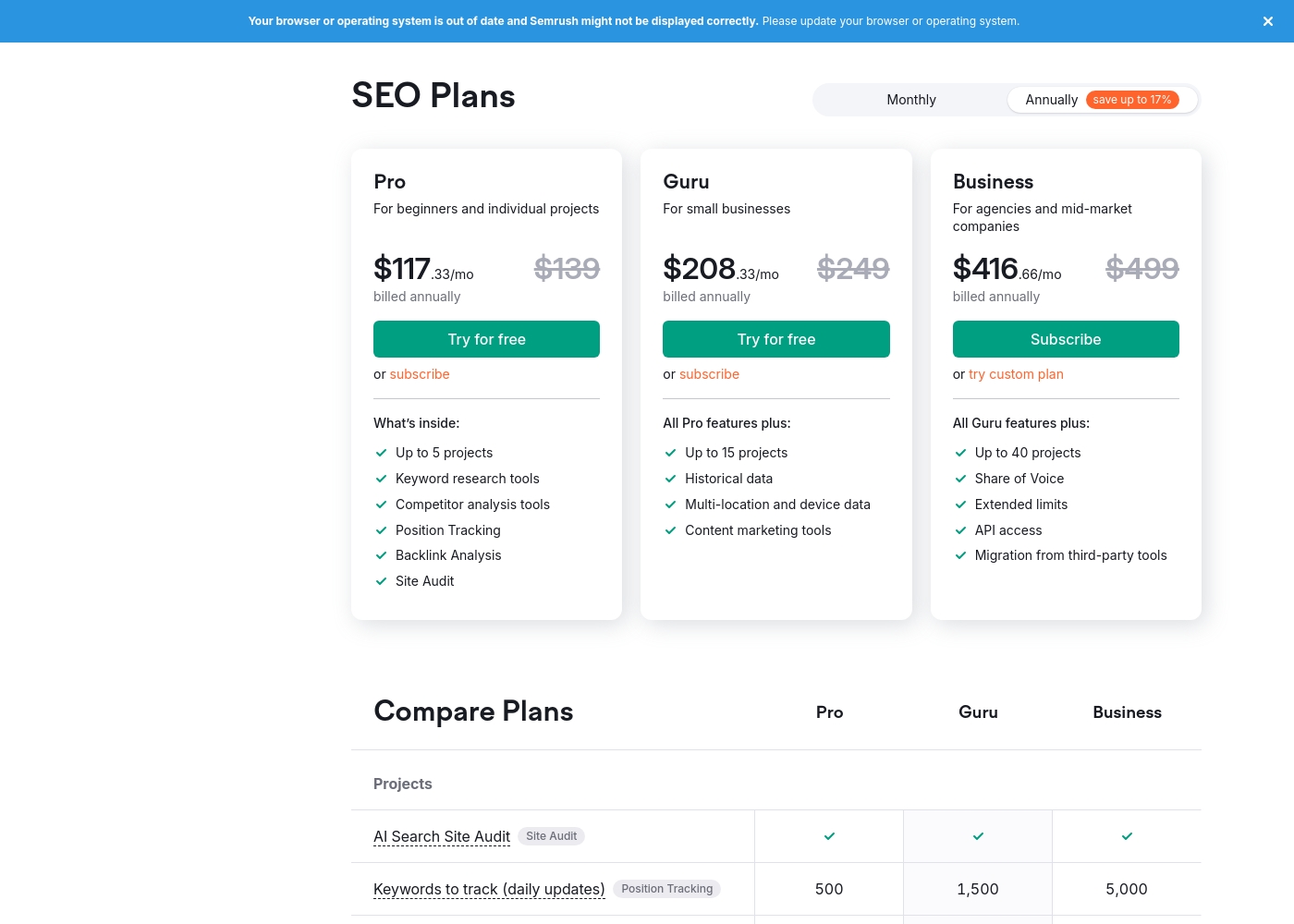
Semrush costs between $117.33 and $499 per month with three plans: Pro at $117.33, Guru at $208.33, and Business at $416.66, all based on annual billing.
Here is a detailed look at what is included in each of Semrush's three SEO plans.
Pro
Price: $117.33/mo billed annually ($139 monthly) Websites Supported: Up to 5 projects Best For: Beginners and individual projects Other Features: Keyword research tools, Backlink Analysis, 500 keywords tracked daily, Competitor analysis tools, Site Audit
- Up to 5 projects
- Keyword research tools
- Competitor analysis tools
- Position Tracking (500 keywords daily)
- Backlink Analysis
- All Pro features plus
- Up to 15 projects
- Historical data
- Multi-location and device data
- Content marketing tools
- All Guru features plus
- Up to 40 projects
- Share of Voice
- Extended limits
- API access
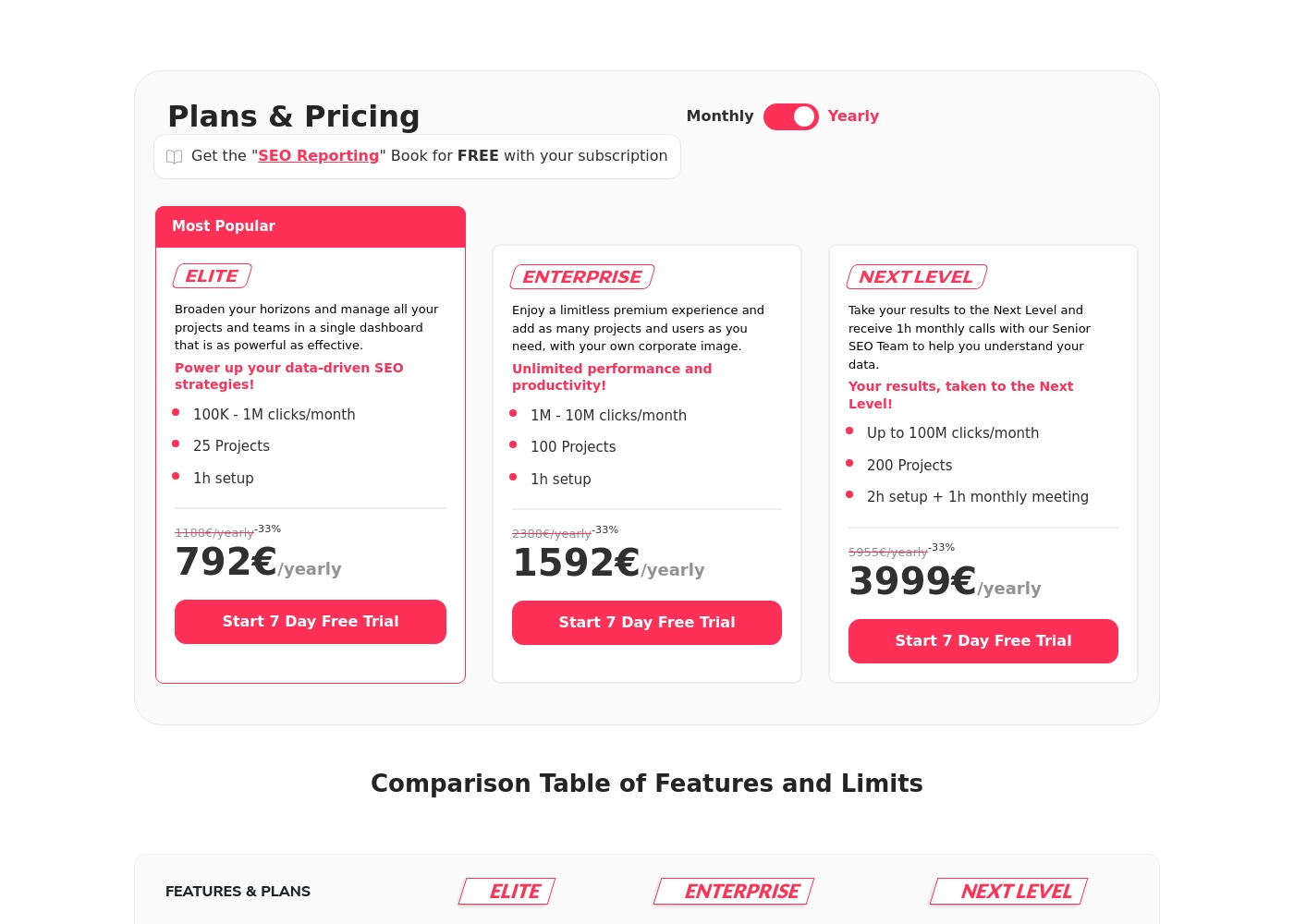
SEOcrawl costs between €792 and €3999 per year with three plans: Elite at €792, Enterprise at €1592, and Next Level at €3999.
Here’s a look at the features and limitations for each annual plan.
ELITE
Price: €792 yearly Websites Supported: 25 Projects Best For: Data-driven SEO strategies handling moderate traffic (100K–1M clicks/month). Other Features: 100K–1M clicks/month, 1h setup, Most Popular plan.
- 100K – 1M clicks/month
- 25 Projects
- 1h setup
- Most Popular
- 1M – 10M clicks/month
- 100 Projects
- 1h setup
- Corporate image customization
- Up to 100M clicks/month
- 200 Projects
- 2h setup
- 1h monthly meeting with Senior SEO Team
Pricing Notes
- Semrush offers monthly commitment options, while SEOcrawl demands a mandatory annual commitment for all tiers.
- Semrush pricing is USD-based and costs up to 17% more monthly than annually.
- SEOcrawl pricing is EUR-based and scales based on website click volume (up to 100M clicks/month).
- Users report widespread, severe issues with Semrush's billing/cancellation process and unexpected auto-renewals.
- Both Semrush and SEOcrawl offer a generous 7-day free trial on their paid plans.
Pricing Head-to-Head
User Reviews
Semrush is widely recognized as a powerful platform tool, but external sentiment currently focuses heavily on operational dissatisfaction. Reviewers frequently describe the software as technically strong but cite pervasive transparency issues related to pricing and subscriptions.
Many users report feeling misled by the "free trial" structure, often citing automatic, unauthorized charges and significant difficulty canceling their subscriptions. The required cancellation process is often described as complicated, hidden, and sometimes 'illegal,' resulting in recurring charges, even for those who canceled minutes late.
I signed up for a free trial and was charged $139.95 automatically without clear consent or transparent terms of service disclosure. I feel completely misled and scammed by this company.
The limited user feedback available for SEOcrawl is centered on significant issues regarding customer support, trust, and pricing integrity. While the platform is noted for its nice UX/UI and strong GSC data visualization, critical reviews raise serious concerns that overshadow these benefits.
Recurring themes include reports of poor customer service and responsiveness. Users detailed instances where promised features, such as unlimited sites for early adopters, were suddenly downgraded or limited (e.g., restricted to 25 sites) following product updates.
I purchased the top-tier plan because it promised unlimited sites and future updates for free. After they introduced Analytics integrations, the package was suddenly downgraded to only 25 sites. It feels like they simply ignored early adopters who trusted their initial promise.
Our Verdict
Semrush versus SEOcrawl is a comparison of breadth versus specialized depth. For the vast majority of marketers, Semrush is the better, safer choice overall. Semrush is the comprehensive powerhouse for 360-degree marketing strategy needs. Semrush's superpower is its massive data infrastructure and competitive intelligence toolkits. It tracks billions of keywords, critical for finding competitive gaps in any market. Semrush provides a single integrated solution for SEO, PPC, content marketing, and navigating the new AI search. You'll use Semrush to optimize nearly every facet of your digital marketing. SEOcrawl's superpower is its relentless focus on Google Search Console data mastery. It permanently eliminates the frustrating 1,000-row export limit, crucial for huge, high-traffic sites. SEOcrawl offers simple, beautiful visualizations and impressive high-volume project limits (up to 200 projects). The deciding factor is your need for internal reports versus external competitive data. If you need competitor intelligence on external sites, you must choose Semrush. If you primarily manage dozens of clients and prioritize GSC reporting capacity, SEOcrawl handles more projects. Be warned, both Semrush and SEOcrawl have documented issues with support and billing. Ultimately, Semrush wins for established value, feature integration, and established track record. Choose Semrush if you manage a full marketing strategy requiring keywords and PPC insights. Choose SEOcrawl only if your primary, unsolvable problem is the GSC data export limit.
Frequently Asked Questions
Which is better for competitive research: Semrush or SEOcrawl?
Semrush is explicitly designed for competitive research using its massive data core. SEOcrawl works only with your verified Google Search Console data. Semrush offers competitive insights on 43 trillion backlinks and 27 billion keywords.
Do I need Semrush if I only need to analyze Google Search Console data?
If GSC limits are your main pain point, SEOcrawl is a specialist that provides a better solution. SEOcrawl permanently removes the standard GSC 1,000-row data limit. Semrush focuses on its own vast data, not GSC filtering issues.
Which tool has a better pricing model: Semrush or SEOcrawl?
Semrush offers more flexibility, with both monthly and discounted annual billing options. SEOcrawl requires a mandatory, strict annual prepayment on all its plans. Both Semrush and SEOcrawl offer a 7-day free trial on their tiers.
Which tool is better for agencies managing large client volumes?
SEOcrawl excels at high project volume, supporting up to 200 projects in its top tier. Semrush is limited to 40 projects on its Business plan. Semrush offers integrated PPC and content tools crucial for agency deliverables.
Does SEOcrawl offer AI tools similar to Semrush?
No, SEOcrawl does not offer any explicit AI tools or LLM visibility tracking. Semrush uses AI insights in its core platform and features dedicated toolkits for AI content optimization. Semrush is better equipped for the AI search shift.
Are there trust issues or billing concerns with Semrush or SEOcrawl?
Yes, both Semrush and SEOcrawl face significant user dissatisfaction regarding support and transparency. Semrush users report complicated cancellations and unexpected fees. Before subscribing to either, check current user reviews carefully.
Ready to Choose?
Both tools have their strengths. Choose based on your specific needs.