Salesforce vs SmartSuite
People often compare these giants: the CRM king versus the workflow disruptor. Salesforce is the established enterprise solution for sales and service processes. SmartSuite offers no-code flexibility and organization-wide operations management. Choosing depends on if you need specialized industry depth or adaptable corporate workflows.
Best for: Enterprise organizations with 500+ employees requiring specialized, industry-specific solutions., Companies needing a deeply integrated, established CRM for Sales and Service teams.
Best for: Mid-market businesses needing a flexible, central work management platform., Teams looking to build customized workflow solutions without requiring developer resources (no-code).
Enterprise Power, Support Needs Fixing
We recognize Salesforce as a globally powerful, feature-rich platform offering expansive, industry-specific tools. However, feedback related to customer support, proprietary billing, and usability is substantially negative and concerning. Overall, the foundational product is essential for large enterprises, but the necessary customer service and contractual practices appear fundamentally broken for many users.
Pros
- Extensive, feature-rich platform capable of handling complex enterprise needs.
- Offers specialized products and industry-specific Cloud solutions.
- Strong ecosystem, community, and AppExchange support.
- Effective for complex data pulling and building detailed reports.
Cons
- Customer service and support are widely reported as nonexistent or abysmal.
- Billing practices are often described as predatory, inflexible, and costly.
- The software is cumbersome, time-consuming, and requires excessive clicks for daily tasks.
- Sales teams pressure long-term contracts (3+ years) and high annual price increases.
Configurable Workflow Hub for Teams
We found SmartSuite to be a powerful platform focused on boosting operational efficiency and organizational alignment. It offers deep customization, strong automation features, and clear tiered pricing, allowing teams to build flexible solutions without requiring coding expertise. Overall, this is a robust option for organizations moving beyond simple task management toward complex process workflow management.
Pros
- Deep process customization for highly tailored solutions.
- Powerful automation engine using triggers, AI, and webhooks.
- Flexible pricing structure that includes a permanent free tier.
- Extensive integration capability (20+ native, 6,000+ via Zapier).
Cons
- Paid plans require a minimum number of billable users, starting at three.
- Higher tiers can become substantially expensive for very large organizations.
- The vast array of features may present a steep initial learning curve.
- File storage limits are modest on lower-tier plans.
AboutSalesforce
Salesforce is a leading global software company recognized for providing integrated technology solutions. It helps businesses across many sectors, offering specific tools for Financial Services, Retail, Healthcare, and more.
This platform focuses on connecting proactively with customers, automating workflows, and unifying data. Importantly, Salesforce incorporates powerful AI agents like Agentforce to improve support, boost productivity, and drive business outcomes.
The system aims to give you a single, unified value chain approach. You can also leverage a strong ecosystem through the AppExchange for additional tools and partners.
AboutSmartSuite
SmartSuite is a powerful, flexible platform designed to streamline operations across your entire organization. It focuses on turning complex, siloed departmental work into integrated, manageable workflows.
Whether you’re handling compliance, managing IT tickets, or driving sales, SmartSuite allows teams to build customized solutions without requiring any dedicated coding. It’s built for businesses looking to gain speed, accountability, and essential visibility in handling their daily tasks. 💡
Highlights
Feature Comparison
Features Overview
We highlight the main differences and pick a winner for each feature.
Pricing Model & Value
SmartSuite uses transparent, tiered pricing; Salesforce requires custom quotes and high commitment.
Salesforce pricing is opaque, requiring a quote for specialized Cloud products. Most subscriptions demand annual contracts and advance payment yearly. This complexity makes planning extremely difficult and slow. SmartSuite offers clear, per-user pricing from a permanent free plan up to $45/user/month annually. You choose the tier that perfectly fits your functional needs and team size. The key difference lies in flexibility: SmartSuite scales affordably for the mid-market. Salesforce is designed exclusively for high-commitment enterprise budgets.
Workflow Automation
SmartSuite offers organization-wide process automation; Salesforce focuses on automation within sales and service clouds.
Salesforce emphasizes automating workflows to streamline core processes like sales cycles and customer service cases. Specialized AI agents, like Agentforce, handle routine tasks efficiently within the CRM structure. This primarily enhances specific, established functions. SmartSuite uses a powerful engine supporting triggers, webhooks, and AI to automate processes like IT escalations or GRC controls. It actively seeks to reduce manual work across your entire organizational portfolio. SmartSuite provides broader, no-code automation flexibility across more functional departments than the core clouds offered by Salesforce.
Enterprise Specialization
Salesforce delivers deep, pre-built industry specialization; SmartSuite provides flexible customization for specialized needs.
Salesforce excels with specialized, purpose-built tools for industries like Healthcare, Retail, and Financial Services. This specificity ensures high compliance and focused operational efficiency instantly. It offers a solution built precisely for your field. SmartSuite allows you to build customized solutions and sophisticated workflows for GRC, procurement, and other complex areas. You are building the specific solution you need without writing a single line of code. If deep, regulated industry functionality is required right away, Salesforce is the safer choice. For highly unique operational workflows, SmartSuite offers better building blocks.
Ecosystem & Integration
Salesforce connects via the massive AppExchange; SmartSuite is flexible and connects to 6,000+ apps via automation hubs.
Salesforce boasts the huge AppExchange, offering thousands of partner apps, components, and tools. This ecosystem provides deep functionality tied directly into the core CRM. It's a vast world of specialized add-ons. SmartSuite offers 20+ native integrations and connects to over 6,000 apps using tools like Zapier and Make. This extensive reach supports complex cross-platform workflows flawlessly. Integration is a core strength of the SmartSuite platform. Salesforce fosters deep, dedicated solution integrations, while SmartSuite offers universal connectivity through third-party automation tools.
Usability and UX
SmartSuite focuses on intuitive interfaces; Salesforce is often described by users as cumbersome and clunky.
Salesforce users frequently report that the software requires too many clicks and is burdensome for daily tasks. Front-line staff often find the complexity confusing and unintuitive to navigate. This slows down vital operations significantly. SmartSuite is designed for modern usability, allowing teams to build and manage tasks in flexible, visual solutions. The no-code approach makes system adoption simpler for most functional users. SmartSuite holds a clear edge in daily usability, especially for non-technical teams managing diverse operational workflows.
Customer Support
SmartSuite offers tiered support options; Salesforce support is consistently rated as "nonexistent" or "abysmal."
Salesforce users report agonizing experiences, struggling desperately to reach a human or receive help. The lack of responsive support is a major, consistent pain point mentioned across user reviews. Priority support resources are typically very unclear initially. SmartSuite provides Priority Support via email and chat access for Enterprise plans. Customers with 25+ users on annual plans also get a dedicated Customer Success Manager. SmartSuite's commitment to tiered, responsive help is vastly superior to the widely criticized customer service reported by Salesforce users.
Scalability
Salesforce is built for massive, complex enterprise needs; SmartSuite provides defined, scalable tiers for large organizations.
Salesforce is inherently designed to handle the massive scale of global Fortune 500 companies. Its architecture supports unlimited growth within specific enterprise commitments. It scales with rapid industry transformation. SmartSuite scales effectively up to the Enterprise plan and beyond via the custom Signature Plan designation. Its per-user model maintains cost predictability for large teams. Both scale well, but Salesforce is the established choice for unparalleled, highly regulated, global complex data management needs.
Platform Flexibility
SmartSuite provides deep, no-code configuration; Salesforce focuses on specialized product adoption.
SmartSuite allows users to build completely customized solutions—from IT incident tracking to HR onboarding—without dedicated coding skills. You build the system around your unique process. It supports any operational methodology your team employs. Salesforce delivers powerful, structured solutions via its Clouds (Sales, Service). Customization often relies on proprietary skills or AppExchange additions. You mostly adopt the system's inherent structure. For general operational flexibility across diverse non-CRM workflows, SmartSuite is distinctly more adaptable.
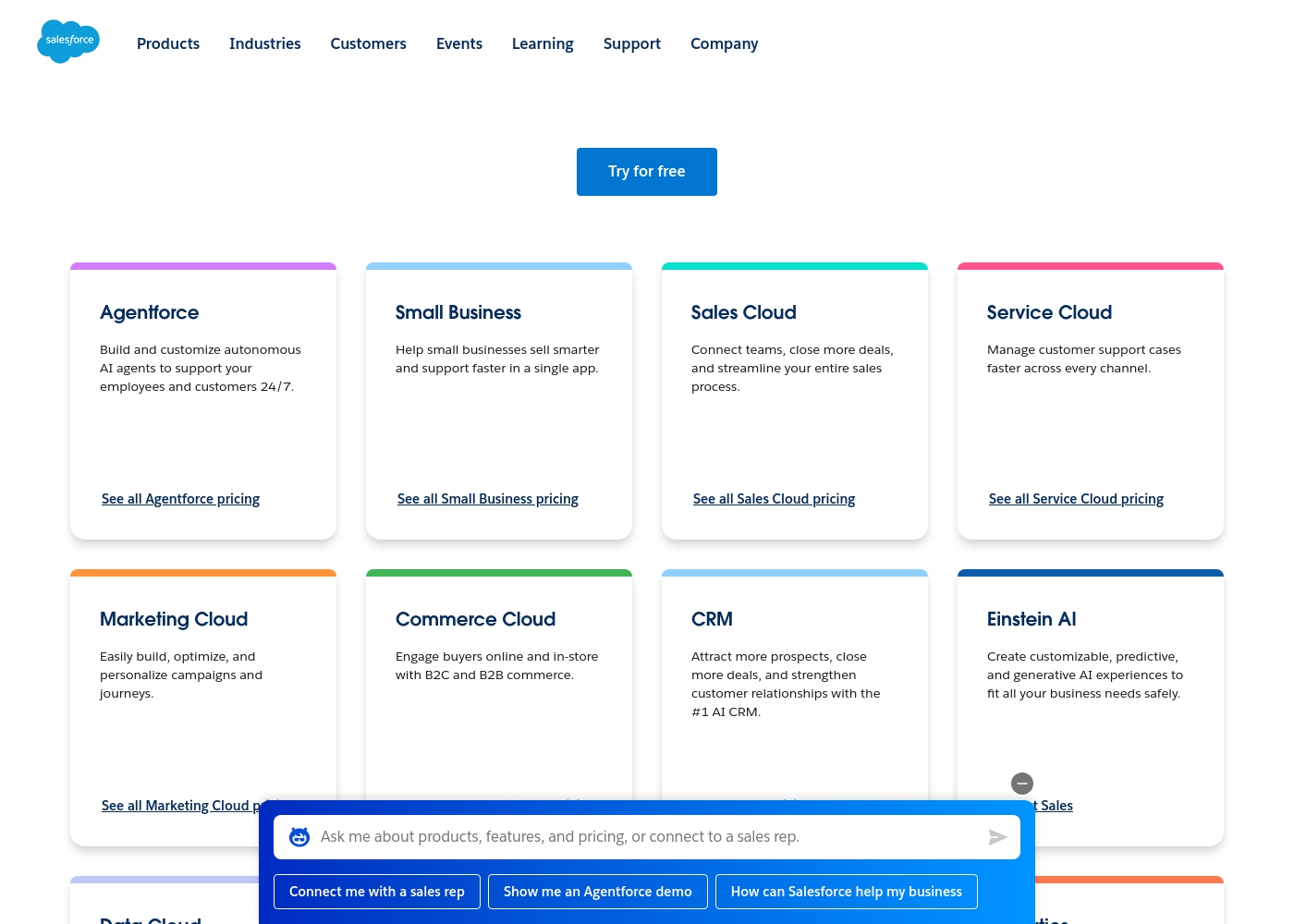
Salesforce pricing is determined on a quote-by-quote basis depending on the specific Cloud products chosen, such as Agentforce, Sales Cloud, and Marketing Cloud.
- Build and customize autonomous AI agents
- Support employees and customers 24/7
- Help small businesses sell smarter
- Faster support in a single app
- Connect sales teams and close more deals
- Streamline the entire sales process
- Manage customer support cases faster
- Manage support across every channel
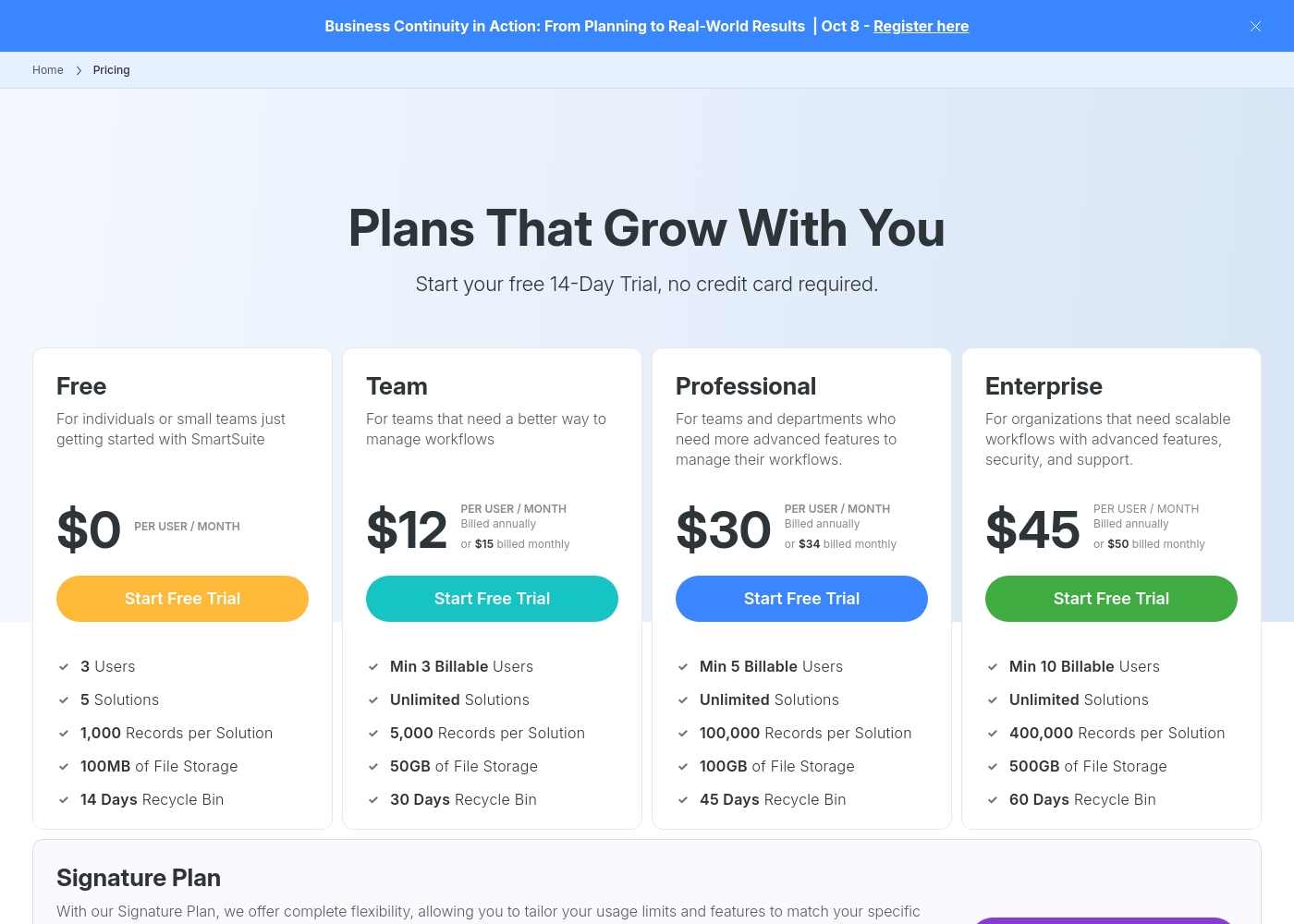
SmartSuite costs between $0 and $45 per user, per month with five plans: Free at $0, Team at $12 (annually), Professional at $30 (annually), Enterprise at $45 (annually), and the custom Signature Plan.
SmartSuite aims to simplify your decision by offering plans that truly grow with you.
Free
Price: $0 PER USER / MONTH Best For: Individuals or small teams just getting started with SmartSuite Other Features:
- 3 Users
- 5 Solutions
- 1,000 Records per Solution
- 100MB of File Storage
- 14 Days Recycle Bin
- 3 Users
- 5 Solutions
- 1,000 Records per Solution
- Min 3 Billable Users
- Unlimited Solutions
- 5,000 Records per Solution
- Min 5 Billable Users
- Unlimited Solutions
- 100,000 Records per Solution
- Min 10 Billable Users
- Unlimited Solutions
- 400,000 Records per Solution
Pricing Notes
- Salesforce almost exclusively uses annual contracts, paid yearly in advance, except for the flexible Salesforce Starter.
- SmartSuite offers a permanent free tier and clear monthly/annual per-user pricing across four published plans.
- SmartSuite paid plans require a minimum number of users (e.g., 3 for Team, 10 for Enterprise).
- Salesforce pricing is determined only by the specific blend of Cloud products and requires contacting sales for a quote.
- SmartSuite offers significant savings by choosing annual billing over their published monthly subscription rates.
Pricing Head-to-Head
User Reviews
User feedback on Salesforce is deeply polarized, leading to a very poor overall Trustpilot rating. While some users acknowledge the platform is a powerful tool with extensive features, the overwhelming sentiment focuses on severe issues with customer service and support responsiveness.
Users frequently describe support as "nonexistent" or "abysmal," reporting long waits, unhelpful automated systems, and difficulty reaching essential account managers. A significant pain point is the perceived lack of accountability and predatory billing practices; customers routinely mention inflexible contracts, mandatory annual price increases, and financial stress, especially for smaller businesses.
I strongly regret ever signing up with Salesforce. Their billing practices are predatory and completely inflexible, causing huge frustration and financial stress. I wish I had taken the time to read these reviews first.
We were unable to incorporate specific user reviews from Trustpilot or Capterra for this assessment. The provided inputs contained the necessary URLs but lacked concrete user snippets detailing external sentiment.
Consequently, this section cannot report on recurring themes regarding support responsiveness, data reliability, or the user experience with onboarding and integrations. We know that platforms like SmartSuite, which focus heavily on comprehensive workflow management and deep customization, often provide excellent structural power.
Our Verdict
This comparison pits established enterprise depth against modern flexibility. For most organizations, SmartSuite is the clear overall winner here. Your decision should rely heavily on where your functional needs lie. Salesforce's superpower is its sheer feature depth and specialized industry cloud solutions. If you are a global bank or hospital needing iron-clad, purpose-built CRM, Salesforce delivers. User reports frequently highlight painfully bad customer support and predatory, inflexible billing practices. SmartSuite's superpower is its no-code flexibility and organizational workflow coverage. You can efficiently manage IT, HR, GRC, and procurement all on this single, customizable platform. SmartSuite offers transparent pricing and a much better, modern user experience than the cumbersome Salesforce interface. The deciding factor is transparency versus complexity, and cost versus commitment. If your industry niche absolutely demands specialized compliance tools, you must choose Salesforce. If you are not a Fortune 500 company, SmartSuite provides superior value, better usability, and less contractual headache. SmartSuite wins for modern work management and mid-market growth.
Frequently Asked Questions
Which is better for small teams: Salesforce or SmartSuite?
SmartSuite is better for small teams due to its permanent free plan and clear tiered pricing. Salesforce requires complex quotes and typically demands high-commitment annual contracts. SmartSuite paid plans start with flexibility, requiring only three users.
Does SmartSuite have AI capabilities matching Agentforce in Salesforce?
Salesforce uses Agentforce AI specifically for customer support and productivity within its platform. SmartSuite’s powerful automation engine allows integration of AI and webhooks into custom workflows. SmartSuite offers broader AI process automation, while Salesforce offers specialized AI functions.
Is Salesforce much more difficult to use than SmartSuite?
Yes, Salesforce is described by many users as cumbersome and clunky for daily tasks. SmartSuite is designed as a modern, intuitive, no-code platform. Teams generally find SmartSuite easier to adopt and use for managing varied workflows.
Why is SmartSuite's pricing more transparent than Salesforce's?
SmartSuite clearly publishes its per-user pricing starting at $0, with defined limits for each paid tier. Salesforce utilizes a quote-based model, making it impossible to determine system costs without speaking to a sales representative.
Which tool offers better options for complex, organization-wide workflow management?
SmartSuite is built specifically for organization-wide workflow management, supporting GRC, IT, and Finance. Salesforce excels at standardized Sales and Service workflows. SmartSuite's no-code flexibility covers far more internal departments.
If I need industry-specific features, should I choose Salesforce or SmartSuite?
Choose Salesforce if you require deep, established industry-specific solutions like Healthcare Cloud or Financial Services. Salesforce provides pre-built compliance and vertical expertise. SmartSuite requires you to configure those specialized workflows yourself.
Ready to Choose?
Both tools have their strengths. Choose based on your specific needs.