Salesflare vs Salesforce
People often compare Salesflare and Salesforce, but they target wildly different buyers. Salesflare is designed for SMBs, focusing totally on usability and automation. Salesforce is the massive, feature-rich platform built for large enterprise complexity. We're breaking down who needs the power and who needs the simplicity first.
Best for: Small and medium B2B sales teams (SMBs), Teams prioritizing automatic data logging and enrichment
Best for: Global Enterprise organizations with 500+ employees, Companies requiring industry-specific solutions (Healthcare, Finserv, Retail)
Simple, Powerful CRM for B2B Success.
We note that Salesflare successfully delivers on its promise of simplifying CRM tasks through strong built-in automation features that cut down on administrative work. The overwhelmingly positive user feedback regarding reliability, ease of use, and speedy customer support increases our confidence in the platform's high value proposition. Overall, Salesflare is a well-priced, effective solution ideal for small and medium-sized B2B teams focused on streamlining follow-up and maximizing efficiency.
Pros
- Automated data input significantly cuts required administrative time.
- Customer support is highly responsive and tailors solutions to specific needs.
- The platform is reported as highly reliable, with users citing years without downtime.
- Simple interface that is deemed very easy to use for startups and small teams.
Cons
- The Enterprise plan requires a minimum commitment of five users to start.
Enterprise Power, Support Needs Fixing
We recognize Salesforce as a globally powerful, feature-rich platform offering expansive, industry-specific tools. However, feedback related to customer support, proprietary billing, and usability is substantially negative and concerning. Overall, the foundational product is essential for large enterprises, but the necessary customer service and contractual practices appear fundamentally broken for many users.
Pros
- Extensive, feature-rich platform capable of handling complex enterprise needs.
- Offers specialized products and industry-specific Cloud solutions.
- Strong ecosystem, community, and AppExchange support.
- Effective for complex data pulling and building detailed reports.
Cons
- Customer service and support are widely reported as nonexistent or abysmal.
- Billing practices are often described as predatory, inflexible, and costly.
- The software is cumbersome, time-consuming, and requires excessive clicks for daily tasks.
- Sales teams pressure long-term contracts (3+ years) and high annual price increases.
AboutSalesflare
Salesflare is an intelligent CRM built specifically for small and medium-sized businesses selling B2B. This platform is designed to be simple yet powerful, ensuring the whole sales team truly benefits from using it. It delivers higher sales results and happier customers by making tracking effortless. Salesflare has been adopted by over 10,000 companies to help them manage contacts and relationships better. ✨
AboutSalesforce
Salesforce is a leading global software company recognized for providing integrated technology solutions. It helps businesses across many sectors, offering specific tools for Financial Services, Retail, Healthcare, and more.
This platform focuses on connecting proactively with customers, automating workflows, and unifying data. Importantly, Salesforce incorporates powerful AI agents like Agentforce to improve support, boost productivity, and drive business outcomes.
The system aims to give you a single, unified value chain approach. You can also leverage a strong ecosystem through the AppExchange for additional tools and partners.
Highlights
Feature Comparison
Features Overview
We highlight the main differences and pick a winner for each feature.
Ease of Use & Adoption
Salesflare minimizes clicks for daily use; Salesforce is powerful but considered cumbersome.
Salesflare focuses on a friendly UI and semi-automatic data entry for a great experience. Setup takes just minutes, helping smaller teams adopt the CRM quickly. Salesforce, while highly customizable, often requires excessive clicks for front-line reps during daily tasks. Users find Salesforce slow and unintuitive for getting core tasks done efficiently. Salesflare avoids friction, making it a CRM your whole team will actually use daily. This operational simplicity is a huge advantage for smaller teams.
Data Automation & Enrichment
Salesflare automatically enriches lead data; Salesforce focuses more on complex reporting.
Salesflare excels at automation, using semi-automatic data filling to keep records current. This native enrichment reduces administrative time for every single sales rep. Salesforce is superb for building detailed reports and pulling complex data sets accurately. However, users must often input or maintain data manually within Salesforce for specific fields. Salesflare helps eliminate copy-paste and keeps data reliable with less intervention. Both tools value data, but Salesflare proactively cleans it up for you.
Customer Service
Salesflare has positive support feedback; Salesforce customers widely report service as abysmal.
Salesflare reviews praise fast response times from their helpful, reliable email support team. Users find their service flexible and focused on finding solutions quickly. Salesforce receives shocking feedback regarding nonexistent support once the contract is signed. Users report being unable to reach a human and dealing with high frustration. This massive difference in customer support reliability is a critical deciding factor. Salesflare offers personal attention, while Salesforce offers frustrating automation.
Scalability & Depth
Salesforce handles global enterprise complexity; Salesflare is optimized for SMB sales processes.
Salesforce is the platform foundational to global, complex enterprise organizations, handling thousands of users. It offers specialized Cloud solutions for industries like Healthcare and Financial Services. Salesflare is powerful but optimized for small to medium B2B teams and general sales complexity. It lacks the dedicated vertical solutions of its massive competitor. If you need a fully customized system for 500+ employees, only Salesforce can provide that inherent depth. Salesflare is robust up to the mid-market level and focuses on speed, not infinite complexity.
Ecosystem and API
Salesforce has the AppExchange giant; Salesflare has strong, direct core integrations.
Salesflare directly integrates with daily communication tools like Gmail, Outlook, and LinkedIn using native features. These focused integrations cut down manual work significantly for sales reps. Salesforce boasts the massive AppExchange, offering thousands of partner apps, specialized integrations, and developer tools. If you need connections to esoteric legacy systems or expansive third-party data, Salesforce is better equipped. Salesflare covers necessary outreach tools; Salesforce covers virtually everything else imaginable.
Pricing Model & Commitment
Salesflare offers clear, flexible monthly terms; Salesforce enforces high-cost, multi-year annual contracts.
Salesflare uses transparent, tiered per-user pricing, allowing monthly or annual subscription choices. You can easily adjust plans and add flexible lead credits as needed. Salesforce typically demands annual contracts, paid yearly in advance, often pushing customers toward three-year commitments. Users often report inflexible deals and mandatory annual price hikes from Salesforce. Salesflare delivers predictability and lower barriers to entry; Salesforce demands significant long-term financial allegiance.
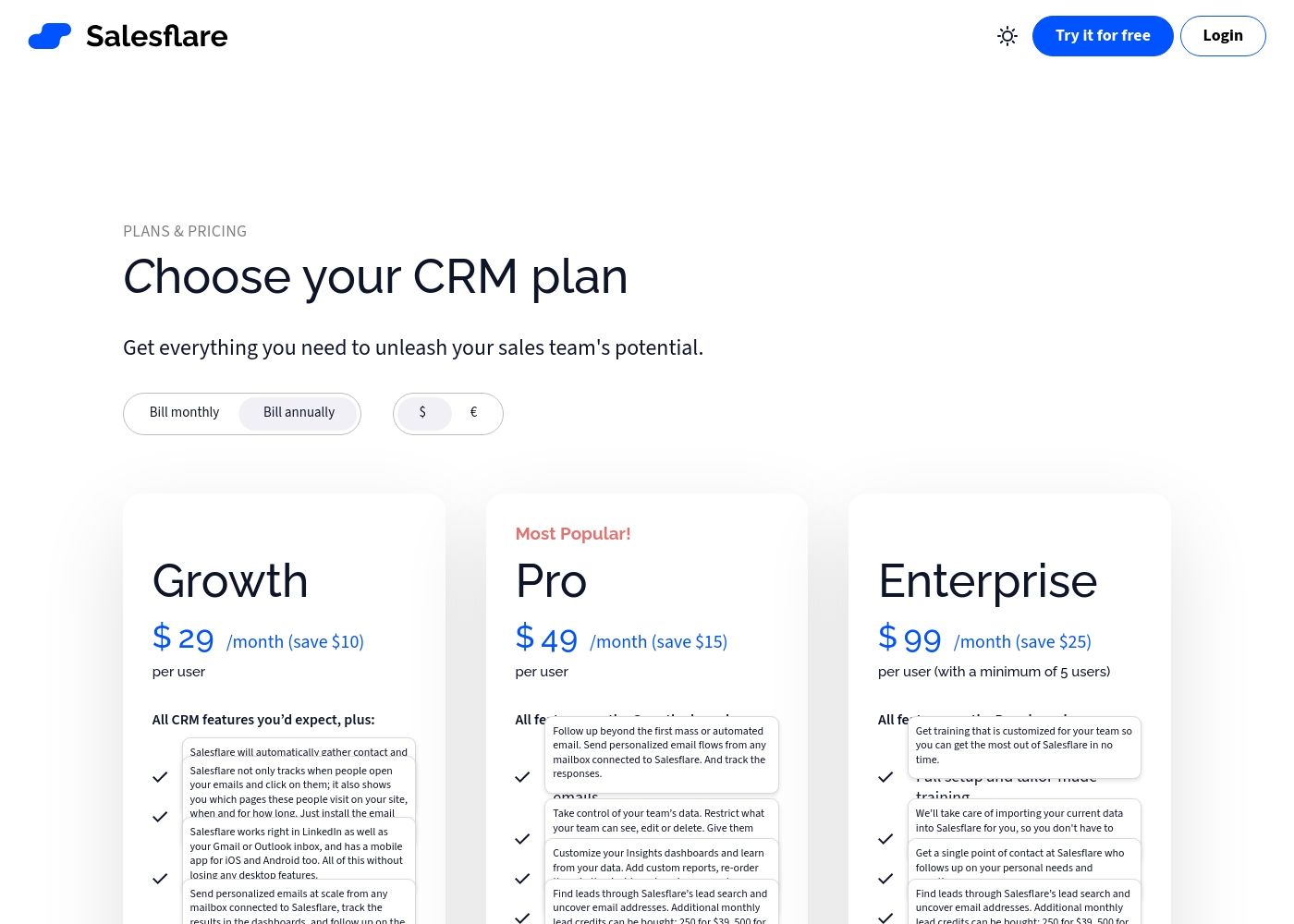
Salesflare costs between $29 and $99 per user per month (billed annually) with three plans: Growth at $29/month, Pro at $49/month, and Enterprise at $99/month.
Now, let's look closer at the features included in each option, focusing on the USD annual rates.
Growth
Price: $29/user/month (Billed Annually) Best For: Teams starting out with sales automation and core CRM needs Other Features:
- Automatic contact and company data input
- Email, link, and website visit tracking
- LinkedIn sidebar and mobile app access
- Send personalized email campaigns
- 5 lead credits included monthly
- Automated CRM data input
- Track emails, links and website visits
- LinkedIn sidebar, email sidebar & mobile app access
- Send personalized email campaigns
- All features on the Growth plan
- Send workflows of multiple emails (email flows)
- Set user permissions and access controls
- Create custom dashboards
- All features on the Pro plan
- Full setup and tailor-made training
- Data migration done for you
- Dedicated account manager
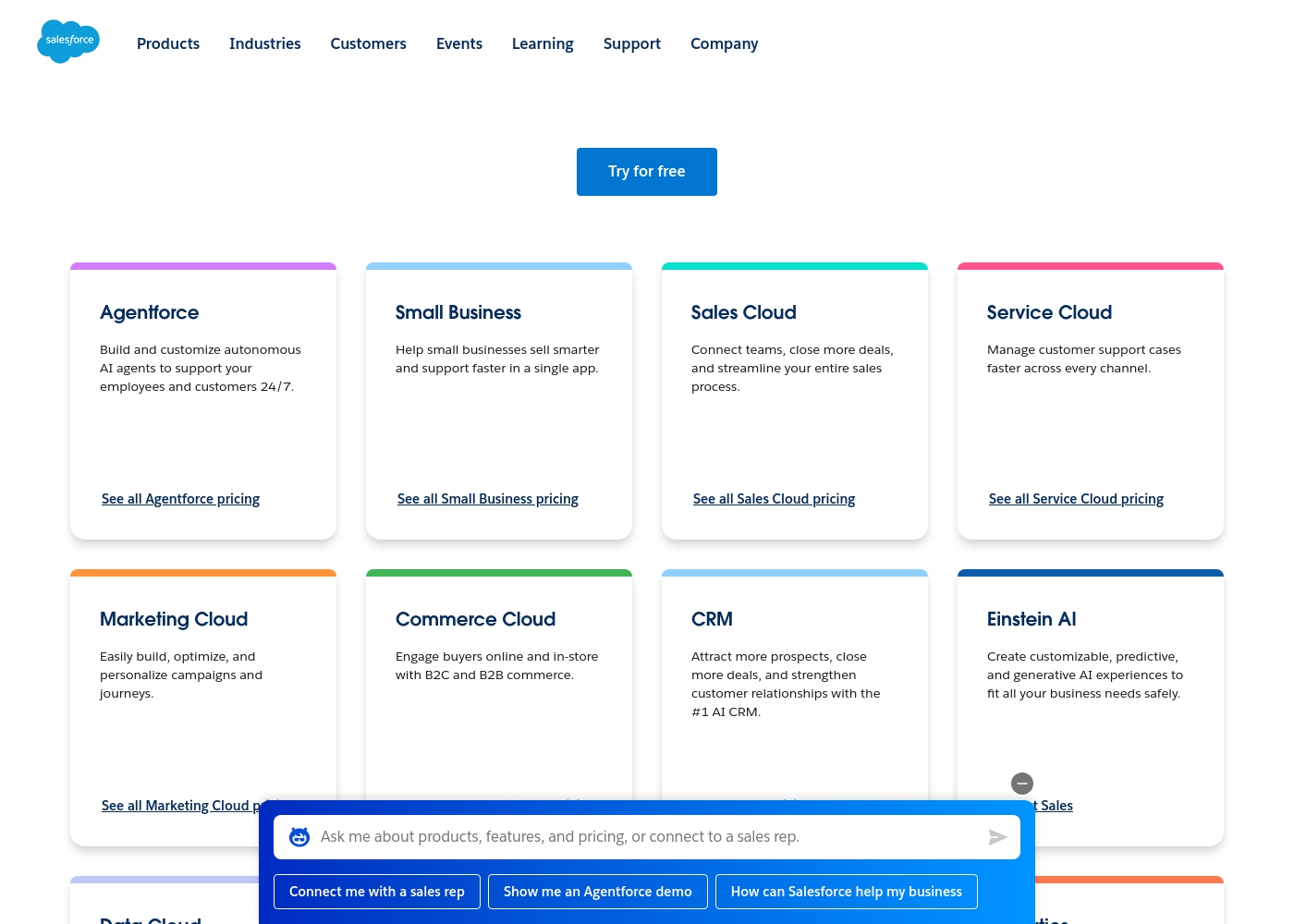
Salesforce pricing is determined on a quote-by-quote basis depending on the specific Cloud products chosen, such as Agentforce, Sales Cloud, and Marketing Cloud.
- Build and customize autonomous AI agents
- Support employees and customers 24/7
- Help small businesses sell smarter
- Faster support in a single app
- Connect sales teams and close more deals
- Streamline the entire sales process
- Manage customer support cases faster
- Manage support across every channel
Pricing Notes
- Salesflare offers flexible, transparent monthly billing and a robust 30-day free trial.
- Salesforce requires custom quotes, and standard contracts are annual commitments paid in advance.
- Users frequently report predatory billing practices and mandated price increases from Salesforce.
- Salesflare costs are based on clear tiers (Growth, Pro, Enterprise); Salesforce blends specific Cloud products (Sales Cloud, Service Cloud).
Pricing Head-to-Head
User Reviews
Salesflare earns exceptionally positive feedback, primarily highlighting its suitability for B2B sales and startups. Users frequently praise the platform's reliability, with some noting they have used it for years “without downtime.” A strong recurring theme is the excellent customer service; the team is described as responsive, accessible, and willing to adjust the product based on user input, ensuring the CRM meets unique business needs.
Users call Salesflare easy to use, intuitive, and a “Flawless CRM.” Its ability to automate data input, manage flexible pipelines, and run effective email campaigns is consistently highlighted as adding significant value. Furthermore, users recognize the pricing as reasonable, offering strong capabilities for the cost.
This is the best CRM for small businesses and startups. The product is great and very easy to use. I also appreciate that the Salesflare team is small and easily accessible.
User feedback on Salesforce is deeply polarized, leading to a very poor overall Trustpilot rating. While some users acknowledge the platform is a powerful tool with extensive features, the overwhelming sentiment focuses on severe issues with customer service and support responsiveness.
Users frequently describe support as "nonexistent" or "abysmal," reporting long waits, unhelpful automated systems, and difficulty reaching essential account managers. A significant pain point is the perceived lack of accountability and predatory billing practices; customers routinely mention inflexible contracts, mandatory annual price increases, and financial stress, especially for smaller businesses.
I strongly regret ever signing up with Salesforce. Their billing practices are predatory and completely inflexible, causing huge frustration and financial stress. I wish I had taken the time to read these reviews first.
Our Verdict
This comparison is a classic battle between focused usability and massive enterprise power. If you prioritize ease of use and immediate value, Salesflare is the clear winner for your team. Salesforce remains the classic champion of complex, massive enterprise infrastructure and limitless scalability. Salesflare’s superpower is making manual CRM data entry tasks disappear automatically. It tracks interactions and integrates natively with Gmail, Outlook, and LinkedIn, killing copy-paste fatigue. Small and mid-sized teams adore Salesflare because it’s simple, intuitive, and actually gets used daily. Salesflare consistently provides a healthier user experience than Salesforce. Salesforce’s superpower is its sheer depth and critical industry specialization. It offers crucial specialized Clouds for Financial Services, Retail, or Healthcare enterprises. Salesforce allows global organizations to unify all business data for a single value chain. If you require advanced reporting and a massive ecosystem via AppExchange, Salesforce delivers unmatched complexity. The deciding factor boils down to your complexity versus your tolerance for administrative friction. If your team is under 100 people and values a positive user experience, choose Salesflare immediately. But if you are a large, global entity needing unparalleled custom infrastructure, you must endure the complexity of Salesforce. Your final verdict depends on your stage. Salesflare offers excellent value, transparency, and superior support for growth-focused SMBs. Salesforce is non-negotiable for organizations needing industrial-grade infrastructure and mandatory expansion.
Frequently Asked Questions
Which is better for small B2B teams: Salesflare or Salesforce?
Salesflare is explicitly designed for small and medium B2B teams seeking ease of use. It focuses on automatic tracking and integrates smoothly with tools like LinkedIn and Gmail. Salesforce is built for enterprise complexity, requiring excessive clicks for small team daily use.
Does Salesflare integrate with LinkedIn like Salesforce?
Yes, Salesflare features strong, native integrations with LinkedIn, Gmail, and Outlook. It offers sidebar functionality to cut down on manual data entry or copying. Salesforce integration for these tools often depends on specific Cloud products or the large AppExchange.
Is Salesforce worth the extra cost and complexity over Salesflare?
Salesforce is worth the cost only if you require its immense scalability and industry-specific feature depth. For most standard sales tracking, Salesflare offers superior value for money and a clear, flexible pricing model. Salesforce is an investment in massive, future-proof infrastructure.
How do the pricing models of Salesflare and Salesforce differ?
Salesflare offers transparent, tiered per-user pricing with monthly or annual options and usage-based lead credits. Salesforce pricing is customized, requires a complex quote, and subscriptions are usually mandated annual commitments paid in advance.
Who has better tools for automated data enrichment: Salesflare or Salesforce?
Salesflare is built around semi-automatic data filling and enrichment to keep lead records current. Getting clean, enriched data requires significantly less manual effort in Salesflare. Salesforce focuses more on reporting and leveraging data once it is already secured in the system.
How does customer support compare between Salesflare and Salesforce?
Salesflare receives strong positive feedback for fast response times and helpful, dependable support quality. Salesforce users frequently report their support system is non-existent, unresponsive, and generally abysmal.
Ready to Choose?
Both tools have their strengths. Choose based on your specific needs.