Quadient vs Voye Global
Quadient and Voye Global serve very different business needs. Quadient focuses on automating financial workflows and customer communications. Voye Global is all about managing global eSIM connectivity for travelling teams. It's a classic case of apples versus oranges.
Best for: Enterprise finance teams automating AP and AR workflows, Customer communications managers handling omnichannel document delivery
Best for: Companies with travelling sales or consulting teams, Operations managers seeking to control global roaming costs
Powerful automation, but support concerns us.
We find Quadient offers robust tools for automating AP/AR and managing customer communications at scale. However, persistent user complaints about customer support and contract flexibility temper our recommendation. Overall, it's a capable suite for larger enterprises, but smaller teams should proceed with caution.
Pros
- Automates end-to-end AP and AR workflows.
- Strong omnichannel document creation and delivery.
- Empowers business users, reducing IT dependency.
- Scales well for high-volume, complex needs.
Cons
- Significant concerns about customer service and support responsiveness.
- Contracts and billing terms can be rigid or difficult.
- May be too complex or costly for small businesses.
- Onboarding and integration can present challenges.
Automated global connectivity, managed simply.
We find Voye Global to be a robust solution for businesses with travelling teams seeking to centralize and automate eSIM management. Overall, it effectively reduces roaming costs and administrative overhead, though the usage-based pricing model lacks public transparency.
Pros
- Automated eSIM deployment and management for the entire team.
- Significant potential for cost savings (50-90% vs. traditional roaming).
- Centralized dashboard for real-time usage monitoring and control.
- Simple employee experience with one-time eSIM installation.
Cons
- Specific per-gigabyte pricing is not publicly listed.
- Requires contacting sales for setup, which may slow initial onboarding.
- No free trial or money-back guarantee is mentioned.
AboutQuadient
Quadient is a suite of process automation solutions focused on two core areas: customer communications management (CCM) and financial workflow automation. It's designed for mid-to-large enterprises that need to design, manage, and deliver personalized documents and messages across digital, print, and mobile channels, while also automating key AP and AR processes. 💡
AboutVoye Global
Voye Global is an enterprise-grade eSIM management platform. 🌐 It gives businesses a single system to deploy, monitor, and control global connectivity for all travelling employees and devices. Think of it as a central command center for keeping your team connected across 141+ countries, with one contract and full visibility into usage and spend.
Highlights
Feature Comparison
Features Overview
We highlight the main differences and pick a winner for each feature.
Core Automation
Quadient automates complex financial and document workflows. Voye Global automates eSIM deployment and connectivity for travellers.
Quadient provides end-to-end automation for accounts payable, accounts receivable, and omnichannel document delivery. It's designed to eliminate manual bottlenecks in financial processes. Voye Global automates the provisioning, assignment, and management of eSIMs for an entire travelling workforce. The goal is to remove the administrative hassle of arranging connectivity per trip. The key difference is the domain. Quadient tackles internal business process automation, while Voye Global tackles external logistics and connectivity. For example, a finance team uses Quadient to process 1,000 invoices automatically. A travel manager uses Voye Global to connect 50 salespeople across 20 countries seamlessly.
Cost Control & Savings
Quadient claims efficiency gains. Voye Global promises direct, measurable roaming cost reductions.
Quadient's value comes from reducing manual labor, errors, and cycle times in AP/AR. Savings are realized through operational efficiency and faster cash cycles. Voye Global explicitly advertises saving 50-90% compared to traditional carrier roaming. Its usage-based model lets you pay only for data consumed, with no upfront bundles. The trade-off is predictability vs. direct savings. Quadient's pricing is custom and opaque. Voye's final cost depends on actual data usage. A company spending $20,000/month on roaming could see savings with Voye. A company with high overtime in its AP department could save with Quadient.
User Experience
Both aim to simplify their respective tasks, but for very different users.
Quadient is designed to empower business users to create templates and manage workflows without IT help. However, implementations are described as complex with a learning curve. Voye Global emphasizes a one-time, simple eSIM installation for employees. The central dashboard is praised for its ease of use by operations managers. The difference lies in the task complexity. Managing financial workflows is inherently more complex than setting up a mobile connection. A marketing manager learns to use Quadient's template editor. A travelling consultant simply installs an eSIM profile once.
Scalability
Both platforms are built to scale, but for different types of growth.
Quadient is built for high-volume, complex enterprise needs, powering over 2 trillion connections annually. It scales with increasing document volumes and user counts. Voye Global scales by adding more users and devices to its eSIM management platform. It's designed for enterprise mobility and fleet management at scale. The scaling challenges are different. Quadient must handle increasing workflow complexity. Voye Global must manage more concurrent connections across more countries. A growing corporation adds 500 new employees to its AP workflow on Quadient. A global consulting firm adds 200 new travellers to its Voye Global dashboard.
Vendor Reliability
Both have strong enterprise positioning, but customer sentiment differs.
Quadient is recognized by analysts like Gartner as a leader. However, Trustpilot reviews consistently cite poor customer service and rigid contracts as major pain points. Voye Global receives positive user reviews for its simplicity and cost savings. Some note a lack of pricing transparency and occasional support delays. The data suggests Quadient's product may be robust but its support is a concern. Voye's product is well-liked but less proven at massive scale. A user might choose Quadient despite support fears for its specific automation features. Another might choose Voye for its proven savings and positive user sentiment.
Implementation & Onboarding
Quadient implementation is complex and resource-heavy. Voye Global has a simpler, structured onboarding process.
For Quadient, external reviews suggest onboarding can be challenging, requiring significant internal resources and planning. Integration isn't always straightforward. Voye Global lists a clear 5-step onboarding process: subscribe, add users, assign eSIMs, set policies, and monitor. It's designed to be streamlined. The difference is in the complexity of the system being deployed. Integrating financial automation is a bigger project than rolling out a connectivity solution. A company expects a 3-month implementation for Quadient with dedicated IT help. A company expects a 1-week rollout for Voye Global with just admin setup.
Quadient pricing: Quadient AP by Beanworks uses a custom pricing model based on your specific workflow and needs. They offer feature-specific packages for purchase orders, invoices, and expenses to ensure you only pay for what you use.
All plans include unlimited users and standard support, with the option to upgrade for faster response times or more entities. This tailored approach allows the platform to scale with your business while removing the burden of manual AP processes once and for all.
Contact them for a personalized quote today and discover how much you could save by automating your business's workflows. Their team of experts is ready to help you find the perfect solution for your accounts payable needs, whether you're a small business or a large corporation.
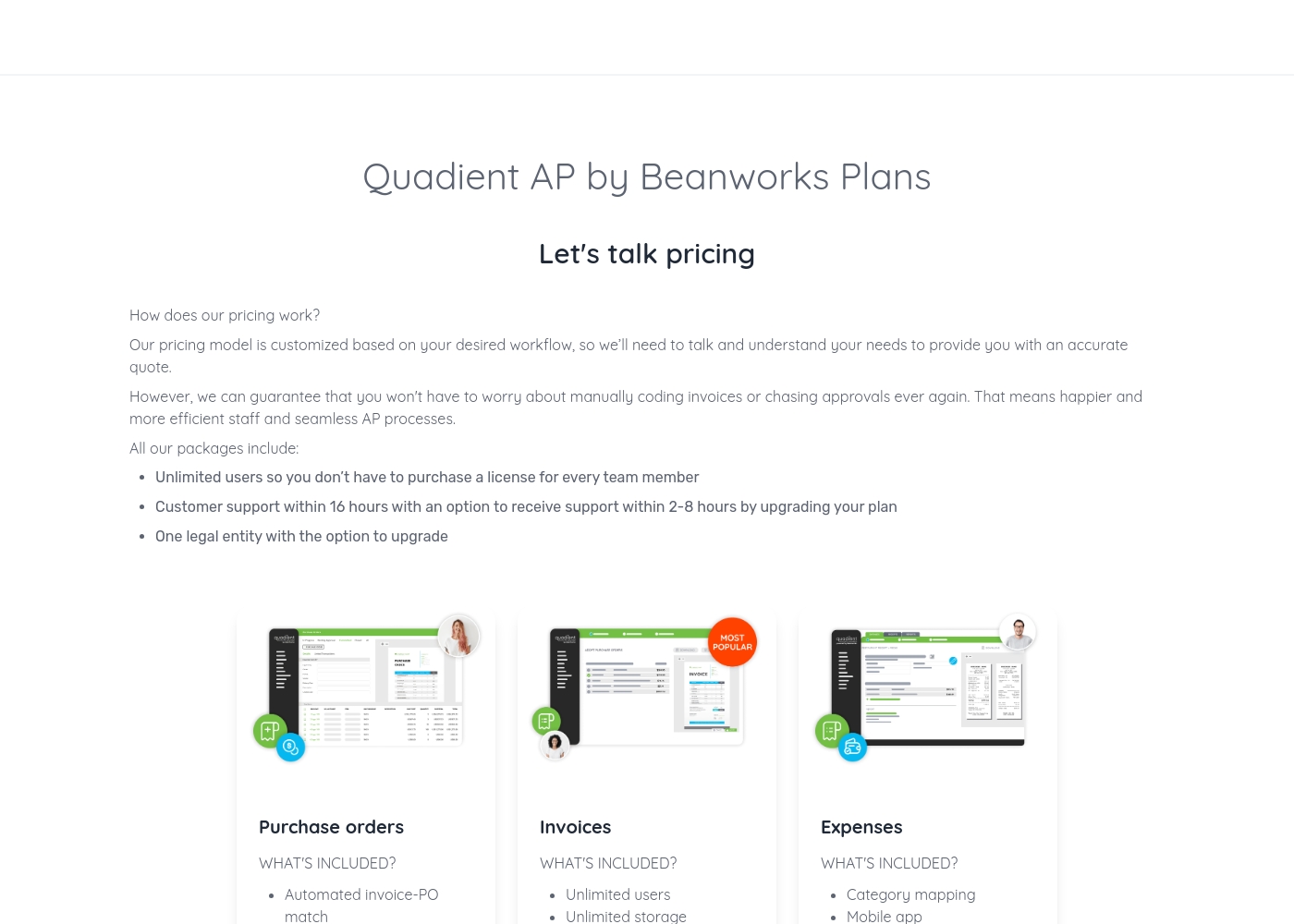
Take a look at the plan structure below for your team.
Company Plan
Best For: Remote teams, travelling employees, and operations managers Other Features: Centralized dashboard, automated eSIM deployment, real-time usage alerts, custom data limits, coverage in 141+ countries
This plan is ideal for businesses that want to ditch the hassle of manual roaming arrangements. It's a great fit if you need full visibility and the ability to control data usage for your team from one spot 🌍.
- Automated eSIM deployment
- Centralized management dashboard
- Custom usage limits and quotas
- Real-time usage alerts
- Coverage in 141+ countries
Pricing Notes
- Quadient AP pricing is custom and based on your specific workflow packages. All plans include unlimited users.
- Voye Global is usage-based; you pay only for data consumed with no prepaid bundles required.
- Neither platform offers a free trial or money-back guarantee based on public information.
- Quadient's pricing model is opaque, requiring sales contact. Voye's specific per-GB rates are also not public.
- Contract flexibility is a reported issue for Quadient, while Voye emphasizes no upfront commitments.
Pricing Head-to-Head
User Reviews
External reviews for Quadient are mixed. On Trustpilot, users frequently complain about poor customer service, slow support, and billing issues, creating a frustrating experience.
💔 Some mention difficult contracts and a lack of responsiveness. However, on Capterra, the limited feedback for the Impress platform is more positive, with a user praising its document creation capabilities and template management as highly important features.
The software itself might work, but the customer service is a nightmare. Getting any help or a simple question answered takes forever. We've wasted so much time trying to get support.
Voye Global receives positive feedback from users who highlight its simplicity and cost savings. Users frequently praise the platform's ease of use and automated eSIM deployment, which eliminates the hassle of managing multiple carrier plans.
🌍 Recurring themes include the significant reduction in roaming expenses compared to traditional options and the convenience of a single dashboard for managing global connectivity. However, some reviews note that the lack of publicly listed pricing can make initial evaluation challenging, and a few users mention occasional delays in customer support response times.
The platform is incredibly easy to use. We set up rules once, and it just works for our team travelling worldwide. Customer support has been responsive whenever we had questions.
Our Verdict
Quadient and Voye Global aren't really competitors. They solve completely different problems. Quadient's superpower is deep workflow automation. It excels at streamlining accounts payable, receivable, and complex customer communications for large enterprises. Voye Global's superpower is simple global connectivity. It eliminates the hassle of managing eSIMs for travelling teams and slashes roaming costs by up to 90%. The deciding factor isn't which is better, but which problem you have. Do you need to automate financial processes and documents? Or do you need to connect travelling employees affordably? Choose Quadient if you're an enterprise tackling manual financial workflows or omnichannel messaging. Choose Voye Global if you manage a team that travels internationally and you're tired of roaming bills and logistics.
Frequently Asked Questions
Which is better for small teams: Quadient or Voye Global?
Voye Global might be simpler for a small travelling team. Quadient's complex automation is likely overkill and too costly for small businesses with simple needs.
Does Quadient have eSIM management like Voye Global?
No. Quadient focuses on customer communications and financial workflow automation. It does not offer eSIM or mobile connectivity management.
Is Voye Global worth the extra cost over a traditional carrier?
Voye Global claims 50-90% savings compared to carrier roaming. For businesses with frequent travellers, the potential savings and administrative ease often justify the usage-based cost.
Can I use Quadient and Voye Global together?
They serve different purposes, so they aren't direct replacements. You could use Quadient for document automation and Voye Global for employee connectivity. They are independent platforms.
Which platform has better customer support?
Based on reviews, Voye Global users report more responsive support. Quadient users frequently cite slow and unhelpful customer service as a major issue.
Do I need a long-term contract with Voye Global?
Voye Global uses usage-based billing without required prepaid bundles. Contract terms aren't public, but it avoids the rigid long-term contracts sometimes reported with Quadient.
Ready to Choose?
Both tools have their strengths. Choose based on your specific needs.