Polylang vs WPML
Polylang and WPML are the two biggest names for multilingual WordPress sites, creating a classic performance versus features choice. WPML offers deep, advanced translation features and an unlimited site license for agencies. Polylang focuses intensely on bloat-free performance and superior speed integration with native WordPress.
Best for: Solo entrepreneurs running single, speed-critical sites, E-commerce businesses prioritizing fast Core Web Vitals
Best for: Agencies requiring unlimited site licenses yearly (€199 plan), Large enterprises needing dedicated internal translator roles
High Performance, Agency-Ready Multilingual Tool
We find Polylang to be an exceptionally strong technical solution built directly into the WordPress core. Its focus on performance and robust multilingual SEO features makes it ideal for scaling agency needs and serious e-commerce platforms. Overall, Polylang is a premium choice for speed-conscious global projects.
Pros
- Optimized for high performance, maintaining Core Web Vitals and avoiding bloat.
- Offers significant volume discounts (up to 80%) for agencies with multiple sites.
- Comprehensive integration with WooCommerce, synchronizing products and attributes.
- Automatic technical SEO implementation, including required `hreflang` tags.
Cons
- No explicit money-back guarantee or free trial for the Pro features.
- Dedicated support is strictly reserved for customers purchasing a Pro license.
- Community support through forums may be unresponsive for free users.
Feature-rich, but users report instability.
We note that WPML is packed with robust features essential for deep WordPress integration and effective multilingual SEO management. However, user experiences frequently cite crippling performance issues, frustrating setup complexity, and non-existent customer support responsiveness. Overall, the significant reported instability and poor service make us cautious despite its powerful translation toolset.
Pros
- Fully featured solution designed for complex WordPress translation needs.
- Includes built-in tools for managing multilingual SEO effectively.
- Seamlessly integrates with WooCommerce and Full Site Editing features.
- Offers choice between manual, team, or high-context AI translation.
Cons
- Customer support is widely reported as extremely poor or unresponsive.
- Creates significant impact on website loading speed and database performance.
- Users must purchase extra credits for machine translation, even with paid licenses.
- Reports of serious incompatibility issues causing site crashes (WooCommerce/RankMath).
AboutPolylang
Polylang is the trusted solution designed to make your WordPress website truly multilingual. It helps businesses, agencies, bloggers, and e-commerce stores speak to a global audience with ease. With over 800,000 sites already using it, it’s a widely recognized and proven tool.
The setup process is remarkably fast; you simply use the installation wizard to add your required languages and the language switcher. Polylang’s interface is designed to align perfectly with standard WordPress workflows, allowing you to start translating directly from your familiar admin screens. ✅
AboutWPML
WPML is the trusted solution for making WordPress sites easily navigable in multiple languages. It efficiently translates core elements like pages, posts, menus, and even text buried within your theme 💡. Designed to be flexible, WPML integrates seamlessly with any theme or plugin that respects the standard WordPress API, ensuring your site remains functional and cohesive.
Highlights
Feature Comparison
Features Overview
We highlight the main differences and pick a winner for each feature.
Website Performance
Polylang is designed to be bloat-free; WPML is frequently reported to cause site slowdowns.
Polylang maintains strong Core Web Vitals by avoiding extra database tables and using only core WordPress features. Its architecture is specifically optimized for high speed, even on complex multilingual sites. WPML users often report significant database bloat and noticeable drops in site loading speed. WPML guarantees no slowdown, but widespread user reviews strongly contradict this claim. If maximizing site speed under load is critical, Polylang offers a much safer, performance-focused architecture.
E-commerce Support
Polylang includes reliable WooCommerce sync; WPML hides it behind higher-tier plans.
Polylang Pro offers full WooCommerce translation and synchronization on every licensed plan. Polylang automatically syncs critical details like product stock, prices, and attributes. WPML only provides e-commerce support on the expensive Multilingual CMS or Agency plans. WPML users have also reported crashes and instability when using it with high-traffic WooCommerce stores. For small to mid-sized e-commerce sites, Polylang is the more reliable and immediately accessible solution.
Machine Translation Workflow
WPML offers more MT options and bundle credits; Polylang only integrates DeepL.
Polylang primarily relies on a DeepL integration for machine translation, which is simple. Polylang does not include translation credits; users simply pay for the external service as needed. WPML offers DeepL, Google, Microsoft, and its own context-aware PTC translation engine. WPML bundles huge upfront credits (e.g., 180,000 words) with its top-tier plan. WPML is better if you require choice or large initial credit bundles for bulk translation tasks.
Support and Stability
WPML's support is poor, despite a guarantee; Polylang's Pro support is better reviewed.
Polylang offers dedicated professional support only for Pro license holders, Monday through Friday. WPML guarantees a 12-hour response time for support questions for paid accounts, which sounds safe. However, WPML reviews are saturated with complaints about unresponsive, rude, or non-existent support staff. Polylang users receive clearer expectations regarding support, which contributes to higher overall user satisfaction. When you need help with a multilingual site crash, Polylang seems the safer bet for getting a professional response.
Agency Licensing
WPML offers unlimited sites for €199; Polylang provides steep percentage discounts up to 25 sites.
Polylang maximizes at a 25-site license, offering a substantial 80% volume discount. Polylang's pricing structure favors agencies with a fixed, high-value client base needing annual renewals. WPML's Agency plan provides unlimited production licenses for only €199 per year. This WPML structure is unbeatable for high-volume agencies or developers managing many small client sites. If your portfolio requires more than 25 managed sites, the WPML Agency plan is the only rational choice.
Learning Curve
Polylang leverages native WordPress simple admin screens; WPML is often criticized as complex.
Polylang uses an intuitive installation wizard and integrates smoothly with standard WordPress workflows. The interface feels like a natural extension of the existing WordPress dashboard for ease of use. WPML setup and configuration are notoriously labeled as complicated and clunky by many users. WPML’s deep feature set requires a steeper learning commitment to manage all the settings effectively. Beginners or users valuing simplicity should choose Polylang for a much quicker onboarding experience.
Cost Per Site & Renewals
WPML is cheaper overall, but Polylang offers a great 50% renewal discount.
WPML's entry plan starts cheaper at €39/year for one blog site. Polylang Pro starts at 99€/year, but features like E-commerce are included from the start. Polylang sweetens the deal with a significant 50% discount on all subsequent annual renewals. Both tools offer good long-term value, but Polylang rewards customer loyalty with better renewal pricing. WPML has lower entry pricing, but Polylang is arguably cheaper in the long run for single-site Pro users.
Money-Back Guarantee
WPML gives 30 risk-free days; Polylang relies on its free core plugin as a trial.
WPML confidently offers a 30-day 'no questions asked' refund policy on all licenses. This WPML guarantee allows users to test the full-featured plugin on a live or staging site. Polylang does not state an explicit money-back policy for its paid Pro versions. Polylang requires users to test foundational features using the limited free core plugin version first. If you want to fully test complex features like WooCommerce before committing, WPML offers the needed guarantee.
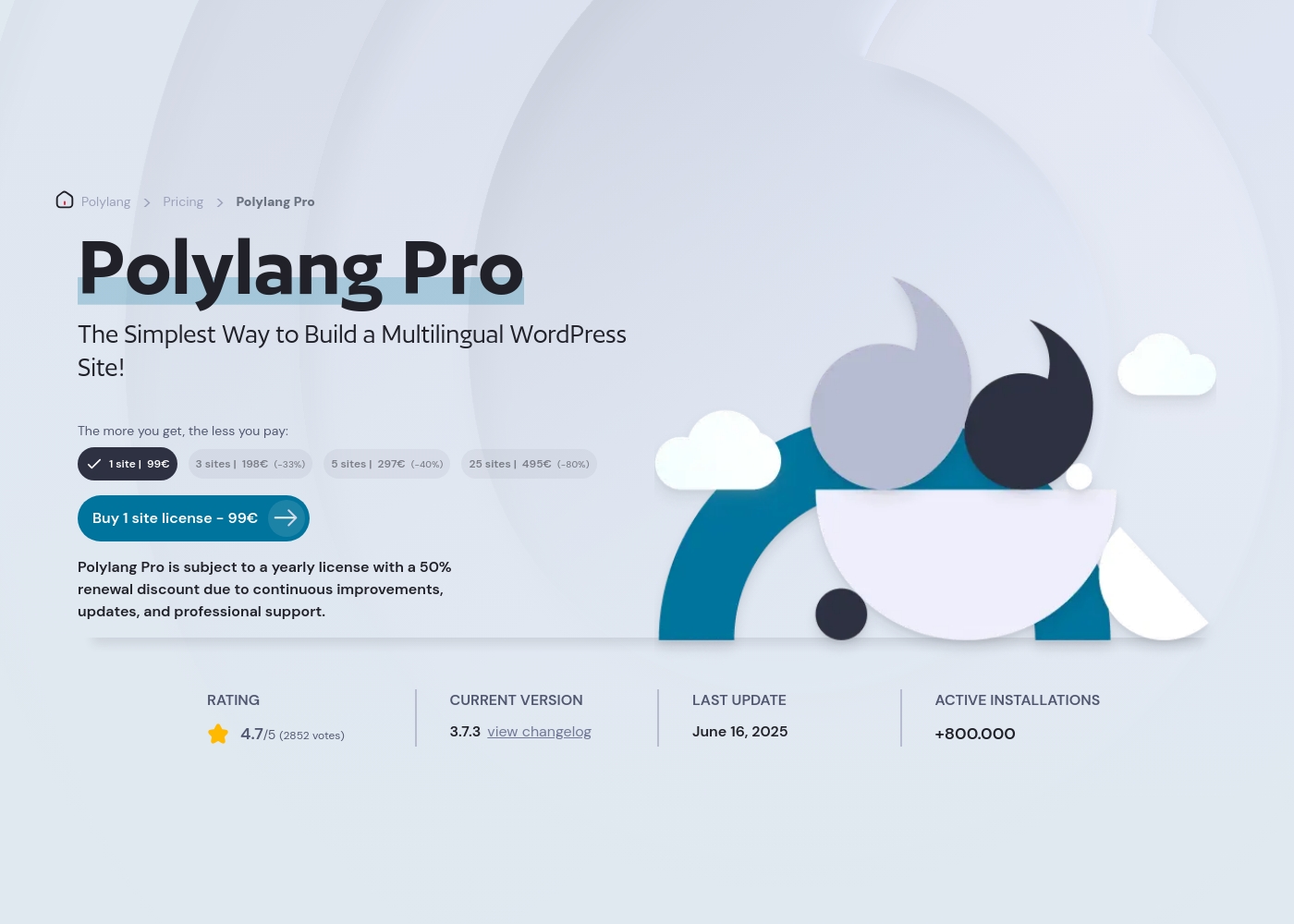
Polylang Pro costs between 99€ and 495€ per year with four main plans: the 1-site license at 99€, the 3-site license at 198€, the 5-site license at 297€, and the 25-site license at 495€.
Since pricing scales directly with your usage, getting the Pro license is incredibly simple. This structure lets you choose the perfect fit for your specific website development requirements.
1-Site License
Price: 99€/year Websites Supported: 1 site Best For: Beginners or single-project business owners Other Features: DeepL Machine Translation, Multilingual SEO, Professional Support, XLIFF Import/Export capabilities
- 1 site license
- DeepL Machine Translation integration
- Multilingual SEO
- Professional Support
- 3 site license
- DeepL Machine Translation integration
- Multilingual SEO
- Professional Support
- 33% discount
- 5 site license
- DeepL Machine Translation integration
- Multilingual SEO
- Professional Support
- 40% discount
- 25 site license
- DeepL Machine Translation integration
- Multilingual SEO
- Professional Support
- 80% discount
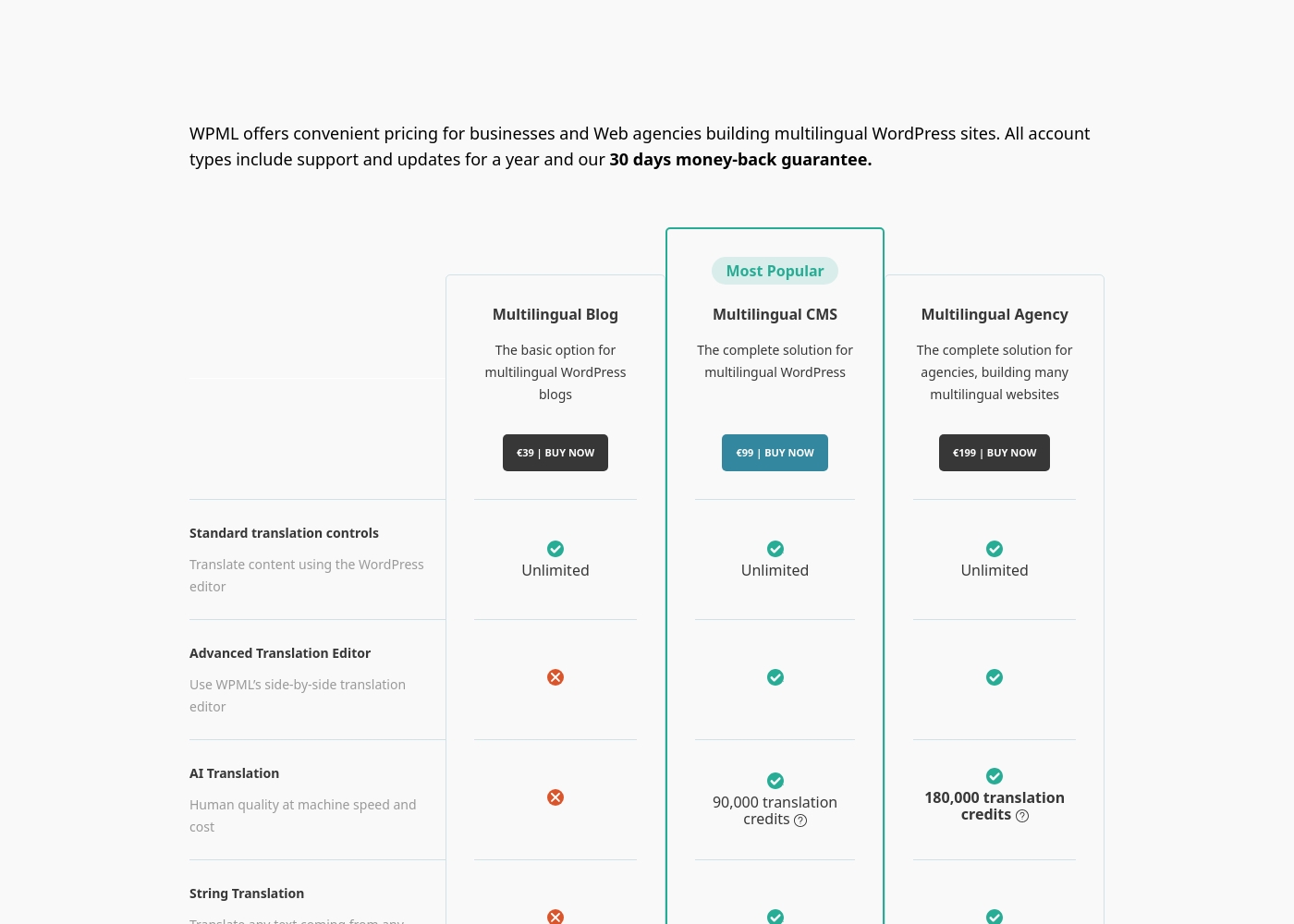
WPML costs between €39 and €199 per year with 3 plans: Multilingual Blog at €39, Multilingual CMS at €99, and Multilingual Agency at €199.
Let's explore what each plan offers for your multilingual WordPress needs.
Multilingual Blog
Price: €39 per year Websites Supported: 1 production website, 3 development websites Best For: Multilingual WordPress blogs Refund Policy: 30 days money-back guarantee Other Features:
- Standard translation controls (Unlimited)
- One year of support and updates
Pricing Notes
- Polylang Pro pricing is simple, scaling exclusively on the number of sites needed.
- Polylang offers a substantial 50% discount on subscription renewals after the first year.
- WPML's annual fee includes a significant bundle of AI translation credits, making it usage-based.
- WPML provides a 30-day money-back guarantee, which Polylang does not offer for its Pro licenses.
- Features like e-commerce and FSE trigger a jump to the €99 tier for WPML, whereas Polylang includes them.
Pricing Head-to-Head
User Reviews
Polylang currently possesses minimal public feedback on Trustpilot, registering only one review, resulting in a 3.2-star average. While there isn't enough data for a broad consensus on overall reliability or usability, the sole review highlights a critical concern regarding customer service structure.
The user, trying to implement the tool for a charity organization, reported being very disappointed because professional support was only accessible to paying customers. This user felt they were directed toward an unresponsive forum, implying that support for the free tier or community users is sorely lacking or ineffective.
I am very disappointed trying to use Polylang for my charity organization. Support is non-existent unless you pay for it. We were sent towards a community forum where no one even replies.
WPML's external sentiment presents a polarized view, though it leans heavily negative on Trustpilot, where it holds a very low rating. Users frequently acknowledge its powerful ability to handle complex multilingual needs when functioning correctly.
However, recurring themes highlight several significant frustrations essential to note. Support responsiveness is a major issue; many reviews describe service as rude, non-existent, or extremely slow, often stalling for days.
For me, WPML is the best solution for translation. I purchased it five years ago, and it still provides the correct tools to make the best translation with 100% success! I can't understand some of the low ratings here.
Our Verdict
This comparison quickly boils down to whether you prioritize performance or unlimited license flexibility. If site speed is a top priority, Polylang is overwhelmingly the better choice for your WordPress site. WPML is known to create database bloat, causing significant and frustrating site slowdowns. Polylang’s superpower is its commitment to a bloat-free architecture and native WordPress integration. Polylang handles complex functions like WooCommerce synchronization reliably across all its Pro plans. Agencies managing up to 25 sites benefit from Polylang's massive volume discounts and easy annual license transfers. WPML’s superpower is its sheer depth of features and robust agency licensing structure. The WPML Agency plan offers unlimited site licenses for a very competitive annual fee, which Polylang doesn't match. WPML also provides convenient bundled credits for its multiple advanced machine translation services. The deciding factor should be risk assessment and stability versus feature depth. If you need 50+ unlimited client sites, you must endure the potential instability of WPML. However, if performance, stability, and great customer reviews matter, Polylang offers a substantially safer, faster multilingual solution. Final Recommendation: Choose Polylang if you run an e-commerce site or care deeply about site speed. Only choose WPML if you absolutely need unlimited site installations or its complex team translation features.
Frequently Asked Questions
Which is better for website speed: Polylang or WPML?
Polylang is significantly better for speed because it's built to be bloat-free by design. WPML adds extra database tables that frequently cause site slowdowns and performance degradation. Polylang adheres only to core WordPress features.
Does Polylang have unlimited site licenses like WPML?
No, Polylang's largest license is for 25 sites, offering an 80% volume discount at that tier. WPML offers a Multilingual Agency plan for only €199/year that allows usage on unlimited production websites.
Is WooCommerce support included in all paid plans for Polylang and WPML?
Polylang includes full WooCommerce support in all its Pro licensed plans, simplifying e-commerce translation. WPML reserves e-commerce support only for its higher-tier Multilingual CMS and Agency licenses.
What happens to my Polylang and WPML pricing after the first year?
Polylang offers a generous, built-in 50% discount on renewal to keep your Pro license active. WPML pricing is generally consistent, but you may need to purchase additional AI translation credits.
Can I get a money-back guarantee with Polylang?
WPML offers a clear 30-day 'no questions asked' money-back guarantee to fully test the plugin. Polylang does not state an explicit refund policy or trial for its paid Pro features.
Why do users often complain about WPML's customer support?
WPML reviews frequently cite support as rude, very slow, or non-existent, despite a guaranteed 12-hour response time. Polylang's dedicated support is generally better reviewed and clearer for Pro customers.
Ready to Choose?
Both tools have their strengths. Choose based on your specific needs.