Phonesites vs Ycode
Phonesites and Ycode are powerful no-code builders for modern digital projects. Phonesites prioritizes incredible speed, focusing on mobile-first lead funnels and quick deployment. Ycode delivers deep design control, a robust CMS, and affordability for truly custom sites. This comparison helps determine which foundation is right for your next project build.
Best for: Solo entrepreneurs needing rapid lead generation funnels and ROI., Marketers running temporary, mobile-first ad campaigns that require fast deployment.
Best for: Designers demanding total visual autonomy and pixel-perfect results., Agencies requiring unlimited free collaboration seats for numerous client projects.
Speedy, simple funnels, built anywhere.
We find Phonesites delivers on its powerful promise of speed and simplicity, enabling anyone to create effective landing pages and automated funnels quickly, even from a mobile device. Overall, this platform is an excellent choice for marketers and small businesses prioritizing efficiency and high lead conversion rates through easy-to-use, powerful automation tools.
Pros
- Extremely fast no-code builder, allowing page creation in minutes.
- Mobile-first design enables construction and management from your phone.
- Includes robust built-in email and SMS lead capture automation.
- Integrated AI writer accelerates content generation (on top tier).
Cons
- The integrated AI writer is only available on the most expensive plan ($69/month).
- The Essential plan is strictly limited to supporting only five websites and 25 pages.
Powerful visual editor with smart pricing.
We see Ycode successfully bridges the gap between powerful design tools and affordability, offering extensive features like an integrated CMS and team collaboration without excessive cost. Overall, this platform presents a compelling alternative for designers and founders seeking complete control over their complex projects.
Pros
- Extremely competitive pricing structure beginning at $5/month annually.
- Comprehensive Free plan perfect for development and testing new projects.
- Total design autonomy via an intuitive visual editor, requiring no code.
- Integrated CMS simplifies content structuring and data management.
Cons
- Custom code integration is restricted to Basic and Pro plans.
- The Mini plan is significantly limited in scope (only 5 published pages).
- No explicit refund policy or money-back guarantee is provided.
AboutPhonesites
Phonesites is an innovative, no-code builder designed to help businesses, marketers, and consultants collect leads and sell products effectively. The core benefit is the ability to create and publish complex digital assets in minutes, using either your phone or desktop. This includes high-converting landing pages, surveys, pop-ups, and digital business cards.
This platform simplifies website creation, ensuring that users with very little technical knowledge can easily have a site up and running in minutes. It's truly built for speed and simplicity. 💡
AboutYcode
Ycode is a comprehensive, all-in-one website builder and integrated CMS. It's built specifically for designers, creators, and founders who want professional results without relying on code. Using its intuitive visual editor, you gain complete design control to craft beautiful, fully responsive websites. You can publish your creations instantly and manage everything easily from one reliable platform. ✅
Highlights
Feature Comparison
Features Overview
We highlight the main differences and pick a winner for each feature.
Speed vs. Customization
Phonesites is built for speed and simplicity; Ycode offers deeper design customization.
Phonesites is designed to launch mobile-first landing pages in minutes, not days. Marketers use Phonesites for fast funnels and immediate campaign deployment often from a phone. Ycode delivers total design autonomy via its powerful visual editor and advanced interactions. Building complex visuals on Ycode might take longer, but the result is highly customized and unique. Phonesites excels at rapid deployment; Ycode offers the creative freedom of a high-end designer tool. If speed to lead is your top goal, Phonesites provides the quicker launch path.
Integrated CMS
Ycode features a robust CMS; Phonesites focuses strictly on static funnel pages.
Ycode includes an integrated, user-friendly CMS for content structuring and organization. The Pro plan supports up to 12,000 CMS items for large, data-heavy sites. Phonesites operates primarily as a fixed landing page and funnel builder. It lacks the dynamic database capabilities of Ycode’s integrated CMS. Ycode is essential for blogs, directories, or any project needing complex content management. Phonesites handles lead capture beautifully but isn't built for content scale.
Lead Generation Focus
Phonesites includes built-in follow-up tools; Ycode focuses on site structure and design.
Phonesites includes automated follow-ups via both email and SMS right out of the box. This integrated funnel system turns traffic into leads efficiently. Ycode offers unlimited form entries but relies on external service integrations for SMS or email automation. Phonesites gives marketers a complete, immediate lead ecosystem. If nurturing captured leads automatically is critical, Phonesites provides greater native capability.
Team Collaboration
Ycode provides unlimited free collaborators; Phonesites' team pricing is not listed.
Ycode supports unlimited team members and collaborators on all paid plans at no extra cost. This makes Ycode extremely cost-effective for large agencies or growing teams. Phonesites does not specify its policy regarding user seats or collaborator fees in the provided data. Ycode's collaboration structure is a massive win for transparency and budget predictability. Teams needing flexible, cost-free scaling should heavily favor Ycode here.
Onboarding & Support
Phonesites offers structured, guided training; Ycode relies on community and email support.
Phonesites helps users accelerate setup via a guided 1:1 orientation call. They also host weekly workshops covering strategy and best practices for their platform. Ycode focuses on strong email support and active community resources for learning. While Ycode reviewers praise timely responses, Phonesites provides more structured, personal training. New users seeking hands-on guidance will benefit most from Phonesites' included resources.
Mobile Workflows
Phonesites explicitly supports building and publishing from a phone; Ycode is desktop-centric.
Phonesites is explicitly designed for mobile-first workflows, allowing users to build and publish pages from any device, including their phone. This offers phenomenal agility for entrepreneurs always on the move. Ycode ensures fully responsive, device-agnostic output but is edited primarily through a desktop visual editor. Phonesites facilitates true on-the-go content management and immediate updates. For flexibility in editing location, Phonesites is superior.
Localization Scale
Ycode handles global multi-language scaling; Phonesites' global features are unlisted.
Ycode's Pro plan unlocks unlimited language localization for truly global sites. Even starter paid plans support 2 or 3 languages for specific campaigns. Phonesites' data does not mention specific language or localization features. Ycode offers the infrastructure necessary to efficiently target and manage multiple global markets. Businesses focused on international growth must rely on Ycode's native localization tools.
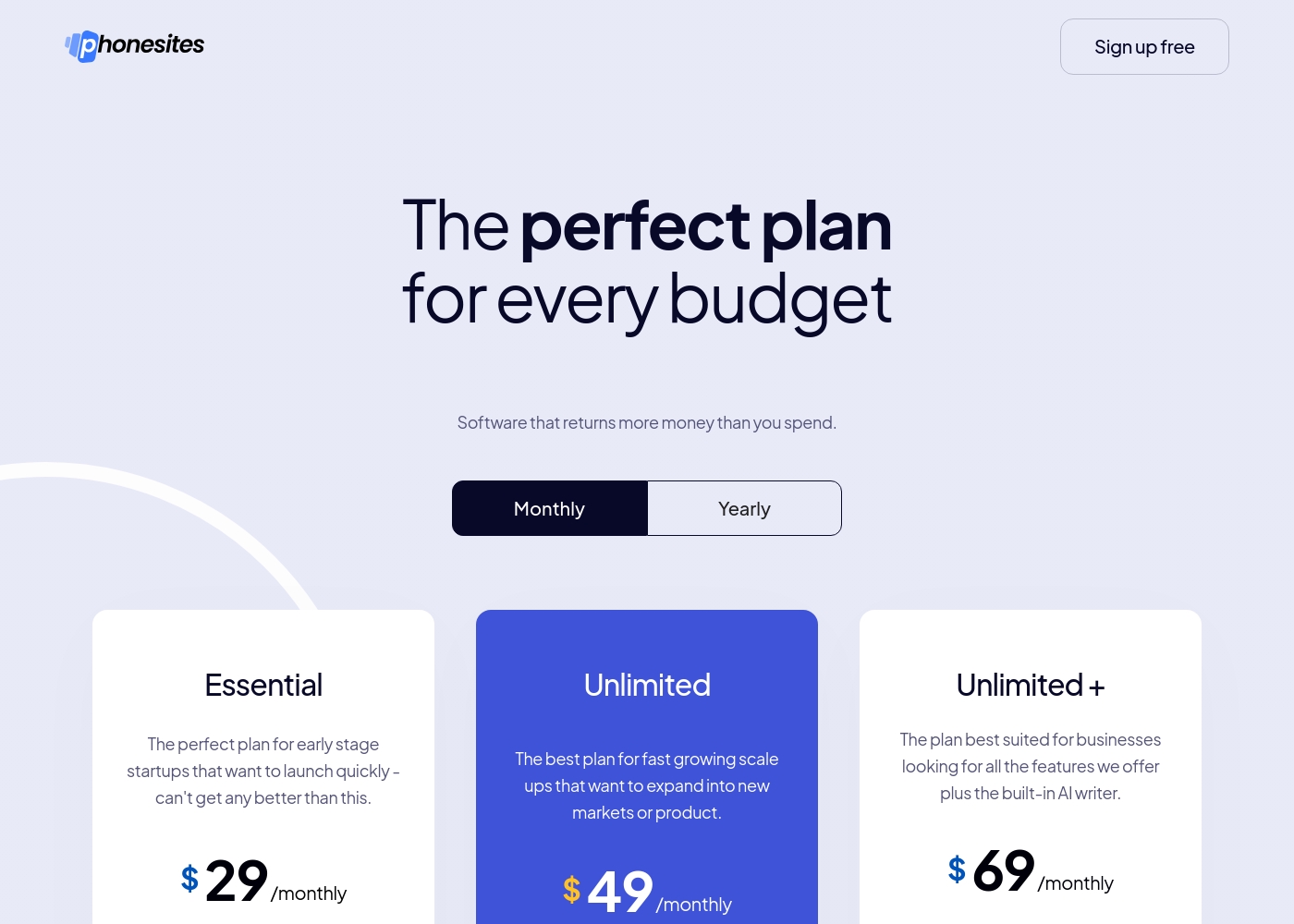
Phonesites costs between $29 and $69 per month with 3 plans: Essential at $29/month, Unlimited at $49/month, and Unlimited + at $69/month.
Here is a detailed breakdown of the features and restrictions for each option.
Essential
Price: $29/month Websites Supported: Up to 5 Websites / 25 Pages Best For: Early stage startups that want to launch quickly Other Features:
- Custom domains
- Subdomains
- 600+ templates
- Free hosting and SSL certificate
- Fast load speed
- Custom domains
- Subdomains
- Email automations
- 600+ templates
- Share my funnel
- Unlimited Websites & Pages
- Custom domains
- Subdomains
- Email automations
- 600+ templates
- Unlimited Websites & Pages
- AI writer credits
- Zoom & phone support
- Funnel closer training
- Permission based selling
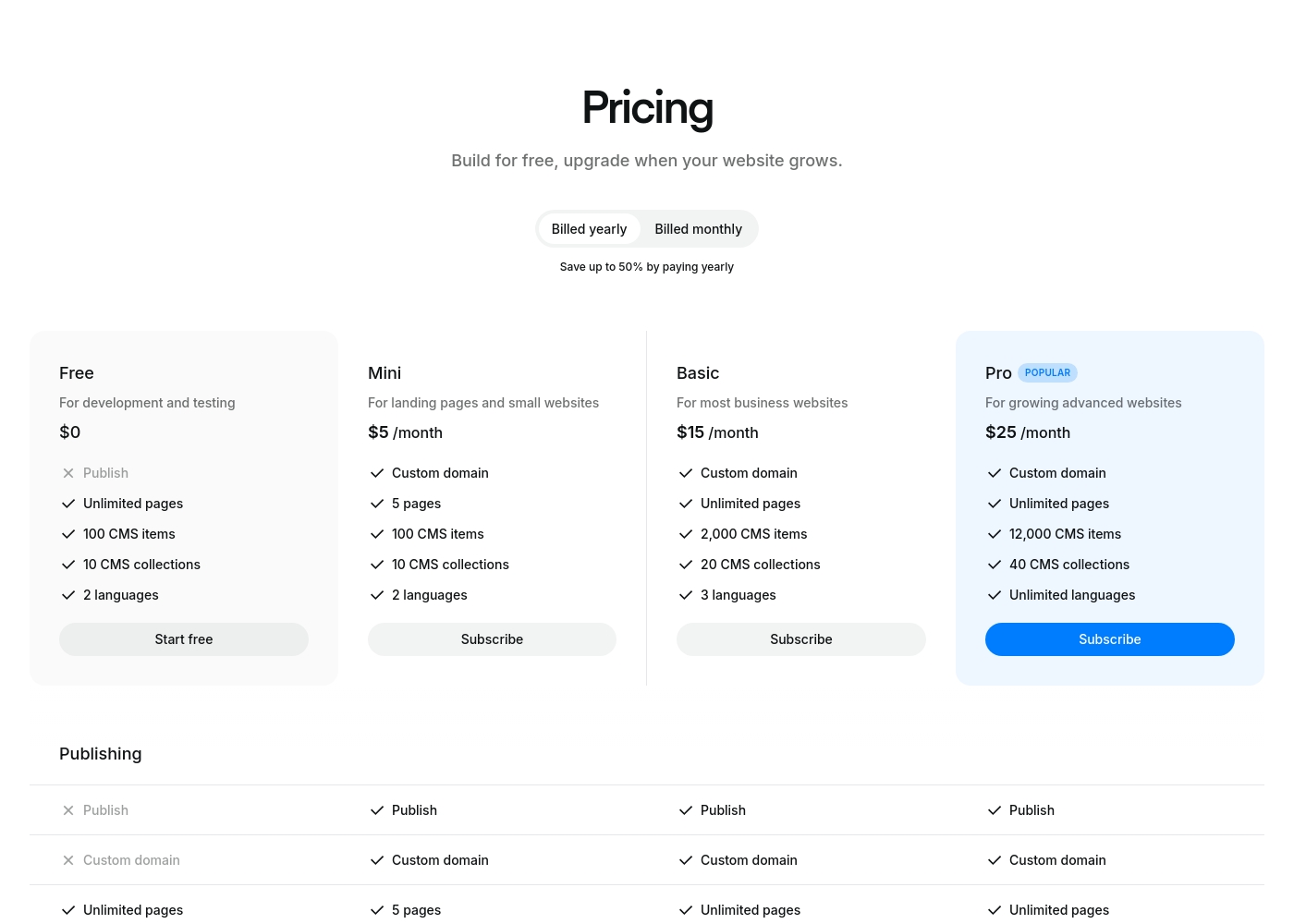
Ycode costs between $0 and $30 per month, with four plans: Free at $0, Mini at $5/month (billed yearly), Basic at $15/month (billed yearly), and Pro at $25/month (billed yearly).
Here’s a breakdown of what each tier offers so you can choose the best fit for your project.
Free
Price: $0 Best For: development and testing Other Features: Unlimited pages on a ycode.site domain, 100 CMS items, 10 CMS collections, 2 languages, 1K monthly visits.
- Publish to ycode.site
- Unlimited pages
- 100 CMS items
- 10 CMS collections
- 2 languages
- Custom domain
- 5 pages
- 100 CMS items
- 10 CMS collections
- 2 languages
- Custom domain
- Unlimited pages
- 2,000 CMS items
- 20 CMS collections
- 3 languages
- Custom domain
- Unlimited pages
- 12,000 CMS items
- 40 CMS collections
- Unlimited languages
Pricing Notes
- Phonesites offers a 14-day free trial on its paid plans.
- Ycode provides a permanent Free plan for developing and testing sites.
- Ycode offers significant savings (up to 50%) when billed annually; paid plans start at $5/month.
- Ycode includes unlimited collaborators free of charge, avoiding high per-seat costs common in other tools.
- Phonesites uses a usage-based tiered system starting around $1.
Pricing Head-to-Head
User Reviews
Phonesites consistently receives high praise for its unmatched simplicity and rapid deployment speed. Users frequently call it the easiest tool they have ever used for building landing pages and sales funnels, often reporting creation times under ten minutes.
A strong recurring theme is the platform’s effectiveness in lead generation, empowering businesses to automate follow-ups via email and SMS, thereby increasing their return on investment (ROI). The mobile-first capability is highly valued, allowing entrepreneurs and marketers to build and launch sophisticated pages entirely from their phone, even without prior web design skills.
This is the best landing page software I’ve ever used. It’s incredibly easy to use, and I love the fantastic layout. The built-in AI writer is truly amazing and helps speed up content creation fast.
Ycode is strongly positioned as a high-value and professional alternative to established web development platforms, frequently emphasizing user satisfaction and powerful design capabilities. The company maintains that thousands of users worldwide praise its innovation and supportive environment.
This platform aims to cut through complexity by combining powerful features with an intuitive, user-friendly interface. Key themes promoted internally include superior user interface design and competitive pricing compared to rivals like Webflow, alongside strong functionality for animation and visual effects.
Our Verdict
Deciding between Phonesites and Ycode comes down to your core goal: speed or customization. Both offer incredibly powerful no-code solutions for building websites today. Phonesites is built as the ultimate marketer’s tool for fast, high-converting lead funnels. Ycode is the ultimate designer’s tool for deep control and scalable data management. Phonesites excels at speed and lead conversion out of the box. You can publish a professional, mobile-optimized landing page in minutes using Phonesites. The platform’s killer feature is native SMS and email follow-up automation. Phonesites even provides 1:1 orientation and workshops to accelerate your learning curve quickly. Ycode’s major superpower is total design autonomy paired with a robust integrated CMS. Ycode is perfect for building complex, beautiful, and dynamic websites without custom code. Using Ycode, you benefit from a permanent Free plan and unlimited free collaborators. This makes Ycode exceptionally scalable and budget-friendly for teams. Your deciding factor should be the project’s complexity versus your time constraints. If you need a website that is constantly updated with structured data, choose Ycode. If you need to launch 10 lead capture campaigns this week with seamless automation, go with Phonesites. Ultimately, Phonesites wins for marketers who need immediate, guided results and lead conversion tools. Ycode wins for designers and agencies needing powerful customization and integrated data structure. Choose the one that serves your primary business function best.
Frequently Asked Questions
Which platform is better for deep visual customization: Phonesites or Ycode?
Ycode is significantly better for deep visual customization and design control. Ycode provides true design autonomy and allows complex scroll effects without code. Phonesites focuses primarily on speed and templates for rapid deployment, limiting granular control.
Does Phonesites include an Integrated CMS like Ycode?
No. Ycode specializes in handling dynamic content via its integrated CMS with thousands of items. Phonesites focuses on optimized static and lead capture pages. If your project needs to manage large amounts of structured data, Ycode is the necessary choice.
Which tool is more affordable for team collaboration?
Ycode is much more affordable for teams as it includes unlimited collaborators for free. Phonesites does not detail its user seat or collaboration pricing structure. Ycode eliminates high per-seat costs, making it ideal for growing agencies.
Can I publish websites or pages from my phone using Ycode or Phonesites?
Phonesites is explicitly designed for mobile workflows, letting users build and publish pages from their phone. Ycode outputs fully responsive sites but is primarily edited using a desktop visual editor. Phonesites offers superior agility for on-the-go editing.
Which platform offers built-in lead nurturing/follow-up?
Phonesites offers powerful built-in lead nurturing via automated SMS and email follow-ups. Ycode provides unlimited form entries but requires connecting external tools for follow-up automation. Phonesites gives marketers a complete internal funnel toolkit.
Do Phonesites or Ycode offer a free plan option?
Ycode offers a strong, permanent Free plan for development and testing new sites. Phonesites operates on a usage-based model but offers a 14-day free trial. Ycode allows you to build complex projects indefinitely without payment.
Ready to Choose?
Both tools have their strengths. Choose based on your specific needs.