Payhip vs Shopify
Payhip and Shopify represent fundamentally different approaches to e-commerce selling. Payhip offers the simplest path for digital creators looking for low overhead and ease. Shopify provides an industrial-strength platform built for high-volume physical retail and global scale. The choice hinges entirely on your product type and appetite for complexity.
Best for: Digital creators and educators selling online courses and memberships, Solo entrepreneurs needing budget-friendly, full-featured platforms

Best for: E-commerce businesses focused on high-volume physical product sales, Brands requiring integrated in-person Point of Sale (POS) systems
Exceptional value for digital creators.
We find Payhip delivers an outstanding value proposition: it eliminates feature-gating across all tiers and handles complex global tax compliance automatically. User feedback consistently validates the platform's ease of use and the quality of its human support staff. Overall, we recommend Payhip highly for anyone selling digital goods, courses, or coaching.
Pros
- Access to all features is included even on the Free Forever plan.
- Customer support is prompt, responsive, and provided by real people.
- Setup is remarkably user-friendly with a clean, easy-to-customize interface.
- Automatically handles complex EU and UK VAT calculation and compliance.
Cons
- Does not permit the sale of Private Label Rights (PLR) products.
- Some specialized functions required by highly ambitious course creators may be absent.

Powerful Platform, Critical Service Gaps
We recognize Shopify offers an enterprise-level platform with impressive scaling tools and high-converting technology for merchants of all sizes. However, user reviews indicate systemic failures in support, billing practices, and marketplace fraud protection. Overall, Shopify provides powerful infrastructure but currently struggles to deliver a reliable, secure, or user-focused experience for many customers.
Pros
- Comprehensive commerce platform built for scaling and global growth.
- Unique Shopify Checkout converts 15% higher than competing platforms.
- Lower credit card transaction fees on Grow and Advanced plans.
- Access to Shopify Capital for loans without sacrificing equity.
Cons
- Customer support is frequently reported as unresponsive, slow, or useless (often relying on chatbots).
- Platform often fails to protect buyers and merchants from fraudulent stores.
- Frequent reports of unauthorized billing and confusing cancellation procedures.
- Complexity makes site setup difficult for non-technical beginners.
AboutPayhip
Payhip is a user-friendly platform designed for creators who want to turn their passion into profit. It makes selling online easy and accessible for everyone. You can create a free, fully customizable website within minutes, with absolutely no coding required ✨. Whether you sell ebooks, software, online courses, or physical inventory, Payhip provides the robust features you need. This platform helps you start, scale, and manage your business effectively, joining over 130,000 trusted creators.
AboutShopify
Shopify is the powerful commerce platform designed to handle every aspect of modern selling. It serves everyone, from solo entrepreneurs launching their first product to large global enterprises. This platform manages your sales whether you are selling direct-to-consumer or handling wholesale B2B transactions. You get an organized, fully centralized Shopify Admin to control everything, from the back office to the front of the store. Millions of merchants trust Shopify; together, they have reached over $1 trillion in collective sales. ✨
Highlights
Feature Comparison
Features Overview
We highlight the main differences and pick a winner for each feature.
Cost of Entry
Payhip has a generous permanent Free Forever plan; Shopify offers a short 3-day trial.
Payhip lets you start selling immediately using their comprehensive Free Forever plan. This plan includes all features, requiring just a 5% transaction fee on sales. You won't need a credit card to launch your Payhip store instantly. Shopify provides a 3-day free trial, but you must subscribe to a paid plan immediately afterward. Shopify’s Basic plan starts at $29/month to access core selling functions. For initial setup, Payhip allows zero commitment, making it much lower risk for testing products. Payhip is the clear winner for beginners and creators prioritizing minimal startup costs and no monthly fee commitment. Shopify's mandatory monthly fee quickly adds up if your sales volume is low or inconsistent. If you are just launching your first digital product, Payhip is the financially smart choice to test the market.
Digital Product Sales
Payhip is purpose-built for creators; Shopify treats digital sales as secondary.
Payhip excels at selling diverse digital products, memberships, and online courses. It includes robust features like drip content and assignments right out of the box. Payhip also facilitates selling 1:1 coaching sessions directly through integrated scheduling. Shopify is primarily optimized for tangible inventory and physical retail operations. While Shopify supports digital goods, you must purchase external apps for membership or advanced course features. This means extra complexity and added monthly costs for Shopify users. Payhip offers these creator-focused tools built-in, simplifying the setup process immensely. Creators get a true all-in-one experience using Payhip for digital delivery. Shopify forces digital creators to depend heavily on its vast app ecosystem. If your core business is selling expertise or digital files, Payhip provides superior native functionality and less integration friction.
Global Tax Compliance
Payhip automatically manages complex digital VAT; Shopify requires external effort.
Payhip handles the significant regulatory headache of digital EU and UK VAT automatically. The platform calculates, collects, and manages these complex international tax obligations on your behalf. This critical feature simplifies global digital sales compliance for Payhip users tremendously. Shopify requires merchants to separately configure tax settings, often needing paid third-party tax apps or services. Managing global compliance is a greater administrative burden on Shopify. This friction means more time spent on bookkeeping instead of scaling your business. Automatic tax handling is a key distinction that saves Payhip creators time and ensures adherence to international law. Shopify offers general tax tools but lacks Payhip's specific focus on digital VAT. If you sell ebooks or courses globally, the automated compliance in Payhip eliminates significant administrative risk.
Ecosystem & Flexibility
Shopify’s 13,000+ app ecosystem dwarfs Payhip’s integrations for extreme customization.
Shopify has an enormous ecosystem offering over 13,000 apps that cover almost any specialization needed. This breadth allows extreme customization, from high-level marketing to niche shipping solutions. Shopify also supports enterprise-level needs like headless commerce via Hydrogen. Payhip focuses on keeping its core platform robust, relying only on standard essential marketing and payment integrations. Payhip’s strength is simplicity, meaning fewer customization levers than Shopify. If a feature isn't built in, you might be out of luck with Payhip. Shopify’s vast integration power is essential for unique business models or physical retail with specific hardware needs. Payhip aims for universal functionality without requiring external apps. For businesses requiring advanced B2B features, complex ERP connections, or highly bespoke solutions, Shopify is the only scalable choice.
Customer Support Quality
Payhip users praise prompt, knowledgeable support; Shopify users frequently report poor experiences.
Payhip provides dedicated 24/7 contact support praised by users as prompt, efficient, and human. Testimonials highlight that the Payhip team helps with complex tasks like migrating stores successfully. Their responsive expertise is a top user benefit. Shopify users frequently report unresponsive support, slow issue resolution, and difficulties managing charges or refunds. Trustpilot reviews consistently describe poor communication and frustrating payout holds when dealing with Shopify support. Customer service is a major differentiator; Payhip earns high marks where Shopify reviews show significant friction. Reliability of help matters when running a business and Payhip excels here. If stellar, dependable customer support is non-negotiable for your operations, Payhip offers a much safer environment.
Physical Retail & POS
Shopify is the leader for physical goods and in-person POS; Payhip offers basic physical support only.
Shopify is designed for unified commerce, seamlessly managing online and in-person sales (POS). The Shopify Admin centralizes inventory and orders for a complete retail solution. Shopify also supports up to 200 inventory locations on its top plan. Payhip supports the sale of physical products and inventory management but lacks integrated POS functionality. Payhip’s focus remains digital selling, treating physical goods as an added feature, not a core strength. It isn't built for a bustling storefront. If your business includes brick-and-mortar sales or requires robust multi-location inventory tracking, Shopify is mandatory. Payhip offers only superficial physical product functionality. Startups focused purely on digital downloads won't care, but physical retailers must choose Shopify.
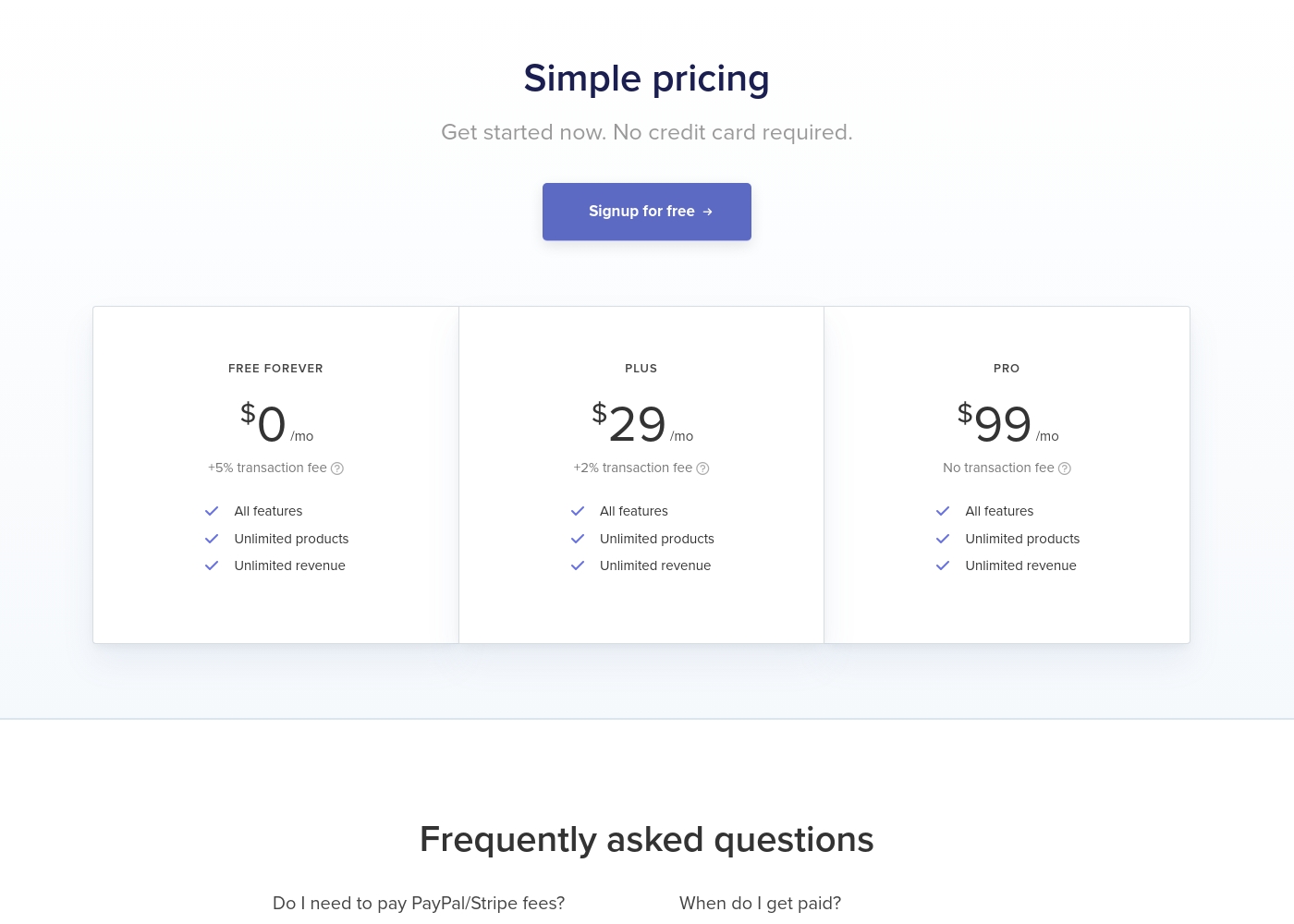
Payhip costs between $0 and $99 per month with three plans: Free Forever at $0/month, Plus at $29/month, and Pro at $99/month.
Here are the details for each tier available through Payhip's simple pricing structure.
Free Forever
Price: $0/mo Best For: Creators starting out Other Features:
- 5% transaction fee
- All features included
- Unlimited products
- Unlimited revenue
- All features
- Unlimited products
- Unlimited revenue
- All features
- Unlimited products
- Unlimited revenue
- All features
- Unlimited products
- Unlimited revenue
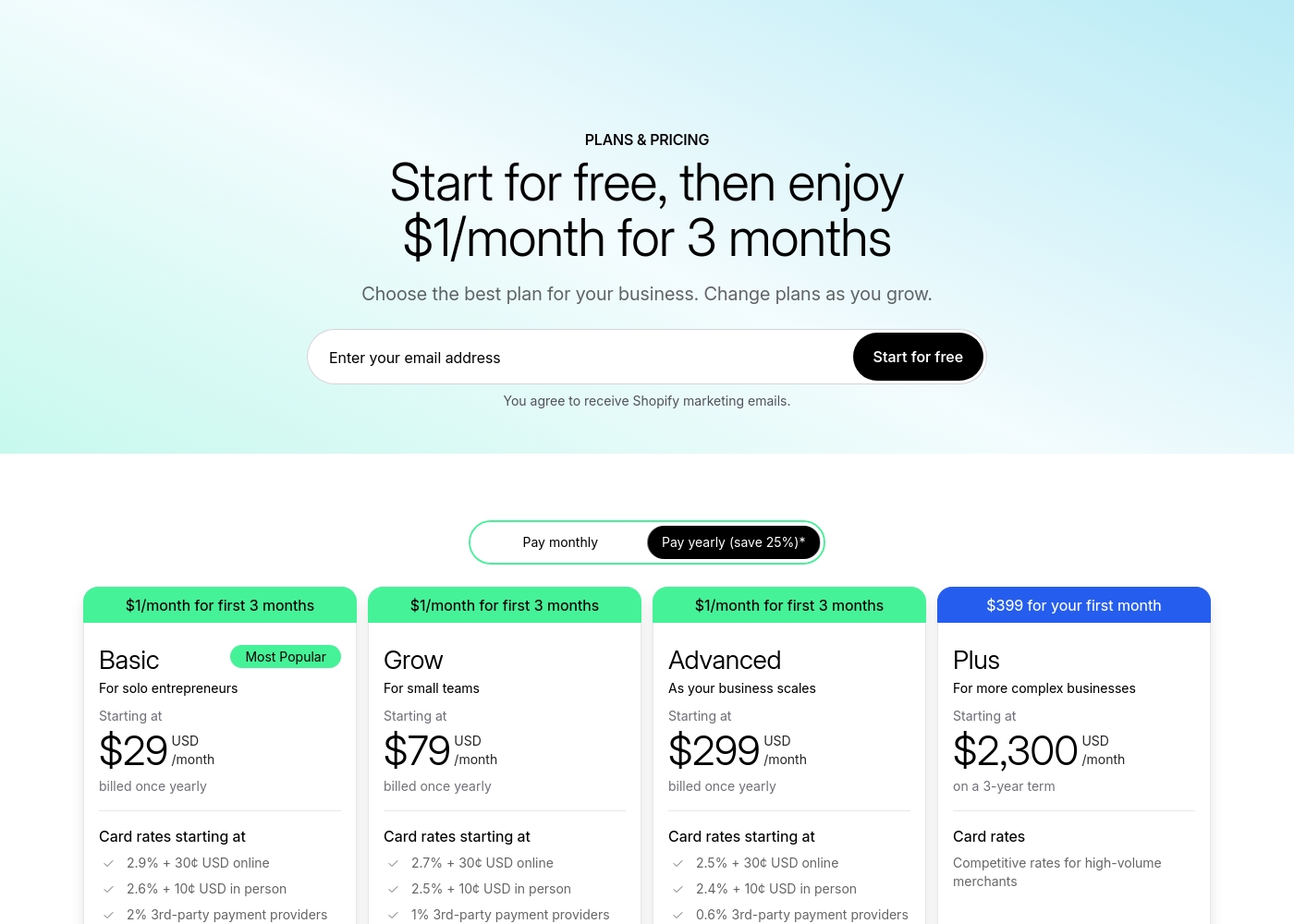
Shopify costs between $5 (Starter) and $2,300 (Plus) per month with six key plans: Starter at $5/month, Basic at $29/month (billed yearly), Grow at $79/month (billed yearly), Advanced at $299/month (billed yearly), Retail at $89/month, and Plus at $2,300/month (on a 3-year term).
Here’s a detailed look at the core subscription options designed to help your business evolve and scale.
Starter
Price: $5 USD / month Best For: Selling instantly through social media and messaging apps Other Features: Simple online store, Learn more link
- Sell instantly through social media and messaging apps
- Simple online store access
- For solo entrepreneurs - Most Popular
- 2.9% + 30¢ USD online card rates
- Up to 77% shipping discount
- 10 inventory locations
- 24/7 chat support
- For small teams
- 5 staff accounts
- 2.7% + 30¢ USD online card rates
- Up to 88% shipping discount and insurance
- 1% 3rd-party payment provider fees
- As your business scales
- 15 staff accounts
- 2.5% + 30¢ USD online card rates
- 3rd-party calculated shipping rates
- Enhanced 24/7 chat support
Pricing Notes
- Payhip uses a Free Forever plan with full features; Shopify offers only a 3-day free trial before moving to mandated paid plans.
- Payhip rewards high volume: upgrading to the Pro plan ($99/mo) eliminates the Payhip transaction fee entirely (0%).
- Shopify offers B2B solutions and financing through Shopify Capital, providing loans up to $2M with 0% equity for rapid growth.
- Shopify's pricing complexity grows with transaction fees and external app costs, whereas Payhip’s cost structure is fixed and transparent.
Pricing Head-to-Head
User Reviews
Payhip receives exceptional feedback for its comprehensive and user-friendly platform, consistently praised across hundreds of reviews. A key draw is the transparent and affordable pricing structure, particularly the powerful Free Forever plan, which allows new creators to start selling digital products without a significant monthly subscription burden.
Users frequently commend the platform's ease of use and simple setup, noting that customization is straightforward and quick, making the onboarding process effortless. However, the most universally lauded aspect is the customer support.
This is a great resource for people entering the online business space with digital products. The platform is well designed, remarkably user friendly, and immediate to launch. The variety of page templates makes getting started really simple and stress-free.
While Shopify is recognized as an exceptionally powerful commerce platform that enables aggressive scaling, external feedback indicates significant user dissatisfaction. Customers frequently cite severe issues with customer support, emphasizing that interactions are often negative, slow, or handled by unhelpful chatbots.
A major recurring theme, especially on Trustpilot, focuses on platform reliability and integrity, with many users openly classifying Shopify as a 'fraudsters paradise' that fails to protect consumers from scam stores operating on the platform. Furthermore, the pricing structure and billing accuracy generate major complaints.
The platform is expensive and gives minimal customer support. You often learn how things work by making costly mistakes. Given their high fees, they should offer much better service.
Our Verdict
Choosing between Payhip and Shopify means deciding between simplicity and infinite scale. Payhip is the clear winner for solo digital creators and those prioritizing simplicity and cost control. Shopify is the industrial-strength champion built for massive physical retail and customization power. Payhip’s superpower is making complex tasks simple, especially for digital products. It automatically handles tricky EU/UK VAT compliance, eliminating a huge international seller headache. Payhip also gives you all features for free, asking only for a transaction cut to start selling. Shopify’s superpower is its sheer, overwhelming scalability and retail focus. You get integrated POS, B2B tools, and access to an ecosystem of 13,000+ apps. If you need centralized inventory across 50 locations, only Shopify can handle that volume. The human experience is the major deciding factor between Payhip and Shopify. Payhip users rave about prompt, helpful 24/7 support staff. Shopify users frequently report major frustration with slow, inconsistent customer service and payout holds. Choose Payhip if you sell courses, downloads, or coaching and value transparent pricing and excellent support. Choose Shopify if you sell physical goods, need robust POS, or require extreme customization via its industry-leading app store.
Frequently Asked Questions
Which platform is better for selling online courses: Payhip or Shopify?
Payhip is significantly better for courses, memberships, and digital products. It includes robust course features like quizzes and drip content natively within the platform. Shopify requires purchasing and integrating third-party apps for similar functionality.
Is Shopify worth the extra monthly cost over Payhip?
Shopify is worth the cost if you sell physical goods or require B2B/wholesale features and POS integration. If you only sell digital products, Payhip offers dramatically better value and lower transaction fees at the Pro tier ($99/mo).
Does Payhip handle global sales tax compliance easily like Shopify?
Payhip handles complex digital EU and UK VAT requirements automatically, simplifying international sales. While Shopify offers tax settings, it generally requires more complex configuration or third-party apps to match Payhip's automation.
Can I use Payhip to integrate sales onto my established website?
Absolutely. Payhip offers a seamless embed feature that lets you place products and a high-converting checkout onto any existing website. You don’t have to relaunch or migrate your entire site to use Payhip’s selling tools.
Which software has better customer support: Payhip or Shopify?
Payhip consistently receives much higher praise for 24/7 customer support quality. Users report Payhip’s staff is prompt and knowledgeable. Shopify reviews frequently note struggles with unresponsive support and slow issue resolution.
Can I get growth funding through Payhip like I can with Shopify?
No, Payhip does not offer internal financing or capital loans. Shopify is unique in offering Shopify Capital, providing loans up to $2M with 0% equity to eligible merchants.
Ready to Choose?
Both tools have their strengths. Choose based on your specific needs.
