Payhip vs Sellfy
Payhip and Sellfy are both excellent, focused platforms for digital creators selling online. They help you launch a branded store quickly without complex coding or hassle. The key difference lies in how they handle transaction fees and subscription costs. Sellfy prioritizes 0% transaction fees while Payhip offers a permanent Free Forever tier.
Best for: Solo entrepreneurs starting with zero budget or testing a small niche., Creators selling 1:1 coaching or personalized educational services.
Best for: Creators selling high-volume digital products exceeding $10k annually., Merchandise brands seeking a seamless, integrated print-on-demand (POD) solution.
Exceptional value for digital creators.
We find Payhip delivers an outstanding value proposition: it eliminates feature-gating across all tiers and handles complex global tax compliance automatically. User feedback consistently validates the platform's ease of use and the quality of its human support staff. Overall, we recommend Payhip highly for anyone selling digital goods, courses, or coaching.
Pros
- Access to all features is included even on the Free Forever plan.
- Customer support is prompt, responsive, and provided by real people.
- Setup is remarkably user-friendly with a clean, easy-to-customize interface.
- Automatically handles complex EU and UK VAT calculation and compliance.
Cons
- Does not permit the sale of Private Label Rights (PLR) products.
- Some specialized functions required by highly ambitious course creators may be absent.
Zero fees, simple selling for creators.
We found Sellfy to be an incredibly efficient, all-in-one platform tailored for creators who prioritize simplicity and cost savings. Its zero-transaction-fee model and built-in marketing tools offer exceptional value, starting at just $22 per month when billed annually. Overall, we confidently recommend Sellfy for easily scaling digital or physical product sales while maintaining total control.
Pros
- No platform transaction fees, improving profitability immediately.
- Extremely fast setup and user-friendly interface for first-time sellers.
- Supports digital, subscriptions, physical, and high-quality print-on-demand products.
- Includes essential growth tools like affiliate marketing and conversion features.
Cons
- Limited payment processing options (primarily Stripe and PayPal Business).
- Store designer offers basic functionality for advanced users seeking complex customization.
- Users report difficulty when trying to implement additional languages.
- Custom shipping labels cannot be fully branded.
AboutPayhip
Payhip is a user-friendly platform designed for creators who want to turn their passion into profit. It makes selling online easy and accessible for everyone. You can create a free, fully customizable website within minutes, with absolutely no coding required ✨. Whether you sell ebooks, software, online courses, or physical inventory, Payhip provides the robust features you need. This platform helps you start, scale, and manage your business effectively, joining over 130,000 trusted creators.
AboutSellfy
Sellfy is an ideal, all-in-one platform built specifically for skilled creators and modern online businesses. It focuses on simplicity without sacrificing the results you need. If you hate complexity, Sellfy makes getting started easy.
You can upload and sell almost anything right away. This includes digital downloads like courses, music, art, and videos. You can also manage complex needs like physical products inventory or use the simple print-on-demand service. Sellfy helps you replace multiple tools with one efficient dashboard. 💡
Highlights
Feature Comparison
Features Overview
We highlight the main differences and pick a winner for each feature.
Platform Transaction Fees
Payhip charges fees unless you pay $99 monthly; Sellfy offers 0% fees on all paid plans.
Payhip starts with a 5% transaction fee on the Free plan, reducing to 0% only on the Pro plan ($99/month). You must factor these fees into your business cost structure. Sellfy provides 0% platform transaction fees on every single paid subscription tier. You only pay the mandated Stripe or PayPal processing fees. For high-volume sellers, Sellfy immediately provides drastically better profitability margins. Payhip's only path to zero fees requires a $99 monthly minimum commitment. Sellfy's affordable paid plans beat Payhip on scale.
Launch Cost & Free Plan
Payhip offers an indefinite Free Forever plan; Sellfy has a 14-day free trial only.
Payhip includes a permanent Free Forever plan that contains the full suite of features and unlimited products. You can start selling right away without spending any money monthly. Sellfy provides a risk-free 14-day free trial to test the entire platform functionality. After two weeks, you must commit to a subscription starting at $22/month (billed annually). Payhip is the clear choice for indefinite risk-free testing and selling with zero commitment. Sellfy quickly requires a monetary investment to continue selling post-trial.
International Tax Handling
Payhip handles complex EU/UK VAT compliance automatically. Sellfy lacks this automated functionality.
Payhip’s unique strength is automatically managing digital EU and UK VAT requirements for international sales. This automation is critical and significantly simplifies compliance obligations for sellers worldwide. Sellfy allows global selling via PayPal/Stripe, but details regarding automated tax management are not specified. This automated VAT handling in Payhip removes a significant regulatory headache. Payhip allows creators to focus on business growth, not complicated international tax law.
Advanced Marketing Tools
Sellfy has explicit built-in growth tools; Payhip offers generic marketing features.
Payhip includes built-in email marketing and general promotional marketing utilities. Specific growth features like upselling or cart recovery are not detailed in Payhip’s offering. Sellfy explicitly unlocks powerful growth features like product upselling, affiliate marketing, and cart abandonment recovery on its Business plan. Sellfy also provides substantially higher email marketing credits (up to 50,000) on its Premium tier. For optimizing conversions and maximizing Average Order Value, Sellfy’s integrated tools are superior.
Product Diversity Focus
Payhip supports 1:1 coaching; Sellfy integrates seamlessly with print-on-demand.
Payhip supports digital downloads, online courses, physical goods, memberships, and 1:1 coaching sessions with scheduling tools. It is highly versatile for selling both digital assets and personalized services. Sellfy supports digital, physical, subscriptions but uniquely includes built-in print-on-demand (POD) services. Sellfy’s POD makes launching custom merchandise lines effortless without managing inventory. If physical product merchandise is central, Sellfy wins; for selling services, Payhip is better.
Digital File Handling
Sellfy clearly supports huge digital products up to 20 GB. Payhip does not advertise specific limits.
Sellfy is transparent about its maximum file size limits, supporting up to 20 GB per file on the Premium plan. This ensures full support for large-format video courses or high-resolution creative asset libraries. Payhip states unlimited product listings but does not specify its maximum individual digital file storage size. Creators selling enormous digital assets can rely on Sellfy’s stated capacity. Payhip requires users to infer or check exact limitations for massive files.
Scalability and Revenue Cap
Sellfy scales revenue up to $200k annually with 0% fees; Payhip has unlimited revenue but costs scale with fees.
Sellfy’s paid plans cap annual revenue sales from $10,000 to $200,000 before requiring a contact upgrade. However, all sales benefit from 0% platform transaction fees. Payhip supports unlimited sales revenue across all plans, including the Free version. Sellfy is designed for predictable monthly costs and zero transaction cuts on high volume. Payhip makes you pay escalating fees unless you commit to the $99/month Pro plan.
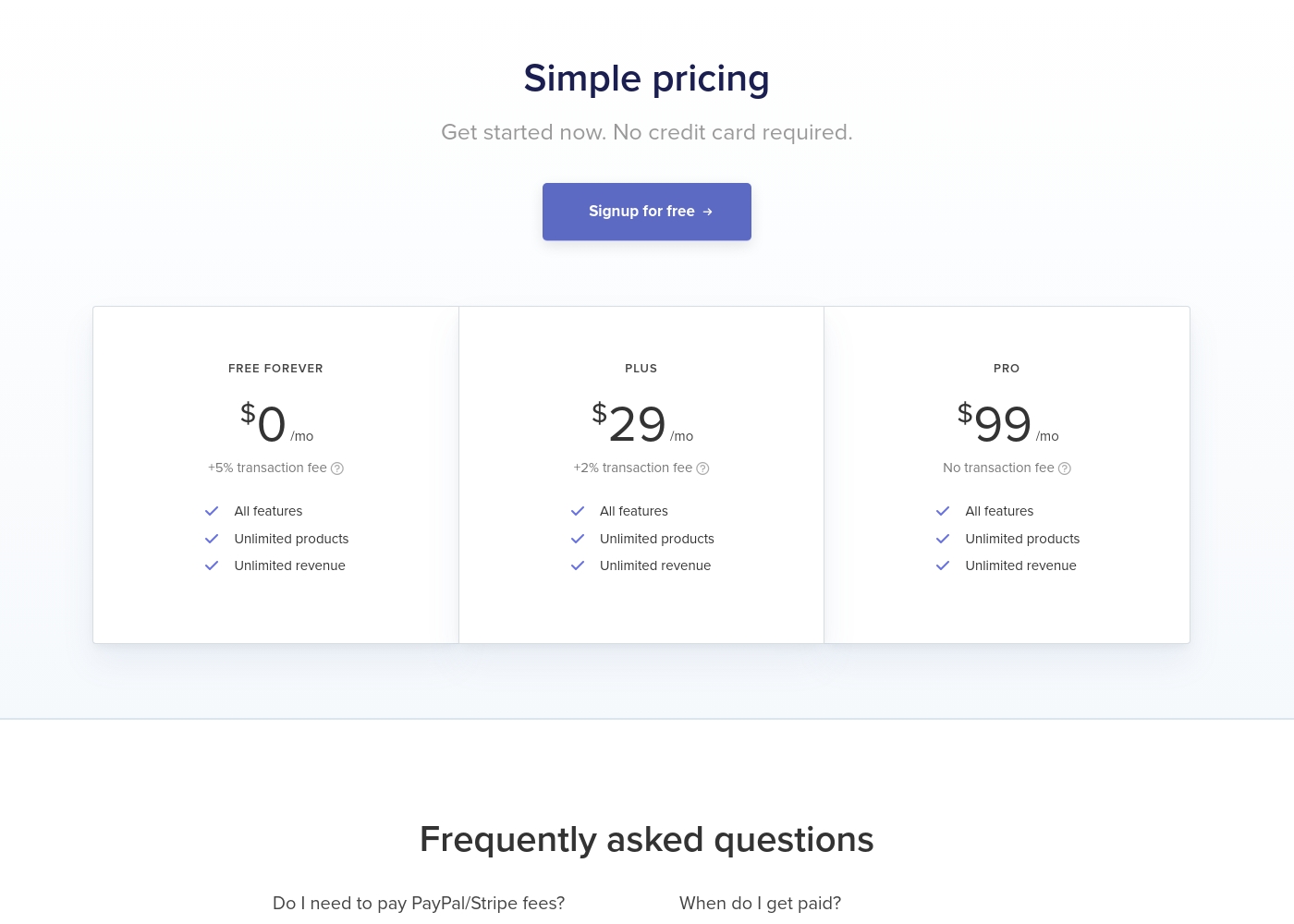
Payhip costs between $0 and $99 per month with three plans: Free Forever at $0/month, Plus at $29/month, and Pro at $99/month.
Here are the details for each tier available through Payhip's simple pricing structure.
Free Forever
Price: $0/mo Best For: Creators starting out Other Features:
- 5% transaction fee
- All features included
- Unlimited products
- Unlimited revenue
- All features
- Unlimited products
- Unlimited revenue
- All features
- Unlimited products
- Unlimited revenue
- All features
- Unlimited products
- Unlimited revenue
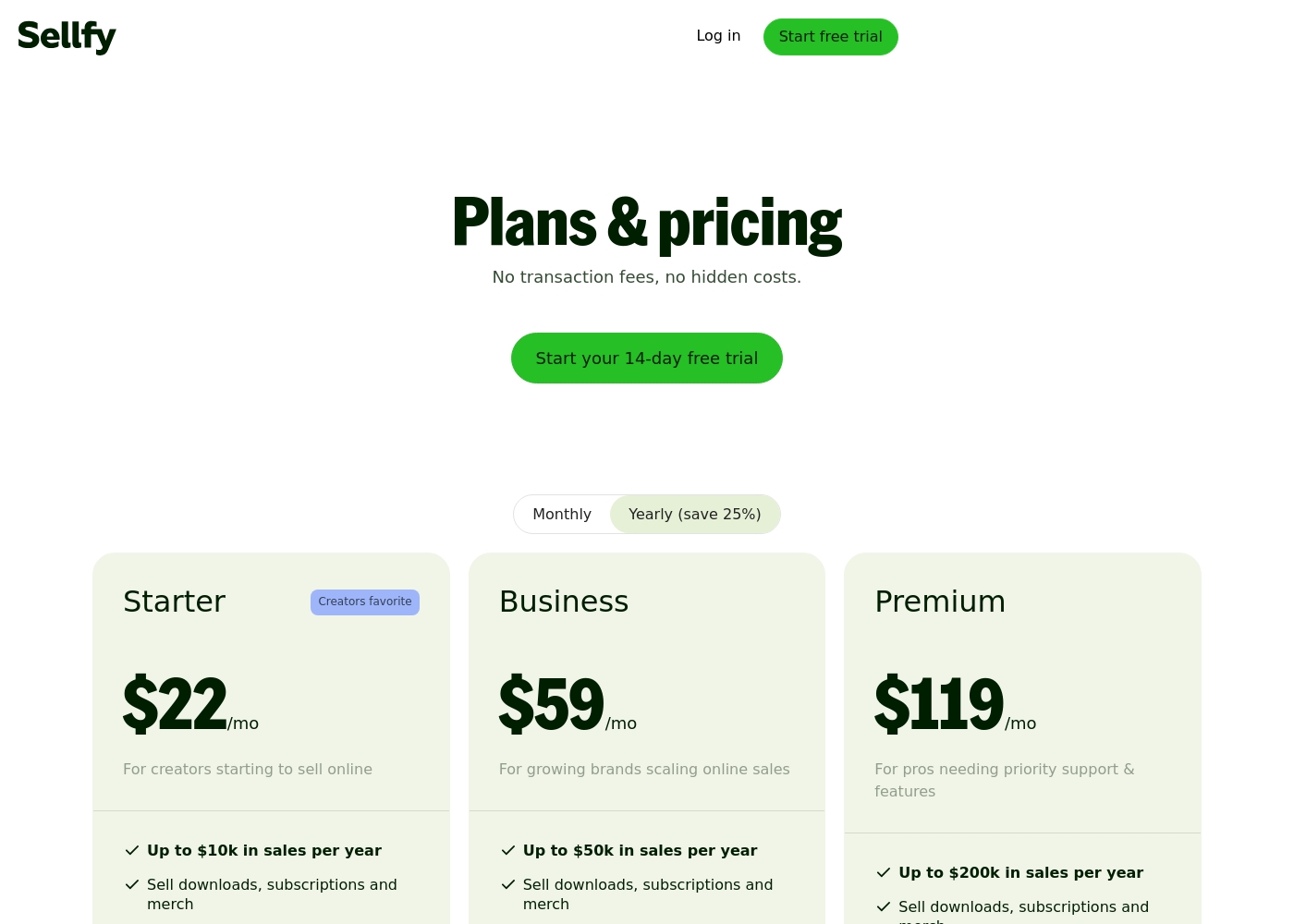
Sellfy costs between $22 and $119 per month (when billed yearly) with three plans: Starter at $22/month, Business at $59/month, and Premium at $119/month.
These plans are designed to scale alongside your business growth. When you choose annual billing versus monthly, you will save 25% on your total subscription cost.
Starter
Price: $22/mo (billed annually) or $29/mo (monthly) Best For: Creators starting to sell online Refund Policy: 30-day money-back guarantee Other Features:
- Up to $10k in sales per year
- Unlimited products (downloads, subscriptions, merch)
- Email marketing with 2,000 free credits
- Maximum product file size is 10GB
- 0% transaction fees
- Sell downloads, subscriptions, and merch
- Unlimited products
- Email marketing (2,000 credits)
- Core marketing features
- 0% transaction fees
- All core features
- Email marketing (10,000 credits)
- Custom fields
- Growth features (Product upselling, Cart abandonment, Affiliate marketing)
- 0% transaction fees
- All Business features
- Email marketing (50,000 credits)
- Advanced options
- Product and design migration
Pricing Notes
- Payhip's pricing is structured where features are the same, but the platform transaction fee decreases (5% to 0%) as the monthly price increases ($0 to $99).
- Sellfy uses 0% platform transaction fees across all paid tiers, but subscription prices are based on your projected annual sales volume.
- Sellfy requires a paid subscription after 14 days, starting at $22/month (billed annually) for the Starter plan.
- To achieve 0% platform fees, Payhip requires the $99/month Pro plan; Sellfy achieves this starting at $22/month.
- Sellfy provides a 30-day money-back guarantee on paid plans; Payhip does not explicitly state this.
Pricing Head-to-Head
User Reviews
Payhip receives exceptional feedback for its comprehensive and user-friendly platform, consistently praised across hundreds of reviews. A key draw is the transparent and affordable pricing structure, particularly the powerful Free Forever plan, which allows new creators to start selling digital products without a significant monthly subscription burden.
Users frequently commend the platform's ease of use and simple setup, noting that customization is straightforward and quick, making the onboarding process effortless. However, the most universally lauded aspect is the customer support.
This is a great resource for people entering the online business space with digital products. The platform is well designed, remarkably user friendly, and immediate to launch. The variety of page templates makes getting started really simple and stress-free.
Reviewers overwhelmingly praise Sellfy for its user-friendliness and affordable structure, highlighting that setup, product uploading, and sales management are quick and easy, even for first-time sellers. Customers frequently mention the platform’s great pricing, noting it's more affordable than competitors because it charges no transaction fees.
Users value its comprehensive features, which successfully support digital products, subscriptions, and even reliable print-on-demand services. Customer support is consistently commended for being helpful and responsive; specific staff members received praise for their timely assistance.
This is the best platform I’ve tried for my mini business. It offers a full set of features for digital, physical, and print-on-demand products. The functionality, speed, and instant money transfer are all perfect.
Our Verdict
This comparison between Payhip and Sellfy is fierce yet surprisingly simple to resolve. They serve creators with different immediate needs. If you are just starting out and need guaranteed zero risk, Payhip is the champion. Payhip offers a Free Forever plan with every single feature included, perfect for launching immediately. If you are selling globally, Payhip handles complex EU/UK VAT collection automatically for you, which is a massive user benefit. Sellfy, however, is built for scale and profit maximization once you have consistent sales. Sellfy’s superpower is its commitment to 0% platform transaction fees across all paid tiers. It supports high sales volume up to $200,000 annually without taking a cut of your earnings. Sellfy also includes great growth features like upselling, affiliate marketing, and integrated print-on-demand services. The central factor is cost structure: Payhip charges marginal transaction fees until you pay $99 monthly. Sellfy charges a subscription but immediately removes platform transaction fees. Choose Payhip if you are selling services, need free access, and demand automated tax compliance. Choose Sellfy if you are confident in high-volume sales and need guaranteed maximum profit margins on those sales. Both are excellent, all-in-one solutions that simplify the selling process.
Frequently Asked Questions
Which platform is better for new creators just starting out: Payhip or Sellfy?
Payhip is superior for new creators because it offers a Free Forever plan with all features. You can start selling immediately without any budget commitment. Sellfy requires a paid plan after its 14-day trial period.
Does Sellfy or Payhip charge transaction fees on sales?
Sellfy charges 0% platform transaction fees on all paid plans, prioritizing maximum profitability for the seller. Payhip charges 5% on its Free plan, scaling down to 0% only on the expensive $99/month Pro plan.
Which tool is better for sellers focused on physical merchandise and apparel?
Sellfy is better because it includes an integrated print-on-demand service (POD). This allows you to launch custom apparel easily without managing any physical inventory. Payhip supports physical goods but lacks the integrated POD.
Can I sell 1:1 coaching services and appointments using Payhip or Sellfy?
Payhip explicitly supports selling 1:1 coaching sessions, integrating setup and scheduling tools. Sellfy focuses more on digital products, subscriptions, and physical goods, not personalized services.
Which platform handles high-volume digital files like 4K course videos?
Sellfy is better for large media files; its Premium plan guarantees support for individual files up to 20 GB. Payhip supports unlimited products but does not specify individual file size limits.
Which platform automatically handles complex VAT for EU sales?
Payhip automatically calculates and manages complex digital EU and UK VAT requirements. This is a critical feature that simplifies compliance for international sellers. Sellfy does not list this automation.
Ready to Choose?
Both tools have their strengths. Choose based on your specific needs.