OttoKit vs Vanta
OttoKit and Vanta serve completely different master's. OttoKit automates app workflows and connects your tools. Vanta automates compliance, risk, and audit prep. This comparison helps you pick the right one for your goal.
Best for: WordPress site owners and agencies, Entrepreneurs automating e-commerce workflows
Best for: Startups needing to achieve SOC 2 or ISO 27001 fast, Security teams managing compliance across multiple frameworks
Ambitious features need better stability.
We find OttoKit features—like AI Agents and the visual builder—highly promising, especially combined with the budget-friendly LTD pricing. Overall, we must caution users about potential risks related to workflow reliability and slow customer support response times.
Pros
- Access to advanced features like AI Agents and Human in the Loop (HITL).
- Highly competitive one-time Lifetime Deal (LTD) pricing structure.
- Visual, no-code drag-and-drop workflow builder.
- Seamless integration designed specifically for WordPress sites.
Cons
- Reported significant issues with workflow reliability and functionality.
- Support response times can be very slow (up to seven days for a fix).
- Support communication observed as sometimes blunt or unhelpful.
- Concerns raised over long-term support model due to heavy LTD strategy.
Powerful compliance automation for growing teams.
We found Vanta excels at automating compliance workflows and reducing manual effort, which aligns with its promise to save time and accelerate deals. Its tiered pricing offers flexibility, but the lack of transparent costs and a free trial means committing to a demo before understanding the full investment.
Pros
- Automates evidence collection and monitoring for frameworks like SOC 2.
- AI-powered questionnaire automation speeds up vendor assessments.
- Unified platform for compliance, risk management, and audit prep.
- Trust Center helps showcase security posture to customers.
Cons
- Pricing requires a custom quote, with no public tiers or free trial.
- Add-ons for key features like Third-Party Risk Management increase costs.
- Initial setup and policy onboarding may have a learning curve.
- Some users report integration challenges with specific tools.
AboutOttoKit
OttoKit is an intuitive cloud platform that connects over 1,200 apps together. It helps you automate what matters across all your business platforms. This tool is ideal for agencies, eCommerce entrepreneurs, and community builders who want processes to run themselves.
OttoKit uses a friendly, drag-and-drop canvas for creating Visual Workflows 💡. You do not need any coding skills to build powerful automations. It’s also the top automation solution specifically designed to integrate with WordPress sites.
AboutVanta
Vanta is an Agentic Trust Platform designed for startups, mid-market, and enterprise companies. It automates the entire process of getting and staying compliant with frameworks like SOC 2, ISO 27001, and HIPAA. The platform combines compliance, risk management, and audit preparation into one place. It's built for security leaders who want to scale their programs without adding headcount. 💡
Highlights
Feature Comparison
Features Overview
We highlight the main differences and pick a winner for each feature.
Core Purpose
OttoKit is a workflow automation platform. Vanta is a compliance and risk management platform.
OttoKit connects over 1,200 apps. You build visual workflows with a drag-and-drop builder. No coding is required. Vanta automates compliance for frameworks like SOC 2. It continuously monitors controls. It helps you prepare for audits and manage risk. The fundamental difference is automation type. OttoKit automates tasks between apps. Vanta automates security compliance processes.
Pricing & Value
OttoKit offers transparent, one-time payments. Vanta provides custom quotes with no public prices.
OttoKit has a free plan and one-time lifetime deals. Prices are public, from $0 to $1299. You pay once and own it. Vanta requires a sales demo for a custom quote. Pricing depends on frameworks and employee count. No free trial exists. OttoKit offers clear, upfront value. Vanta's cost is opaque until you engage sales. This is a huge decision factor.
Target User
OttoKit serves agencies and WordPress users. Vanta serves security leaders and compliance teams.
OttoKit is built for agencies, eCommerce, and community builders. It's perfect for anyone needing no-code app automation. Vanta is for startups to enterprises. It's designed for security and engineering leaders managing compliance programs. You're comparing apples and oranges here. One is a general automation tool. The other is specialized compliance software.
Integrations
OttoKit connects apps you already use. Vanta connects to your cloud, code, and HR tools.
OttoKit integrates with over 1,200 tools like CRMs, forms, and payment gateways. Focus is on connecting existing tech stacks. Vanta integrates with cloud providers, code repos, and identity providers. The focus is on monitoring and proving security controls. OttoKit's integration breadth is wider. Vanta's integrations are deeper for security monitoring.
AI Capabilities
Both use AI for automation, but in very different contexts.
OttoKit offers AI Agents. These monitor data and take automated actions in your workflows. It's about task execution. Vanta offers the Vanta Agent. It drafts policies and answers security questionnaires. It's about compliance work. OttoKit's AI automates business processes. Vanta's AI automates security and compliance tasks.
Reliability & Trust
Vanta has stronger, more consistent user reviews. OttoKit has concerning reliability reports.
Vanta has a 4.2/5 rating on Trustpilot. Users praise its automation and support. It's trusted for critical compliance. OttoKit has a 2.8/5 rating. A Trustpilot review reported workflow failures and slow support. Reliability is a major concern. For mission-critical tasks, Vanta's reputation is stronger. OttoKit needs to prove its stability.
OttoKit costs between $0 and $1299.00 (one-time) with 4 plans: Free at $0, Pro at $349.00, Business at $649.00, and Business Plus at $1299.00.
Here’s a breakdown of the four available options.
Free
Price: $0 Best For: Anyone to get started with automation and basic features. Refund Policy: Not applicable Other Features:
- 1 Workspace
- 20 Workflows
- 1 WordPress Connection
- Limited Core Apps
- 20 Workflows
- 1 WordPress Connection
- All available Integrations
- Standard Support
- AI Agents
- Unlimited Workflows
- Premium Support
- MCP
- AI Agent
- Unlimited Workflows
- Premium Support
- 5 Workspaces
- Unlimited WordPress Connections
- MCP
- Unlimited Workflows
- Unlimited Workspaces
- Unlimited WordPress Connections
- Premium Support
- MCP

Take a look at the details for each tier below to see which fits your company's current stage.
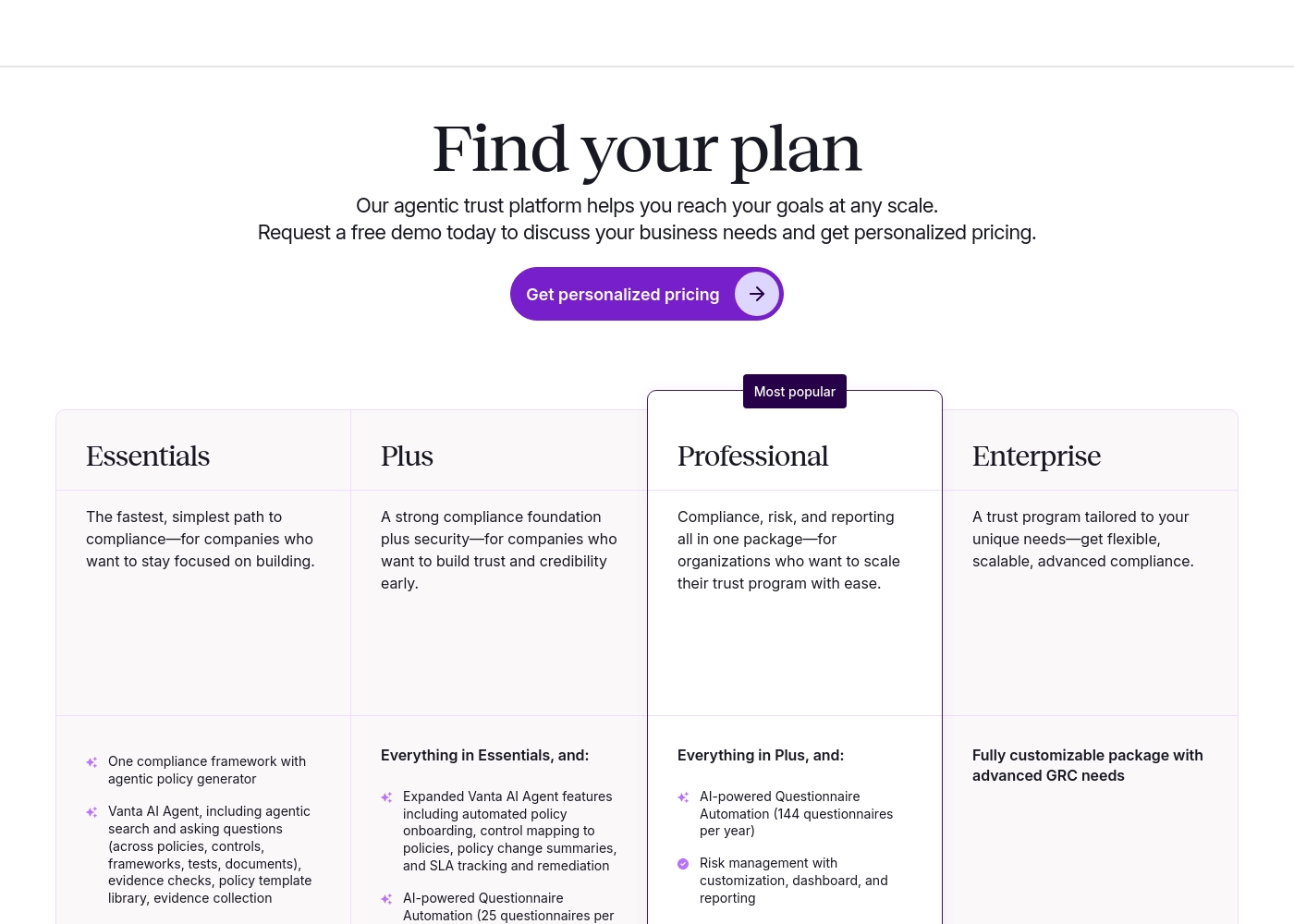
Essentials
Best For: Companies who want to stay focused on building while reaching compliance. Other Features: One compliance framework, Vanta AI Agent, Automated evidence collection, Basic reporting and audit workflows, Auditor API access.
This plan is the fastest way for startups to build a compliance foundation. It's a great fit if you're laser-focused on one framework and need evidence collection that just works.
- One compliance framework with agentic policy generator
- Vanta AI Agent (search, evidence checks, policy templates)
- Automated evidence collection for audit readiness
- Basic reporting and audit workflows
- Auditor API and Trust Center access
- Automated policy onboarding
- Control mapping and SLA tracking
- AI-powered Questionnaire Automation (25 per year)
- Access Management
- AI-powered Questionnaire Automation (144 per year)
- Risk management with customization and reporting
- Advanced Trust Center
- Custom monitoring tests and automation
- Advanced reporting (six customizable reports)
- Fully customizable package
- Advanced GRC needs
- Workspaces and SCIM
- Advanced control management
Pricing Notes
- OttoKit offers a permanent free plan with 250 tasks per month.
- OttoKit's paid plans are one-time Lifetime Deals with a 14-day money-back guarantee.
- Vanta has no free plan or trial. Pricing requires a sales demo and is customized per company.
- Vanta's Professional plan is its most popular tier, but costs are not public.
Pricing Head-to-Head
User Reviews
OttoKit currently has minimal external feedback, with only one detailed review available on Trustpilot. This single user reported a highly mixed but ultimately concerning experience.
While the platform offers powerful functionality—the reviewer noted, "When it works, it works well"—they reported significant issues with reliability during testing. All three workflows tested required support intervention.
I was very hopeful about OttoKit, but the testing phase was deeply concerning. Of the three workflows we built, all had major issues requiring support. I cannot trust this product for any of my client work right now.
We couldn't access specific review snippets from Trustpilot or Capterra due to security blocks, but we know these platforms host user feedback on Vanta. Based on common themes in the compliance software space, users typically praise ease of use, automated evidence collection, and strong customer support that helps during audits.
However, recurring concerns often include custom pricing that can feel expensive for smaller teams, occasional integration hiccups with certain tools, and a learning curve during initial onboarding. The platform's reliability for continuous monitoring is frequently highlighted, though some note the AI questionnaire automation needs refinement.
Vanta automated our SOC 2 evidence collection, saving our team dozens of hours monthly. The platform is intuitive, and support was responsive when we had audit questions.
Our Verdict
This isn't a fair fight. OttoKit and Vanta are built for completely different jobs. OttoKit is your no-code app connector. It shines when you need to automate tasks between WordPress, CRMs, and payment tools. Its one-time pricing is a major win for budget-conscious teams. Vanta is your compliance autopilot. Its superpower is turning SOC 2, ISO 27001, and audit prep from a nightmare into a streamlined process. It helps sales teams close deals faster. The deciding factor is your goal. Do you need to automate business workflows? Choose OttoKit. Do you need to automate security compliance? Choose Vanta. For most people comparing these two, the answer is clear. Pick Vanta if compliance is blocking your growth. Pick OttoKit if you're drowning in manual app tasks. They solve different problems.
Frequently Asked Questions
Which is better for small teams: OttoKit or Vanta?
It depends entirely on your need. OttoKit is better for small teams automating app workflows, with its free plan and clear pricing. Vanta is better for small security teams needing to get compliant quickly, but you'll need a demo quote.
Does OttoKit offer a free trial like Vanta?
No, but OttoKit is better in this area. It offers a permanent free plan with 250 tasks per month. Vanta does not offer a free plan or a free trial.
Is Vanta worth the extra cost over OttoKit?
They aren't competitors, so a direct cost comparison is tricky. Vanta is a specialized compliance platform with custom pricing. OttoKit is a general automation tool with a one-time fee. Value depends on whether you're buying compliance or workflow automation.
Can I use OttoKit for security compliance?
No. OttoKit is a workflow automation tool for connecting apps. It does not have features for compliance frameworks like SOC 2, risk management, or audit preparation. For those needs, use Vanta.
Which tool has better customer support?
Based on reviews, Vanta has better support. Users praise its responsiveness. OttoKit has received reports of slow response times and blunt communication from its support team.
Do I need to be technical to use OttoKit or Vanta?
OttoKit is designed for non-technical users with its visual builder. Vanta is designed for security and compliance professionals, which may require more specialized knowledge during setup.
Ready to Choose?
Both tools have their strengths. Choose based on your specific needs.