NinjaOne vs Seel
NinjaOne and Seel tackle completely different business headaches. NinjaOne unifies IT management for internal teams. Seel automates post-purchase chaos for online stores. Choosing between them is simple once you identify your core problem.
Best for: IT teams seeking to consolidate multiple management tools into a single platform., MSPs looking to scale operations with AI-powered automation and unified management.
Best for: E-commerce merchants on Shopify drowning in WISMO tickets, Online stores wanting to offer flexible, 'return for any reason' policies
Unified, fast, and user-friendly IT ops.
We find NinjaOne excels as a consolidated IT management platform, delivering on its promise of streamlined operations and rapid deployment. Overall, it offers powerful automation and a clean interface, making it a strong choice for teams looking to replace multiple single-purpose tools.
Pros
- Unified console for RMM, patching, backup, and service desk.
- Rapid deployment and user proficiency, often in under a month.
- Strong, responsive customer support and free unlimited training.
- Automated patch management that significantly cuts remediation time.
Cons
- Public pricing requires a sales consultation for exact quotes.
- Not suitable for on-premise deployment needs.
- May offer more features than very small teams require.
- Dependence on cloud connectivity for all operations.
Excellent post-purchase automation for e-commerce.
Seel effectively automates the post-purchase chaos, handling returns, tracking, and support with impressive AI. Overall, we find it's a robust, secure solution that delivers on its promise to reduce merchant workload and improve the customer experience, though it requires a custom consultation for pricing.
Pros
- Significantly reduces WISMO tickets with automated tracking updates.
- Provides 24/7 AI-powered live support for common shopper queries.
- Offers a branded, configurable resolution portal for returns/refunds.
- Integrates smoothly with platforms like Shopify.
Cons
- Pricing is not public; requires a custom demo and consultation.
- No free trial or free plan is explicitly offered.
- Initial onboarding and setup may require merchant effort.
- Services like 'One-click resale' are still in beta.
AboutNinjaOne
💡 NinjaOne is a unified IT operations platform designed for IT teams and managed service providers (MSPs). It acts as a central hub to manage all your endpoints, secure devices, automate patching, handle backups, and provide remote support.
The software is built to replace multiple single-purpose tools. It's for organizations that want to streamline device management, improve security compliance, and boost helpdesk efficiency from one place.
AboutSeel
Seel is a post-purchase infrastructure platform for online merchants. It provides the tools to manage the entire customer experience after the "Buy" button is clicked. Think of it as a centralized system for handling returns, refunds, and support queries, powered by AI and trained on millions of interactions. ✅
Highlights
Feature Comparison
Features Overview
We highlight the main differences and pick a winner for each feature.
Primary Purpose
NinjaOne manages internal IT infrastructure. Seel manages the post-purchase customer experience.
NinjaOne serves as a single console for IT teams to manage endpoints, patch security, and handle support tickets. It aims to replace multiple fragmented IT tools. Seel serves e-commerce merchants by automating returns, refunds, and post-checkout support inquiries. It aims to reduce the operational load on customer service teams. NinjaOne is an internal operational tool. Seel is a customer-facing operational tool.
Automation & AI
NinjaOne automates IT tasks. Seel automates customer interactions.
NinjaOne uses Patch Intelligence AI to automate security updates across devices. It can reduce patch cycles from 72 hours to minutes. Seel uses AI agents to handle 24/7 shopper support chats and delivery tracking updates. It directly reduces 'where is my order?' ticket volume. NinjaOne's AI optimizes backend IT processes. Seel's AI directly interacts with and resolves customer queries.
E-commerce Integration
NinjaOne doesn't do e-commerce. Seel is built for it.
NinjaOne focuses on integrating with security and IT tools like CrowdStrike and ServiceNow. It has no features for online retail. Seel integrates directly with Shopify. It manages returns, refunds, and delivery tracking for online stores. If you run an online store, Seel is relevant. If you manage IT systems, NinjaOne is relevant.
IT Management
NinjaOne is a full IT platform. Seel has no IT management features.
NinjaOne provides remote access, patch management, mobile device management, and endpoint backup. It's a comprehensive IT operations tool. Seel provides no tools for managing internal computers, servers, or networks. Its focus is entirely external. For any internal IT needs, NinjaOne is the only option between these two.
Customer Support for Users
NinjaOne supports your IT team. Seel supports your customers.
NinjaOne offers free, unlimited expert support with a 98+ CSAT rating to help your IT staff use the platform. Seel provides a merchant dashboard and help center for store owners. Its AI supports shoppers directly. NinjaOne improves your internal support capabilities. Seel extends your external customer support.
Pricing Model
NinjaOne is transparent. Seel requires a consultation.
NinjaOne lists a public price range of $1.50 to $3.75 per device per month. You can estimate costs upfront. Seel does not list public pricing. You must book a demo for a custom quote based on your volume. NinjaOne lets you budget early. Seel requires a sales conversation to get started.
Free Trial Availability
NinjaOne offers a trial. Seel does not.
NinjaOne provides a 14-day free trial. You can test endpoint management and patching features in your environment. Seel does not mention a free trial or free plan. You can only book a demo. NinjaOne lets you try before you buy. Seel requires commitment to see the platform.
Security Compliance
Both are secure, for different industries.
NinjaOne is built to meet SOC 2, ISO 27001, and FedRAMP standards. These are common requirements for enterprise IT and government. Seel is SOC 2 Type II, GDPR, and CCPA compliant. It also holds an insurance license in all 50 US states. Both meet high security standards, but tailored to their respective fields.
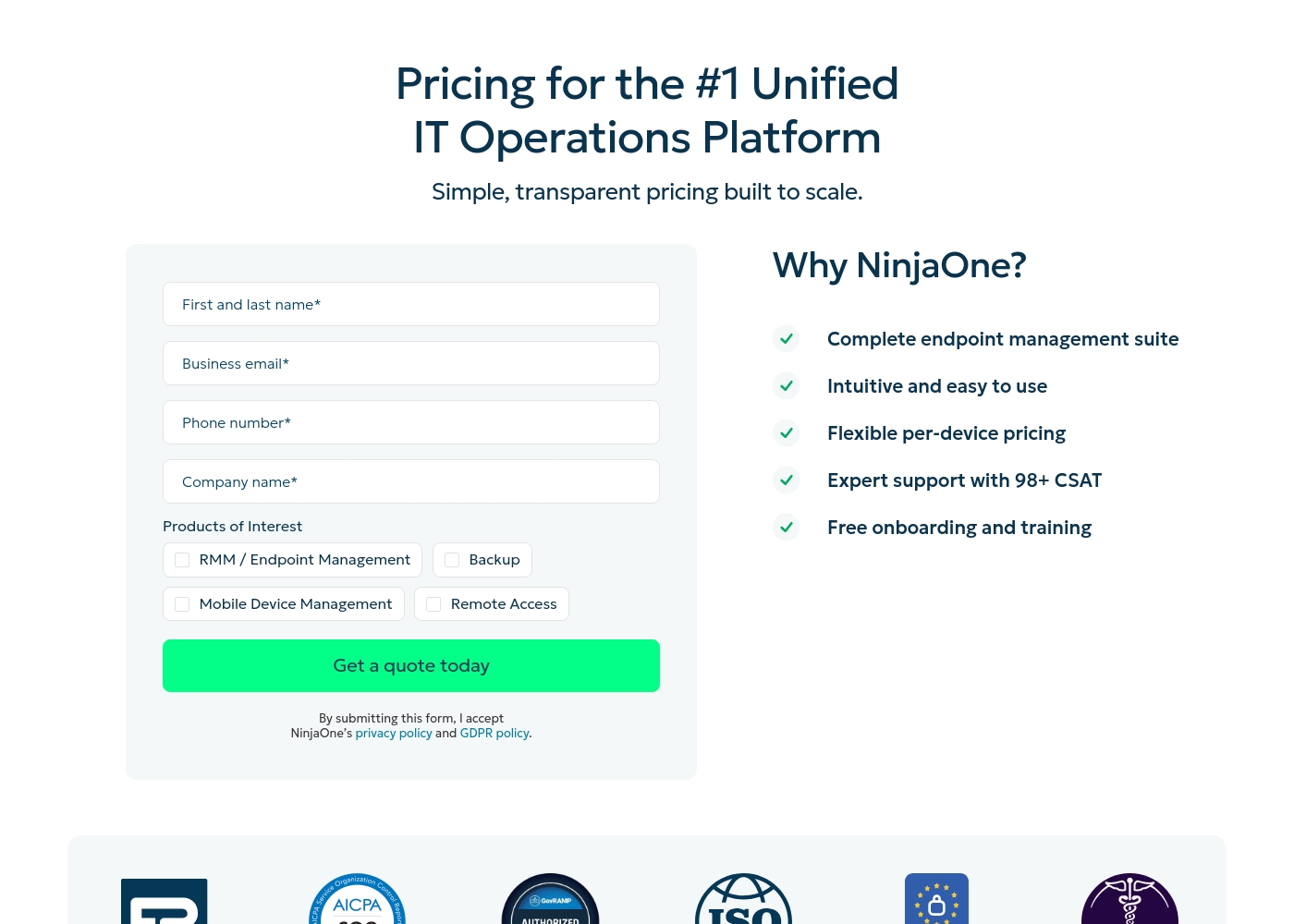
NinjaOne costs between $1.50 and $3.75 per endpoint each month with one flexible plan that scales based on your device count and specific product needs.
Here is how their pricing model works for your team.
Unified IT Operations
Price: From $1.50 to $3.75 per device monthly Best For: MSPs and IT departments managing multi-OS environments Refund Policy: 60-day cancellation notice Other Features: Remote monitoring and management, autonomous patch management, endpoint security, backup, and free unlimited training.
- RMM / Endpoint Management
- Autonomous Patch Management
- Mobile Device Management (MDM)
- Endpoint and SaaS Backup
- Remote Control & Service Desk
Here's a look at the services Seel offers to help manage your post-purchase experience.
Worry-Free Purchase®
Best For: Online retailers wanting to offer comprehensive refunds and returns for any reason. Other Features: - Automatic return/refund processing, - Resolution portal for shoppers, - One-click resale (beta) functionality, - Configurable resolution requirements.
This service is perfect if you want to give your shoppers total confidence during checkout. It lets customers return items for reasons ranging from product issues to simple second thoughts. 🛍️
- Comprehensive refunds and returns for any reason
- Configurable resolution rules
- One-click resale listing (beta)
- Integration with Shopify gift cards
- 24/7 live AI support chat
- Automated delivery tracking
- Real-time resolution status for shoppers
- Custom AI training on brand policies
Pricing Notes
- NinjaOne has transparent, public pricing that scales with device count.
- Seel requires a sales demo to get a custom quote for its merchant services.
- NinjaOne offers a 14-day free trial; Seel does not explicitly offer one.
- NinjaOne's cost is predictable per endpoint. Seel's cost is likely tied to transaction volume or service usage.
Pricing Head-to-Head
User Reviews
NinjaOne enjoys strong praise on both Trustpilot and Capterra for its intuitive interface and responsive support. 👍 Users consistently highlight the platform's ease of use, noting that the unified console simplifies managing endpoints across multiple operating systems.
The automated patch management is frequently cited as a major time-saver, reducing security risks and manual workloads. Customer support receives high marks for being fast, knowledgeable, and proactive.
NinjaOne replaced about 10 different tools for us. The interface is clean, and support is always helpful when we need it. Deployment was smoother than we expected.
We found user sentiment for Seel on Trustpilot to be overwhelmingly positive, with many praising the platform's impact on their operations. A recurring theme is the significant reduction in 'Where Is My Order?' (WISMO) tickets and post-purchase support workload, thanks to the reliable tracking and AI chat.
Users frequently highlight the ease of use for both merchants and shoppers, noting that integration is straightforward and the branded resolution portal feels seamless. Several reviews mention the accuracy and helpfulness of the customer support when issues arise.
Seel has been a game-changer for our support team. The automated tracking updates cut our WISMO tickets by a huge margin. It's easy to set up and the branded portal looks great.
Our Verdict
For most readers, this is a tie because you're comparing a hammer to a sewing machine. They solve wildly different problems for different people. NinjaOne's superpower is unifying your internal IT operations. It replaces 10-15 separate tools with one console for managing devices, security, and support. Seel's superpower is automating the post-purchase headache. It uses AI to handle delivery tracking, returns, and shopper support, drastically cutting 'where is my order?' tickets. The deciding factor is your core problem. If your internal IT team is overwhelmed, choose NinjaOne. If your customer support team is overwhelmed, choose Seel. Final verdict: Pick NinjaOne to streamline IT ops and security. Pick Seel to fix your e-commerce returns and support. There's no cross-shopping here.
Frequently Asked Questions
Which is better for small teams: NinjaOne or Seel?
It depends on your team's function. Small IT teams benefit from NinjaOne's unified management. Small e-commerce teams benefit from Seel's support automation. They serve different needs.
Does NinjaOne have e-commerce features like Seel?
No. NinjaOne is strictly for IT operations and endpoint management. It has no features for online retail, returns, or shopper support.
Is Seel worth the extra cost over NinjaOne?
This is an incorrect comparison. Seel isn't more expensive; it's a different product. You can't substitute one for the other. Evaluate based on your specific problem.
Can I migrate from NinjaOne to Seel easily?
You wouldn't migrate between them, as they serve different purposes. They are not competing products in the same category.
Which tool is easier to set up?
Both are cloud-based. NinjaOne emphasizes rapid deployment (under 30 days). Seel notes integration is smooth but requires policy configuration. Neither is a heavy on-premise install.
Do I need a contract for either tool?
NinjaOne offers monthly or annual billing with 60-day cancellation notice. Seel's terms are part of a custom service agreement from their sales team.
Ready to Choose?
Both tools have their strengths. Choose based on your specific needs.