NetSuite vs Zoho Books
This is the ultimate comparison of massive enterprise scale versus simplicity. NetSuite is built as a custom AI Cloud ERP for massive business complexity. Zoho Books offers affordable, end-to-end cloud accounting for growing businesses. Let's find your perfect financial system fit.
Best for: Enterprise organizations requiring a single source of truth across all disparate data streams., Large, complex businesses managing high-volume ERP, CRM, and Ecommerce operations simultaneously.
Best for: Solopreneurs and small businesses needing affordable, end-to-end cloud accounting., Teams requiring multi-currency support for frequent international transactions with real-time rates.
Powerful ERP, Difficult Implementation, High Cost.
We recognize NetSuite’s position as a dominant AI Cloud ERP, capable of handling complex integrations and large-scale data requirements for over 43,000 customers. Overall, the significant costs, mandatory reliance on outside consultants, and consistent reports of poor customer support and outdated usability prevent us from recommending this solution without major reservations.
Pros
- Comprehensive AI Cloud ERP designed for scalable, complex enterprises.
- Provides a single source of truth across ERP, CRM, and ecommerce data.
- Proven market adoption with over 43,000 current customers.
- Powered by a robust and powerful Oracle database backend.
Cons
- Extremely high costs and aggressive, unpredictable annual renewal price hikes.
- Outdated, bulky, and unintuitive user interface (UI).
- Customer support is frequently non-existent, unresponsive, or rude.
- Difficult integration API throws frequent, non-specific errors.
Scalable Accounting with Clear Value.
We find that Zoho Books provides a comprehensive and budget-friendly alternative to complex accounting systems. The scalability, permanent free tier, and full financial management capabilities are major strengths. Overall, this is a top recommendation for growing businesses needing feature-rich accounting without high legacy costs.
Pros
- Permanent Free plan available for micro-businesses.
- Highly scalable pricing structure with competitive annual rates.
- Cloud-based, comprehensive solution covering invoicing, inventory, and expenses.
- User-friendly interface simplifies daily financial tasks.
Cons
- Severe MFA reset issues reported across the Zoho suite can lock users out of accounts.
- Mixed reports regarding customer service responsiveness.
- All plans impose explicit annual limits on invoices and expenses.
- External accounting-specific feedback on accuracy and reliability is limited.
AboutNetSuite
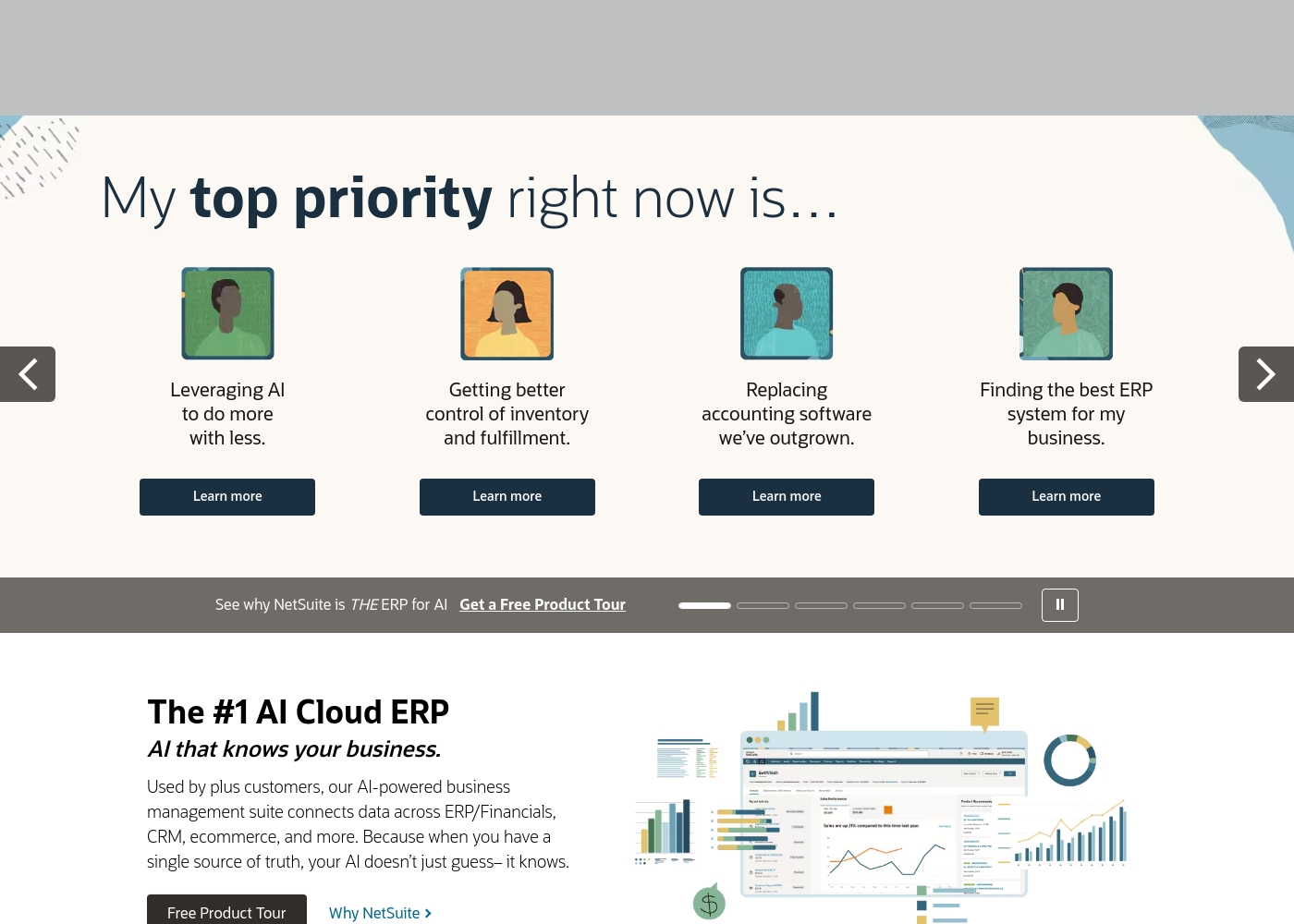
NetSuite is clearly positioned as an AI-powered business management suite. It's known widely as the #1 AI Cloud ERP. This powerful suite is designed to connect key functional areas of your enterprise.
It expertly handles everything from ERP/Financials to CRM and ecommerce data. Over 43,000 customers rely on these integrated products to help fuel their essential growth. 💡
AboutZoho Books
Zoho Books is comprehensive, cloud-based accounting software built specifically for growing businesses. It helps you manage your entire financial workflow seamlessly, integrating key functions into one place. You can handle everything from tracking expenses to controlling inventory and processing invoices. Because it’s available through mobile apps for iOS and Android, you can easily manage your books on the go. ✅
Highlights
Feature Comparison
Features Overview
We highlight the main differences and pick a winner for each feature.
Pricing & Value
NetSuite uses custom pricing and is expensive; Zoho Books is transparent and highly affordable.
NetSuite uses a private, customized enterprise subscription model. Costs require a specific quote based on complex implementation needs. Pricing is extremely high, and users report aggressive annual renewal hikes. Zoho Books offers transparent tiered pricing starting at $0/month. Extra users are cheap at only $3/user/month. They provide flexible plans designed to avoid frequent price surprises. The difference boils down to a massive budget variation. NetSuite is prohibitively expensive and lacks transparency; Zoho Books is budget-friendly. Zoho Books clearly offers vastly superior value for money for any small or growing operational budget.
Ease of Use
Zoho Books has a user-friendly UI; NetSuite is widely reported as bulky and outdated.
NetSuite users frequently describe the system as complex, bulky, and generally unintuitive. Many reviewers feel the interface is outdated and slow. Complex setup often requires engaging expensive external consultants for assistance. Zoho Books is widely praised for its high ease of use and user-friendly interface. It's built for simple, fast cloud accounting workflows right out of the box. Users find they can manage finances easily without intensive training or consultants. NetSuite demands time and external expertise due to its steep learning curve. Zoho Books is designed to be immediately accessible for daily accounting tasks. If quick adoption and minimum training are high priorities, Zoho Books is the clear winner for your team.
Target Audience & Scale
NetSuite handles vast enterprise complexity; Zoho Books serves growing small businesses well.
NetSuite is positioned as the #1 AI Cloud ERP for large, complex enterprise organizations. The system supports over 43,000 global customers needing the highest scalability. It handles massive, high-volume ERP, CRM, and ecommerce data loads. Zoho Books targets growing businesses and solopreneurs needing affordable, end-to-end accounting. It caters well to budget-conscious teams who need core finance features. Zoho Books helps businesses scale their finances simply. The key difference is the level of complexity each tool is built to sustain. NetSuite manages massive custom ERP implementations; Zoho Books delivers essential accounting foundations. If your business growth requires unifying dozens of departments into an AI-powered data structure, choose NetSuite for the scale.
AI and Intelligence
NetSuite offers deep business AI; Zoho Books focuses on workflow automation.
NetSuite's core promise is offering 'AI that knows your business,' providing smart, reliable recommendations. This intelligence is based on unified, accurate data from a "single source of truth." Zoho Books focuses on automation features like customizable workflows and reports to save time. It uses automation to streamline standard accounting processes. Deep, structural AI intelligence for large-scale decision-making is not its main focus. NetSuite leverages unified data across the entire organization for powerful business decision support. Zoho Books uses automation to simply make repetitive accounting tasks faster and easier. If strategic, high-level AI recommendations are essential for your global business, NetSuite is the only choice here.
Integration Focus
NetSuite unifies all ERP functions; Zoho Books integrates well within the Zoho ecosystem.
NetSuite specializes in deep functional integration across ERP, CRM, and Ecommerce data. Its design mandates creating a seamless, unified data structure organization-wide. This unification across functional areas is its core strength. Zoho Books offers seamless integration primarily within the broader Zoho ecosystem (like Zoho CRM). This provides excellent value if you already depend on Zoho apps. Some users report occasional connectivity limits with outside tools. NetSuite forces total enterprise data integration as its central architecture. Zoho Books provides affordable, efficient ecosystem integration, offering great value to Zoho users. For mandatory, high-volume, cross-functional data syncing across 100+ entities, NetSuite is engineered to handle that load.
Customer Support
Zoho Books has reliable support; NetSuite users consistently report non-existent service.
NetSuite's customer support is a major frustration reported across many user reviews. Reviewers mention support being unresponsive, sometimes rude, or non-existent post-sale. The specific support SLAs are not publicly guaranteed. Zoho Books offers comprehensive support via email, voice, and chat on its paid plans. While some users noted occasional response delays, the support is widely available and generally reliable. This is a critical trade-off: NetSuite's enterprise support is often deemed inadequate for its high price. Zoho Books provides predictable access to support. If you value being able to actually reach a person when your data is critical, Zoho Books offers a safer bet.
NetSuite operates primarily on a customized enterprise model. Because it is a powerful AI Cloud ERP solution, you won't find standard, predefined pricing tiers. Pricing requires a direct quote based on your specific business size and needs.
Custom ERP Implementation
Best For: Businesses needing a scalable, integrated ERP solution or replacing outgrown accounting software Other Features:
- Connects data across ERP/Financials, CRM, and ecommerce
- AI-powered business management suite
- Used by 43,000+ customers
- Provides a single source of truth
This is the right choice if you need a comprehensive system that leverages AI to connect all your data. It's designed to help growing companies move past disparate systems and gain better control over operations like inventory and fulfillment.
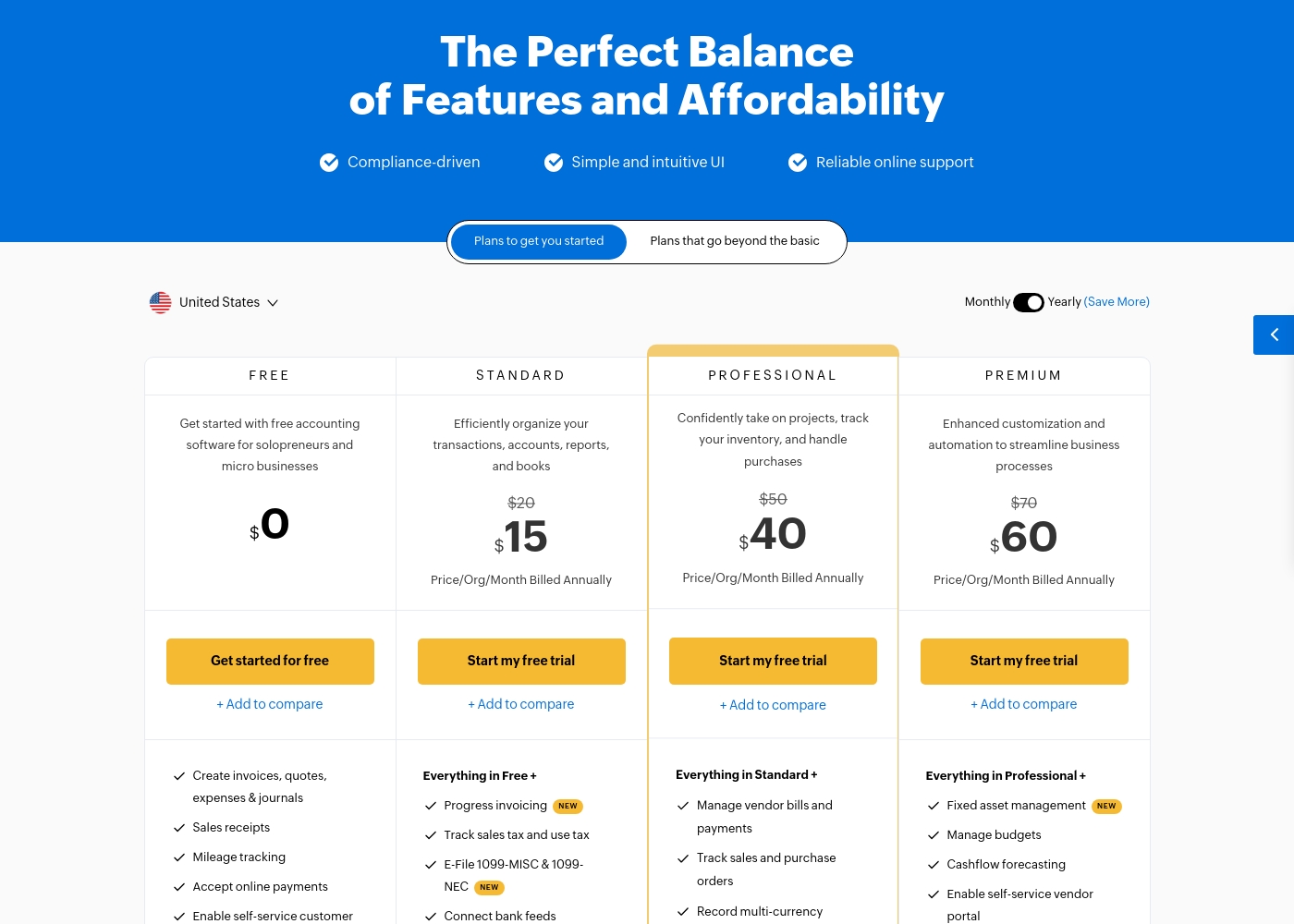
Zoho Books costs between $0 and $240 per month (billed annually) with six plans: FREE at $0, STANDARD at $15, PROFESSIONAL at $40, PREMIUM at $60, ELITE at $120, and ULTIMATE at $240.
Zoho Books offers plans built to grow with your company, from sole proprietors to large teams. Let's look closely at what is included in each option.
FREE
Price: $0.00 Best For: Solopreneurs and micro businesses (up to $50K annual revenue) Other Features:
- Create invoices, quotes, expenses, and journals
- Process sales receipts and track mileage
- Enable self-service customer portal
- Email Support (1 User + 1 Accountant)
- Create invoices, quotes, expenses & journals
- Sales receipts
- Mileage tracking
- Accept online payments
- Enable self-service customer portal
- Progress invoicing
- Track sales tax and use tax
- E-File 1099-MISC & 1099-NEC
- Connect bank feeds
- Generate divisional reports with reporting tags
- Manage vendor bills and payments
- Track sales and purchase orders
- Record multi-currency transactions
- Bill timesheets
- Project profitability
- Fixed asset management
- Manage budgets
- Cashflow forecasting
- Enable self-service vendor portal
- Set up custom domain
Pricing Notes
- NetSuite uses a highly customized enterprise subscription model; pricing requires a direct quote and is not public.
- Zoho Books offers a Free plan and tiered pricing starting at $0/month, making costs transparent and predictable.
- NetSuite users frequently report extremely high, aggressive annual renewal price hikes, a significant hidden cost.
- Zoho Books allows easy scaling with cheap user add-ons ($3/user/month) billed monthly or annually.
- NetSuite requires engaging expensive external consultants for implementation and setup, significantly inflating the total cost.
- Zoho Books offers a 14-day free trial, whereas NetSuite only offers a Free Product Tour.
Pricing Head-to-Head
User Reviews
User reviews for NetSuite present a stark contrast to its marketed position, frequently highlighting issues with pricing, support, and usability. Many users describe the system as unintuitive, bulky, and slow, noting that the interface feels decades outdated; one reviewer suggested the UI looks like it is from the 1980s.
This complexity often necessitates hiring expensive consultants, even for routine tasks. Pricing is a major pain point; users report that the software is significantly more expensive than competitors, with costs frequently reaching tens or hundreds of thousands annually, and aggressive price increases during renewals are common.
I wasted thirty minutes getting the runaround about pricing. When they finally gave a quote, the rep was extremely rude and said my business wasn't a 'good fit' due to the high starting price. Poor customer service is unacceptable for an enterprise product like this.
While Zoho maintains an overall positive rating of 4.1/5 across thousands of reviews, most specific feedback provided recently centers on the Zoho Social tool, not the Books accounting software. Regardless, the consensus affirms Zoho’s commitment to excellent ease of use and high functional value.
Users consistently praise the platform for its intuitive interface, which streamlines workflows and simplifies multi-account management. Many appreciate that Zoho provides advanced functionality for a fraction of the cost of competitors, representing significant value for startups and small teams.
This platform offers huge functionality without the huge price tag. I used managers that cost ten times more, but Zoho offers the same key features and is incredibly user-friendly. It’s excellent value.
Our Verdict
Choosing between NetSuite and Zoho Books boils down to your company's stage and complexity. NetSuite is the powerful, expensive ERP. Zoho Books is the affordable, user-friendly accountant. NetSuite's core strength is its powerful AI Cloud ERP framework. It creates a critical single source of truth across your ERP, CRM, and ecommerce data. NetSuite uses this deep organization-wide insight to provide smart, reliable recommendations for large enterprises, a major edge. Zoho Books wins on accessibility, pricing, and ease of deployment. It delivers seamless, end-to-end cloud accounting right out of the box. Zoho Books makes daily invoicing and expense management quick, easy, and incredibly affordable, often starting with a free plan. The deciding factor is your budget and complexity tolerance. NetSuite requires massive investment, specialized consultants, and you must tolerate its bulky interface. Zoho Books offers a clean UI, transparent pricing, and free migration services. Choose Zoho Books if you need reliable accounting that grows with you transparently. Pick NetSuite only if you are a massive, complicated corporation that requires an AI-driven, unified ERP solution.
Frequently Asked Questions
Which is cheaper: NetSuite or Zoho Books?
Zoho Books is significantly cheaper, offering a Free plan and transparent tiered pricing. NetSuite uses a custom enterprise subscription model and is extremely expensive. Users report NetSuite having frequent, aggressive annual price hikes.
Does NetSuite offer a free trial like Zoho Books?
No, NetSuite does not offer a traditional free trial period. You must request a Free Product Tour to view the system. Zoho Books offers a clear 14-day free trial.
Which tool is better for integrating CRM and accounting?
NetSuite excels at deep functional integration, unifying ERP, Financials, and CRM into one system. Zoho Books integrates seamlessly with the broader suite of Zoho apps, especially Zoho CRM.
Is NetSuite harder to use than Zoho Books?
Yes, widely so. Zoho Books is praised for its user-friendly interface and simplicity. NetSuite is frequently criticized in reviews for its bulky, complex, and unintuitive user interface.
Which software is better for managing multiple international currencies?
Zoho Books explicitly supports multi-currency transactions using real-time exchange rates. NetSuite's capabilities are implied by its global user base, but specific details are not published.
Who provides better customer support: NetSuite or Zoho Books?
Zoho Books provides reliable email, chat, and voice support on paid plans. NetSuite users consistently report unresponsive, non-existent, or rude customer support, despite the high cost.
Ready to Choose?
Both tools have their strengths. Choose based on your specific needs.